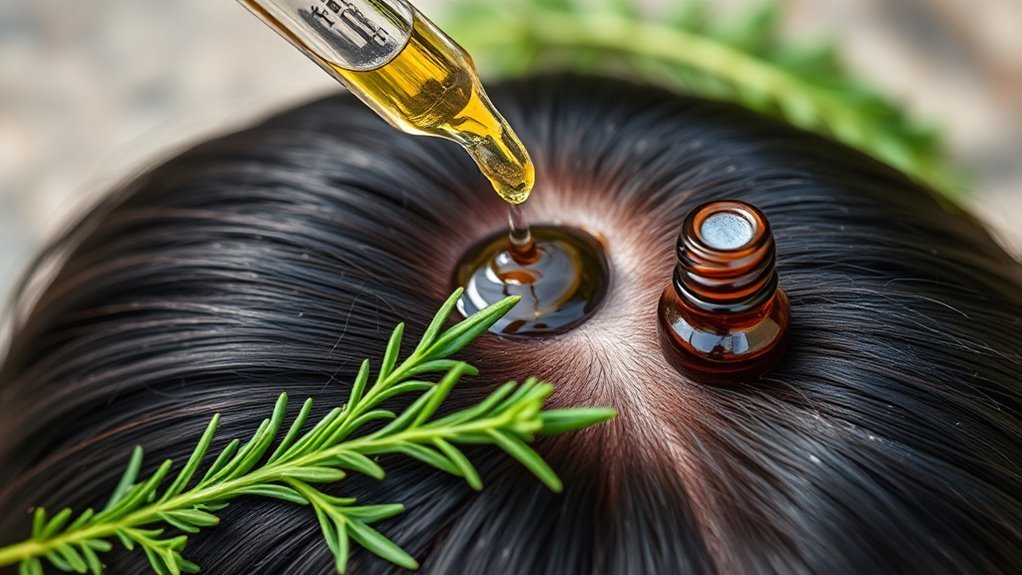
Does rosemary oil grow hair? Early clinical research suggests rosemary oil may modestly support hair density in people with pattern hair loss (androgenetic alopecia), though the evidence is far smaller than for FDA-approved minoxidil. In the landmark Panahi et al. (2015) trial, rosemary oil and 2% minoxidil produced comparable hair-count gains after 6 months—but the trial lacked a placebo group and tested 2% rather than 5% minoxidil—so always dilute essential oil to 1%–2% in a carrier oil and set realistic expectations.
Quick Answer
Rosemary oil shows modest potential for mild pattern thinning after at least 6 months of consistent use, with less scalp itching than 2% minoxidil in one small 2015 trial. However, 5% topical minoxidil remains better supported by clinical evidence. Never apply undiluted rosemary essential oil to your scalp; dilute to 1%–2% in a carrier oil and patch test first.
Does Rosemary Oil Grow Hair? What Clinical Studies Show
Three key pieces of human evidence define what we actually know—and do not yet know—about rosemary oil for hair regrowth:
- Panahi et al. (2015, Skinmed): This randomized trial followed 100 men with androgenetic alopecia (50 per group) using rosemary oil lotion vs. 2% topical minoxidil for 6 months. Neither group showed a significant hair-count jump at 3 months, but both rose significantly at 6 months with no statistically significant difference between them, and rosemary oil caused less scalp itching. Important caveats: there was no placebo arm, the trial compared against 2% minoxidil (not the stronger 5% strength), and it used a standardized lotion rather than a homemade DIY mix.
- Patel et al. (2025, Cureus): A 90-day trial of 90 adults found rosemary-lavender and rosemary-castor blends outperformed coconut oil on several hair measures, though multi-ingredient formulas cannot isolate rosemary’s standalone effect.
- Gupta et al. (2026, Medicina / PMC13414076): A systematic review and network meta-analysis of male pattern hair loss treatments found only one qualifying monotherapy trial for rosemary oil and ranked 5% topical minoxidil highest in effectiveness.
Popular claims that rosemary oil “blocks DHT” come from laboratory and mouse studies using rosemary leaf extract, not human trials of essential oil. Meanwhile, conditioning hair oils can make strands look glossier and feel smoother without increasing follicle count—for strand conditioning rather than scalp regrowth, see our L’ANZA Keratin Healing Oil guide.
Rosemary Oil vs. Minoxidil: Side-by-Side Comparison
| Factor | Rosemary Oil (Diluted) | Topical Minoxidil (2% / 5%) |
|---|---|---|
| Regulatory status | Cosmetic / botanical (not FDA-approved for hair loss) | FDA-approved over-the-counter hair loss medication |
| Clinical evidence | Limited (1 main 6-month trial vs. 2% minoxidil; no placebo arm) | Extensive; 5% strength ranked more effective in 2026 NMA |
| Timeline to assess | At least 6 months of consistent use | 6 to 12 months per AAD treatment guidance |
| Common side effects | Contact dermatitis, redness, or burning if undiluted | Scalp itching, dryness, initial shedding, unwanted facial hair |
How to Dilute and Apply Rosemary Oil Safely
Pure rosemary essential oil is highly concentrated and can burn or sensitize your scalp if applied straight from the bottle. Following Tisserand Institute dilution standards and Cleveland Clinic dermatologist guidance, start with a cautious 1% dilution and stay at or below 2%:
- Measure a carrier oil: Pour 1 tablespoon (about 15 mL) of a gentle carrier oil such as jojoba or fractionated coconut oil into a clean glass bottle.
- Add rosemary essential oil: Mix in roughly 3 drops for a ~1% dilution (or up to 6 drops for ~2%, assuming ~20 drops per mL).
- Patch test first: Per the AAD home-testing method, apply a tiny dab to a test spot twice daily for 7 to 10 days to check for delayed allergic contact dermatitis (just as you would when introducing active facial skincare—see our retinol sensitivity guide).
- Apply to the scalp, not just strands: Part your hair, apply a small amount along thinning areas, massage gently for 1 to 2 minutes, and wash out if residue or irritation occurs. Starting 2 to 3 times per week is practical, though no single DIY frequency is clinically standardized.
While evaluating scalp treatments over 3 to 6 months, minimize mechanical and thermal breakage as well—our curling iron sizing and heat-styling guide covers gentler styling habits.
Safety Warning: Never swallow essential oils, keep them away from eyes, broken skin, and children, and consult a clinician before using concentrated rosemary oil during pregnancy, breastfeeding, or if you have epilepsy. Sudden bald patches, heavy shedding, or scalp pain require a dermatologist evaluation rather than DIY oils.
Frequently Asked Questions
Can Rosemary Oil Be Mixed With Other Essential Oils?
Yes, rosemary oil can be combined with oils like lavender or peppermint in a carrier oil, though mixing oils is not proven to boost regrowth further. Calculate your 1% to 2% dilution limit based on the total drops of all essential oils combined.
Is Rosemary Oil Safe During Pregnancy or Breastfeeding?
Concentrated rosemary essential oil should not be assumed safe as a scalp treatment during pregnancy or breastfeeding because human safety data are limited. Avoid starting concentrated essential oil scalp treatments without medical guidance.
Can Rosemary Oil Be Used on Color-Treated Hair?
Yes, properly diluted rosemary oil can be applied to the scalp on color-treated hair if your skin tolerates it. Avoid applying essential oils to a scalp that is freshly irritated from hair dye or bleach.
Should Rosemary Oil Be Applied to a Wet or Dry Scalp?
Either a clean dry scalp or a slightly damp scalp is fine; no clinical trial proves one grows more hair. Applying to a dry scalp often makes it easier to part hair cleanly and avoid excess buildup.
Can Rosemary Oil Help With Eyebrow or Beard Growth?
There is no solid clinical evidence proving rosemary oil increases eyebrow or beard density. Never apply essential oils near your eyes—even when diluted—and consult a dermatologist for patchy facial hair loss.
Conclusion
Rosemary oil is a low-cost botanical option that showed comparable 6-month hair-count gains to 2% minoxidil in one small 2015 study, though broader evidence still favors FDA-approved 5% minoxidil. If you try it for mild pattern thinning, dilute it to 1%–2% in a carrier oil, patch test carefully, track scalp photos over 6 months, and see a dermatologist if hair loss is sudden, patchy, or worsening.
Sources
- Panahi et al., Skinmed (2015): 6-month randomized trial of rosemary oil vs. 2% minoxidil in 100 men with androgenetic alopecia.
- Patel et al., Cureus (2025): 90-day trial comparing rosemary-containing oil blends with coconut oil.
- Gupta et al., Medicina (2026): Systematic review and network meta-analysis ranking 5% minoxidil above off-label monotherapies.
- Tisserand Institute: Dilution for Essential Oils: Safe topical dilution ratios and skin sensitization risks.
- Cleveland Clinic: Rosemary Oil for Hair: Dermatologist guidance on scalp use and expectations.
- AAD: Hair Loss Diagnosis and Treatment: Evidence-based options including minoxidil timelines.
- AAD: How to Test Skin Care Products: 7–10 day home patch-testing method.