
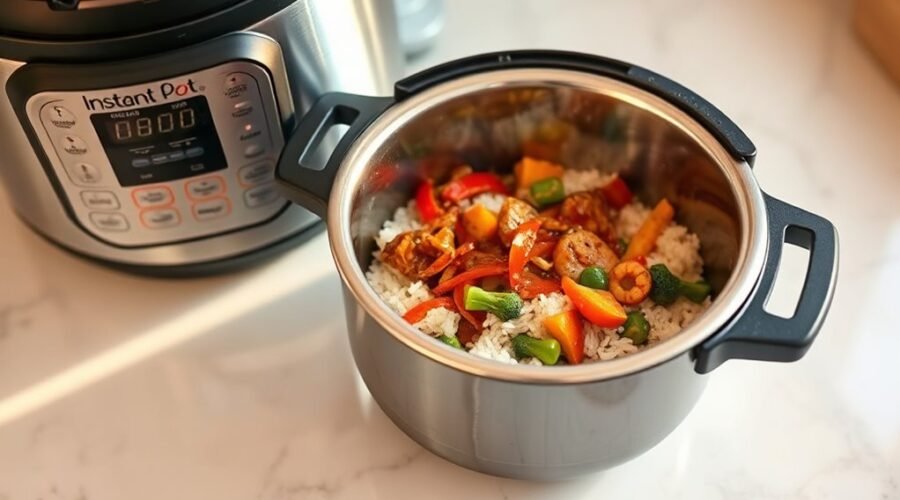
Instant Pot pot in pot recipes (PIP) let you cook delicate dishes, small batches, or a main dish and side simultaneously by placing a pressure-safe container on a raised trivet above 1 cup of water (1½ cups in an 8-quart model) inside the main inner pot. Always use stainless steel, anodized aluminum, or food-grade silicone containers—never standard Pyrex or unrated glass—and never seal the inner dish airtight. Below are 9 tested Pot-in-Pot recipes numbered 1 through 9 with exact trivet water amounts, High Pressure times, and pressure-release rules.
Quick Answer
Add 1 cup water (6-qt) or 1½ cups water (8-qt) to the main pot, insert a metal trivet, and set a 6- to 7-inch stainless steel bowl, springform pan, or silicone mold on top. Match the High Pressure time and release method to your dish—and check meats, fish, and egg dishes with an instant-read thermometer.
Container Safety Warning (Pyrex & Glass Ban): “Oven-safe” does not mean pressure-cooker-safe. Per Kansas State University Extension (citing Corelle Brands), Pyrex glassware is not recommended inside electric pressure cookers because uneven heat and thermal shock can crack or shatter glass. Avoid glass containers unless the manufacturer explicitly rates that exact product for pressure cooking; choose stainless steel, anodized aluminum, or food-grade silicone instead, and never clamp an airtight lid onto the inner dish.
Pot-in-Pot Container Rules & Quick Setup
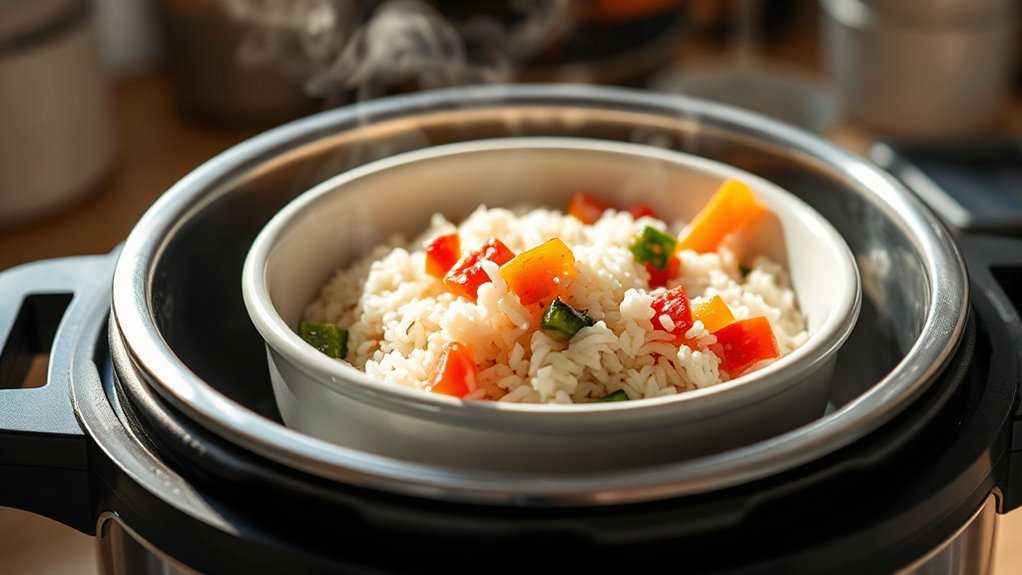
- Best containers: 6- or 7-inch stainless steel bowls/stackable inserts (fastest heat transfer), 7-inch anodized aluminum springform pans (for lasagna and cheesecake), and food-grade silicone egg-bite molds.
- Trivet water baseline: Use 1 cup water in a 6-quart pot and 1½ cups water in an 8-quart pot for single-dish PIP (check your model’s manual if it requires 1½ cups minimum in a 6-quart). For two-dish meals, the thin sauce in the bottom pot provides the steam.
- Foil cover rule: Tent or crimp foil loosely over casseroles, egg bites, and cheesecake to block dripping lid condensation; leave rice, oats, and pasta uncovered. Never seal airtight.
- Easy removal: Fold a 20-inch strip of heavy-duty foil in thirds lengthwise to make a lifting sling under pans that lack handles.
All 9 Instant Pot Pot in Pot Recipes at a Glance
| # | Recipe | Main Pot Liquid | Container & Cover | High Pressure | Release |
|---|---|---|---|---|---|
| 1 | Butter Chicken & White Rice | Chicken tomato sauce below | Stainless bowl, uncovered | 10 min | 10 min NR, then QR |
| 2 | Lasagna Pie | 1 cup (6-qt) / 1½ cups (8-qt) | 7″ springform, foil-covered | 20 min | Full NR |
| 3 | Fluffy Egg Bites | 1 cup (6-qt) / 1½ cups (8-qt) | Silicone mold, foil-covered | 8 min (Steam/High) | 10 min NR, then QR |
| 4 | Small-Batch Mac & Cheese | 1 cup (6-qt) / 1½ cups (8-qt) | Stainless bowl, uncovered | 5 min | Quick Release |
| 5 | Steamed Salmon & Veggies | 1 cup (6-qt) / 1½ cups (8-qt) | Stainless pan or foil boat | 3 min (1″ fillets) | Quick Release |
| 6 | Creamy Rice Pudding | 1 cup (6-qt) / 1½ cups (8-qt) | Stainless bowl, uncovered | 10 min | 10 min NR, then QR |
| 7 | No-Burn Steel-Cut Oats | 1 cup (6-qt) / 1½ cups (8-qt) | Stainless bowl, uncovered | 10 min | 15 min NR, then QR |
| 8 | Fluffy White / Jasmine Rice | 1 cup (6-qt) / 1½ cups (8-qt) | Stainless bowl, uncovered | 4 min | 10 min NR, then QR |
| 9 | 7-Inch Baked Cheesecake | 1–1½ cups water | 7″ springform, loosely foiled | 25–30 min | 15–20 min NR |
The 9 Instant Pot Pot-in-Pot Recipes
1. Butter Chicken & White Rice (Two-Dish Meal)
Based on Instant Pot’s official Butter Chicken and Rice, this two-tier meal cooks 1 lb boneless chicken thighs in spiced tomato sauce in the main pot while 2 cups rinsed long-grain white rice + 2½ cups water cook in an uncovered stainless bowl on a tall trivet above. Set to High Pressure for 10 minutes, followed by a 10-minute Natural Release and Quick Release. Confirm chicken reaches 165°F (74°C) internally before stirring in butter and cream.
2. Pot-in-Pot Lasagna Pie
Following Instant Pot’s Easy Lasagna Pie, layer marinara, broken no-boil lasagna noodles, ricotta mixed with 1 egg, mozzarella, and Parmesan in a greased 7-inch springform pan and cover with foil. Pour 1 cup water into a 6-quart pot (1½ cups for 8-quart), lower the pan onto the trivet with a foil sling, and cook on High Pressure for 20 minutes with a Full Natural Release. Rest 10–15 minutes before slicing (if using meat, pre-cook it first and ensure the casserole reaches 165°F).
3. Fluffy Silicone-Mold Egg Bites
Using Instant Pot’s Fluffy Egg Bites ratios, blend 4 large eggs, ¾ cup shredded Monterey Jack, ½ cup cottage cheese, ¼ cup heavy cream, and ½ tsp salt. Pour into a greased 7-cup silicone egg-bite mold with cooked bacon or finely chopped spinach, cover loosely with foil, and place on a trivet over 1 cup water (1½ cups in 8-qt). Cook for 8 minutes on Steam or High Pressure with a 10-minute Natural Release. Egg dishes must reach 160°F (71°C) internally. Prefer whole peeled eggs? See our Instant Pot hard-boiled eggs 5-5-5 vs. 4-4-5 guide.
4. Small-Batch Pot-in-Pot Mac & Cheese
Combine 1 cup dry elbow macaroni, 1 cup water or chicken broth, and ¼ tsp salt in an uncovered 6-inch stainless steel bowl. Place on a trivet over 1 cup water (1½ cups in 8-qt) and cook on High Pressure for 5 minutes, then do a Quick Release. Lift the bowl carefully and stir in 1 tbsp butter, 3 tbsp warm milk, ½ tsp mustard powder, and 1 cup shredded sharp cheddar until smooth.
5. Steamed Salmon & Crisp-Tender Vegetables
Season two 1-inch-thick salmon fillets with lemon slices, garlic, dill, and salt in a shallow stainless pan or foil boat; place quick-steaming vegetables like asparagus or thin zucchini coins beside them (avoid dense raw potatoes or thick carrots, which need longer cycles). Set on a trivet over 1 cup water (1½ cups in 8-qt), cook on High Pressure for 3 minutes, and use an immediate Quick Release. Verify fish reaches 145°F (63°C) and flakes easily with a fork.
6. Creamy Pot-in-Pot Rice Pudding
Cooking rice pudding in a raised bowl eliminates bottom-pot scorching. Combine ½ cup rinsed Arborio or short-grain white rice, 1 cup water, 2 tbsp sugar, a pinch of salt, and 1 cinnamon stick in an uncovered stainless bowl. Place on a trivet over 1 cup water (1½ cups in 8-qt), cook on High Pressure for 10 minutes, and allow a 10-minute Natural Release. Stir in ½ cup warm milk (or coconut milk), ½ tsp vanilla extract, and raisins after cooking until creamy.
7. No-Burn Pot-in-Pot Steel-Cut Oats
If direct-pot oatmeal triggers a Burn notice on your machine, combine 1 cup traditional steel-cut oats, 2½ to 3 cups water, and ½ tsp salt in an uncovered stainless steel bowl. Set on a trivet over 1 cup water (1½ cups in 8-qt), cook on High Pressure for 10 minutes, and allow a 15-minute Natural Release before stirring well. For toasted-butter flavor and freezer meal-prep pucks, follow our full Instant Pot steel-cut oats guide.
8. Pot-in-Pot White or Jasmine Rice (Zero-Stick Side)
Rinse 1 cup long-grain white or jasmine rice until clear and place in an uncovered stainless steel bowl with 1 cup water (1:1 ratio, plus a pinch of salt). Set on a trivet over 1 cup water (1½ cups in 8-qt), cook on High Pressure for 4 minutes, and allow a 10-minute Natural Release before fluffing. This method leaves the main pot spotless and is easy to pair with Instant Pot chicken bone broth instead of plain water for extra flavor.
9. 7-Inch Pot-in-Pot Baked Cheesecake
Per Instant Pot’s Classic Cheesecake guide, press a graham cracker crust into a greased 7-inch springform pan, pour in a classic cream-cheese-and-egg batter, and cover loosely with foil (optional to prevent water droplets). Pour 1 to 1½ cups water into a 6- or 8-quart pot, lower the pan onto the trivet with a foil sling, and cook on High Pressure for 25 minutes (uncovered) or 28–30 minutes (foil-covered), followed by a 15- to 20-minute Natural Release. Blot surface condensation gently, cool 1 hour, and chill at least 4 hours before slicing.
USDA Safe Internal Temperatures: Always confirm doneness with a food thermometer per FoodSafety.gov: poultry 165°F (74°C), fish 145°F (63°C), egg dishes 160°F (71°C), and casseroles/leftovers 165°F (74°C).
Pros and Limitations of Pot-in-Pot Cooking
- Pros: Prevents Burn warnings on thick sauces, dairy, and grains; cooks a main dish and rice in one cycle; simplifies cleanup since the main pot mostly holds water.
- Limitations: Cannot brown or crisp surfaces without a broiler finish; secondary containers reduce usable volume; two-dish meals only work when both foods share compatible cook times and release methods.
Key Takeaways
- Use stainless steel, anodized aluminum, or silicone containers—skip standard Pyrex/glass unless explicitly rated for pressure cookers.
- Pour 1 cup water (6-qt) or 1½ cups water (8-qt) under the trivet for single-dish PIP recipes, and never seal the inner dish airtight.
- Cover casseroles, egg bites, and cheesecake loosely with foil; leave rice, pasta, and oats uncovered.
- Verify meat, fish, and egg dishes with a food thermometer rather than relying on timer settings alone.
Frequently Asked Questions
Can I Use Pyrex or Glass Bowls for Instant Pot Pot-in-Pot Cooking?
No, unless the glass manufacturer specifically rates that exact container for electric pressure cookers. Corelle Brands (the maker of Pyrex) advises against using Pyrex glassware inside pressure cookers because uneven heating and thermal shock can cause it to crack or shatter. Use stainless steel bowls, anodized aluminum pans, or food-grade silicone molds instead.
How Much Water Goes Under the Trivet for Pot-in-Pot Cooking?
For single-dish Pot-in-Pot recipes, pour 1 cup of water into a 6-quart Instant Pot (1½ cups for an 8-quart model, or follow your manual's minimum liquid requirement) before placing the trivet. For two-dish meals like butter chicken and rice, the chicken sauce itself supplies the required liquid below the trivet.
Should I Cover the Inner Container During Pot-in-Pot Cooking?
Cover dishes that shouldn't get wet from lid condensation—such as lasagna, egg bites, and cheesecake—loosely with aluminum foil (or a silicone lid with a vent). Leave rice, oats, and pasta uncovered so steam circulates evenly. Never clamp an airtight lid onto the inner container.
What Size Pans Fit Inside a 6-Quart vs. 8-Quart Instant Pot?
A 7-inch round springform pan or 6- to 7-inch stainless steel bowl fits most 6-quart and 8-quart Instant Pots with room for steam circulation and a foil sling. Always measure your inner pot's interior diameter and height before buying accessories—an 8-inch pan will not fit a 6-quart pot.
Why Did My Pot-in-Pot Food Come Out Undercooked?
Food inside a secondary container heats slightly slower than food touching the main inner pot directly, especially in thick ceramic dishes or deep pans. Use thin stainless steel or anodized aluminum pans, leave at least ½ inch of clearance around the sides for steam, and follow PIP-specific High Pressure and Natural Release times.
Sources
- Kansas State University Extension: Using Pyrex in Pressure Cookers — Corelle Brands guidance against using Pyrex glassware inside electric pressure cookers.
- Instant Pot: Butter Chicken and Rice — Two-dish PIP arrangement and 10-minute High Pressure / 10-minute NR timing.
- Instant Pot: Easy Lasagna Pie — 7-inch springform pan, 20-minute High Pressure, and Full Natural Release.
- Instant Pot: Fluffy Egg Bites — Silicone mold setup, 8-minute Steam/High cycle, and 10-minute NR.
- Instant Pot: Classic Cheesecake — 7-inch springform pan, 1½ cups water, 25-minute High Pressure, and 20-minute NR.
- FoodSafety.gov: Safe Minimum Internal Temperatures — Poultry (165°F), fish (145°F), egg dishes (160°F), and leftovers (165°F).


[…] No-Burn Alternative: If your model is sensitive to Burn notices, cook your oats inside a stainless steel bowl on a trivet over 1 cup of water—see Recipe #7 in our Instant Pot pot-in-pot recipes guide. […]