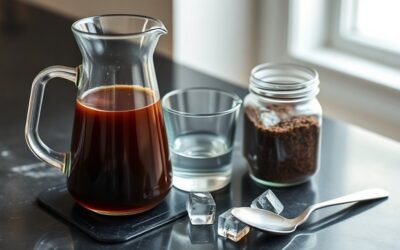
Does cold brew have more caffeine than hot drip or iced coffee? Sometimes—but not because cold water extracts more caffeine. Cold brew often beats regular iced coffee per serving because it is brewed at a heavier coffee-to-water mass ratio (1:4 to 1:8 vs. ~1:16 for hot drip), whereas a full 16 oz cup of hot drip coffee with no ice frequently contains more total caffeine than an iced cold brew.
The Core Science in One Sentence
Hot water wins on extraction speed (minutes), while cold brew wins on starting coffee mass (concentrate ratios)—so the stronger cup depends on your final dilution and how much ice displaces liquid in the glass.
Does Cold Brew Have More Caffeine Than Hot Drip or Iced Coffee?

Most confusion around cold brew caffeine comes from mixing up concentration per ounce with total caffeine per cup. Here is how the three brewing styles compare mechanically and chemically:
| Variable | Cold Brew | Hot Drip Coffee | Regular Iced Coffee |
|---|---|---|---|
| Typical Brew Ratio | 1:4 – 1:8 (concentrate) or 1:10 – 1:12 (RTD) | 1:15 – 1:17 | 1:15 – 1:17 (brewed hot, chilled over ice) |
| Water Temp & Time | 38–70°F for 12–18 hrs | 195–205°F for 3–5 min | 195–205°F for 3–5 min, then iced |
| Ice Displacement | Yes (reduces liquid volume in cup) | None (full liquid volume) | Yes (plus rapid melt dilution) |
| Caffeine Winner | Highest per oz if undiluted or lightly diluted | Often highest total mg in a full 16 oz mug | Usually lowest total mg per cup |
If you want exact café chain numbers (Starbucks vs. Dunkin’ vs. homemade cups) and Arabica vs. Robusta bean breakdowns, see our guide on how much caffeine is in cold brew.
Mass Ratio vs. Temperature Extraction Efficiency
Two opposing forces determine how much caffeine ends up in your glass:
- Temperature extraction efficiency (why hot water is faster): Caffeine solubility climbs sharply with heat. Near-boiling water (195–205°F) rapidly pulls the bulk of available caffeine from ground coffee in just 3 to 5 minutes.
- Coffee-to-water mass ratio (why cold brew can feel stronger): Because cold brew is commonly steeped at 1:4 to 1:8—using two to three times more dry coffee per unit of water than a standard 1:16 hot drip batch—there is simply far more total caffeine available in the brewing vessel. To see how those ratios translate into grams and cups, check our cold brew coffee ratio master chart.
Once you dilute a 1:5 cold brew concentrate 1:1 with water, its effective ratio lands near 1:10—still stronger per ounce than standard 1:16 drip coffee. Dilute it 1:2 with water and milk, however, and it lands right alongside regular hot drip coffee.
What Peer-Reviewed Studies Actually Show
Controlled lab chemistry clears up several stubborn coffee myths. In a widely cited 2017 study in Scientific Reports by Megan Fuller and Niny Z. Rao (Thomas Jefferson University), researchers tracked caffeine extraction in both hot and cold brews across roast levels and grind sizes:
- 6–7 hour caffeine plateau: Under their room-temperature cold-brew conditions, caffeine reached equilibrium between 6 and 7 hours—meaning steeping 18 or 24 hours shifts flavor and bitterness more than it increases caffeine.
- Coarse-grind advantage over hot brew: At identical coarse grinds, cold brew samples reached higher caffeine concentrations than their hot-brew counterparts because extended contact compensated for larger particle diffusion paths.
- Medium roast beat dark roast: Medium-roast cold brews yielded higher caffeine concentrations than dark-roast cold brews under the same conditions.
- Grind size mattered less at equilibrium: Medium vs. coarse grind sizes did not dramatically change final equilibrium caffeine concentrations once enough steeping time passed.
Curious how cold brew extraction compares against pressurized 9-bar espresso shots? Read our dedicated breakdown of does cold brew have more caffeine than espresso.
Why Regular Iced Coffee Usually Loses on Caffeine
Regular iced coffee starts as standard hot-brewed drip coffee (around 1:16) and is poured over ice—or brewed double-strength over ice so melting cubes bring it back to ~1:16. Either way, ice occupies roughly a third to half of the cup’s volume. A 16 oz iced coffee therefore holds far less brewed coffee than a 16 oz hot mug, and less caffeine per fluid ounce than a 1:8 or 1:10 cold brew.
How to Control Your Caffeine Dose Safely
- Measure concentrate first: Use a jigger or measuring cup to pour 2–4 oz of concentrate before adding water, ice, or milk so you know your exact portion.
- Do not judge caffeine by smoothness: Cold brew has lower titratable acidity and tastes smoother than hot drip, which makes it easy to drink a large 16–24 oz glass quickly without noticing the caffeine load.
- Respect daily limits: The U.S. FDA cites 400 mg/day as a general limit for most healthy adults, and ACOG advises staying under 200 mg/day during pregnancy.
- Store safely: Keep homemade cold brew refrigerated at 40°F (4°C) or below and consume within 7 days.
Medical Warning: Stop consuming caffeine if you experience severe jitters, nausea, or a racing heartbeat, and seek prompt medical care for chest pain, fainting, or persistent palpitations.
Frequently Asked Questions
Does cold water extract more caffeine than hot water?
No—gram for gram at the same ratio, hot water extracts caffeine much faster (within 3–5 minutes) because caffeine is more soluble at high temperatures. Cold brew catches up only through prolonged steeping (reaching equilibrium around 6–7 hours) and typically exceeds iced coffee only when brewed at a heavier coffee-to-water mass ratio.
Why does a 16 oz hot drip coffee often have more caffeine than a 16 oz cold brew?
Ice displacement is the biggest reason. A 16 oz cup of hot drip coffee contains 16 full ounces of brewed liquid, whereas a 16 oz cold brew or iced coffee is partly filled with ice—leaving fewer fluid ounces of actual coffee in the cup.
Does steeping cold brew for 24 hours add more caffeine than 12 hours?
Usually not much. In a 2017 Scientific Reports study by Fuller and Rao, caffeine reached extraction equilibrium between 6 and 7 hours at room temperature. Steeping 12 to 24 hours continues to shift body and bitterness, but adds little extra caffeine.
Does dark roast cold brew have more caffeine than medium roast?
Not necessarily. In controlled cold-brew testing (Fuller & Rao, 2017), medium-roast samples actually yielded higher caffeine concentrations than dark-roast samples brewed under the same conditions. Bean species (Robusta vs. Arabica) and coffee weight matter far more than roast color.
Does diluting cold brew concentrate reduce its total caffeine?
Adding water or milk lowers the caffeine concentration per ounce, but it does not remove caffeine from the glass. If you pour 4 oz of concentrate and add 4 oz of water, drinking the whole 8 oz glass delivers the exact same total milligrams as drinking the 4 oz concentrate straight.