Most people don’t realize UV nail lamps aren’t just “one product” but a category split by power, mobility, and cure behavior. You’ll see desktop, cordless, and portable models, and each one changes how fast gels cure, how evenly they set, and how safely they perform over time. The differences matter more than the price tag, and once you compare wattage, lamp type, and use case, the right choice gets much clearer.
What Is a UV Nail Lamp?
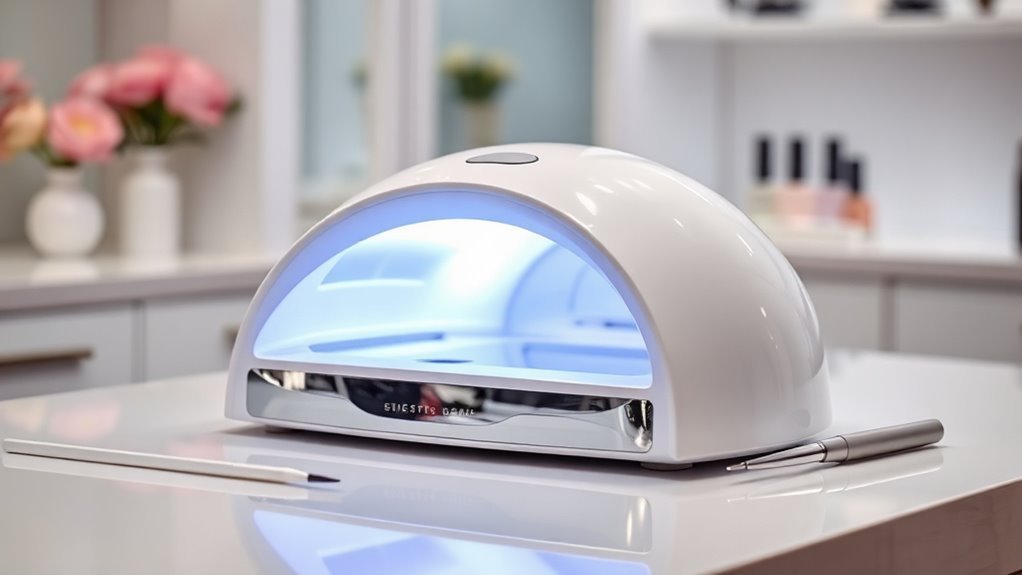
A UV nail lamp is a curing device that uses ultraviolet light to harden gel nail polish, top coats, and related formulas in minutes rather than air-drying over hours. You use it to turn soft gel into a durable finish, and that shift changes your manicure timeline fast.
The UV lamp benefits are measurable: faster service, tighter cure control, and longer wear with less chipping. In trend terms, gel systems keep growing because you can get salon-level results at home or in a studio without waiting around. You also gain more freedom to layer, design, and move on with your day.
Still, you should weigh safety considerations, including exposure time, skin sensitivity, and manufacturer guidance on wattage and curing cycles. When you understand how the lamp works, you can choose smarter products, reduce waste, and keep your routine efficient, modern, and self-directed.
UV Nail Lamp Types: Desktop, Cordless, and Portable
Once you know how curing works, the next choice is the lamp format that fits your workflow: desktop, cordless, or portable.
Desktop features usually deliver the highest stability, wider hand clearance, and faster batch sessions, so you can move through sets with less interruption.
Cordless convenience matters when you want freedom from outlets, especially for mobile services or tight spaces.
Portable advantages show up in weight, compact storage, and travel-friendly power options, giving you more control over where and how you work.
Look at user experiences, not just specs: people often rate build quality, timer accuracy, and heat management as the real differentiators.
Safety considerations include auto shutoff, low-heat modes, and battery reliability, since freedom also means reducing avoidable risks.
For any format, use maintenance tips like wiping reflective surfaces, checking cords or batteries, and replacing worn components.
Choose the lamp that matches your pace, your space, and your independence.
How UV and LED Curing Works
When you expose gel polish to the right wavelength, the photoinitiators absorb energy and trigger polymerization, turning liquid resin into a hard, durable film. You’re not just drying product; you’re driving a Curing Process that links molecules into a crosslinked network.
Photoinitiators absorb light, sparking polymerization and transforming liquid resin into a durable, crosslinked film.
UV Light Effects determine how efficiently that reaction starts, so wavelength alignment matters more than guesswork. UV lamps usually cast a broader spectrum, while LED units deliver a narrower, targeted output that many brands now optimize for faster activation and cleaner energy use.
For you, that means the finish feels less like a coating and more like a controlled material transformation. The result is a harder surface, stronger wear resistance, and fewer failures from smudging or undercure.
As the market shifts toward precision hardware, understanding this chemistry helps you choose tools that support freedom, consistency, and salon-grade performance without extra complexity.
How to Choose Wattage and Cure Time
Wattage and cure time work together, but higher wattage doesn’t automatically mean faster or better curing. You should match output to your formula’s specs, because real performance depends on LED density, wavelength, and polish thickness.
For gel systems, higher wattage can improve coverage and shorten waits, but only when the lamp’s spectrum aligns with the product. That’s one of the main wattage benefits: more consistent energy delivery across the nail surface.
Your cure time considerations should start with the brand’s chart, then adjust for base coat, color, and top coat layers. If you under-cure, you risk lifting; if you over-cure, you can waste time and stress the finish.
Track results by batch and brand so you can compare trends, not guesses. You deserve a setup that gives you control, speed, and reliable results without relying on hype.
Salon vs. At-Home UV Nail Lamps
If you’re comparing salon and at-home UV nail lamps, the biggest difference is usually consistency, not just power. In salons, technicians control placement, timing, and product pairing, so UV technology delivers predictable results. At home, you gain portable convenience and autonomy, but you also take on calibration and prep.
| Factor | What you get |
|---|---|
| Salon experiences | Faster, more uniform curing, less guesswork |
| At-home use | Freedom, lower cost per session |
| Safety considerations | More control over exposure and product fit |
| Trend impact | More consumers are choosing self-managed beauty |
Data shows at-home lamps now rival pro units in wattage, yet performance still depends on technique. If you want liberation from appointments, choose a lamp with even LED coverage, timer presets, and clear safety considerations. If you value flawless consistency, salon experiences still set the benchmark. Your best choice depends on whether you prize control, speed, or the confidence of expert handling.
Frequently Asked Questions
How Often Should I Replace UV Nail Lamp Bulbs?
You should replace UV nail lamp bulbs every 6 to 12 months, depending on your bulb lifespan and how often you use the lamp.
If you notice slower curing, uneven results, or fading output, you’re due for a swap sooner.
Track usage hours, because replacement frequency rises with heavy salon-style use.
Data shows performance drops before total failure, so replacing early keeps your routine efficient, independent, and consistently empowered.
Are UV Nail Lamps Safe for Sensitive Skin?
UV nail lamps can be okay for sensitive skin, but you should treat them cautiously because UV radiation risks can trigger skin reactions.
You’ll lower exposure by using shorter curing times, broad-spectrum SPF, or fingerless gloves.
Dermatologist advice usually says to avoid overuse if you notice redness, itching, or dryness.
For best nail health, you should track your skin’s response and choose low-heat, well-calibrated devices whenever possible.
Can UV Nail Lamps Cure All Gel Polish Brands?
No, you can’t assume a UV nail lamp cures every gel polish brand. You need to check gel polish compatibility, because formulas vary by wavelength, pigment load, and chemistry.
You’ll also notice curing time differences: some brands harden in 30 seconds, others need two minutes or more. Data from salon testing shows mismatches cause tacky finishes and weak wear.
Match lamp specs to product labels, and you’ll get more reliable results.
Do UV Nail Lamps Work on Toenails Too?
Yes, you can use a UV nail lamp on toenails too. Like a tool in the right hands, it cures gel polish application on toes as effectively as on fingers, provided your polish matches the lamp’s wavelength.
You’ll want to keep sessions even and timed, since consistent exposure improves results and supports toenail health.
Market trends show at-home pedicures keep growing, and you don’t need salon dependence to get durable shine.
How Do I Clean and Disinfect a UV Nail Lamp?
You clean and disinfect your UV nail lamp by unplugging it, wiping the exterior and tray with 70% isopropyl alcohol, and avoiding liquid near vents or bulbs.
For lamp maintenance, remove dust after each use and check cords regularly.
Use safety precautions: let surfaces dry fully, don’t spray directly inside, and replace worn parts fast.
Data shows consistent cleaning cuts contamination risk and keeps performance stable for your routine.
Conclusion
So, when you pick a UV nail lamp, you’re really choosing between speed, mobility, and consistency. Desktop models typically deliver the most stable curing, while cordless and portable options fit travel and flexible use. Higher wattage often cuts cure time, but the right balance depends on your gel system. Picture it like a simple spectrum: stationary, flexible, ultra-compact. If you’ve worried that compact means weak, today’s designs often prove otherwise with efficient curing performance.