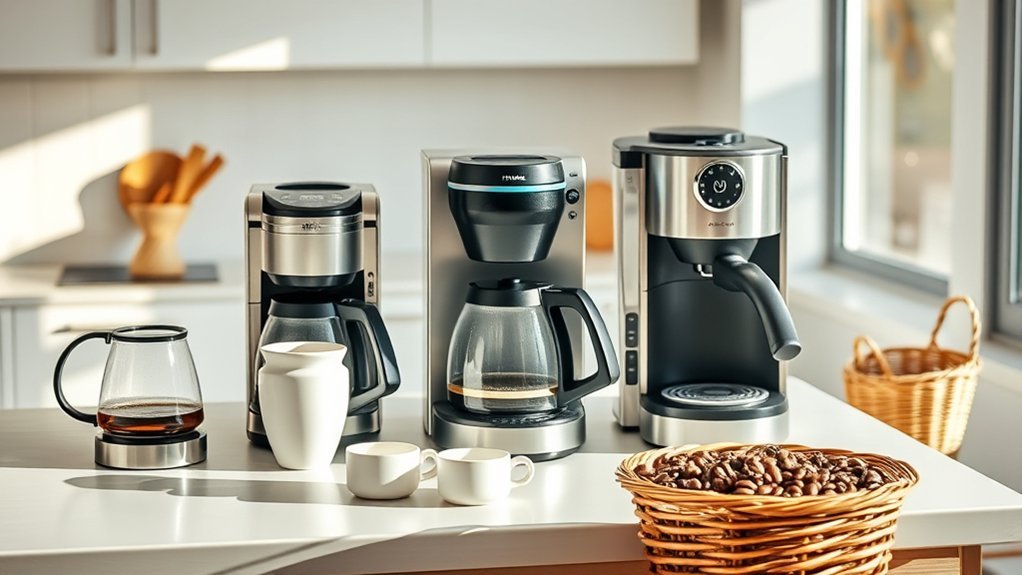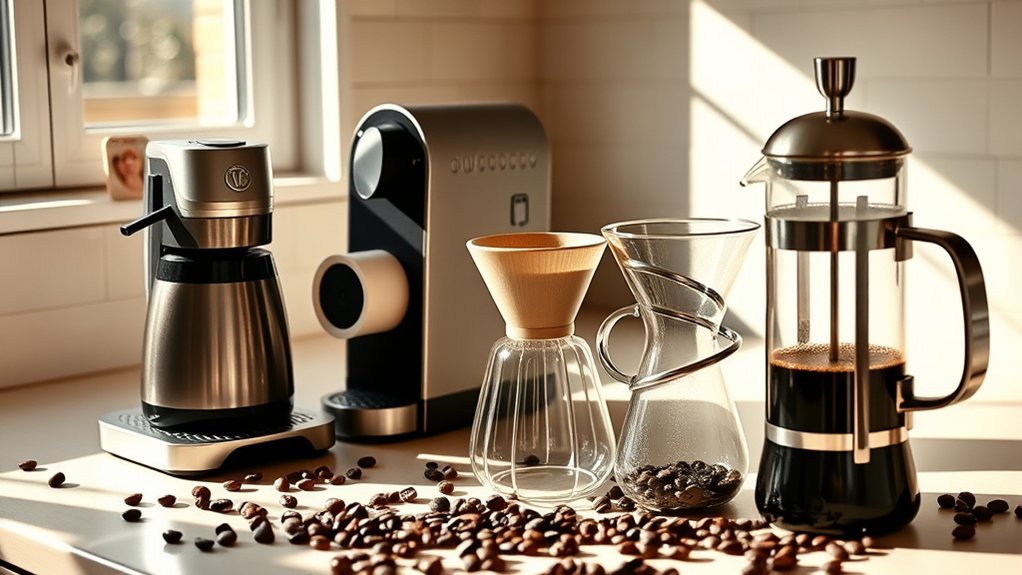

Yes, you can use distilled water in some coffee makers, but it is not the best choice for every machine or every cup of coffee. Distilled water contains very little dissolved mineral content, which reduces limescale but can also change extraction and flavor. Some manufacturers specifically tell owners not to use distilled water, so check the manual for your exact model before filling the reservoir.
Quick Answer
Distilled water can work in a simple brewer if the manufacturer allows it, but it is not universally safe or ideal. Some Keurig, Breville, and espresso-machine manuals warn against very low-mineral water. It reduces scale but may flatten flavor or interfere with sensors. Filtered or properly remineralized water is usually the easier choice.
Key Takeaways
- Check your exact coffee maker manual before using distilled, deionized, reverse-osmosis, or other very low-mineral water.
- Distilled water greatly reduces new mineral scale, but its lack of hardness and alkalinity can change coffee flavor.
- Some machines need mineral-containing water for normal sensing or operation, while certain espresso-machine manufacturers also warn about corrosion from excessively pure water.
- TDS is only a rough estimate of dissolved material; hardness, alkalinity, chloride, sodium, and the specific mineral balance also matter.
- For standard hot drip coffee, a public SCA brewer-certification document specifies roughly 92–96°C, or 198–205°F, at the coffee bed during brewing.
- For most homes, clean filtered water or correctly remineralized distilled/RO water is a better starting point than untreated distilled water.
At a Glance
| Time Required | A few minutes to check your model manual; longer if you test hardness, alkalinity, or other water parameters |
| Difficulty | Easy |
| Tools Needed | Coffee maker manual; optional water-quality report, hardness/alkalinity test, or TDS meter |
| Cost | No extra cost to check your manual; filtration, testing, and remineralization costs vary by product and water source |
Warning: Do not assume distilled water is compatible with every brewer. The Keurig K-Supreme guide says not to use distilled water, while the Breville Grind Control manual warns against distilled, demineralized, or highly filtered water because it can affect the machine’s function and coffee taste. Some espresso machines also depend on mineral-containing water for reliable sensing. Follow the instructions for your exact model.
Why Water Quality Matters for Coffee Brewing

Brewed coffee is mostly water, so the water’s taste and chemistry strongly affect the finished cup. Water acts as the solvent that dissolves acids, sugars, aromatic compounds, caffeine, and many other soluble materials from ground coffee.
Minerals such as calcium and magnesium can interact with coffee compounds during extraction. Bicarbonate alkalinity also matters because it buffers acidity. Research published in the Journal of Agricultural and Food Chemistry examined how dissolved cations interact with several coffee compounds and concluded that mineral composition can influence extraction. The authors also emphasized that there is no single water composition that produces the best result for every coffee. See the study on dissolved cations in coffee extraction.
Water can also carry tastes and odors into the cup. Chlorine, sulfur-like odors, excessive hardness, high chloride levels, or stale reservoir water may affect flavor. Clean, fresh water that tastes pleasant on its own is therefore a better starting point than water with a noticeable odor or mineral aftertaste.
Pure water and good brewing water are not necessarily the same thing. Coffee generally benefits from clean water with a suitable balance of minerals and alkalinity.
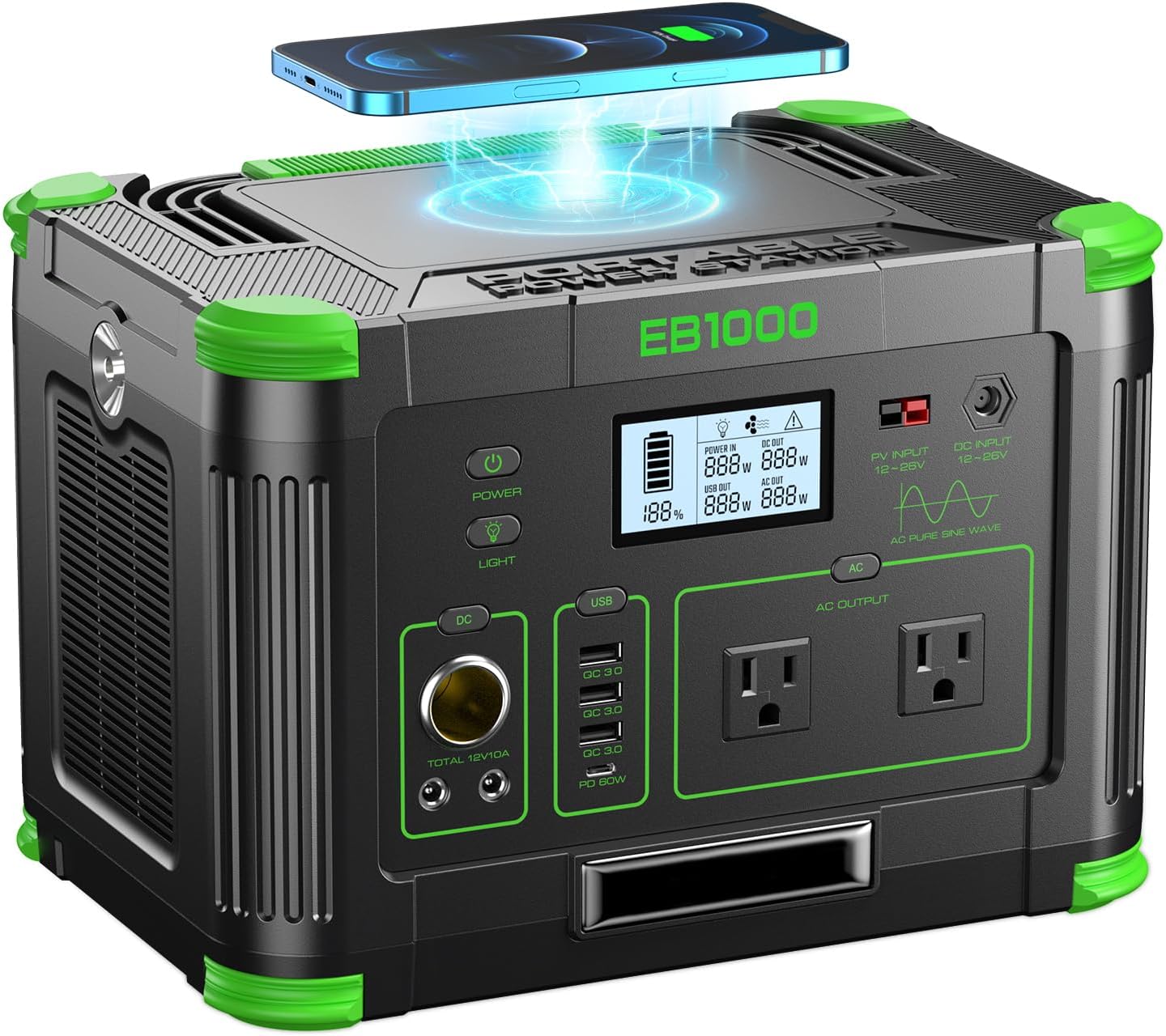
Power your essentials anywhere with a 999Wh pure sine wave power station delivering up to 1000W continuous with 2000W surge. It supports fast charging via USB-C PD 60W and USB-A QC 18W, plus simultaneous output for multiple devices through AC, USB, wireless, and car/DC ports. Recharge using AC, car, or solar with a built-in MPPT controller and dual cooling fans, while the upgraded battery management system protects against surges, short circuits, and overheating.

4-IN-1 WATER TESTING METER – Measures Total Dissolved Solids (TDS), Electrical Conductivity (EC), and temperature in °C/°F. Compact digital design suitable for testing drinking water, aquariums, hydroponics, and RO systems.

Ideal for commercial use. Includes a carrying case with belt clip.
How Distilled Water Affects Coffee Flavor
Distillation turns water into vapor and condenses it again, leaving most dissolved minerals behind. The U.S. Geological Survey describes distilled water as very pure water with few dissolved ions and correspondingly low electrical conductivity.
That low mineral content has one clear benefit for many appliances: distilled water contributes very little calcium-carbonate scale compared with hard water. However, the lack of hardness and alkalinity can also change how coffee extracts and how acidity is perceived. Depending on the beans, roast, recipe, and brewing method, untreated distilled water may produce coffee that seems:
- Thin or hollow
- Sharp or overly bright
- Muted or lacking sweetness
- Less aromatic than the same coffee brewed with suitably mineralized water
Distilled water does not automatically make coffee bitter, sour, weak, or technically over-extracted. Grind size, coffee dose, brew ratio, contact time, temperature, agitation, and bed saturation still affect extraction. Water chemistry changes the environment in which extraction occurs; it does not replace the rest of the brewing recipe.
Distilled water can reduce scale, but the same low mineral content that helps with scale may produce less satisfying coffee or conflict with a machine’s water requirements.
Understanding Total Dissolved Solids and Their Role in Coffee Flavor
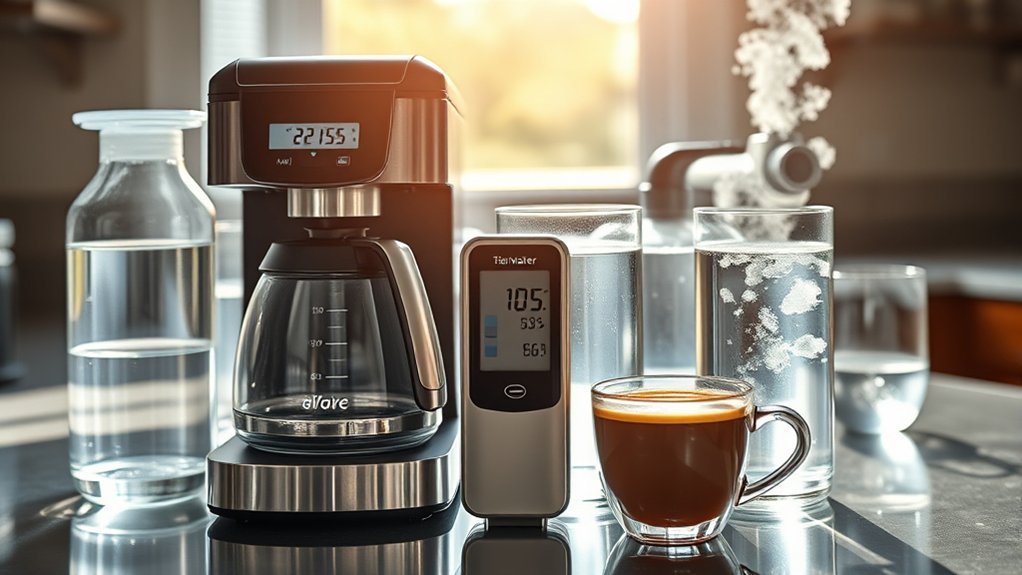
Total dissolved solids, or TDS, is an estimate of the amount of dissolved material in water. Many consumer TDS meters actually measure electrical conductivity and convert that reading into an estimated parts-per-million value. They do not tell you whether the dissolved material is calcium, magnesium, sodium, bicarbonate, chloride, sulfate, or something else.
A publicly available Specialty Coffee Association brewer-certification document describes test water with a baseline dissolved mineral content of about 150 ppm, calcium hardness of 17–85 mg/L, and pH of 7.0 ±0.5. These are controlled brewer-testing conditions, not a rule that every cup of coffee must use exactly 150 ppm water. The SCA’s current Certified Equipment program directs manufacturers to its current Equipment Standards resources, so use the public figures as useful technical context rather than a universal recipe. See the public SCA Minimum Certification Requirements for Coffee Brewers.
A low TDS reading does not prove that coffee will be under-extracted, and a high reading does not prove that it will be over-extracted. A TDS meter is better used as a screening and consistency tool:
- A reading near zero suggests that the water contains very little dissolved ionic material.
- A sudden change may indicate that the source water or treatment system has changed.
- Two waters with similar TDS can brew differently because their mineral composition and alkalinity differ.
- A TDS meter cannot replace hardness, alkalinity, chloride, or manufacturer-specific water testing when those values matter to the machine.
Note: Do not confuse water TDS with beverage TDS. Water TDS describes dissolved material in the water before brewing, while coffee-beverage TDS measures the concentration of extracted coffee solids in the finished drink.
Is Distilled Water the Best Choice for Brewing Coffee?
Untreated distilled water is rarely the best all-purpose choice. It can be useful as a controlled starting water when tap water is extremely hard, tastes unpleasant, or varies substantially, but the finished brewing water still needs to suit both the coffee and the machine.
Before using distilled water, answer two questions:
- Does your machine permit very low-mineral water? Check the exact model manual. For example, the Breville Grind Control manual warns against distilled, demineralized, and highly filtered water because it can affect machine operation and taste. The Keurig K-Supreme guide also tells users not to use distilled water.
- Do you like the resulting coffee? Brew the same coffee with distilled and filtered or remineralized water while keeping dose, grind, ratio, temperature, and contact time as consistent as possible. A side-by-side test is far more useful than comparing two different recipes.
For many homes, clean filtered tap water is the easiest starting point. If basic filtration improves chlorine and odor but the water remains excessively hard, properly remineralized distilled or reverse-osmosis water can provide more control.
The best brewing water is compatible with your machine, tastes clean, supports the flavor you want, and does not create excessive scale or corrosion risk.
Which Coffee Makers Can Use Distilled Water?
| Brewer Type | Distilled-Water Guidance | What to Check |
|---|---|---|
| Simple drip or manual brewer | Very low-mineral water may physically brew without a sensing problem, but flavor can still suffer and the manufacturer’s water rules still apply. | Manual, warranty guidance, taste, and material requirements |
| Keurig K-Supreme | The official guide says not to use distilled water. | Use fresh water that meets the instructions for the exact Keurig model |
| Breville Grind Control | The manual warns against distilled, demineralized, and highly filtered water because of machine-function and taste concerns. | Follow the BDC650 manual rather than applying the rule to every Breville product |
| Some reservoir espresso machines | Very pure water can be unsuitable when a machine relies on water conductivity for sensing. Very low mineral content can also increase corrosion concerns in some espresso systems. | Manufacturer hardness, alkalinity, TDS, pH, and chloride limits |
| Pour-over brewer without electronic water sensing | Distilled water can be used as the water source, but remineralization often gives you more control over flavor. | Kettle instructions, recipe, taste, and repeatability |
La Marzocco provides a useful example of why “less scale” does not always mean “better for the machine.” Its water specifications warn that very pure water can be corrosive and, in some models, may contain too little mineral content for the machine to recognize that water is present. Its published water limits are specific to La Marzocco equipment and should not be copied blindly to another brand.
Note: Brand name alone is not enough. Two machines from the same manufacturer can have different water requirements because their sensors, boilers, heating systems, filters, and materials differ.
How Water Hardness Affects Your Coffee’s Flavor
Water hardness mainly describes dissolved calcium and magnesium. These minerals can participate in extraction, but excessive hardness promotes scale and can contribute to a heavy, dull, or mineral-forward cup.
Hardness is not the same as alkalinity. Alkalinity describes the water’s ability to neutralize acids and is often associated with bicarbonate. High alkalinity can soften or hide pleasant coffee acidity even when the hardness itself is within a workable range.
Impact of Mineral Content
Calcium and magnesium do not affect every coffee in exactly the same way. Roast level, origin, processing method, brew recipe, and personal preference all influence the result. In general:
- Some mineral content can support fuller extraction and a more complete flavor profile.
- Very low-mineral water may produce coffee that seems thin, sharp, or muted.
- Excessive hardness increases scale risk and can flatten flavor.
- High sodium or chloride can create undesirable flavor or equipment concerns even when total TDS appears reasonable.
Ideal Hardness Range
There is no single hardness number that suits every coffee maker and every palate. The public SCA brewer-certification document uses a calcium-hardness range of 17–85 mg/L for controlled testing. By contrast, individual espresso-machine manufacturers may specify different and considerably narrower ranges for equipment protection.
Start with your machine manufacturer’s water limits. This is especially important for espresso and automatic machines, where boilers, valves, corrosion control, scaling, and water-level sensing may impose requirements that do not apply to a simple manual pour-over setup.
Flavor Extraction Process
Suitable water helps dissolve coffee compounds, but water is only one part of the extraction process. Before blaming the water, confirm that you are also using:
- An appropriate grind size
- A consistent coffee-to-water ratio
- Fresh coffee
- The intended contact time
- A stable brewing temperature
- Even saturation of the grounds
If coffee tastes weak with distilled water, do not immediately grind much finer or greatly extend the brew time. First compare the cup with filtered or properly remineralized water while keeping everything else consistent. Otherwise, you may change the recipe to compensate for the water and create a new extraction problem.
Should You Add Minerals to Distilled Water for Coffee?
Remineralizing distilled water can improve brewing performance and flavor when it is done accurately. The goal is not simply to make a TDS meter display a higher number. The finished water needs an appropriate balance of hardness, alkalinity, pH, and other ions for the brewer you are using.
Potassium bicarbonate, for example, can add alkalinity but does not provide calcium or magnesium hardness. A balanced recipe may therefore require more than one component. For most home users, the simplest approach is a purpose-made coffee-water remineralization packet or concentrate mixed exactly according to its instructions.
Warning: Do not add an unmeasured pinch of baking soda, potassium bicarbonate, magnesium salts, calcium salts, or other powders directly to a coffee maker reservoir. Mix a measured recipe completely in a separate container and confirm that the finished water meets the machine manufacturer’s requirements.
If you build water from a published recipe, use an accurate scale and prepare a measured concentrate rather than trying to weigh extremely small amounts for a single cup. Label the container, record the recipe, and store any concentrated ingredients safely away from children and from ordinary food containers that could cause confusion.
How to Brew With Distilled Water If Your Machine Allows It
If your coffee maker permits distilled water and you choose to use it, keep the rest of the brewing process consistent. That makes it easier to identify whether a flavor change comes from water chemistry rather than the beans, grind, dose, or brewing technique.
Adjust Mineral Content Carefully
- Use a measured coffee-water remineralization product according to its label.
- Prepare the finished water in a separate clean container before filling the reservoir.
- Do not rely on TDS alone to confirm that hardness and alkalinity are appropriate.
- Change only one major variable at a time when comparing water recipes.
- Record the product dose or recipe so you can repeat a successful result.
- Check the finished water against manufacturer limits when your machine publishes specific requirements.
Pro Tip: Brew two small batches with the same beans, grind, dose, ratio, and brewer—one with your normal suitable water and one with the water you are testing. Taste both after they cool slightly. Comparing sweetness, acidity, body, aroma, and aftertaste side by side gives you more useful information than changing several brewing variables at once.
Monitor Brewing Temperature
A public Specialty Coffee Association brewer-certification document specifies that water at the coffee bed should reach at least 92°C during the first minute, remain at or above that level during the cycle, and not exceed 96°C. That is approximately 198–205°F. These figures describe the certification test method rather than a special temperature rule for distilled water.
You do not need to open an automatic coffee maker or insert a thermometer into electrical equipment. A properly operating automatic brewer controls its own heating system. For manual brewing, follow your recipe and remember that boiling temperature decreases with elevation, so “just off boil” is not an exact temperature everywhere.
Distilled water does not require its own unusually low brewing-temperature range. Water chemistry and brewing temperature are separate variables. If a cup tastes weak, harsh, sour, or bitter, evaluate the water together with grind, ratio, contact time, and temperature instead of assuming one setting is always responsible.
What Are the Best Alternatives to Distilled Water for Coffee Brewing?
| Water Type | Advantages | Limitations | Best Use |
|---|---|---|---|
| Filtered tap water | Convenient; carbon filtration can reduce chlorine and odors while generally leaving much of the mineral content | Basic carbon filters may not substantially reduce hardness | Best starting point for many homes |
| Remineralized distilled or RO water | Consistent and adjustable; can provide controlled hardness and alkalinity | Requires correct measuring and confirmation that the finished water suits the machine | Hard-water areas and repeatable specialty-coffee brewing |
| Bottled spring water | Often contains useful minerals and may taste clean | Mineral composition varies by source, brand, and bottling location | Travel or occasional brewing after checking the mineral analysis |
| Untreated tap water | Low cost and readily available | May contain noticeable chlorine, excessive hardness, sediment, or other taste problems | Suitable when it tastes clean and meets the machine’s requirements |
| Softened water | Can reduce calcium and magnesium hardness | Ion-exchange softeners may increase sodium, and softened water may not meet every coffee-machine specification | Use only when taste and manufacturer guidance are acceptable |
| Untreated distilled, deionized, or very low-mineral RO water | Very low scale contribution and a consistent starting point | May produce less satisfying flavor and can conflict with machine sensing or water specifications | Best treated as a starting water for measured remineralization unless the brewer explicitly allows it untreated |
“Purified water” on a bottle is not a complete brewing specification. It may be low-mineral reverse-osmosis water, distilled water, or treated water with minerals added back for taste. Check the mineral analysis or producer’s water-quality information rather than relying only on the marketing term.
Reverse osmosis and distillation are also not the same process. Both can produce very low-mineral water, but an RO system may include a remineralization stage or blend some source water back into the finished water. Deionization uses another treatment process and can also produce extremely low-conductivity water. What matters to your coffee maker is the chemistry of the finished water, not only the treatment name.
How to Maintain Your Coffee Maker When Using Distilled Water
Distilled water greatly reduces scale contributed by the water itself, but it does not eliminate coffee oils, fine grounds, biofilm, dust, or residue in the brew basket and carafe. Cleaning and descaling are separate maintenance tasks.
| Maintenance Task | General Guidance |
|---|---|
| Discard a paper filter | After each brew |
| Rinse the brew basket and permanent filter | After use once the parts are cool, unless your manual specifies another procedure |
| Wash the carafe and removable parts | Regularly after brewing according to the manufacturer’s cleaning instructions |
| Clean the reservoir | As directed by the manual and whenever residue, film, or odor appears |
| Replace a reservoir filter cartridge | According to the filter and brewer manufacturer |
| Descale the machine | When the machine indicates or the manual requires it; actual frequency depends on water chemistry, previous scale, design, and usage |
If you switch between distilled, tap, bottled, and remineralized water, scale from previous use can remain inside the machine. Running several batches of distilled water does not reliably remove existing mineral deposits. Use only the descaling product and procedure approved for your model.
Also remember that some machines use fixed maintenance reminders rather than directly measuring the amount of scale inside the brewer. Low-mineral water therefore does not automatically justify ignoring a descale light or manufacturer maintenance instruction.
Why Results With Distilled Water Vary
People can reach different conclusions about distilled water because they are brewing different coffees with different machines, recipes, mineral profiles, and taste preferences. A useful comparison needs to control those variables rather than relying on an isolated cup.
Why Taste Differences Can Be Noticeable
Untreated distilled water contains very little hardness or alkalinity. Compared with suitably mineralized water, that can change extraction and the way acidity, sweetness, body, and aroma are perceived. The effect may be subtle in one coffee and obvious in another.
A dark roast served with milk may hide small water differences, while a lightly roasted coffee brewed as filter coffee may expose them more clearly. The best way to judge your own preference is to compare water sources using the same coffee and recipe.
Why Less Scale Does Not Mean Zero Maintenance
People in hard-water areas may see a major reduction in new visible scale when they switch to very low-mineral water. That benefit is real, but it should not be confused with complete machine maintenance. Coffee oils and organic residue still require cleaning, and old scale can remain inside the brewer.
Very low mineral content can also create the opposite type of equipment problem in machines that require conductivity for water sensing or specify minimum hardness and TDS for material protection. The safest balance is water that limits excessive scale while remaining within the brewer manufacturer’s requirements.
Use Flavor as a Troubleshooting Clue
If distilled water produces disappointing coffee, use the flavor as one clue rather than assuming the water is the only cause:
- Thin or hollow: Compare the same recipe with suitable filtered or remineralized water before changing the grind.
- Sharp or sour: Check water alkalinity together with brew temperature, grind size, ratio, and contact time.
- Bitter or drying: Check grind fineness, contact time, coffee dose, ratio, and temperature.
- Muted or chalky: Review hardness and alkalinity and descale the machine if mineral deposits are present.
- Chlorine-like or medicinal: Try fresh carbon-filtered water and clean the reservoir according to the manual.
A repeatable test is more useful than changing several variables at once. Keep the beans, dose, grind, ratio, brewer, and temperature as consistent as possible while comparing water sources.
Frequently Asked Questions
Can distilled water damage my coffee maker over time?
It depends on the machine. Distilled water greatly reduces scale, but some coffee makers require mineral-containing water for sensing or normal operation. Some espresso-machine manufacturers also warn that excessively pure water can contribute to corrosion. Follow the water specifications for your exact model.
How does distilled water affect coffee’s caffeine content?
Distilled water alone does not let you reliably predict the caffeine content of a cup. Coffee species, dose, serving size, grind, contact time, temperature, brew ratio, and extraction all matter. Do not use distilled water as a method for controlling caffeine intake.
Is there a specific ratio for mixing distilled water and minerals?
There is no universal ratio because concentrates and remineralization products have different strengths and machines have different water limits. Follow a purpose-made coffee-water product label or a validated recipe measured accurately by weight rather than estimating with a pinch of mineral salts.
Can I use distilled water for cold brew coffee?
Yes, if the brewing equipment permits it. Distilled water is not automatically better for cold brew, though. Water chemistry still affects extraction and flavor, so compare untreated distilled water with suitable filtered or remineralized water using the same coffee, ratio, and steeping time.
Does distilled water require a different brewing temperature?
No special temperature range is required simply because the water is distilled. For standard hot drip brewing, a public SCA certification document uses roughly 92–96°C, or 198–205°F, at the coffee bed. Adjust water chemistry and brewing temperature as separate variables.
Is reverse-osmosis water the same as distilled water?
No. Distillation and reverse osmosis are different treatment methods, although both can produce water with very low mineral content. Some RO systems add minerals back or blend treated water with source water. Check the chemistry of the finished water rather than assuming every RO source behaves like distilled water.
Can I mix distilled water with tap or spring water?
You can if the other water is safe to drink, tastes clean, and the final blend meets your coffee maker’s requirements. Mixing can reduce hardness when distilled water is blended with harder water, but the result depends on both sources. Measure the proportions consistently if you want repeatable coffee.
Does distilled water eliminate the need to descale?
It greatly reduces new scale from calcium and magnesium in the water, but it does not necessarily remove old deposits or override your brewer’s maintenance requirements. Follow the machine’s descale indicator and manual, and continue cleaning the carafe, brew basket, reservoir, filters, and other removable parts.
Conclusion
You can use distilled water in a coffee maker only when the machine’s instructions permit it. Its very low mineral content can greatly reduce new scale, but untreated distilled water may produce coffee that seems thin, sharp, or muted. More importantly, certain machines explicitly reject distilled water or require mineral-containing water for normal sensing, operation, or equipment protection.
For most people, clean filtered water is the simplest starting point. If local water is extremely hard or tastes unpleasant, properly remineralized distilled or reverse-osmosis water can give you more control—provided the finished water meets the brewer manufacturer’s requirements. Check the manual first, change one brewing variable at a time, compare cups side by side, and let both taste and machine compatibility guide your choice.
Sources
- Specialty Coffee Association — Public Minimum Certification Requirements for Coffee Brewers — public brewer-test conditions including brewing temperature and test-water mineral parameters.
- Journal of Agricultural and Food Chemistry — The Role of Dissolved Cations in Coffee Extraction — mineral-ion interactions with coffee compounds and the importance of mineral composition.
- U.S. Geological Survey — Conductivity and Water — distilled water, dissolved ions, and electrical conductivity.
- Breville Grind Control BDC650 Instruction Manual — manufacturer guidance concerning distilled, demineralized, and highly filtered water.
- Keurig K-Supreme Use & Care Guide — model-specific instruction not to use distilled water.
- La Marzocco — Water Specifications — manufacturer guidance on TDS, hardness, alkalinity, corrosion, and water-sensing concerns with very pure water.