You can clean a coffee maker without vinegar, but the safest method depends on what you are trying to remove. Wash removable parts with mild dish soap, and use the cleaning or descaling method approved for your exact machine when mineral scale is inside the water path. The steps below work as a general guide for drip and single-serve brewers, but your model instructions always take priority.
Quick Answer
To clean a coffee maker without vinegar, wash removable parts with warm water and mild dish soap. For mineral scale inside the water path, use the descaling method and product approved for your exact model. Do not assume baking soda, citric acid, lemon juice, or tablets are safe internally unless the manufacturer says so.
Key Takeaways
- Cleaning removes coffee oils, grounds, stains, and surface residue; descaling removes mineral deposits inside the water system.
- Use warm, soapy water on removable washable parts and follow the model-approved descaling method for the internal water path.
- Baking soda can help with carafe stains and odors, but it should enter the reservoir only when the manufacturer provides a compatible procedure.
- Do not circulate soft drinks, essential oils, bleach, dish soap, lemon juice, or unapproved tablets through the machine.
- Wash used parts regularly and descale according to the manual, cleaning indicator, water conditions, and number of brew cycles.
At a Glance
| Time Required | Usually 20–60 minutes; some model-specific cleaning or descaling programs take longer |
| Difficulty | Easy for routine cleaning; model instructions are important for internal descaling |
| Tools Needed | Owner’s manual or manufacturer support instructions, mild dish soap, soft cloth or non-scratch sponge, clean water, and an approved descaling product if descaling is due |
| Cost | Routine washing may use supplies you already have; approved descaler costs vary by brand and model |
Why Cleaning Your Coffee Maker Regularly Matters
Coffee makers collect two different kinds of buildup. Coffee oils and fine grounds settle on the carafe, lid, filter basket, pod holder, and other removable parts. Minerals in water can also form scale inside the reservoir, heater, pump, and tubing.
Both kinds of buildup can affect flavor and performance. Coffee residue can create stale or bitter flavors. Mineral scale can restrict water flow, interfere with heating or brewing performance, produce partial brews, or trigger a clean or descale warning.
Hygiene matters as well. A small 2011 NSF household study involving 22 families ranked coffee-machine reservoirs fifth among the germiest household locations tested. That small study does not mean every coffee maker is unsafe, but it supports regularly emptying, washing when permitted, and drying damp reservoir areas.
The most useful routine is simple: remove coffee residue after brewing, let damp parts dry, and descale the internal water path when your machine’s instructions call for it.
Cleaning Versus Descaling
Cleaning and descaling solve different problems. Using the correct method prevents wasted effort and reduces the chance of putting an unsuitable substance into the machine.
| Task | What It Removes | Typical Method |
| Routine cleaning | Coffee oils, grounds, stains, and surface residue | Warm water and mild dish soap on removable washable parts |
| Descaling | Calcium and other mineral deposits in the internal water path | The descaling product and cycle approved for the specific machine |
Warning: Unplug the coffee maker and let it cool before removing or washing parts. Never immerse the powered base, cord, or plug. Do not mix cleaning products or pour bleach, dish soap, essential oils, soft drinks, or another unapproved cleaner into the internal water path.
Signs It’s Time to Clean Your Coffee Maker
Visible residue is not the only sign that your machine needs attention. Clean or descale it when you notice one or more of the following:
- Brown coffee stains or an oily film on the carafe, lid, or filter basket
- A stale, bitter, sour, or unusual taste that is not caused by the coffee itself
- Musty odors from the reservoir or brew basket
- Slower brewing or an incomplete brew cycle
- Unusual sputtering or changes in normal water flow
- White or chalky mineral deposits near water outlets or inside a removable reservoir
- A clean or descale indicator on the control panel
- Visible mold, slime, or residue in a damp removable component
A cleaning light does not always turn off merely because cleaning liquid passed through the machine. Some models require a dedicated button sequence or a complete programmed cycle, so check the model instructions before repeating the process.
Safe Vinegar-Free Alternatives and What to Avoid
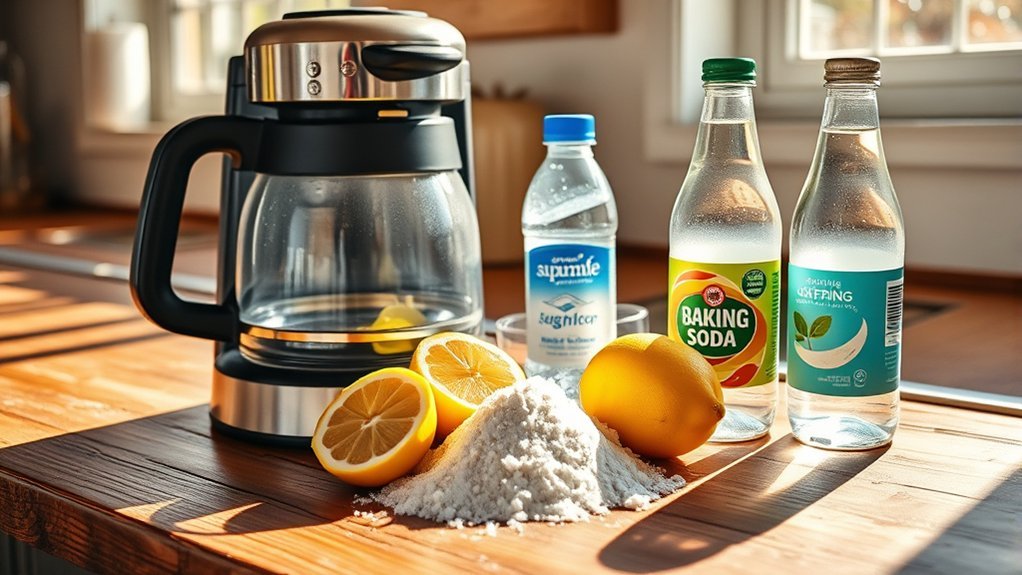
Manufacturer-Approved Coffee-Machine Descaler
A purpose-made descaler that your coffee-maker manufacturer accepts is usually the most dependable vinegar-free choice for internal mineral scale. These products are formulated for appliance use and are intended to dissolve scale when mixed and rinsed according to their labels.
Compatibility still matters. Some machines accept several coffee-machine descalers, while others specify one product or another cleaning method. For example, current Philips instructions for the Café Aromis say to use Philips Descaler CA6700 and not substitute another product.
Baking Soda
Baking soda is useful for deodorizing a carafe and gently loosening stains on washable surfaces. Make a thin paste with baking soda and water, apply it with a soft sponge, then wash the part with dish soap and rinse thoroughly.
Do not assume that a baking-soda solution can be run through every coffee maker. Cuisinart’s current general cleaning guidance, for example, recommends its reservoir baking-soda procedure only when the reservoir is removable and provides a specific mixture and rinse sequence. Treat that as Cuisinart-specific guidance rather than a universal recipe for other brands.
Citric Acid
Citric acid is used in some commercial descaling products. However, loose citric-acid powder should enter a coffee maker only when the appliance instructions or an approved descaler label provides a compatible concentration. A stronger homemade mixture is not automatically better and may be difficult to rinse completely.
Lemon Juice
Lemon juice is acidic, but its strength varies and fresh juice may contain pulp, sugars, and aromatic residue. It can be useful for some removable glass items after thorough washing, but it should not be circulated through a coffee maker unless the manufacturer specifically approves it.
Denture Tablets
Denture tablets vary in formulation. Because an appliance manufacturer usually does not specify the tablet type, dose, contact time, or rinse requirement, do not run them through the coffee maker unless your model instructions explicitly permit that product. If the machine calls for a cleaning tablet, use the type intended for that coffee system.
Which Vinegar-Free Method Should You Use?
| Problem | Best Starting Method | Internal Use? |
| Coffee oils and loose grounds | Warm water and mild dish soap on removable parts | No dish soap in internal tubing unless specifically instructed |
| Carafe stains or odor | Dish soap; baking-soda paste when the material allows it | Usually surface cleaning only unless your manufacturer gives a reservoir procedure |
| Mineral scale | Model-approved descaling product and programmed cycle | Yes, when used exactly as instructed |
| Blocked pod-brewer needle | The manufacturer’s needle-cleaning procedure | Use a cleaning tool or paper clip only if the exact model instructions direct you to |
Cleaners to Avoid in the Water Path
- Soft drinks: Sugar, coloring, sweeteners, and flavoring can leave residue.
- Essential oils: Oils can cling to plastic, silicone, filters, and tubing and affect later brews.
- Dish soap: Appropriate for many removable parts, but not for pumps or internal tubing unless the manufacturer explicitly instructs it.
- Bleach or household disinfectant: Do not circulate these through a home coffee maker unless the manufacturer provides a specific compatible procedure.
- Unapproved acidic mixtures: Lemon juice or loose citric acid should not be treated as universally safe descalers.
- Abrasive powders or pads: They can scratch the carafe, warming plate, reservoir, or finished surfaces.
Note: “Natural” does not automatically mean safe for an appliance. The correct cleaner is the one compatible with the machine’s internal materials and cleaning program.
How to Clean Your Coffee Maker Without Vinegar
This general process suits many automatic drip and single-serve machines. Change any step that conflicts with the instructions for your model.
-
Read the cleaning section of the manual. Confirm the recommended descaler or cleaning product, cleaning-cycle buttons, removable parts, filter-removal instructions, needle-cleaning procedure if applicable, and required rinse cycles.
-
Turn off, unplug, and cool the machine. Remove used grounds, paper filters, pods, and any remaining coffee or accessible water.
-
Remove the washable parts. Depending on the model, these may include the carafe, carafe lid, filter basket, permanent filter, drip tray, pod holder, and removable reservoir.
-
Wash removable parts. Use warm water, mild dish soap, and a soft sponge or cloth. Check the manual before placing any part in a dishwasher. Use a baking-soda paste on stubborn carafe stains only when the material and manufacturer permit it.
-
Rinse and inspect each part. Remove all soap and loosened residue. Check small openings for trapped grounds. Do not insert an object into a needle, valve, or tube unless the instructions for your exact model specifically direct you to do so.
-
Wipe the machine. Use a damp cloth on the exterior and a completely cool warming plate. Keep liquid away from the cord, plug, control-panel openings, and powered base.
-
Prepare the approved descaling treatment. If internal descaling is due, mix or use the product exactly as its label and the coffee-maker instructions direct. Remove a charcoal or water filter first when required.
-
Run the proper cleaning program. Start the model’s clean or descale cycle. If the manufacturer instead calls for a regular water-only brew function or another sequence, follow that procedure without adding coffee or a pod. Do not interrupt a programmed cycle unless instructed.
-
Complete every rinse cycle. Empty the carafe or collection container, refill the reservoir with fresh water, and run the number of rinses stated by the manufacturer or descaler label. Continue rinsing if any cleaner odor or unusual taste remains.
-
Dry and reassemble. Let washable parts air-dry or dry them with a clean towel when appropriate. Reinstall the water filter if required, reassemble the machine, and run a final water-only cycle if the instructions recommend it.
Pro Tip: After the final rinse, let a small amount of dispensed water cool, then smell and taste it. If you detect cleaner, citrus, soap, or another unusual flavor, discard it and run another full fresh-water rinse.
What If You Cannot Find the Manual?
Search the manufacturer’s official support site using the exact model number printed on the coffee maker. If you still cannot confirm the internal cleaning procedure, limit your work to removable parts and exterior surfaces rather than guessing at a descaling concentration or pushing tools into internal openings. Manufacturer customer support is the safest next step when a machine has an unusual cleaning system.
Adjust the Method to Your Coffee Maker Type
Automatic Drip Coffee Makers
Wash the carafe, lid, brew basket, and reusable filter regularly. Descale the reservoir, heater, and internal tubing only with the method approved for that brewer. Do not put dish soap into a fixed internal reservoir.
Single-Serve Coffee Makers
Clean the drip tray and pod holder, and follow the model instructions for clearing the entrance or exit needle. Do not improvise with a tool simply because another brewer uses one. Some Keurig cleaning procedures, for example, specifically direct users to carefully use a straightened paper clip on certain needle openings. Other machines may use a different tool or procedure. Remember that pod-puncture needles themselves are sharp.
When the machine has a dedicated descale mode, complete the entire program and required rinse sequence. An ordinary brew cycle may not reset a descale warning.
Espresso and Bean-to-Cup Machines
These machines may require separate routines for descaling, backflushing, cleaning tablets, milk-system cleaning, the group head, and the steam wand. Do not substitute a generic drip-coffee procedure. Follow the machine’s maintenance prompts and specified products.
Tips for Ongoing Coffee Maker Maintenance
A simple schedule prevents many odor, residue, and scale problems:
- After each use: Discard grounds or pods, rinse the carafe and basket, and wipe spills from the warming plate after it cools.
- Daily when used: Wash removable food-contact parts with warm, soapy water when the manual permits. Rinse and dry them thoroughly.
- Weekly: Inspect the reservoir, lid, pod holder, reusable filter, and drainage areas for residue or standing water.
- Periodically: Wash a removable reservoir and allow it to dry. Replace or clean a water filter on the schedule specified for the machine.
- When prompted or scheduled: Descale according to the model instructions, water conditions, and brew count. Do not assume one interval applies to every machine.
Keurig guidance illustrates why the model matters. Some legacy Keurig guides recommend descaling every three to six months, while current support for certain machines specifies every three months or uses a brew-count trigger. Follow the instructions for your exact brewer rather than a brand-wide rule.
Filtered water does not eliminate scale. An OXO maintenance guide, for example, says regular descaling remains necessary even when filtered water is used and bases the cleaning reminder for that brewer on brew cycles.
Pro Tip: When the design permits, leave the empty reservoir or brew-basket lid open after cleaning so trapped moisture can evaporate. Reassemble removable parts only after they are dry.
Troubleshooting After Cleaning
The Water Tastes or Smells Like Cleaner
Do not brew coffee yet. Empty the reservoir, rinse removable parts again, and run another complete fresh-water cycle. Repeat until cooled water has no unusual odor or flavor.
The Coffee Maker Is Still Brewing Slowly
Confirm that the complete descale cycle finished and that the approved product was prepared correctly. Check the basket, reusable filter, pod holder, and manufacturer-approved water outlets for grounds or residue. If flow remains slow, stop repeating stronger homemade mixtures and contact the manufacturer.
The Descale Light Stays On
Some machines require a dedicated descale mode, a specific button sequence, or a complete rinse process before the warning resets. Running an ordinary brew cycle may not clear the indicator. Follow the exact completion and reset procedure for the model.
The Machine Leaks After Cleaning
Turn the coffee maker off and unplug it. Check that the reservoir, carafe lid, filter basket, drip tray, seals, and removable valves are seated correctly. Do not operate a machine that leaks near electrical parts.
You See Mold or Slime
Stop brewing. Wash every accessible removable part according to the manufacturer’s directions. If contamination appears inside inaccessible tubing, a sealed reservoir, or damaged material, contact the manufacturer. Replacing a heavily contaminated or deteriorated component may be safer than attempting an unapproved chemical treatment.
Frequently Asked Questions
Can I use baking soda to clean my coffee maker?
Use baking soda to deodorize or gently scrub a washable carafe, basket, or removable reservoir when the material and manufacturer permit it. Do not run one generic baking-soda mixture through every brewer. Cuisinart, for example, publishes an internal baking-soda procedure only for machines with a removable reservoir.
How often should I clean my coffee maker?
Wash removable food-contact parts after use or daily when the machine is used, as permitted by the manual. Descale on the model-specific schedule or when its indicator appears. The interval may depend on water conditions, usage, brew count, and the machine’s maintenance program.
Will citric acid affect the taste of my coffee?
A compatible, correctly measured, and fully rinsed descaling product should not leave a sour flavor in the next brew. A sour or chemical taste means residue may remain, so run additional fresh-water cycles. Use loose citric-acid powder internally only when your model instructions provide or approve the concentration.
Is it safe to clean my coffee maker with essential oils?
Do not put essential oils into the reservoir or internal water path. Oils can cling to plastic, silicone, filters, and tubing and may affect later brews. Use mild dish soap on approved removable parts and the manufacturer-approved method for internal scale.
Can I use soft drinks to clean my coffee maker?
No. Soft drinks may contain sugar, coloring, sweeteners, and flavoring that can leave residue in the reservoir or internal tubing. Acidity alone does not make a liquid an appropriate appliance descaler.
Can I use lemon juice instead of vinegar?
Do not circulate lemon juice unless the coffee-maker manufacturer specifically approves it. Its acidity varies, and fresh juice may contain pulp, sugar, and aromatic residue. A model-approved descaling method is a more dependable vinegar-free choice for the internal water path.
Can I use denture tablets in my coffee maker?
Only when the appliance manufacturer specifically approves the tablet and provides a dose and rinse procedure. Denture-tablet formulas vary. If your machine calls for a cleaning tablet, use the type intended for that coffee system.
How many water cycles should I run after descaling?
Run the number required by the coffee-maker instructions or descaler label. Some machines need one full fresh-water rinse, while others require several stages or multiple reservoirs of water. Continue rinsing if any cleaner smell or taste remains.
Can I clean a Keurig needle with a paper clip?
Some Keurig models specifically instruct users to carefully insert a straightened paper clip into designated needle openings to loosen coffee grounds. Do this only when the instructions for your exact model call for it. Pod-puncture needles are sharp, so never place your fingers inside the pod holder.
Can I skip descaling if I use filtered water?
No. Filtered water does not guarantee that mineral scale will never form. Follow the model’s normal descaling schedule or cleaning indicator even when you use filtered water.
Sources
- NSF — Clean the Germiest Home Items — supports the 2011 household study and the carefully framed coffee-reservoir hygiene discussion.
- Cuisinart — How to Clean a Coffee Maker — supports unplugging, removable-part cleaning, baking-soda limitations, rinsing, and model-specific cleaning methods.
- Keurig Support — Cleaning and Descaling Guidance — supports model-specific descaling schedules, warning-light behavior, and maintenance procedures.
- OXO — 12-Cup Coffee Maker Instructions — supports cycle-based descaling, drying damp areas, and continued descaling even when filtered water is used.
- Philips — Café Aromis Descaling Instructions — demonstrates why some machines require a specified descaler rather than household substitutes.
Conclusion
The safest way to clean a coffee maker without vinegar is to match the cleaner to the job and the machine. Use warm water and mild dish soap for removable washable parts, baking soda only where the manufacturer or material allows it, and the approved descaling method for mineral buildup inside the water system. Complete every required rinse, let damp parts dry, and avoid improvised liquids or tools that are not approved for your model. This routine helps protect the brewer while keeping coffee residue, odors, and mineral scale under control.