
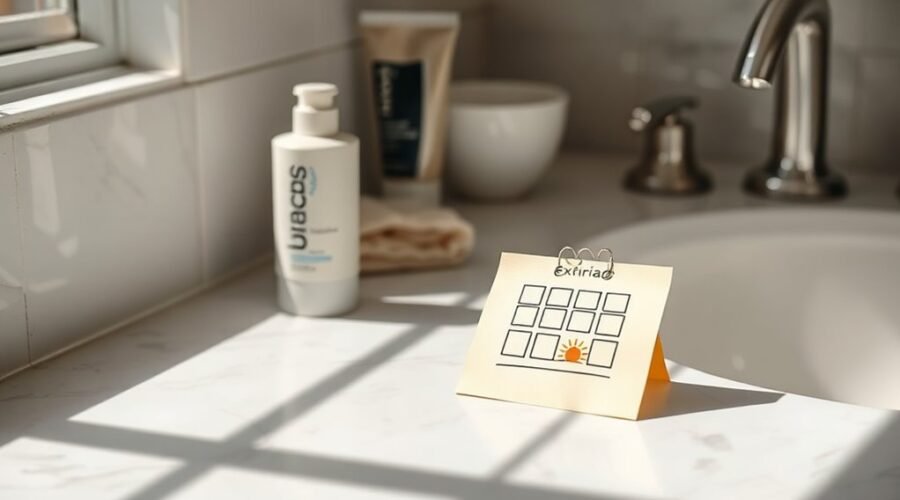
Does sunscreen expire? Yes—sunscreen loses effectiveness over time as its active UV filters and stabilizing emulsifiers break down. Under FDA rules, you should discard sunscreen past its printed expiration date, or three years after purchase if no expiration date is printed, and sooner if heat has caused it to separate or smell off.
Quick Answer
Yes, sunscreen expires. Follow the printed expiration date when stored properly. In the United States, OTC sunscreens without a printed date are required to remain stable for at least three years and should be discarded three years after purchase—or immediately if the color, odor, or texture changes.
Key Takeaways
- Last summer’s bottle may still be fine: Check the printed date and confirm it was not baked in a hot car.
- Looks can be deceiving: A normal texture does not guarantee an expired bottle still provides its labeled SPF.
- All formulas expire: Chemical lotions, sprays, and mineral sunscreens all break down over time.
- Mark undated bottles: Write the purchase month and year on the container with a permanent marker.
Does Sunscreen Expire? The FDA 3-Year Rule

In the United States, sunscreen is regulated as an over-the-counter (OTC) drug. Under federal stability regulations (21 CFR 211.137), manufacturers must print an expiration date unless stability testing confirms the formula remains effective for at least three years.
Because of this 3-year rule, the FDA advises treating any undated sunscreen as expired three years from the date of purchase—not three years from the day you first open it. If you cannot remember when you bought an undated bottle, throw it away.
| Bottle Condition | Recommended Action |
|---|---|
| Printed expiration date has not passed | Usable if stored away from heat and the formula looks and smells normal. |
| No date; purchased under 3 years ago | Generally usable under U.S. FDA guidance if properly stored and unchanged. |
| No date; 3+ years old or purchase date unknown | Discard and replace with a fresh bottle. |
| Separated, watery, grainy, discolored, or rancid | Throw away immediately, even if the printed date has not passed. |
When replacing an expired beach bottle, you may also want to compare reef safe sunscreen brands that use non-nano zinc oxide or titanium dioxide for coastal travel.
How to Tell If Sunscreen Has Gone Bad
Always check the label first, then test a small dab on the back of your hand. The American Academy of Dermatology (AAD) advises discarding sunscreen whenever you notice these warning signs:
- Separation: Watery or oily liquid pooling out before the lotion, even after shaking.
- Texture changes: Clumpy, gritty, overly runny, or hard to spread evenly.
- Odor changes: Sour, rancid, or noticeably different from when the bottle was new.
- Color shifts: Yellowing, darkening, or uneven streaks.
- Damaged packaging: Cracked tubes, broken seals, or malfunctioning spray nozzles.
Note that sunscreens sold as cosmetics outside the United States often display an open-jar Period After Opening (PAO) icon such as “12M,” meaning use within 12 months of opening. Follow whichever limit comes first.
Safety Warning: Do not rely on expired sunscreen for UV protection. Degraded formulas can deliver patchy, unpredictable SPF—increasing your risk of sunburn—and spoiled preservatives can irritate sensitive skin.
How to Store Sunscreen So It Lasts Until Its Expiration Date
Good storage cannot extend a bottle past its expiration date, but poor storage can ruin a fresh sunscreen in a single afternoon. Follow these habits to preserve stability:
- Avoid heat and direct sun: Never leave sunscreen in a parked car, on a sunny windowsill, or beside a heater.
- Shade it at the beach: Wrap bottles in a towel, tuck them inside a shaded bag, or keep them in a cooler.
- Keep the original container: The Skin Cancer Foundation recommends keeping sunscreen in its original packaging rather than decanting it into untested travel bottles.
- Date undated bottles: Following Mayo Clinic guidance, write the purchase month and year directly on any bottle without a printed expiration date.
Shelf Life vs. Wear Time on Your Skin
Shelf life tells you how long sunscreen stays stable in the bottle, whereas wear time tells you how long it protects your skin outdoors. Even a brand-new bottle of broad-spectrum SPF 30+ needs to be applied generously (roughly one ounce for full-body adult coverage) and reapplied every two hours, or immediately after swimming, heavy sweating, or towel drying.
If you are curious how UV rays still interact with your skin during outdoor wear, read our guide on whether you can tan with sunscreen.
Frequently Asked Questions
Can sunscreen expire before the printed date?
Yes. Excessive heat, direct sunlight, contamination, or a cracked container can break down sunscreen before its printed date. Discard any bottle that separates, smells rancid, or changes color or texture.
Does sunscreen expire faster after opening?
Opening a bottle exposes the formula to air and potential contamination, though U.S. drug labels rely on the printed expiration date or the 3-year purchase rule rather than a universal post-opening countdown. If an international cosmetic sunscreen displays an open-jar PAO symbol such as 12M, follow that limit too.
Can I use sunscreen from last summer?
Yes, if it has not passed its printed expiration date (or 3 years since purchase if undated), was stored away from heat, and still looks, smells, and spreads normally. If you are unsure how old it is, replace it.
Do mineral sunscreens expire too?
Yes. Even though zinc oxide and titanium dioxide are stable minerals, the emulsifiers, preservatives, and base lotions that hold them evenly in suspension break down over time, causing uneven UV coverage.
Does spray sunscreen expire differently than lotion?
Both sprays and lotions follow the same FDA expiration rules, but pressurized cans can also lose propellant or develop clogged valves. Discard any spray bottle that is past date or no longer sprays evenly.
Conclusion
Sunscreen does expire, and a smooth texture does not guarantee full UV protection once a bottle passes its date. Follow the printed expiration date—or the FDA 3-year rule for undated U.S. bottles—store your sunscreen away from heat, and replace any formula that separates, smells off, or has an unknown purchase date.
Sources
- U.S. Food and Drug Administration (FDA): Sunscreen expiration dates, the 3-year rule, and safe use.
- FDA Inspection Technical Guide (21 CFR 211.137): Expiration dating and stability testing requirements for human drug products.
- Mayo Clinic: Sunscreen shelf life and marking undated bottles.
- American Academy of Dermatology (AAD): Visible signs of sunscreen spoilage.
- Skin Cancer Foundation: Heat protection and original-container storage advice.


[…] reusing a mineral bottle from a previous beach trip, check the printed date first—our guide on whether sunscreen expires explains how heat and age affect shelf […]