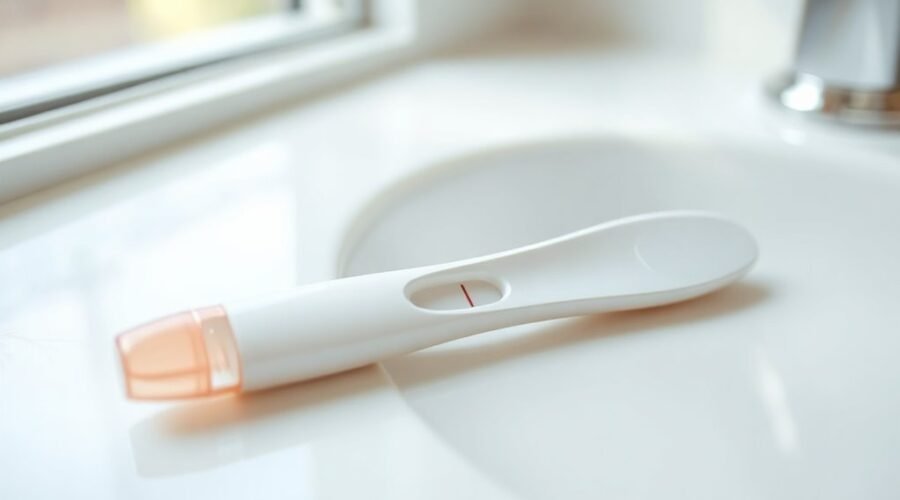
Seeing a faint line on ovulation test strips means your urine contains baseline luteinizing hormone (LH), which counts as a negative result rather than an active LH surge. Unlike home pregnancy tests—where any visible colored line signals the presence of hCG—a standard qualitative ovulation predictor kit (OPK) only turns positive when the test line is as dark as or darker than the control line. Understanding why faint LH lines appear, when to switch to twice-daily testing, and how hydration affects strip darkness helps you pinpoint your true 12-to-36-hour ovulation window without guesswork.
What a Faint Line on Ovulation Test Strips Actually Means

Your anterior pituitary gland releases low, pulsatile amounts of luteinizing hormone throughout the entire menstrual cycle. Because baseline LH typically ranges between 1.9 and 12.5 mIU/mL outside the ovulatory peak, standard urine test strips (calibrated to trigger a full positive around 20 to 25 mIU/mL) almost always develop a pale or medium second line.
When you evaluate a strip within the manufacturer’s 5-to-10-minute reading window, use the control line as your brightness benchmark. If the test line is noticeably lighter than the control line, your body has not yet crossed the surge threshold required to rupture a dominant ovarian follicle. Once the surge hits, urinary LH spikes rapidly—often reaching 40 to 200 mIU/mL—which turns the test line equal in pigment intensity or visibly deeper than the control band.
Ovulation Test Line Interpretation & Action Table
| Visual Strip Reading | Hormonal Meaning | Result Status | Recommended Next Step |
|---|---|---|---|
| Faint test line (lighter than control) | Baseline urinary LH present below surge threshold | Negative (Low) | Continue testing once daily around the same afternoon hour |
| Medium line darkening over 1–2 days | LH is beginning to rise toward the mid-cycle peak | Negative (Approaching Surge) | Increase testing to twice daily (late morning and early evening) |
| Test line equal to or darker than control | Full LH surge detected (typically ≥25 mIU/mL) | Positive (Peak Fertility) | Expect ovulation within 12–36 hours; prioritize timed intercourse |
| No control line visible | Insufficient sample wicked or defective reagent strip | Invalid Test | Discard strip and retest with a fresh strip and proper dip depth |
5 Common Reasons Your Ovulation Test Lines Stay Faint
- Testing too early or too late in your cycle: Starting tests several days before your follicular phase matures—or after the surge has already passed—shows only background LH.
- Diluted urine from high fluid intake: Drinking large amounts of water, tea, or coffee within 2 hours of collection lowers urinary hormone density and washes out pigment intensity.
- Missing a rapid 12-hour LH peak: Some women experience a sharp, brief LH spike that rises in the morning and clears by the next day. Once-daily testing can easily miss the peak and show only faint pre- and post-surge lines.
- Testing with first-morning urine on standard LH strips: Unlike hCG, the LH surge typically begins in the early morning hours in blood but takes several hours to filter into urine. Late morning through early evening (10:00 AM–8:00 PM) usually gives a clearer LH reading on traditional strips.
- Anovulatory cycles or hormone shifts: Stress, travel, postpartum recovery, thyroid shifts, or polycystic ovary syndrome (PCOS) can delay follicular maturation, resulting in weeks of faint fluctuating lines without a true surge.
When to Start Testing Based on Your Cycle Length
Because the luteal phase (the time between ovulation and your next period) normally lasts about 12 to 14 days, you can estimate your starting test day by subtracting 17 days from your average total cycle length. If you are preparing for pregnancy and stocking up on early-stage essentials, you can also browse our guides to the best prenatal vitamins for pregnancy and when to take a pregnancy test for accurate results.
| Average Cycle Length | Expected Ovulation Window | Cycle Day to Begin LH Testing |
|---|---|---|
| 21–22 days | Days 7–9 | Day 5 |
| 25–26 days | Days 11–13 | Day 8 or 9 |
| 28 days | Days 13–15 | Day 10 or 11 |
| 30–32 days | Days 15–18 | Day 13 or 14 |
| 34–35 days | Days 19–21 | Day 17 |
Step-by-Step Checklist for Accurate Ovulation Strip Readings
- Pick a consistent midday or afternoon window: Test between 11:00 AM and 3:00 PM for once-daily checks, or at 11:00 AM and 7:00 PM when the line starts darkening.
- Hold back on excess liquids for 2 hours: Avoid chugging water right before testing so your urine retains natural hormone concentration.
- Dip strictly to the max line for the specified seconds: Submerge the strip vertically into a clean cup for 5 to 10 seconds (per your brand insert), keeping the fluid below the maximum marker line.
- Lay the strip flat and set a timer: Place the test on a dry, non-absorbent surface and read it at exactly 5 minutes (never after 10 to 15 minutes, when evaporation lines distort the dye).
- Cross-check with fertile cervical mucus and BBT: Pair strip readings with clear, stretchy egg-white cervical mucus (EWCM) before ovulation and a sustained 0.4°F–0.8°F basal body temperature shift afterward. For additional family-planning guides, see our overview of early pregnancy symptoms before a missed period.
Frequently Asked Questions
Does a faint line on an ovulation test mean you are ovulating?
No. On a standard urine ovulation predictor kit (OPK), a faint test line that is lighter than the control line is a negative result. It simply reflects baseline luteinizing hormone (LH) that is normally present in urine throughout your menstrual cycle rather than an ovulatory LH surge.
Why do ovulation tests behave differently from pregnancy tests when reading a faint line?
Home pregnancy tests detect human chorionic gonadotropin (hCG), which is normally absent unless implantation has occurred, so any colored test line indicates pregnancy. By contrast, your pituitary gland secretes low levels of LH every day, so an ovulation test only turns positive when the test line is as dark as or darker than the control line.
Does drinking water before taking an ovulation test make the line fainter?
Yes. Excess fluid intake within 2 hours of testing dilutes urinary LH concentration and can make an active surge look artificially faint. Limit liquids for about 2 hours before collecting your sample and test between 10:00 AM and 8:00 PM at consistent times each day.
Can PCOS or perimenopause cause confusing faint or dark ovulation test lines?
Yes. Polycystic ovary syndrome (PCOS), diminished ovarian reserve, and perimenopause can elevate baseline LH levels, causing persistent dark or fluctuating test lines even when ovulation has not occurred. Pairing LH strips with basal body temperature (BBT) tracking helps confirm whether ovulation actually took place.
What should you do if your ovulation test lines get darker and then fade without turning positive?
An LH surge can peak and drop within 12 to 24 hours. If you only test once a day, you may catch the rising or falling edge of a brief surge as a medium-faint line while missing the peak. Testing twice daily (late morning and early evening) as your fertile window approaches prevents missed short surges.
How long after a true positive ovulation test does ovulation happen?
Once the test line matches or exceeds the control line in darkness, ovulation typically occurs within 12 to 36 hours. The highest-probability fertile days are the day of the positive LH surge test and the following day.