If you have ever wondered how does a percolator work, the answer is a continuous gravity-fed vapor-lift loop: heat boils a small pocket of water trapped under the base of a vertical stem tube, expanding steam bubbles push near-boiling water up the tube to strike the lid spreader, and gravity pulls that water down through a perforated basket of coffee grounds back into the lower chamber. Because the pot is vented at the spout rather than sealed like a Moka pot, this open cycle repeats until you cut the heat—progressively concentrating the brew while risking over-extraction if left boiling too long.
How Does a Percolator Work? The 4-Stage Thermodynamic Cycle
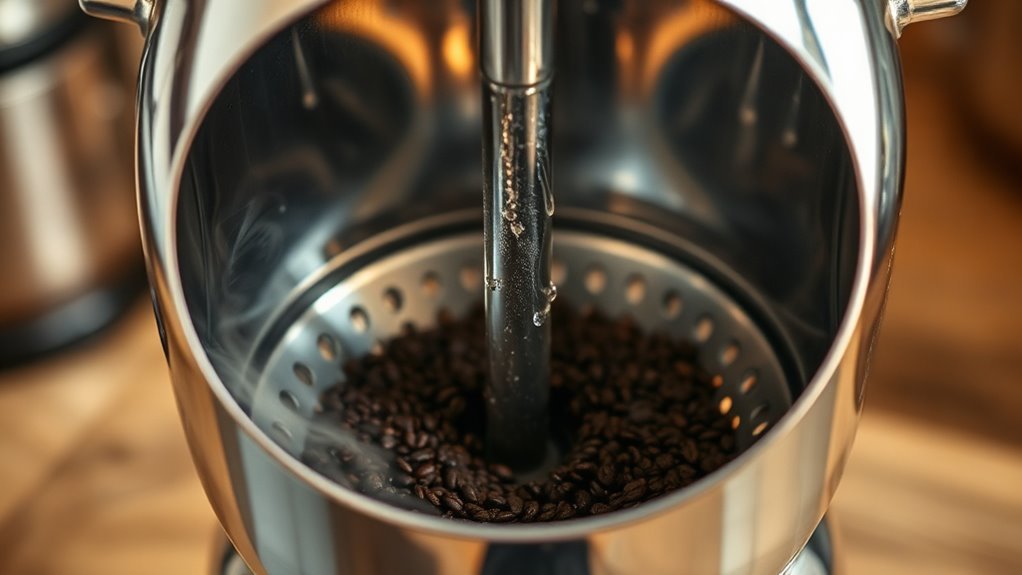
A classic stovetop or electric percolator has no moving mechanical pump. Instead, it turns heat energy directly into fluid lift through four repeating physical stages:
- Localized heating in the lower chamber: The hollow, inverted-funnel base of the stem tube sits directly on the hottest zone of the pot floor. It traps a thin layer of water that heats faster than the surrounding reservoir.
- Vapor-lift pressure inside the stem tube: When water inside the funnel base reaches 212°F (100°C) at sea level, vapor bubbles form and expand rapidly. Because steam is far less dense than liquid water, those rising bubbles push intermittent slugs of hot water up the narrow riser tube—a classic bubble-pump effect.
- Dispersion and gravity percolation through the perforated basket: Water exits the top of the stem, hits the clear glass or metal knob dome, and showers across the perforated spreader lid. Gravity then pulls the water down through the coffee bed and out the bottom holes of the basket.
- Recirculation and rising bulk temperature: The brewed coffee drips back into the lower chamber, mixes with the reservoir, and gets drawn under the stem funnel again. With each pass, both the brew concentration and the bulk liquid temperature climb higher.
For a hands-on breakdown of every removable component and how to assemble them correctly, read our guide on how to use a coffee percolator.
Why Cycling Boiling Water Over-Extracts Coffee and Strips Volatiles
Specialty coffee extraction typically targets water between 195°F and 205°F (90°C–96°C) in a single pass. A percolator breaks both of those rules by design, which explains its bold—and sometimes harsh—reputation:
- Re-brewing already extracted liquid: Instead of fresh water meeting fresh grounds once, increasingly hot coffee passes over the same grounds dozens of times. Early cycles extract bright acids and sugars; later cycles at near-boiling temperatures extract heavier, astringent tannins and bitter compounds.
- Thermal degradation and volatile loss: Coffee’s most prized floral, fruity, and nutty aromas come from delicate volatile organic compounds with low boiling points. Repeatedly heating brewed coffee near 212°F drives those volatiles out through the vented spout as fragrant steam—which is why percolator coffee often smells wonderful in the kitchen while tasting flatter or more bitter in the cup.
- Coarse-grind compensation: Because high temperature and multi-pass contact accelerate extraction, percolators rely on a coarse grind to reduce surface area and keep gravity flow moving smoothly through the basket.
Managing how fast those surges hit the dome is the practical key to taming bitterness—see our dedicated tutorial on how to perk coffee in a percolator for cadence control and boil-over prevention.
Electric vs. Stovetop Percolator Thermodynamics
Both electric and stovetop percolators use the exact same vapor-lift physics, but they regulate heat differently:
- Electric percolators: Feature a recessed pump well directly beneath the stem base with a dedicated high-wattage heating element. Because only the small well needs to boil to start pumping, electric models begin perking quickly while the main reservoir is still below boiling. Once the bulk coffee reaches a preset cutoff temperature, a bi-metallic thermostat switches off the brew element and drops to a lower-wattage warming circuit.
- Stovetop and campfire percolators: Heat the entire bottom plate continuously. There is no thermostat to stop the cycle, so the bulk liquid will stay at a rolling boil unless you manually turn down the burner to a gentle simmer and remove the pot from heat once brewing finishes.
Physics Comparison: Percolator vs. Moka Pot vs. Drip Brewer
| Feature | Gravity Percolator | Moka Pot (Stovetop Espresso) | Automatic Drip Brewer |
|---|---|---|---|
| Driving Force | Atmospheric vapor-lift + gravity | Sealed steam pressure (~1–2 bar) | One-way vapor-lift + gravity |
| Water Passes | Multiple recirculating passes | Single upward pass | Single downward pass |
| Typical Brew Temp | ~200–212°F (rises over cycle) | ~195–210°F (varies by heat) | ~195–205°F (single pass) |
| Grind Requirement | Coarse / medium-coarse | Fine-medium | Medium |
| Volatile Retention | Lower (vented boiling steam) | Moderate to high | High |
Pros, Limitations & Thermal Safety Checklist
Ready to apply these physics to your daily cup—including paper disk filters, starting water temperature, and reheating without re-perking? Follow our step-by-step guide on how to make coffee in a percolator.
- Pros: Zero electricity required on stovetop models, simple durable metal parts with no paper filters strictly required, and hot, full-bodied coffee that stays warm well in cold outdoor settings.
- Limitations: Easy to over-extract into bitterness if left perking too long, lower aromatic nuance than pour-over or drip, and fine sediment passes through metal basket holes unless a disk filter is added.
- Safety checklist: Never overfill past the max line (leaves room for vapor expansion), keep the lid seated tightly while perking so scalding splashes stay contained, use potholders on metal handles, and let the basket cool slightly before removing it.
Frequently Asked Questions
How does water climb up a percolator stem tube without an electric pump?
A percolator uses a vapor-lift (bubble-pump) mechanism. The flared funnel at the base of the stem traps a small pocket of water directly over the heat source; as that water flashes into steam bubbles, the expanding vapor lowers the fluid density inside the narrow tube and pushes alternating slugs of hot water upward to the lid dome.
Does a gravity-fed percolator build high steam pressure like a Moka pot?
No. Unlike a Moka pot, which seals its lower boiler with a rubber gasket to build roughly 1 to 2 bars of pressure, a classic coffee percolator is vented at the spout and lid. It operates near atmospheric pressure and relies on localized boiling under the stem base plus gravity drainage.
Why does percolator coffee often taste more bitter than drip coffee?
Two thermodynamic factors drive bitterness: first, the brew liquid repeatedly cycles through the grounds at near-boiling temperatures (around 200 to 212 degrees F), which extracts late-stage bitter compounds faster than single-pass 195 to 205 degrees F drip brewing; second, continuous boiling vents away delicate volatile aromatics through the steam spout.
How does an electric percolator know when to stop perking?
Most electric percolators use a dual-element heating base with a bi-metallic thermostat. A high-wattage pump well heats water inside the stem base until the bulk liquid in the pot approaches boiling temperature, at which point the thermostat opens the main heating circuit and switches to a low-wattage Keep Warm element.
Why does fine-ground coffee disrupt percolator thermodynamics?
Fine coffee particles pack tightly against the perforated metal basket, slowing gravity drainage back into the lower chamber. That bottleneck causes the upper basket to flood, increases contact time with near-boiling water, and allows fine grit to wash into the lower chamber where it continues over-extracting.