When an old coffee maker stops working or no longer fits your needs, start by checking its model for recalls and reviewing your local disposal rules. If it is safe and repairable, keeping it in service is usually the best first option. A clean, reliable machine may be donated or sold, while a failed unit can often go to a small-appliance or electronics recycler. Do not assume that every coffee maker belongs in curbside recycling or household trash.
Quick Answer
Check the model for recalls before testing it. Repair it if safe and practical, donate or sell it only if it works reliably, or use a verified small-appliance or e-waste recycler. Follow local curbside rules, and never put a lithium-ion battery or battery-powered brewer in household trash or recycling.
Key Takeaways
- Check the brand and model in the CPSC recall database before testing, repairing, donating, or reselling a coffee maker.
- Try cleaning, descaling, replacing user-serviceable parts, or using a manufacturer-approved repair before replacing a safe machine.
- Donate only a clean, fully working machine with no damaged cord, leaks, burn marks, pest contamination, or unresolved recall.
- Curbside rules vary: many programs reject complete small appliances, while some municipalities specifically accept qualifying coffee makers.
- Verify retailer, manufacturer, and recycling programs before traveling because accepted products, limits, and fees can change.
- Keep the housing and cord intact unless an official recall remedy, manufacturer instruction, or receiving facility specifically requires otherwise.
At a Glance
| Time Required | About 15–30 minutes for recall checking, inspection, cleaning, and preparation, plus travel or pickup time |
| Difficulty | Easy, provided no internal electrical or battery work is attempted |
| Tools Needed | Mild dish soap, soft cloth, towel, and a box or reusable bag for detachable parts |
| Cost | Often free; repair, pickup, shipping, specialty recycling, or hazardous-waste fees may apply |
Check Local Disposal Rules and Recalls First
Coffee-maker disposal rules are not uniform across the United States. The EPA reports that 25 states plus the District of Columbia have electronics recycling laws, but the products covered and the disposal requirements differ. Do not assume that a state e-waste law automatically includes every drip brewer, espresso machine, or pod machine. Check your state environmental agency and city or county waste authority for the exact appliance type. See the EPA’s current electronics-stewardship regulations overview.
Curbside rules can also differ sharply. Many recycling programs do not accept complete electrical appliances in household carts, but there are exceptions. For example, the New York City Department of Sanitation currently tells residents that smaller corded appliances that are mostly metal or plastic—including coffee makers—can be set out with recycling. Check the NYC appliance-disposal guidance as an example of why local instructions matter.
Before you plug in an old machine to test it, search the brand and model number in the U.S. Consumer Product Safety Commission recall database. Follow the official remedy instead of normal troubleshooting or recycling advice when a recall applies.
Warning: A recall remedy can require you to stop using or physically disable a machine. For example, a June 11, 2026 CPSC recall of Kidisle KC101B coffeemakers instructs consumers to stop using them and cut the power cord as part of the refund procedure. Always follow the specific recall instructions for your model.
Choose Whether to Repair, Donate, or Recycle It
Once you know the machine is not subject to a stop-use recall, use its condition—not convenience alone—to choose the safest next step.
| Repair | The machine is not recalled and has a minor problem such as mineral buildup, a clogged user-removable component, a damaged gasket, or a replaceable carafe. |
| Donate, sell, or give away | It brews correctly, is clean, includes its essential parts, and has no leaks, damaged wiring, burnt odor, contamination, or unresolved recall. |
| Recycle | It is broken, uneconomical to repair, rejected for donation, unsafe to continue using, or at the end of its useful life. |
| Trash only when permitted | No suitable reuse or recycling option is available and your municipal waste authority confirms household disposal is allowed. Lithium-ion batteries and devices containing them require separate handling. |
Understanding the E-Waste Problem
Coffee makers contain a mixture of materials that may include steel, aluminum, copper wiring, glass, circuit boards, heating components, and several types of plastic. Their mixed construction is one reason many household recycling programs direct complete machines to a small-appliance or electronics collection point instead of a normal curbside cart. Local rules still control, and some municipalities specifically accept corded small appliances with curbside recycling.
The U.S. Environmental Protection Agency’s product-specific waste data includes electric coffee pots in its small-appliance category. In 2018, the EPA estimated that the United States generated about 2.2 million U.S. tons of small-appliance waste. Approximately 5.6% was recycled, 18.5% was combusted with energy recovery, and 75.9% was landfilled. These figures cover many kinds of small appliances, not coffee makers alone, and they are 2018 data rather than a current annual estimate. See the EPA’s small-appliance data.
The broader problem continues to grow. The Global E-waste Monitor 2024 reported that the world generated 62 million metric tonnes of e-waste in 2022, while only 22.3% was documented as properly collected and recycled. See the Global E-waste Monitor 2024.
Globally, less than one-quarter of the e-waste generated in 2022 was documented as properly collected and recycled.
Repair and reuse generally keep a useful appliance out of the waste stream longer. When those options are no longer practical, a suitable recycler can recover selected materials and manage the remaining components through an appropriate downstream process.
Is Your Coffee Maker Repairable?
Begin with simple checks that do not require opening the appliance, but only after confirming that no recall requires you to stop using it. Stop immediately if you see damaged wiring, melted plastic, smoke residue, severe corrosion, or evidence that water has reached electrical components.
Check the Power Source First
Unplug the coffee maker, inspect the plug and visible cord, and look for cuts, melted areas, exposed wire, or loose prongs. If the cord appears undamaged and the model is not recalled, you can verify the wall outlet with another working device. Also check whether a ground-fault circuit interrupter outlet or circuit breaker has tripped.
Review the manufacturer’s manual for a reset procedure, thermal-cutoff explanation, error code, or model-specific troubleshooting step. If the outlet works but the machine remains dead, an internal fuse, switch, heating element, control board, thermal protector, or electrical connection may have failed.
Warning: Do not open the housing, bypass a safety switch, splice a damaged cord, defeat a thermal protector, or test energized internal components unless you are qualified to repair electrical appliances. Repeated breaker or GFCI tripping is a reason to stop using the machine, not to keep resetting the circuit.
Inspect for Visible Damage and Recalls
Check the carafe, lid, reservoir, brew basket, pod holder, hot plate, hinges, and exterior housing. A replaceable glass carafe, gasket, lid, or removable basket may be worth replacing. A cracked housing, scorched connector, leaking boiler, badly corroded base, or damaged power cord usually requires professional evaluation.
Search the brand and model number on the CPSC recall database before repairing, testing, donating, or reselling the machine. Follow the recall remedy exactly. Do not donate or sell a recalled unit when the remedy calls for stopped use, return, destruction, disposal, refund, or another corrective action.
Evaluate Cleaning Requirements
A coffee maker that brews slowly, produces a smaller serving, makes unusual pumping sounds, or leaves water in the reservoir may have mineral buildup or a blocked user-removable component rather than a failed electrical part.
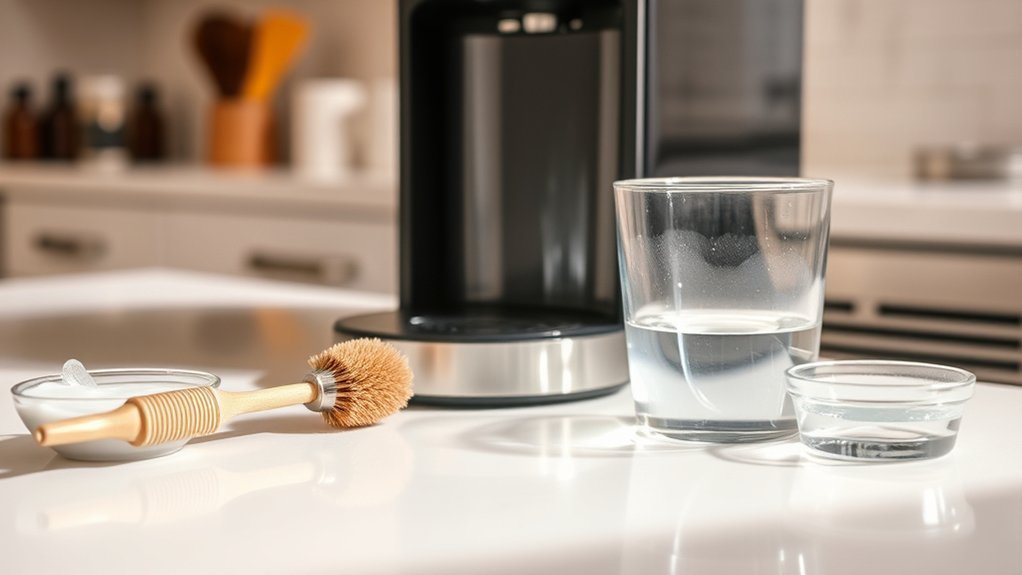
Clean the carafe, brew basket, water tank, pod holder, and other user-removable parts according to the manufacturer’s manual. Use the descaling solution and procedure approved for that model. Vinegar is permitted for some machines but discouraged for others, while baking soda is not a universal descaler.
Pro Tip: Search the exact model number with the words “manual,” “descale,” “replacement parts,” or “repair.” A low-cost carafe, gasket, filter, brew basket, or other manufacturer-approved part can extend the appliance’s useful life.
Know When to Stop Repairing
Professional repair may not be cost-effective for a basic countertop brewer, but it can make sense for a premium espresso machine, built-in coffee system, commercial brewer, or model with readily available replacement parts and service support.
Stop using the appliance until it is evaluated if it trips a breaker, produces smoke or sparks, smells like burnt wiring, leaks into the base, overheats, has an intermittent cord connection, or shows melted or scorched electrical parts.
Donate a Functional Coffee Maker
A working coffee maker may be useful to a charity shop, housing program, community group, neighbor, student, or family setting up a home. Donation is appropriate only when the machine operates safely and the receiving organization confirms that it accepts used small electrical appliances.
Prepare It for Donation
- Check the brand and model in the CPSC recall database before plugging the machine in for a test.
- If no recall prevents use and there is no visible electrical damage, run a normal water-only cycle and confirm that the machine heats, pumps, and shuts off as designed.
- Clean and dry the reservoir, carafe, brew basket, drip tray, pod holder, reusable filters, and exterior.
- Include essential parts, the model number, and the manual when available.
- Disclose cosmetic wear and any known repair history.
- Remove a smart brewer from your account and reset connected features according to the manufacturer’s instructions.
- Do not donate a machine with leaks, mold, pest residue, damaged wiring, burnt odors, missing safety parts, an unreliable power connection, or an unresolved recall.
Local Charity Acceptance
Donation policies differ by location, available storage, appliance age, electrical-testing procedures, and local resale rules. Check the specific receiving site before bringing the coffee maker.
| Possible Recipient | Typical Policy | What to Do First |
|---|---|---|
| Habitat for Humanity ReStore | Habitat’s national guidance says household appliances should generally be less than 10 years old, in good working order, and complete with their included parts; local acceptance still varies. | Use the ReStore locator and contact the selected store. |
| Goodwill | Goodwill’s national guidance includes small appliances among household goods it may accept, but donation rules vary by local Goodwill organization. | Check the Goodwill donation guidance and the selected local organization. |
| Local shelter or housing program | Some accept small appliances; others accept only new goods or items currently requested by residents. | Ask whether the program currently needs and accepts a used coffee maker. |
| Salvation Army location | National guidance generally accepts operating, non-built-in appliances but says local ordinances and needs vary. Appliances with mechanical problems, missing cords, rust, or heavy dirt are generally rejected. | Review the Salvation Army donation FAQ and confirm with the local center. |
| Community center, school, or nonprofit | Usually accepts only equipment that meets a current operational need and any applicable electrical-safety policy. | Request approval instead of leaving an unsolicited appliance. |
Online Donation and Resale Platforms
You can also offer a working coffee maker through a local Buy Nothing group, Freecycle community, Nextdoor, Craigslist, Facebook Marketplace, or another local resale service. State clearly that the item is used, describe its condition accurately, include the model number, and explain whether it has been tested.
Arrange the handoff in a safe location when practical. Do not advertise a recalled, electrically damaged, leaking, contaminated, or unreliable machine as functional.
Eco-Friendly Recycling for a Broken Coffee Maker
A broken coffee maker may be accepted through a municipal small-appliance program, e-waste event, permanent household collection center, scrap or appliance recycler, retailer program, or manufacturer arrangement. Acceptance depends on the machine type, its battery, the recycler’s equipment, and local rules.
Warning: Do not put a complete coffee maker in a curbside recycling cart unless your local recycling provider specifically lists that type of appliance as accepted. Mixed electrical appliances can be rejected by programs that handle only bottles, cans, paper, cardboard, and ordinary household containers.
How to Find a Suitable Recycler
- Search your city, county, or municipal waste-management website for “small appliance,” “electronic waste,” “e-waste,” “coffee maker,” or “household appliance.”
- Call the facility and give the appliance type, brand, model, approximate size, and whether it contains a rechargeable battery.
- Ask about residency requirements, fees, appointment rules, quantity limits, commercial-equipment restrictions, and whether the machine must remain assembled.
- Confirm whether the facility accepts the removable glass carafe, plastic water tank, metal filter, and electrical base together or separately.
- For a battery-powered unit, ask whether the facility wants a user-removable battery separated or the complete device left intact.
- When appropriate, consider a facility certified under the R2 or e-Stewards standard. The EPA explains both electronics-recycler certifications.
The EPA also maintains an electronics donation and recycling guide with resources for finding collection options.
Retailer Recycling Programs
Retailer programs can be convenient, but they do not accept every coffee maker. As checked on September 2, 2026, Best Buy’s U.S. in-store recycling list specifically includes coffee machines that only use pods among eligible home and appliance products accepted free at participating stores. The page lists a limit of three eligible items per household per day for this category and says recycling is intended for residents.
The same Best Buy page lists general “coffee/espresso machines” among products that are not accepted in that home-and-appliance drop-off category. A standard drip brewer, espresso machine, combination brewer, or commercial coffee machine therefore needs another destination unless the current Best Buy rules for your location say otherwise. Check the current Best Buy recycling list before visiting because categories, limits, fees, and state-specific conditions can change.
Should You Separate the Materials?
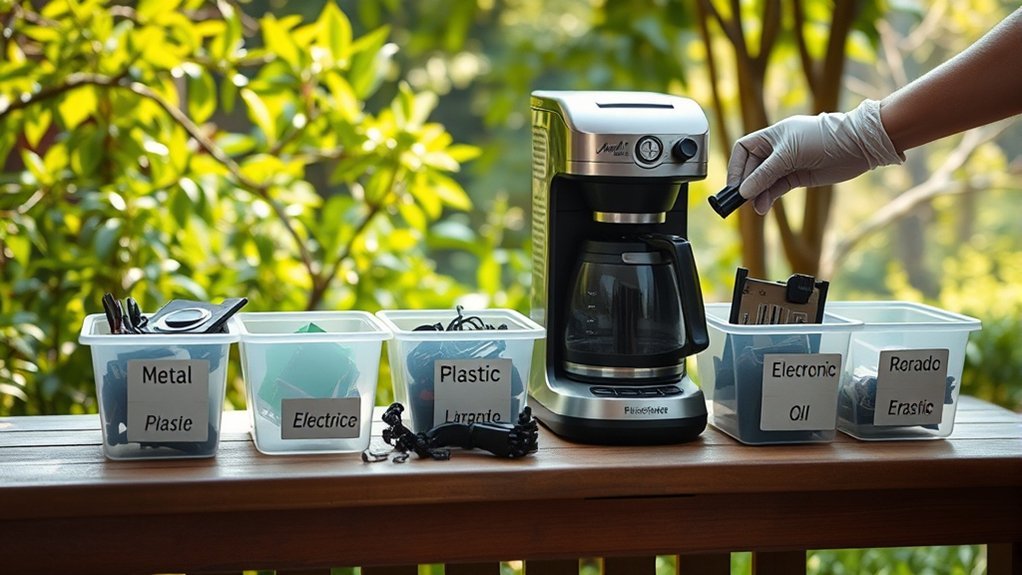
Remove only normal user-detachable parts unless the manual, an official recall remedy, or the receiving program tells you otherwise. These parts may include the carafe, lid, brew basket, reusable filter, water tank, drip tray, and pod bin.
Do not cut off the power cord, open the electrical base, or dismantle the heating system merely to separate metal and plastic. Recyclers use different processing systems, and some require the appliance to arrive intact. The exception is when an official recall remedy or receiving facility specifically instructs you to disable or disassemble a particular component.
Note: A loose glass carafe is not automatically accepted in a household glass-recycling bin. Heat-resistant glass can have a different composition from beverage bottles and jars, so follow the local program’s rules instead of assuming it belongs with container glass.
Manufacturer Take-Back Programs
Some manufacturers offer recycling, replacement, refurbishment, return, or trade-in arrangements for selected products, but there is no universal coffee-maker take-back system. Programs can be limited by country, model, warranty status, purchase channel, shipping method, or battery type.
Use the following process:
- Find the brand and exact model number on the rating label.
- Check the model for recalls before doing anything else.
- Visit the manufacturer’s official support or sustainability website.
- Search for “recycling,” “take-back,” “end of life,” “return,” “trade-in,” or “product disposal.”
- Confirm that the program accepts the complete machine rather than only pods, filters, packaging, cartridges, or accessories.
- Read all packing, battery, shipping, destruction, and proof-of-purchase requirements.
- Contact customer support when the published instructions are unclear.
For example, Keurig publishes an official K-Cup pod recycling guide and K-Cycle information. Those pod-recycling instructions should not be treated as proof that a complete Keurig brewer is accepted through the same program. Verify whole-machine disposal or return options through the brand’s current support information.
How to Prepare a Coffee Maker for Disposal
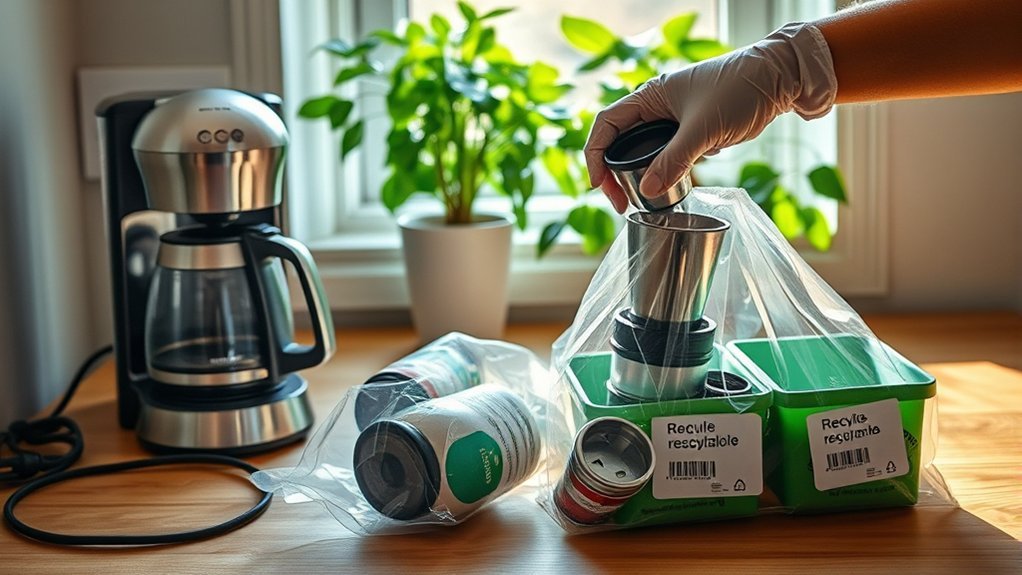
Preparing the appliance helps prevent spills, odors, mold, loose parts, and rejected drop-offs during storage or transport. Recall instructions take priority over the general steps below.
- Check for a recall. Search the brand and model in the CPSC database. If a recall applies, follow its stop-use, return, destruction, refund, or disposal instructions before proceeding.
- Unplug and cool the machine. Disconnect it from power and allow the hot plate, boiler, heating element, water, and steam system to cool completely.
- Remove coffee and accessible water. Empty the reservoir, carafe, pod bin, drip tray, filter, and brew basket without opening the electrical housing.
- Clean user-removable parts. Wash them according to the manual with mild dish soap or the approved cleaning method.
- Dry everything. Leave the reservoir and removable parts open until accessible moisture has evaporated.
- Reset smart features. If the brewer connects to Wi-Fi or an account, remove it from the app, disconnect linked services, and perform the manufacturer’s factory-reset procedure when available.
- Secure loose parts. Reinstall them or place them in a labeled bag or box so they do not break during transport.
- Keep the cord attached by default. Coil it loosely and secure it with a reusable tie. Cut or remove it only when an official recall remedy, manufacturer instruction, or receiving facility specifically requires that step.
- Follow the recipient’s instructions. Label the appliance when requested and bring identification, proof of residency, appointment confirmation, or payment when the collection program requires it.
Battery-Powered or Rechargeable Coffee Makers
Some portable coffee makers contain removable or sealed rechargeable batteries. Check the manual or product markings for the battery type and tell the recycler about the battery before drop-off.
The EPA states that lithium-ion batteries and devices containing them should not go in household garbage or municipal recycling bins because damaged batteries can start fires during collection, transport, sorting, or disposal. Use a battery-recycling, electronics-recycling, or household hazardous-waste program instead. See the EPA lithium-ion battery guidance.
If a battery is designed for user removal, follow the manufacturer’s instructions and the receiving facility’s requirements. If it is sealed inside the appliance, do not pry open the housing merely to remove it.
Warning: Do not puncture, crush, bend, heat, short-circuit, or force a sealed battery out of the machine. A swollen, leaking, damaged, smoking, or unusually hot battery is a potential fire hazard. Contact the manufacturer, local household hazardous-waste program, or qualified battery recycler for instructions before transport; call emergency services if there is an imminent fire risk.
What to Do With a Leaking Coffee Maker
Unplug it immediately if you can do so without touching water or wet electrical surfaces, and keep people away from the appliance. Place it on a dry, stable, noncombustible surface only when it can be moved safely. Do not continue testing a machine that leaks into its base or near the cord connection.
Empty removable water containers only when you can do so without touching wet electrical areas. A leak from a loose carafe lid or removable tank may have a simple cause. A leak from the boiler, heating chamber, internal hose, electrical base, or cord-entry area calls for professional repair or recycling.
Environmental Impact of Proper Disposal
Keeping a repairable coffee maker in service avoids replacing it before necessary. Donating or selling a safe working machine extends its useful life. Recycling a failed appliance can recover selected metals, plastics, electronic components, and other materials while directing the mixed electrical assembly to a facility equipped to handle it.
Proper handling can provide four practical benefits:
- Less avoidable waste: Repair and reuse delay disposal and the need for a replacement appliance.
- Safer material management: A suitable facility can identify rechargeable batteries and other components requiring controlled handling.
- Material recovery: Metals and selected plastics or electronic materials may be returned to manufacturing or recycling streams.
- Better accountability: Certified and properly managed programs can provide stronger controls over how used electronics move through downstream processors.
No recycling process recovers every material. A practical priority order is to maintain the appliance, repair it when safe and worthwhile, reuse or donate it when fully functional, and recycle it when it reaches the end of its useful life.
Frequently Asked Questions
Can I recycle my coffee maker with regular household recycling?
Only if your local recycling program explicitly accepts that type of small appliance. Many programs require a separate small-appliance or electronics drop-off, while some municipalities, including New York City for qualifying corded appliances, allow coffee makers with curbside recycling.
What parts of a coffee maker can be recycled?
A recycler may recover metals, wiring, circuit boards, selected plastics, and other materials. Removable carafes, tanks, filters, and trays may follow separate local rules. Ask the receiving facility whether it wants those parts attached or separated.
Are disposal guidelines different for each coffee maker brand?
They can be. A brand may publish model-specific cleaning, repair, battery, recall, return, or recycling instructions. Check the official manual and support website, and confirm that an advertised program accepts the complete brewer rather than only pods or accessories.
How can I find a local recycling program for small appliances?
Search your city or county waste website, contact a permanent e-waste or small-appliance center, or look for a local collection event. Give the program the machine type and model and ask about fees, residency rules, batteries, and preparation requirements before traveling.
What should I do if my coffee maker is leaking?
Unplug it if you can do so safely and stop using it. A loose removable tank or damaged carafe may be replaceable, but water leaking into the base, heating area, electrical housing, or cord connection requires professional inspection or recycling.
Can a coffee maker go in the household trash?
Local rules vary. Check repair, reuse, recycling, and e-waste options first, then ask your municipal waste authority whether household disposal is allowed. Lithium-ion batteries and devices containing them should not be placed in household trash or municipal recycling bins.
Should I remove the power cord before recycling the machine?
Usually not. Many recyclers prefer the appliance intact, so coil the cord securely for transport. However, an official recall remedy or receiving facility may specifically require the cord to be cut or removed, and those instructions take priority.
Can I donate an old coffee maker that still works?
Yes, provided it is clean, complete, safe, reliable, and not subject to an unresolved recall. Contact the charity, thrift store, shelter, or community group first because acceptance rules for used electrical appliances vary.
Does Best Buy recycle coffee makers?
As checked on September 2, 2026, Best Buy lists coffee machines that only use pods among eligible free in-store recycling items, while general coffee/espresso machines are listed as not accepted in that category. Check the current Best Buy list and your participating store before visiting.
What should I do if my coffee maker has been recalled?
Stop using it when the recall says to stop and follow the exact CPSC or manufacturer remedy. Do not donate, resell, repair, dismantle, or recycle it in a different way when the recall requires a specific return, refund, destruction, or disposal procedure.
Conclusion
The right way to dispose of a coffee maker depends on its condition, recall status, battery type, and the programs available where you live. Check recalls and local rules first. Repair a safe machine when the problem is minor, donate or sell it only when it works reliably, and use a suitable recycling program when it reaches the end of its useful life. A few minutes spent confirming recalls, batteries, accepted-item lists, and preparation rules can prevent an unsafe donation, fire risk, rejected drop-off, or improper disposal.
Sources
- U.S. EPA: Durable Goods Product-Specific Data — U.S. small-appliance waste, recycling, combustion, and landfill estimates.
- Global E-waste Monitor 2024 — global e-waste generation and documented collection and recycling statistics.
- U.S. EPA: Electronics Donation and Recycling — reuse, donation, battery, and recycling guidance.
- U.S. EPA: Frequent Questions on Lithium-Ion Batteries — disposal, fire-risk, transport, and damaged-battery guidance.
- U.S. Consumer Product Safety Commission Recall Database — recall checks and official remedies before repair, testing, donation, or resale.
- Best Buy Electronics and Appliances Recycling — current retailer acceptance, limits, exclusions, and state-specific recycling conditions.