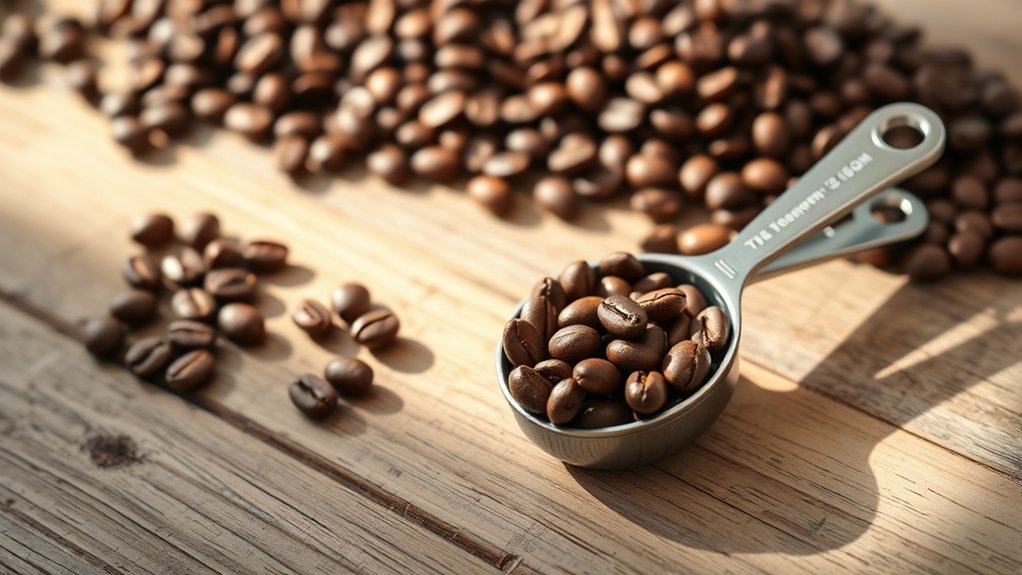
A coffee scoop is a convenient way to measure ground coffee, but it is not a perfectly standardized unit. A common coffee scoop holds about 2 level tablespoons, or roughly 30 milliliters. That often works out to around 9 to 10 grams of ground coffee, although the actual weight changes with the roast, grind size, and how tightly the coffee settles in the scoop. For repeatable brewing, use the scoop as a starting point and a digital scale when accuracy matters.
Quick Answer
Most coffee scoops are designed to hold about 2 level tablespoons, or roughly 30 mL. That often weighs around 9–10 grams of ground coffee, but weight changes with roast, grind, and packing. For consistent brewing, weigh coffee and water and start near 55 grams of coffee per liter of water.
Key Takeaways
- A common coffee scoop holds about 2 level tablespoons, equal to roughly 30 mL by volume.
- Two tablespoons of ground coffee often weigh about 9–10 grams, but the exact weight varies with the coffee and grind.
- For filter coffee, 55 grams per liter is a useful starting point, while a practical 1:15 to 1:18 coffee-to-water range lets you adjust strength to taste.
- An 8-ounce mug generally needs about 13–16 grams of coffee at a 1:15 to 1:18 ratio, not a fixed number of scoops for every coffee.
- A digital scale is more repeatable than measuring grounds by volume because roast level, grind, and settling all change how much coffee fits in a scoop.
At a Glance
| Time Required | About 1–2 minutes to measure coffee and water |
| Difficulty | Easy |
| Tools Needed | Coffee scoop or measuring tablespoon; digital scale recommended |
| Cost | No added cost if you already own measuring spoons; a scale is optional |
What Is the Standard Coffee Scoop Size in Tablespoons and Grams?
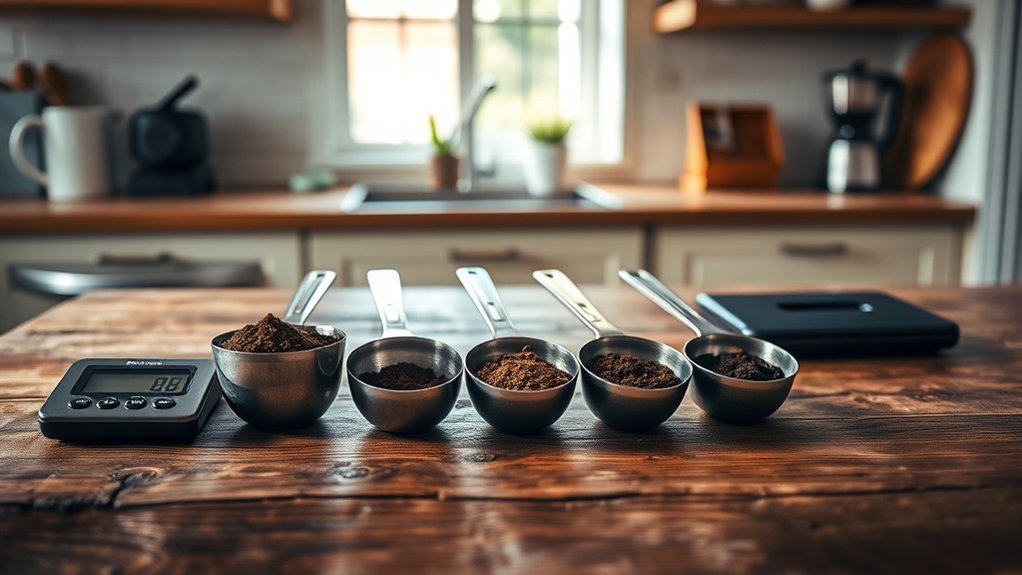
A common coffee scoop holds 2 level tablespoons. According to the National Institute of Standards and Technology, one U.S. tablespoon is approximately 15 mL, so two tablespoons equal about 30 mL.
The important distinction is that tablespoons and milliliters measure volume, while grams measure mass. Two tablespoons of ground coffee often weigh around 9 to 10 grams, but that number is only an estimate. Different roast levels, grind sizes, bean varieties, and packing densities can change the weight that fits into the same scoop.
For example, Moccamaster uses a two-tablespoon scoop and recommends approximately 55 grams of ground coffee per liter of water in its published brewing formula. Its measurements show why a scoop can be convenient while grams remain the more dependable way to reproduce a recipe.
Note: A “coffee scoop” is not the same type of defined measurement as a tablespoon. Scoop capacities can vary by manufacturer. Check an unfamiliar scoop before assuming it holds two tablespoons.
Power your essentials anywhere with a 999Wh pure sine wave power station delivering up to 1000W continuous with 2000W surge. It supports fast charging via USB-C PD 60W and USB-A QC 18W, plus simultaneous output for multiple devices through AC, USB, wireless, and car/DC ports. Recharge using AC, car, or solar with a built-in MPPT controller and dual cooling fans, while the upgraded battery management system protects against surges, short circuits, and overheating.

Color: Red Constructed with durable BPA-free plastic this coffee ground scooper is made to last and it s top-rack dishwasher safe for a quick and easy clean up.

Durable and attractive stainless steel construction for longevity
How to Check Your Coffee Scoop Size
If you do not know the capacity of your scoop, use a standard tablespoon measure. Fill the coffee scoop with water using one level tablespoon at a time. If two tablespoons fill it, the scoop holds approximately 30 mL.
When measuring coffee grounds, use a level scoop rather than a heaping scoop. Heaping scoops vary too much from one serving to the next.
How to Measure Coffee Beans and Grounds Precisely
A digital kitchen scale is the easiest way to make your coffee recipe repeatable. Place your brewing container or dosing cup on the scale, press the tare button to return the display to zero, and then add the desired amount of coffee.
If you do not have a scale, start with two level tablespoons for approximately every 6 fluid ounces of water. That is a practical volume-based shortcut used in coffee-maker guidance, including Moccamaster’s brewing instructions.
Do not pack coffee tightly into the spoon or scoop. Fill it naturally and level the top. Packing changes the amount of coffee without giving you a reliable way to reproduce it later.
Whole Beans vs. Ground Coffee
If you are measuring by weight, 15 grams of whole beans remain 15 grams after grinding, aside from a tiny amount that may remain in the grinder. If you are measuring by volume, however, whole beans and ground coffee occupy space differently. Do not assume one scoop of whole beans equals one scoop of grounds by mass.
Pro Tip: Weigh the whole beans before grinding. This keeps your dose consistent even when you change grind size or switch to a different roast.
Mastering the Coffee-to-Water Ratio for Consistent Brewing
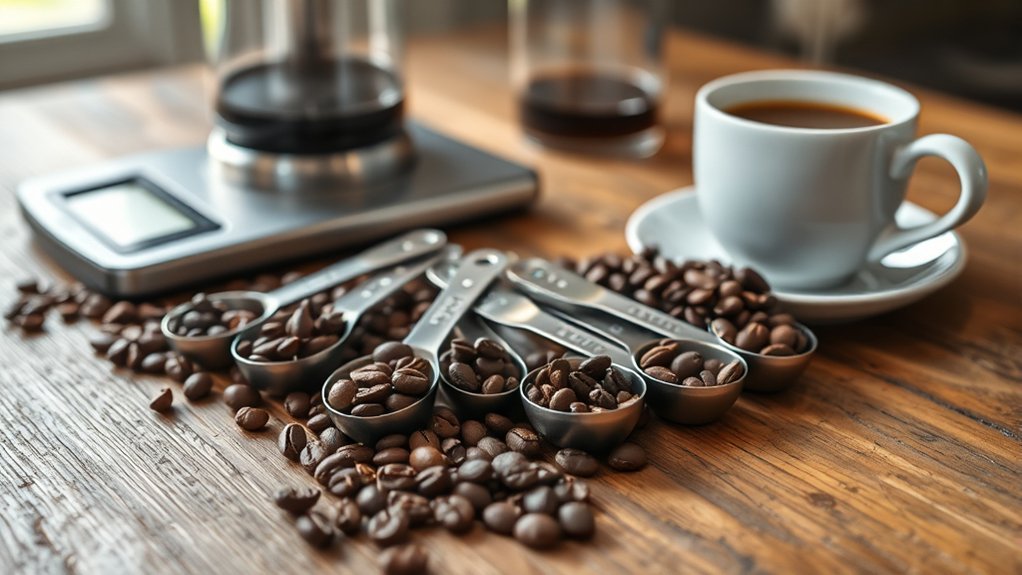
The coffee-to-water ratio is more useful than memorizing a different number of scoops for every mug. A practical starting range for many filter-coffee recipes is about 1:15 to 1:18 by weight. A ratio of 1:16 means one gram of coffee for every 16 grams of water.
Moccamaster publishes a 55 g/L recommendation, which is approximately a 1:18.2 ratio. That provides a useful benchmark for balanced filter coffee and is close to historical Specialty Coffee Association Golden Cup guidance.
A simple starting formula is about 55 grams of coffee for each liter of water, then adjust one variable at a time to match your taste.
Ideal Coffee Ratios
There is no single ratio that every person must prefer. These are useful starting points:
- 1:18: lighter-strength starting point for many filter brews.
- 1:17: balanced middle ground.
- 1:16: somewhat stronger.
- 1:15: stronger brew using more coffee for the same amount of water.
To calculate your dose, use this formula:
Coffee dose in grams = water in grams ÷ desired ratio.
Because 1 mL of brewing water weighs approximately 1 gram for ordinary kitchen calculations, a 240 mL mug using a 1:16 ratio needs about 15 grams of coffee.
Measuring Techniques Comparison
A scoop is fast and convenient, but a scale offers better measurement precision. A two-tablespoon scoop may hold around 9 to 10 grams of one coffee and a different amount of another because the grounds do not all have the same density.
For casual brewing, level tablespoons are perfectly workable. For recipe testing, pour-over, espresso, or dialing in a new coffee, grams make it easier to change one brewing variable without accidentally changing another.
Adjusting for Vessel Size
Scale the coffee dose with the amount of water rather than simply adding one scoop whenever the mug looks larger. At a practical 1:15 to 1:18 range, approximate starting amounts are:
| Water | Approx. mL | Coffee at 1:18 | Coffee at 1:15 |
| 6 fl oz | 180 mL | 10 g | 12 g |
| 8 fl oz | 240 mL | 13 g | 16 g |
| 10 fl oz | 300 mL | 17 g | 20 g |
| 12 fl oz | 355 mL | 20 g | 24 g |
| 15 fl oz | 444 mL | 25 g | 30 g |
| 16 fl oz | 473 mL | 26 g | 32 g |
| 20 fl oz | 591 mL | 33 g | 39 g |
How to Adjust Coffee Measurements for Various Cup Sizes
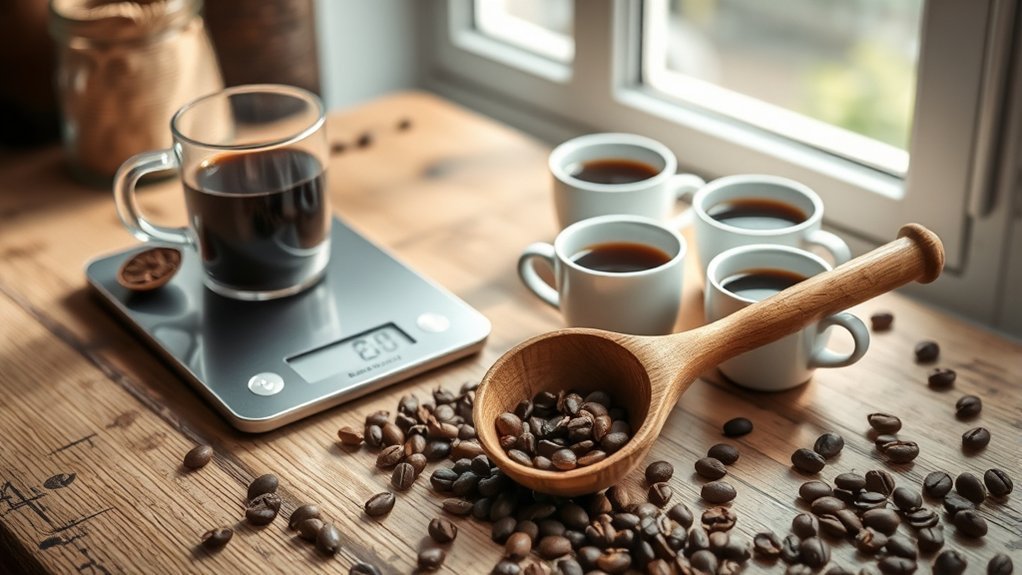
The word cup causes some of the biggest measurement mistakes in coffee. A U.S. household measuring cup is 8 fluid ounces, or roughly 240 mL, while the cup markings on a coffee maker may represent a smaller manufacturer-defined serving.
Before calculating your coffee dose, check how much water you are actually brewing rather than relying only on the number printed beside the reservoir.
Standard Cup Measurements
NIST lists approximately 180 mL for 6 fluid ounces and 240 mL for 8 fluid ounces. Using those volumes with a 1:15 to 1:18 ratio gives:
- 6-ounce serving: about 10–12 grams of coffee.
- 8-ounce mug: about 13–16 grams.
- 12-ounce mug: about 20–24 grams.
- 15-ounce mug: about 25–30 grams.
- 20-ounce travel mug: about 33–39 grams.
If your ground coffee happens to weigh roughly 5 grams per tablespoon, you can convert those figures to tablespoons as a rough shortcut. The scale remains more accurate.
Adjusting for Larger Mugs
Larger mugs need proportionally more coffee. Do not use three tablespoons for a 15-ounce travel mug simply because three tablespoons sounds like a large dose; that can produce a much weaker ratio than intended.
For example, 444 mL of water divided by a 1:18 ratio is about 25 grams. At 1:15, the same mug uses about 30 grams.
For a 20-ounce mug containing about 591 mL, a reasonable 1:15 to 1:18 range is approximately 33 to 39 grams.
Consistency in Brewing Ratios
Once you find a ratio you enjoy, write it down and use it as your baseline. Keep the dose and water amount steady while you adjust grind size, brew time, temperature, or technique.
This makes troubleshooting much easier because you know which variable caused the change in flavor.
How Grind Size Affects Coffee Measurements
Grind size affects extraction and water flow more directly than it affects the ideal coffee dose. Smaller particles expose more surface area and generally extract more quickly, while larger particles extract more slowly. Research published in the Journal of Food Process Engineering confirms that grind size materially changes coffee extraction kinetics.
That does not mean every finer grind requires less coffee. In pour-over and espresso, grinding too fine can also slow flow, increase resistance, or contribute to uneven extraction. Baratza’s V60 brewing guidance, for example, recommends making small grind adjustments based on flow and taste.
For consistent recipes, weigh the same coffee dose first. Change the grind separately and taste the result before changing the ratio.
How Roast Level Influences Coffee Density
Roast level is another reason a scoop cannot guarantee an exact weight. During roasting, coffee beans lose mass and expand. Research on the physical properties of roasted coffee has found that density decreases as roasting progresses, particularly under higher roasting temperatures.
A 2018 study in Industrial Crops and Products documented bean expansion and declining density during roasting, while newer 2024 research in the Journal of Food Engineering likewise examined increasing porosity and changing density during roasting.
In practical terms:
- Lighter roasts are generally denser. A given weight often occupies less volume than the same weight of a darker roast.
- Darker roasts are generally less dense. The beans have expanded more and lost additional mass during roasting.
- A scoop can therefore hold different weights. The same two-tablespoon volume does not guarantee the same gram dose from one roast to another.
- A scale removes that uncertainty. Fifteen grams remains 15 grams regardless of how much space the coffee occupies.
Roast level can also influence caffeine measurements, but the relationship is more nuanced than saying one roast always contains dramatically more caffeine. The National Coffee Association notes relatively small roast-related differences compared with the many other variables that affect a brewed serving.
Practical Tips for Consistent Coffee Brewing With a Scale
A scale turns a vague scoop measurement into a repeatable recipe. A simple workflow is:
- Choose how much water you want to brew.
- Select a starting ratio, such as 1:17 or 1:18.
- Divide the water weight by the ratio to calculate your coffee dose.
- Tare the scale before weighing your beans or grounds.
- Brew the coffee using the correct grind range for your method.
- Taste it and change one variable at a time on the next brew.
For example, 500 grams of water at a 1:17 ratio requires about 29.4 grams of coffee. Rounding to 29 or 30 grams is practical for home brewing.
If the coffee tastes balanced but you simply want a more concentrated drink, use a slightly stronger ratio. If it tastes harsh, sour, hollow, or uneven, examine grind size and extraction before assuming the dose alone is the problem.
Coffee Scoop Size Basics
These points resolve the most common measurement problems before you start brewing:
- One common coffee scoop: about 2 level tablespoons or 30 mL.
- Approximate ground-coffee weight: often around 9–10 grams per two-tablespoon scoop, but not guaranteed.
- One tablespoon: approximately 15 mL by U.S. kitchen measurement.
- Best accuracy: measure coffee in grams and water in grams or milliliters.
- Unknown scoop: check its volume with a proper tablespoon measure before using it as a brewing reference.
Exploring Brewing Techniques for Different Coffee Types
Different brewing methods need different grind sizes and techniques, but you can still use a consistent coffee-to-water ratio as your starting framework.
Drip Coffee
Start around 55 grams of coffee per liter of water and use the grind recommended by your brewer. Automatic brewers are often designed around a medium or medium-coarse grind, although the exact setting depends on the machine and grinder.
Pour-Over Coffee
Pour-over brewing gives you more control over water flow, agitation, and grind. Begin with a measured coffee-to-water ratio and adjust grind size based on drawdown time and flavor rather than changing several variables at once.
French Press Coffee
A French press generally works well with an evenly coarse grind. Baratza likewise recommends coarse grinding for French press brewing. You can still begin within roughly the same 1:15 to 1:18 ratio range and adjust to taste.
Espresso
Espresso is the least suitable method for scoop-based dosing. Small changes in dose can noticeably affect puck depth, flow, and extraction, so measure the coffee in grams and follow the basket or machine manufacturer’s recommended dose range.
Troubleshooting Common Coffee Brewing Issues
Coffee strength and coffee extraction are related, but they are not the same thing. A cup can be strong yet poorly extracted, or relatively light while still tasting balanced.
- Coffee tastes too weak but otherwise pleasant: Try a stronger ratio, such as moving from 1:18 toward 1:17 or 1:16.
- Coffee tastes sour, sharp, or thin: It may be under-extracted. Depending on the method, try a slightly finer grind or more effective contact with the water before dramatically increasing the dose.
- Coffee tastes harsh, drying, or unpleasantly bitter: It may be extracting too aggressively or unevenly. A coarser grind or shorter contact time may help, depending on the brewer.
- Flavor changes from one brew to the next: Weigh your coffee and water, keep the ratio fixed, and avoid heaping scoops.
- A new roast tastes different at the same scoop count: Roast density may have changed the number of grams inside each scoop. Weigh the dose instead.
Note: Change one brewing variable at a time. If you alter the dose, grind, water temperature, and brew time together, you will not know which adjustment improved or worsened the cup.
Frequently Asked Questions
Can I Use a Coffee Scoop for Other Ingredients?
Yes. If your coffee scoop holds two tablespoons, you can use it as a roughly 30 mL volume measure for other ingredients. Do not assume the ingredient will weigh 10 grams, however. Flour, sugar, salt, coffee, and other foods have different densities.
How Many Scoops for a French Press?
Base the dose on the amount of water rather than the press size alone. For 600 mL of water, a 1:16 ratio uses about 37.5 grams of coffee. If your scoop actually holds about 10 grams, that is roughly four level scoops. Use an evenly coarse grind and adjust the final ratio to taste.
Does the Type of Coffee Bean Affect Scoop Size?
The scoop’s physical volume does not change, but the weight of coffee inside it can. Bean variety, roast level, grind size, and how the grounds settle all affect density. That is why grams are more reliable than scoops when you want the same dose every time.
Can I Measure Coffee Without a Scoop?
Yes. Use a standard measuring tablespoon and measure two level tablespoons in place of a common two-tablespoon coffee scoop. For better precision, weigh the coffee in grams with a kitchen scale.
Is There a Difference Between a Coffee Scoop and a Measuring Spoon?
Yes. A U.S. measuring tablespoon is a defined kitchen volume of approximately 15 mL. A coffee scoop is a utensil whose capacity depends on its design, although many common coffee scoops hold two tablespoons, or about 30 mL.
How Many Tablespoons Are in One Coffee Scoop?
A common coffee scoop holds two level tablespoons. Because scoop sizes are not universal, check your particular scoop with a standard tablespoon measure if you are unsure.
How Many Grams of Coffee Should I Use Per Cup?
First determine how much water your “cup” contains. For 6 fluid ounces, start around 10–12 grams. For an 8-ounce mug, start around 13–16 grams. Those ranges correspond to approximately a 1:18 to 1:15 coffee-to-water ratio.
Conclusion
A coffee scoop is best treated as a convenient volume tool, not an exact gram measure. Many scoops hold about 2 level tablespoons, or roughly 30 mL, and that volume often contains around 9 to 10 grams of ground coffee. The actual weight can change with the coffee, so a scale gives you more consistent results.
For brewing, focus on the relationship between coffee and water. Start near 55 grams per liter or within a 1:15 to 1:18 range, then adjust to your taste. Once you find a ratio you enjoy, keep it consistent and change grind size or other brewing variables one at a time.
Sources
- National Institute of Standards and Technology — Metric Kitchen — tablespoon, fluid-ounce, cup, and milliliter measurement equivalencies.
- Moccamaster USA — Recommended Water-to-Coffee Formula — two-tablespoon scoop guidance and 55 g/L brewing formula.
- Journal of Food Process Engineering — Coffee Extraction, Temperature, and Grind Size — research supporting the effect of particle size on extraction kinetics.
- Industrial Crops and Products — Physical Properties of Coffee During Roasting — bean expansion and density changes during roasting.
- Journal of Food Engineering — Coffee Bean Porosity During Roasting — newer research on porosity and thermophysical changes during roasting.
- National Coffee Association — Coffee Roasts — roast-level characteristics and caffeine context.