
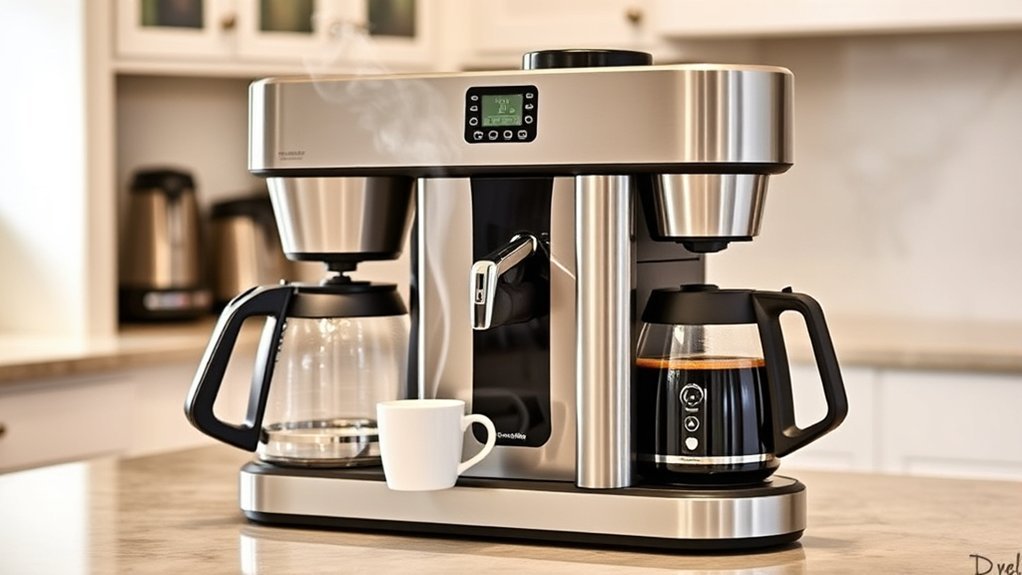
A dual brew coffee maker combines two or more brewing formats in one appliance. Depending on the model, it may brew coffee from pods and loose grounds, make both single cups and full carafes, or support all three options. The right machine can replace two appliances, but capacities, controls, accessories, and cleaning needs vary widely.
Quick Answer
A dual brew coffee maker lets you prepare coffee in more than one way, usually with pods, loose grounds, single-cup servings, or a carafe. Some models also offer iced settings, stronger brews, hot water, or milk frothing. Check the exact brewing formats and accessories before buying because features are not standardized.
Key Takeaways
- “Dual brew” can describe pods plus grounds, single-cup plus carafe brewing, or a machine that supports all three.
- Brew sizes, pod compatibility, reservoirs, carafe capacity, and strength settings differ by model.
- A specialty or concentrated coffee setting can work well in milk drinks, but it does not produce true pressure-brewed espresso.
- Ground coffee offers more control and less packaging, while pods offer faster setup and easier cleanup.
- Follow the manufacturer’s cleaning and descaling instructions because vinegar is not approved for every coffee maker.
What Is a Dual Brew Coffee Maker?
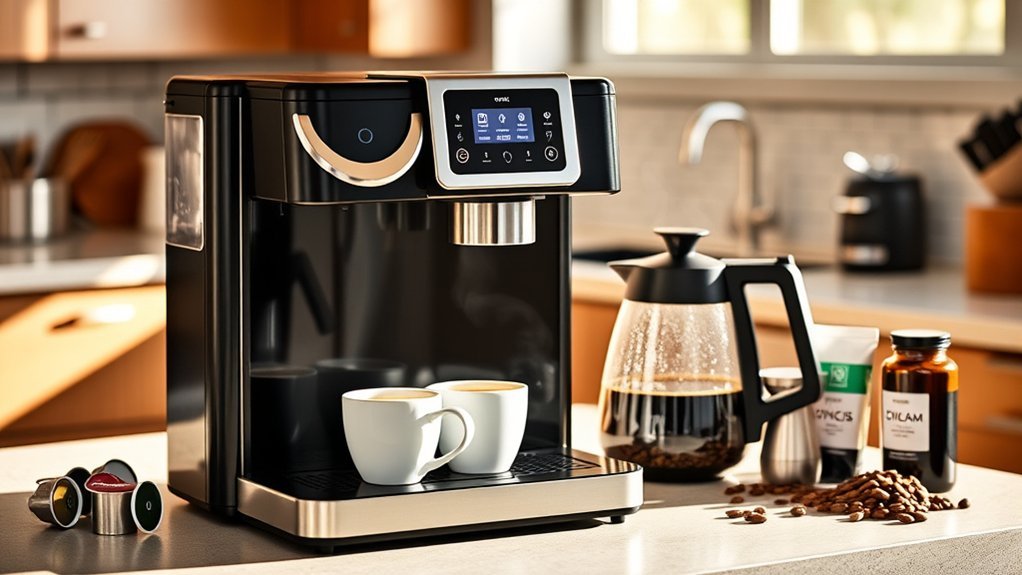
A dual brew coffee maker is a multi-format brewer. The name is used for several related appliance designs rather than one fixed set of features.
The most common configurations are:
- Pods and ground coffee for single servings: You insert either a compatible pod holder or a small grounds basket.
- Single-serve and carafe brewing: One side makes a personal cup while the other brews ground coffee into a glass or thermal carafe.
- Pods, single-serve grounds, and a carafe: These machines combine the widest range of brewing options in one housing.
Some advanced systems add iced-coffee settings, strength controls, programmable carafe brewing, an independent hot-water dispenser, or a milk frother. Those are optional features rather than requirements for the category.
Dual brew describes brewing flexibility, not a standard feature list. Always compare the exact model number instead of relying on the category name alone.
Power your essentials anywhere with a 999Wh pure sine wave power station delivering up to 1000W continuous with 2000W surge. It supports fast charging via USB-C PD 60W and USB-A QC 18W, plus simultaneous output for multiple devices through AC, USB, wireless, and car/DC ports. Recharge using AC, car, or solar with a built-in MPPT controller and dual cooling fans, while the upgraded battery management system protects against surges, short circuits, and overheating.

FASTER BREWING: Single-serve coffee maker brews a coffee pod faster vs. Keurig K-Elite upon startup. Compatible with K-Cups, it's perfect for a busy lifestyle while delivering optimal flavor.

2-IN-1 BREWING VERSATILITY: Unlock ultimate convenience by brewing with your favorite coffee grounds or pods.
How Does a Dual Brew Coffee Maker Function?
A dual brewer heats water and sends it through the selected coffee holder. The water path, basket, serving size, and flow rate may change based on the mode you choose.
Brewing Methods Explained
For a pod brew, the machine punctures a compatible capsule and pushes hot water through the enclosed coffee. For loose grounds, you measure coffee into a reusable basket or paper-lined filter. Carafe models use a larger basket and send the brewed coffee into a multi-cup pot.
Some machines use one removable adapter for both pod and grounds brewing. Others have separate sides, lids, reservoirs, or baskets. Follow the loading instructions for your model because using the wrong basket or overfilling it can cause weak flow, grounds in the cup, or overflow.
Versatile Beverage Options
Basic dual brewers make standard hot coffee. Depending on the model, you may also find:
- Regular, bold, rich, or strong settings
- A brew-over-ice mode
- Small-cup, mug, travel-mug, and carafe sizes
- Programmable carafe brewing
- A separate hot-water outlet
- A built-in or fold-away milk frother
- A concentrated specialty-coffee setting
Note: Concentrated “specialty” coffee is not the same as espresso. Espresso is produced with pressure and a much finer grind. A concentrated drip brew can still provide a stronger coffee base for a latte-style drink.
User-Friendly Features
Useful controls may include clearly labeled mode buttons, a display, automatic shutoff, delayed carafe brewing, a removable reservoir, and a height-adjustable cup rest. Some current machines use touch controls, while others use physical buttons and dials.
Before buying, check whether changing from pods to grounds requires an adapter, whether the unused basket can be stored inside the machine, and whether the reservoir is easy to remove under your cabinets.
Must-Have Features of Dual Brew Coffee Makers
The best feature set depends on how you normally make coffee. A household that fills a carafe every morning has different needs from someone who makes one travel mug at a time.
| Feature | Why It Matters | What to Verify |
|---|---|---|
| Brewing formats | Determines whether you can use pods, single-serve grounds, a carafe, or all three. | Included pod holder, grounds basket, carafe, and adapters |
| Brew sizes | Helps prevent cups that are too small or too diluted. | Separate size lists for pods, grounds, and carafe mode |
| Pod compatibility | Not every capsule shape or reusable pod fits every brewer. | Approved pod type and reusable-filter compatibility |
| Reservoir design | A larger removable tank reduces refills and is easier to wash. | Capacity, removal direction, handle, and water window |
| Carafe type | Glass carafes use a warming plate; thermal carafes retain heat without one. | Capacity, heat retention, replacement cost, and drip control |
| Cleaning access | Removable baskets and needle holders are easier to clear and rinse. | Dishwasher-safe parts and a documented descale cycle |
| Counter fit | Combination brewers can be wider or deeper than expected. | Width, depth, lid clearance, reservoir access, and mug height |
Ground Coffee vs. Pods: Pros and Cons
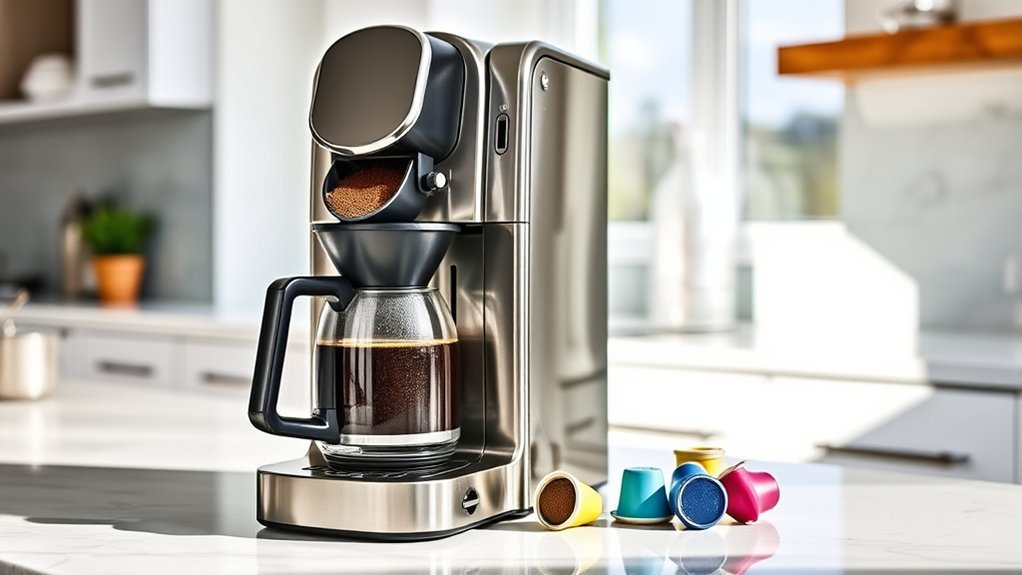
Ground coffee gives you more control over the coffee variety, freshness, grind, and dose. Pods reduce measuring and cleanup while delivering a repeatable serving.
| Factor | Ground Coffee | Coffee Pods |
|---|---|---|
| Setup | Requires measuring and filling a basket. | Insert a compatible pod and select the size. |
| Control | More control over dose, roast, grind, and coffee source. | The coffee dose and grind are fixed inside the pod. |
| Consistency | Depends on accurate measuring and the correct grind. | Usually consistent when the same pod and size are used. |
| Cleanup | The basket and filter need to be emptied and rinsed. | The pod is removed, but the holder and needle area still need cleaning. |
| Ongoing cost | Often costs less per serving, depending on the coffee purchased. | Convenient but commonly costs more per serving. |
| Waste | Used grounds and many paper filters can be composted where accepted. | Disposal depends on pod construction and local recycling rules. |
The U.S. Environmental Protection Agency lists coffee grounds and paper filters among materials that can be added to a home compost pile. Check local guidance before composting or recycling any coffee product.
Pro Tip: Start with the manufacturer’s recommended coffee amount. If the cup tastes weak, increase the dose or choose a stronger setting instead of selecting a smaller cup and repeatedly restarting the machine.
Why Choose a Dual Brew Coffee Maker?
A dual brewer is useful when household members prefer different serving sizes or coffee formats. One person can use a pod for speed, while another can use fresh grounds or make a carafe for several people.
Versatile Brewing Options
The main benefit is choice. You can keep pods for rushed mornings or guests while using ground coffee when you want more control. A carafe mode is useful for breakfast, meetings, or entertaining.
Optional iced and strength settings provide more flexibility, but they should not outweigh basic factors such as reliable brewing, easy cleaning, and affordable replacement parts.
Compact Design Benefits
One combination machine may occupy less total space than a separate pod brewer and drip coffee maker. However, dual brewers are not automatically compact. Some are wide two-sided machines, while others use a deeper layout with a carafe stored beside or behind the single-serve area.
Measure the counter from the wall to the front edge. Also measure the space below the cabinet with the reservoir lid, pod lid, and brew basket fully open.
Quick Beverage Preparation
Single-serve modes can be faster than brewing a full pot, but actual time depends on water warm-up, serving size, strength setting, and the machine’s condition. Carafe brewing naturally takes longer because more water must be heated and passed through the grounds.
Do not rely on one category-wide brewing-time estimate. Compare manufacturer specifications for the exact model and serving size you plan to use.
Limitations to Consider
- There are more baskets, holders, seals, and water pathways to clean.
- A two-sided brewer may take more counter space than a basic drip machine.
- Pod compatibility may be limited to a specific capsule shape.
- Switching between flavored pods and plain coffee may leave temporary aromas in shared components.
- Some machines require separate reservoirs to be filled for each brewing side.
- Many models cannot brew a single cup and a carafe at the same time.
- Replacement pod holders, carafes, and filters may add to long-term cost.
Tips for Maintaining Your Dual Brew Coffee Maker
Regular cleaning protects water flow and helps prevent stale coffee oils from affecting flavor. Because combination machines differ, the owner’s manual should be the final authority for removable parts, cleaning products, and descaling steps.
After Each Use
- Discard the used pod or grounds after the machine has cooled.
- Rinse the grounds basket, reusable filter, and pod holder as directed.
- Wash the carafe and lid with mild dish soap.
- Wipe splashes from the drip tray and warming plate.
- Clean a frother immediately after milk use if your model has one.
Weekly Cleaning
- Wash removable reservoirs and lids if the manual permits it.
- Inspect the pod holder and grounds basket for blocked openings.
- Wipe the coffee outlet and the area beneath the brew basket.
- Run a water-only cycle after strongly flavored coffee or beverage pods.
- Check the carafe lid and drip-stop valve for trapped grounds.
Descaling
Minerals from water can collect inside the heater and tubing. Common signs include slower brewing, increased noise, reduced serving volume, or an illuminated clean or descale light.
Use the solution, amount, soaking period, and rinse procedure stated in your manual. Hamilton Beach publishes vinegar-based instructions for selected FlexBrew models, while other manufacturers may call for a formulated coffee-maker descaling solution. Never assume that one method is approved for every machine.
Warning: Unplug the coffee maker and let hot components cool before removing or cleaning them. Pod systems contain sharp piercing needles. Do not place your fingers inside the pod holder, and never immerse the electrical base, cord, or plug in water.
Common Problems and Troubleshooting
| Problem | Likely Cause | What to Try |
|---|---|---|
| Brewing is slow | Mineral scale, a clogged pod needle, or an overfilled grounds basket | Run the approved descale cycle and clean removable openings according to the manual. |
| The cup is short | Low water, trapped scale, a blocked outlet, or retained water inside the system | Refill the correct reservoir, clean the outlet, descale, and run a water-only test. |
| Grounds enter the cup | Too-fine coffee, too much coffee, a damaged filter, or a basket that is not seated correctly | Use the recommended grind and dose, inspect the filter, and reinstall the basket. |
| Coffee tastes weak | Too little coffee, a large serving size, stale grounds, or the wrong brew mode | Use fresh coffee, measure the recommended dose, or select a stronger setting. |
| Water leaks or overflows | An overfilled reservoir, incorrect basket, blocked valve, missing seal, or misaligned carafe | Unplug the machine, let it cool, reinstall the parts, and stop using it if leakage continues. |
If the electrical base leaks, the cord becomes damaged, or the brewer repeatedly trips an outlet, stop using it and contact the manufacturer or a qualified appliance technician.
Current Dual Brew Coffee Maker Examples
Ninja, Keurig, and Hamilton Beach sell well-known combination brewers, but their current models serve different needs. The examples below illustrate those differences rather than ranking the brands.
Ninja DualBrew
The current Ninja DualBrew Pro CFP307 supports coffee pods and loose grounds. Ninja lists nine grounds sizes from a small cup to a full carafe and four pod sizes from 6 to 12 ounces.
It also provides Classic, Rich, Over Ice, and Specialty modes, along with a fold-away frother and a separate hot-water system. Its Specialty mode makes concentrated coffee for milk-based drinks; it does not turn the machine into an espresso maker.
Keurig K-Duo
The Keurig K-Duo Hot & Iced Gen 2 brews single cups from K-Cup pods and carafes from ground coffee. Current features include Strong Brew, an iced-beverage setting, and a shared 72-ounce reservoir.
This configuration is designed for households that want familiar pod brewing plus a conventional ground-coffee carafe. It does not have the same frother and independent hot-water feature set as the Ninja DualBrew Pro.
Hamilton Beach FlexBrew
The Hamilton Beach FlexBrew Trio 49976 can brew a single serving from a compatible pod or loose grounds and can make up to a 12-cup carafe on the other side.
Hamilton Beach lists up to 10 ounces for a pod serving and up to 14 ounces for single-serve ground coffee on this model. It also includes regular and bold strength settings, two separate reservoirs, and a removable pod-piercing assembly.
What Should You Look for in a Dual Brew Coffee Maker?
Start with the brewing method you will use most often. Extra modes are useful only when the basic capacity, fit, and cleaning design work for your routine.
- Confirm the configuration. Check whether the machine supports pods, single-serve grounds, a carafe, or all three.
- Check every brew-size list. Pod and ground-coffee modes may offer different maximum sizes.
- Verify pod compatibility. Do not assume every capsule or reusable pod will fit.
- Measure your space. Include the lid-open height, reservoir-removal path, carafe handle, and travel-mug clearance.
- Choose a carafe type. Glass is easy to monitor but normally uses a hot plate. Thermal carafes hold heat without continued warming.
- Review reservoir access. A removable or repositionable tank may be easier to fill beneath cabinets.
- Inspect the cleaning design. Removable baskets, drip trays, pod holders, and needle assemblies simplify routine care.
- Look for replacement parts. Confirm that carafes, baskets, filters, seals, and pod holders are available.
- Compare warranties and support. Keep the model number and proof of purchase in case service is needed.
- Prioritize coffee quality. Consistent water distribution and temperature matter more than a long list of rarely used modes. The Specialty Coffee Association’s certified home-brewer list is one optional reference for drip-brewing performance, although many dual brewers are not part of that program.
Frequently Asked Questions
Can I use flavored coffee pods with a dual brew coffee maker?
Yes, provided the pod is compatible with your model. Strong flavors may remain briefly in the pod holder or shared outlet, so remove the used pod and run a water-only cycle before making plain coffee.
How long does a dual brew coffee maker take to brew?
There is no standard brewing time. A small single serving may take only a few minutes, while a full carafe takes longer. Warm-up time, serving size, brew-strength setting, water temperature, and mineral buildup all affect the result.
Are dual brew coffee makers easy to clean?
They can be easy to maintain when the baskets, pod holder, reservoir, and drip tray are removable. However, a dual brewer has more components than a basic drip machine. Empty used coffee promptly, rinse removable parts, and descale according to the manual.
Can I make tea with a dual brew coffee maker?
You can use a compatible tea pod or an independent hot-water dispenser if the machine includes one. Do not place loose tea, powdered drink mix, milk, or creamer in the water reservoir unless the manufacturer specifically permits it.
What is the average lifespan of a dual brew coffee maker?
There is no dependable category-wide lifespan. Water hardness, daily use, descaling, construction, and replacement-part availability all affect service life. Consider replacement when leaks, electrical faults, heater failure, or recurring flow problems remain after approved maintenance.
Can I use a reusable coffee pod?
Only use a reusable filter approved for the exact brewer. Reusable pods vary in height, lid shape, and needle clearance. An incompatible accessory may prevent the lid from closing or interfere with water flow.
Does a specialty setting make real espresso?
No. A specialty setting generally makes a smaller, more concentrated drip brew. It can provide a stronger base for lattes or cappuccino-style drinks, but it does not use the pressure-based extraction of an espresso machine.
Can a dual brewer make a single cup and a carafe at the same time?
Many models cannot operate both brewing modes at once because they share a heater, pump, reservoir, or control system. Check the owner’s manual if simultaneous brewing is important to you.
Conclusion
A dual brew coffee maker is a practical choice when you want pod convenience without giving up loose grounds or carafe brewing. The most important step is confirming what “dual” means for the exact model. Compare its supported formats, serving sizes, pod system, reservoir access, counter footprint, carafe, cleaning process, and replacement parts before buying.
Features such as iced coffee, a frother, hot water, touchscreen controls, or specialty concentrate can be useful, but they are not universal. Choose the simplest machine that supports the drinks and serving sizes you will use regularly.
Sources
- SharkNinja — Ninja DualBrew Pro Specialty Coffee System CFP307 — grounds and pod sizes, brew styles, frother, specialty concentrate, and hot-water features
- Keurig — K-Duo Hot & Iced Single Serve & Carafe Coffee Maker Gen 2 — current Keurig dual-brewer configuration and features
- Hamilton Beach — FlexBrew Trio Coffee Maker 49976 — pod, grounds, carafe, serving-size, reservoir, and cleaning-access details
- Hamilton Beach — How to Clean Your Coffee Maker — manufacturer cleaning and vinegar-descaling guidance for selected models
- U.S. Environmental Protection Agency — Composting at Home — composting guidance for coffee grounds and paper filters
- Specialty Coffee Association — Certified Home Brewers — independent home-brewer performance reference