For a drip coffee maker, aim for a coffee-to-water ratio of 1:16 to 1:18, with 1:17 being the ideal balance for flavor. This means using about 1 to 2 tablespoons (10 to 12 grams) of ground coffee per 6 ounces of water. For a typical 10-cup maker, you’ll need around 10 to 12 tablespoons (70-85 grams) of coffee. With the right measurements, you can enhance your brew considerably. You’ll discover even more tips to perfect your cup!
Key Takeaways
- Use a coffee-to-water ratio of 1:16 to 1:18 for balanced flavor in drip coffee.
- For every 6 ounces of water, add 1-2 tablespoons (10-12 grams) of ground coffee.
- A standard 10-cup coffee maker requires 10 to 12 tablespoons (70-85 grams) of coffee.
- Use a kitchen scale to measure coffee by weight for consistent results.
- Adjust the ratio to 1:15 for a stronger brew or 1:18 for a milder taste.
Understanding the Coffee-to-Water Ratio for Drip Coffee

When brewing a perfect cup of drip coffee, understanding the coffee-to-water ratio is crucial. The ideal ratio falls between 1:16 and 1:18, with 1:17 being the sweet spot for balanced flavor.
For every 6 ounces of water, you should use about 1-2 tablespoons of ground coffee, translating to 10-12 grams. If you’re working with a standard 10-cup coffee maker, aim for 10 to 12 tablespoons or 70-85 grams of coffee.
Adjusting the ratio to 1:15 can yield a stronger brew, enhancing coffee extraction. To achieve consistent results with your brewing techniques, consider measuring coffee by weight using a kitchen scale.
This precision guarantees you get the best flavor and strength in every cup.
What Is the Ideal Amount of Coffee Per Cup?
When brewing coffee, getting the right amount per cup is key to achieving that perfect flavor.
Typically, you’ll want to use about 1 to 2 tablespoons of coffee for every 6 ounces of water, but feel free to adjust this based on your taste preferences.
Whether you prefer a stronger or milder brew, knowing these standard measurements will help you craft your ideal cup.
Standard Coffee Measurements
Finding the right amount of coffee for your drip coffee maker can elevate your brewing experience considerably.
The standard coffee-to-water ratio is typically between 1:16 and 1:18, with 1:17 being ideal for most coffee types. For every 6 ounces of water, use about 1 to 2 tablespoons (or 10 to 12 grams) of ground coffee based on your desired strength.
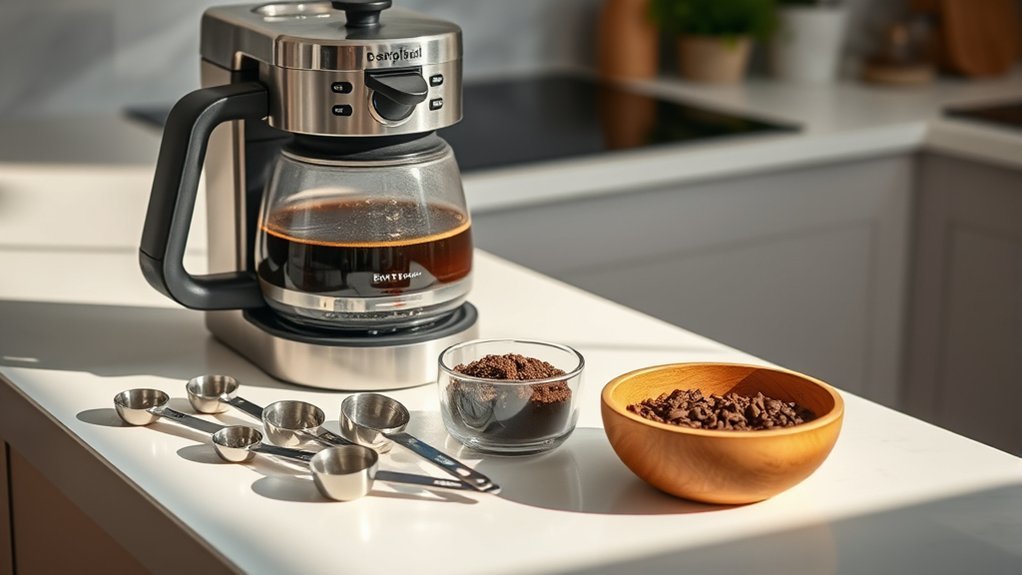
A common practice is to use one leveled coffee scoop, which equals about 2 tablespoons, per cup. If you’re brewing with a 10-cup coffee maker, aim for around 10 scoops (100-120 grams) of coffee for best flavor.
Experimenting with different brewing techniques can help you find the perfect balance for your taste preferences.
Adjusting for Personal Preference
Adjusting the coffee amount to suit your personal taste can greatly enhance your brewing experience. Start by experimenting with different ratios to discover what aligns with your coffee flavor preferences. Here’s a quick guide to help you find your ideal amount:
| Coffee Amount (Tablespoons) | Water Amount (Ounces) |
|---|---|
| 1 | 6 |
| 2 | 12 |
| 3 | 18 |
| 1.5 | 12 |
| 2.5 | 16 |
For a milder taste, use 1 tablespoon; for a bolder flavor, try 3 tablespoons. Remember, factors like grind size and water temperature also affect the final cup, so adjust accordingly to nail down your perfect brew!
Measuring Coffee for the Perfect Coffee-to-Water Ratio: Scoops vs. Grams

When it comes to brewing the perfect cup of coffee, accurate measurements are key.
You can choose between using scoops or weighing your coffee in grams, each method offering its own advantages.
Understanding these options helps you find the ideal coffee-to-water ratio for your taste.
Importance Of Accurate Measurements
To brew the perfect cup of coffee, accurate measurements are essential for achieving the ideal coffee-to-water ratio. Typically, this ratio falls between 1:15 and 1:18 for drip coffee makers.
While a scoop might seem convenient, it can vary in weight, leading to inconsistency in your brew. Using a kitchen scale to measure coffee in grams guarantees precision, helping you maintain coffee freshness and flavor balance.
For a standard 6-ounce cup, aim for about 10 grams of ground coffee, adjusting according to your taste preferences. Remember, differences in grind size and density can greatly impact extraction.
Scoops Versus Weight Methods
Accurate measurements play an essential role in brewing a great cup of coffee, and choosing between scoops and weight methods can greatly impact your results.
While using a scoop might seem convenient, scoop accuracy can vary, especially with different grind sizes and densities. A standard scoop equates to about 10 grams, but this may not hold true for every coffee type.
On the other hand, weight benefits come into play when you use a kitchen scale for precise measurements. The recommended coffee-to-water ratio for drip coffee makers is 1:17, translating to 55 grams per liter of water.
For consistent flavor and strength, measuring by weight is your best bet, ensuring you brew the perfect cup every time.
Why Precision Matters in Coffee Measurements
Precision in coffee measurements is essential for achieving a consistent and enjoyable brew, as even slight variations can dramatically alter the flavor profile.
Using a kitchen scale to measure your coffee in grams rather than relying on scoops guarantees accurate coffee-to-water ratios, typically around 1:17 for drip coffee. This precision helps prevent common brewing issues like over-extraction, which can create bitterness, or under-extraction, leading to a weak and sour taste.
The National Coffee Association suggests 1-2 tablespoons of coffee for every 6 ounces of water, but fine-tuning your measurements allows you to explore different brewing techniques and discover your perfect strength and flavor profiles.
With precision, you’ll elevate your coffee experience to a whole new level.
How to Adjust Your Coffee Ratios for Better Flavor
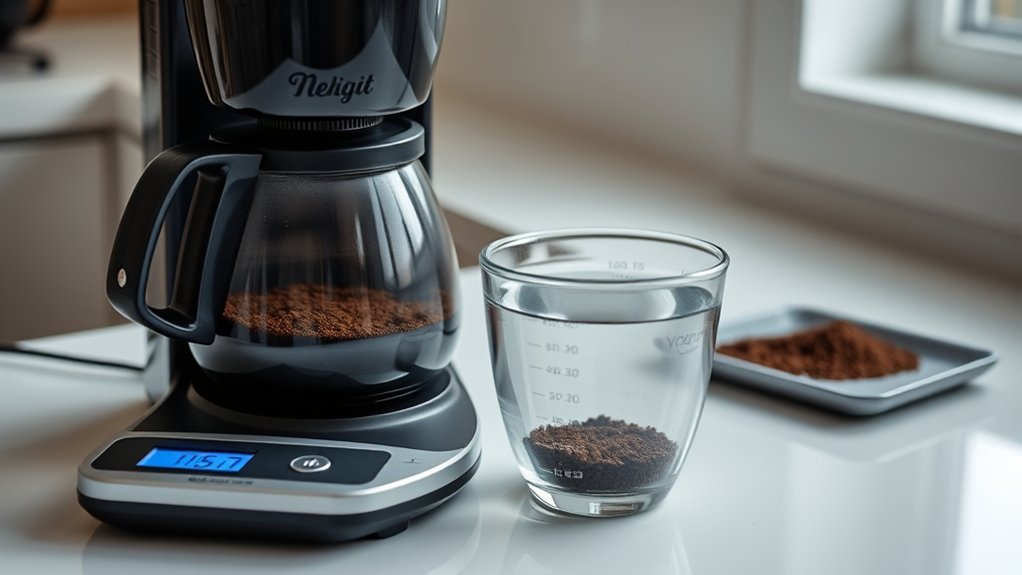
Adjusting your coffee ratios can transform your brew into something truly special.
Start by experimenting with different amounts of coffee, and don’t forget to tweak your grind size and brew time as well.
These small changes can make a big difference in flavor, helping you find your perfect cup.
Experiment With Ratios
Finding the perfect coffee-to-water ratio can elevate your brewing experience greatly. Start with the standard 1:17 ratio and adjust based on your taste preferences.
If you want a bolder coffee flavor, try a tighter ratio like 1:15, using less water per gram of coffee. For a milder cup, go for a looser ratio such as 1:18.
Begin with 2 tablespoons of coffee for every 6 ounces of water, then modify this amount to enhance or lessen the flavor intensity.
Keep track of your adjustments and note the resulting flavor profiles, which will help you refine your brewing techniques over time.
Adjust Grind Size
Experimenting with your coffee ratios isn’t the only way to enhance your brew; the grind size plays a significant role too.
For balanced flavor in drip coffee, start with a medium grind size. This allows water to flow evenly, optimizing flavor extraction.
Remember, grind adjustments can shift the coffee-to-water ratio. Finer grinds extract flavors faster, meaning you might need less coffee for the same strength. Conversely, a coarser grind is ideal for a 1:15 to 1:17 ratio, preventing bitterness from over-extraction.
If your coffee tastes weak, try switching to a finer grind to boost strength and body. Regularly adjusting grind size, while keeping your ratio consistent, helps you explore different flavor profiles and achieve the perfect cup.
Consider Brew Time
While you might focus on the coffee-to-water ratio, brew time is equally essential for achieving the perfect cup. Brew time considerably impacts flavor extraction; longer brews can lead to over-extraction if your ratio isn’t adjusted.
For drip coffee makers, a standard brew time of 5-10 minutes works well with a coffee-to-water ratio of 1:16 to 1:18 for ideal flavor balance. If you extend the brew time, consider using a tighter ratio, like 1:15, to prevent bitterness.
Conversely, shorter brew times may benefit from a looser ratio, such as 1:17, to encourage sweeter flavor notes. Experimenting with both brew time and coffee-to-water ratios will help you find a customized flavor profile that suits your taste preferences.
Top Mistakes to Avoid With Your Drip Coffee Maker
When brewing your morning cup of coffee with a drip coffee maker, it’s easy to overlook some common mistakes that can drastically impact your drink’s quality.
Here are four key pitfalls to avoid:
- Wrong Coffee-to-Water Ratio: Aim for 1:16 to 1:18, or about 1 to 2 tablespoons per 6 ounces of water.
- Ignoring Cup Size: Adjust measurements based on your coffee maker’s cup size—many use a 5 oz cup instead of the standard 8 oz.
- Neglecting Grind Size Importance: Use a medium grind for even extraction and ideal flavor.
- Skipping Coffee Machine Maintenance: Regular cleaning and descaling are essential for maintaining performance and coffee quality.
Avoiding these mistakes will elevate your coffee game!
Tips for Brewing Consistently Great Coffee Every Time
To brew consistently great coffee every time, it’s essential to pay attention to a few key factors that can elevate your morning ritual.
First, stick to the ideal coffee-to-water ratio of 1:17 for balanced flavor; this translates to about 10-12 grams of coffee for every 6 ounces of water. Always measure your coffee by weight using a kitchen scale for precision.
Regularly clean your coffee maker to guarantee peak performance and flavor consistency. Don’t forget about coffee storage—keep your beans in an airtight container in a cool, dark place for maximum flavor preservation.
Finally, experiment with grind size and brewing times to find your perfect balance, assuring each cup is tailored to your taste preferences.
Exploring Different Brewing Methods and Their Ratios
Exploring different brewing methods can greatly enhance your coffee experience, as each technique brings out unique flavors and aromas.
Experimenting with various brewing techniques can elevate your coffee enjoyment, revealing distinctive flavors and aromas.
Here are some popular brewing techniques and their ideal coffee-to-water ratios:
- Drip Coffee Maker: Use a 1:17 ratio for balanced flavor, about 68-75 grams of coffee for a 10-cup brew.
- Pour-Over: A ratio of 1:14 to 1:16 highlights delicate flavor nuances.
- French Press: Opt for a tighter ratio of 1:12 to 1:15 for a rich, full-bodied taste.
- Espresso: For concentrated flavor, use a strong 1:2 ratio, requiring 18-20 grams for a double shot.
How Grind Size Affects Your Coffee Strength
While the grind size of your coffee beans might seem like a minor detail, it plays an essential role in determining the strength and flavor of your brew. Finer grinds extract flavors more quickly, leading to a stronger cup, while coarser grinds require longer extraction times and may yield a milder taste.
For drip coffee makers, a medium grind is usually suitable, allowing for ideal extraction without bitterness. If you prefer a bolder flavor, consider making grind adjustments towards a finer texture, but be cautious of over-extraction.
Balancing your water-to-coffee ratio is vital; a finer grind often calls for slightly less coffee to prevent unwanted bitterness. Experimenting with grind sizes will help you find your perfect brew strength.
Troubleshooting: Fixing Bad Coffee Taste?
If you’ve ever taken a sip of coffee only to be met with disappointment, you know how essential it’s to troubleshoot that bad taste.
Here are some key steps to enhance your brew:
- Adjust the Ratio: If you’re facing coffee bitterness, try a coffee-to-water ratio of 1:17 to avoid over-extraction.
- Grind Size Matters: A sour flavor may indicate under-extraction; use a finer grind or extend your brewing time.
- Freshness is Key: Verify your coffee is freshly ground and used within a week of roasting for peak flavor.
- Clean Your Maker: Regularly clean your coffee maker to eliminate mineral deposits and old oils that can taint your coffee.
Follow these tips to enjoy a better cup every time!
Frequently Asked Questions
How Does Water Temperature Affect Coffee Extraction?
Water temperature greatly impacts coffee extraction. If it’s too low, you won’t extract enough flavors; if it’s too high, you risk over-extraction, leading to bitterness. Aim for a balanced temperature for ideal taste and aroma.
Can I Reuse Coffee Grounds for a Second Brew?
You can reuse coffee grounds for a second brew, but expect a milder flavor. The coffee strength weakens, resembling a gentle morning mist rather than a bold sunrise. Different brewing methods might yield varying results, though!
What Type of Water Is Best for Brewing Coffee?
Filtered water’s your best bet for brewing coffee. It reduces impurities while balancing mineral content, enhancing flavor. Avoid distilled water, as it lacks minerals that contribute to a rich, full-bodied cup you crave.
Does Coffee Freshness Impact the Ideal Ratio?
Absolutely, coffee freshness greatly impacts the ideal ratio. As coffee ages, its flavor profile dulls, weakening your brew. Fresh beans release vibrant flavors, so adjust your ratios to capture that delicious essence for a perfect cup.
How Can I Store Coffee Beans for Optimal Freshness?
Store your coffee beans in airtight containers or vacuum-sealed bags. This method minimizes air exposure, preserving freshness and flavor. Keep them in a cool, dark place to maintain ideal quality for your brews.
Conclusion
To sum up, mastering the coffee-to-water ratio can turn your morning brew into a caffeinated masterpiece. Remember, the ideal measurement is about one to two tablespoons of coffee per six ounces of water, but feel free to adjust based on your taste preferences. With a little practice, you’ll brew coffee so good it’ll make your taste buds dance like they’re at a rock concert! So grab your drip coffee maker and get ready to impress yourself with every cup.