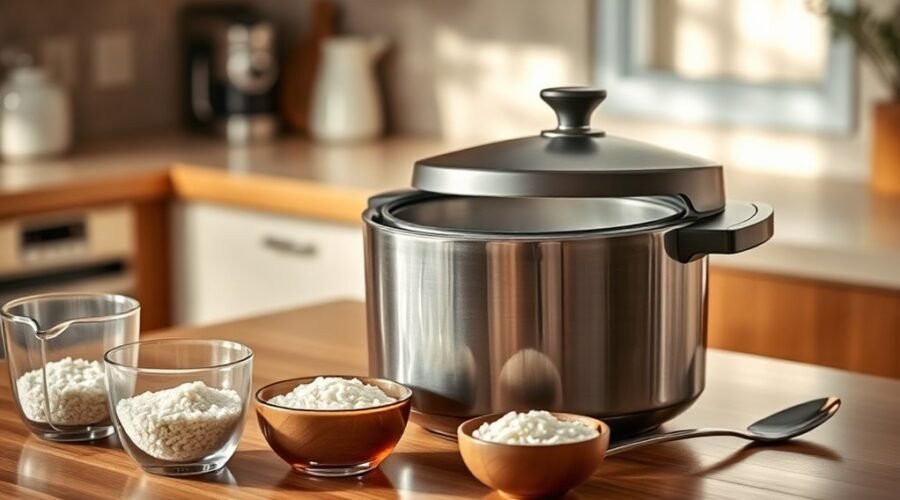
The right rice water ratio rice cooker formula depends on two things: your grain variety and whether you measure with a 180 mL rice-cooker cup or a 240 mL US cup. As a reliable baseline in a standard vented rice cooker, use 1:1.5 to 1:1.75 for long-grain white rice, 1:1.25 to 1:1.5 for Jasmine, 1:1.1 to 1:1.25 for short-grain sushi rice, and 1:2 to 1:2.25 for brown rice—then rest covered for 10 minutes before fluffing.
Quick Answer
Use 1.5–1.75 parts water per 1 part rinsed long-grain white rice, 1.25–1.5 parts for Jasmine, 1.5 parts for Basmati, 1.1–1.25 parts for short-grain/sushi rice, and 2–2.25 parts for brown rice. Always match your measuring cup to your method: inner-pot fill lines are calibrated to 180 mL (¾ US cup) scoops, not 240 mL US cups.
Rice Water Ratio Rice Cooker Chart by Grain Type
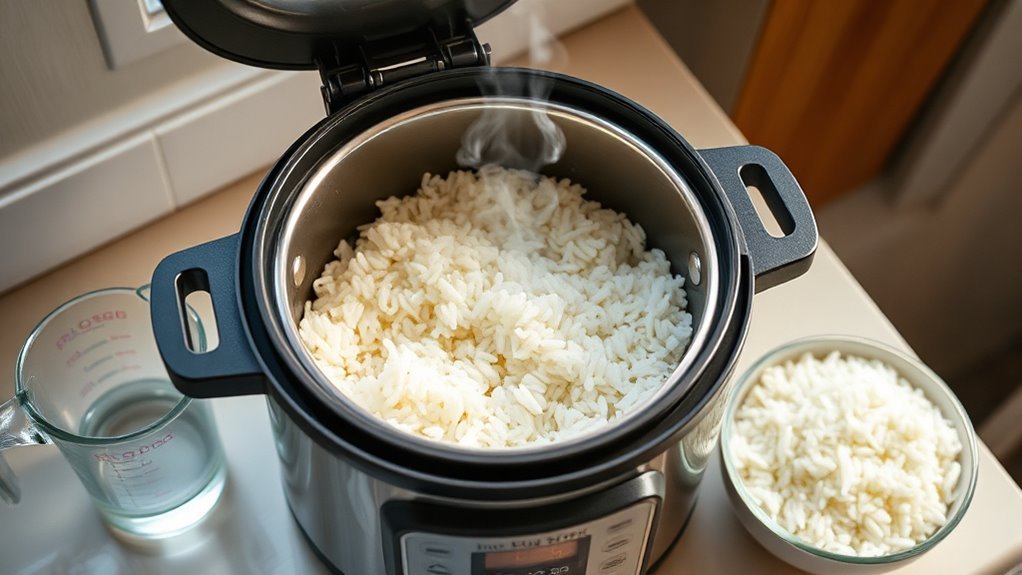
Unlike a sealed pressure cooker (which uses a 1:1 ratio because almost no steam escapes), a rice cooker vents steam throughout the boil. Using the lower end of each range works best in tightly sealed fuzzy-logic (Micom) cookers, while basic one-switch glass-lid cookers usually need the upper end.
| Rice Variety | Rice : Water Ratio | Water per 1 US Cup (240 mL) | Water per 1 Rice Cup (180 mL) | Rinse / Soak Tip |
|---|---|---|---|---|
| Long-Grain White | 1 : 1.5–1.75 | 1½–1¾ US cups (360–420 mL) | 270–315 mL | Rinse 3×; no soak needed |
| Thai Jasmine White | 1 : 1.25–1.5 | 1¼–1½ US cups (300–360 mL) | 225–270 mL | Rinse 2–3×; drain well |
| White Basmati | 1 : 1.5 | 1½ US cups (360 mL) | 270 mL | Rinse well; optional 15-min soak |
| Short-Grain / Sushi | 1 : 1.1–1.25 | 1⅛–1¼ US cups (265–300 mL) | 200–225 mL | Rinse until clear; soak 20–30 min |
| Long or Short Brown | 1 : 2–2.25 | 2–2¼ US cups (480–540 mL) | 360–405 mL | Rinse; optional 30-min soak; use Brown mode |
| Wild Rice | 1 : 2.5–3 | 2½–3 US cups (600–720 mL) | 450–540 mL | Rinse well; drain excess water if any remains |
New to operating your machine from start to finish? Read our How to Use a Rice Cooker: Step-by-Step Guide. Want to plan dinner timing? Check How Long Does a Rice Cooker Take?, or see our Zojirushi Rice Cooker Instructions if you use a Micom or induction-heating model.
180 mL Rice-Cooker Cup vs. 240 mL US Cup Conversion Table
Almost every rice cooker—from Aroma to Tiger and Zojirushi—ships with a small plastic scoop calibrated to the traditional Japanese gō: 180 mL (about ¾ of a 240 mL US standard cup). Mixing a 240 mL US cup for the dry rice with the pot’s internal fill lines is the single most common cause of crunchy, undercooked batches.
| Rice-Cooker Cups (180 mL) | Equivalent in US Cups (240 mL) | Total Dry Volume (mL) | Inner Pot Water Line to Use |
|---|---|---|---|
| 1 rice cup | ¾ US cup | 180 mL | Line “1” |
| 2 rice cups | 1½ US cups | 360 mL | Line “2” |
| 3 rice cups | 2¼ US cups | 540 mL | Line “3” |
| 4 rice cups | 3 US cups | 720 mL | Line “4” |
Lost Your Rice Scoop? Just use a standard ¾ US cup dry measure (or 180 mL) for each “cup” of rice if you want to keep using your inner pot’s printed water lines—or ignore the pot lines completely and measure both rice and water with your 240 mL US measuring cup using the ratio chart above.
Step-by-Step: Measure, Rinse, Cook & Rest
- Measure dry rice first: Level off your scoop before rinsing so wet grains don’t pack down and distort the ratio.
- Rinse 2 to 4 times in cool water: Swirl gently in a fine-mesh strainer or separate bowl until the cloudy starch runoff clears noticeably, then drain well.
- Add measured water (or fill to the matching inner line): Pour in cold water according to the grain chart—or if using the 180 mL scoop, fill to the matching White/Brown/Sushi line inside the bowl.
- Adjust for high altitude (above 3,000 ft): Water boils at a lower temperature at elevation and evaporates faster. Add 1 to 2 tablespoons of extra water per cup of rice and allow an extra 5 minutes of covered resting.
- Cook undisturbed: Close the lid and select the matching grain cycle. Never lift the lid mid-cook.
- Rest 10 minutes before fluffing: Once the cooker switches to Keep Warm, keep the lid shut for 10 minutes so moisture redistributes from the center to the edges, then fold gently with a damp rice paddle.
Pros & Limitations: Inner Pot Lines vs. Manual Cup Ratios
- Inner pot water lines — Pros: Fast, automatically accounts for the rice already sitting in the bowl and your specific cooker’s evaporation rate; ideal for white, sushi, and brown rice on Micom models. Limitations: Only accurate when using the 180 mL scoop; less flexible for specialty blends or broths with vegetables.
- Manual cup ratios — Pros: Works with any measuring cup (180 mL or 240 mL) as long as you use the same cup for both rice and liquid; easy to tweak by 2 tablespoons for firmer or softer texture. Limitations: Requires draining rinsed rice thoroughly so clinging rinse water doesn’t throw off the ratio.
Troubleshooting Mushy or Undercooked Rice
| Problem | Most Likely Cause | Fix |
|---|---|---|
| Crunchy or chalky core | Used 240 mL US cup with 180 mL pot lines, or skipped rest | Sprinkle 2–3 tbsp hot water over top, close lid, and re-run for 5 min (or rest 10 min) |
| Soggy or mushy batch | Too much water or poorly drained wet rice after rinsing | Fluff immediately with lid open to vent steam; cut water by 2 tbsp per cup next batch |
| Browning or crust on bottom | Unrinsed starch or left on Keep Warm for hours | Rinse rice 3× before cooking and turn off Keep Warm after serving |
USDA Food Safety: Cooling & Storing Cooked Rice
Dry rice often carries dormant spores of Bacillus cereus that survive cooking. If cooked rice sits in the temperature danger zone (40°F to 140°F), those spores germinate and can create heat-stable toxins that reheating will not destroy.
USDA 2-Hour Cooling Rule: Per USDA FSIS Leftovers & Food Safety guidelines, transfer leftover rice from the cooker into shallow airtight containers and refrigerate at 40°F (4°C) or below within 2 hours (1 hour if the room is above 90°F). Use within 3 to 4 days and reheat to 165°F (74°C) only once.
Key Takeaways
- Standard rice cookers vent steam and require more water than a 1:1 Instant Pot: use 1:1.5–1.75 for long-grain white, 1:1.25–1.5 for Jasmine, and 1:2–2.25 for brown rice.
- A rice-cooker cup equals 180 mL (¾ US cup), not 240 mL—never mix a 240 mL scoop with inner-pot fill lines.
- Add 1–2 tbsp water per cup at altitudes above 3,000 feet, and always rest rice covered for 10 minutes before fluffing.
- Cool leftovers in shallow containers and refrigerate within 2 hours to prevent Bacillus cereus growth.
Frequently Asked Questions
Why is a rice cooker measuring cup 180 mL instead of a 240 mL US cup?
Most rice cookers follow the traditional Japanese gō measurement (180 mL, or 3/4 of a 240 mL US cup). The fill lines printed inside your rice cooker bowl are calibrated strictly to 180 mL rice-cooker cups—so scooping rice with a 240 mL US cup and filling to the inner pot line will leave your rice under-watered and crunchy.
What is the right rice-to-water ratio for white rice in a standard rice cooker?
In a standard vented rice cooker, use 1.5 to 1.75 cups of water per 1 cup of rinsed long-grain white rice, 1.25 to 1.5 cups for fragrant Jasmine rice, 1.5 cups for Basmati, and 1.1 to 1.25 cups for short-grain sushi rice. Tightly sealed fuzzy-logic (Micom) cookers lose less steam, so they sit at the lower end of each range or follow their internal bowl lines.
Why is a rice cooker water ratio higher than an Instant Pot 1:1 ratio?
An Instant Pot cooks inside a locked pressure vessel with almost zero steam loss, so 1:1 hydrates white rice completely. A rice cooker vents steam continuously through its lid during boiling, requiring 25% to 75% more water to compensate for evaporation.
How much water does brown rice need in a rice cooker?
Because brown rice keeps its fibrous outer bran layer, it requires 2 to 2.25 cups of water per 1 cup of dry brown rice in a rice cooker—and benefits from a 20- to 30-minute pre-soak plus the dedicated Brown Rice setting if your model has one.
How long can cooked rice safely stay in a rice cooker or at room temperature?
Only hold cooked rice hot above 140°F on an active Keep Warm cycle for short serving windows. Once the cooker is turned off, USDA FSIS guidelines require cooling leftovers in shallow containers and refrigerating at 40°F or below within 2 hours (1 hour if ambient temperature is over 90°F) to prevent Bacillus cereus toxin formation.
Sources
- Aroma Housewares: What Is the Real Rice Cup Size? — 180 mL industry-standard rice cooker cup vs. 240 mL US cup.
- USDA FSIS: Leftovers and Food Safety — 2-hour cooling rule, 40°F–140°F danger zone, and 165°F reheating target.
- Ohio State University Extension: Bacillus cereus — cooked rice spore survival and safe cooling practices.
- Harvard T.H. Chan School of Public Health: Rice — grain variety characteristics and cooking differences.