
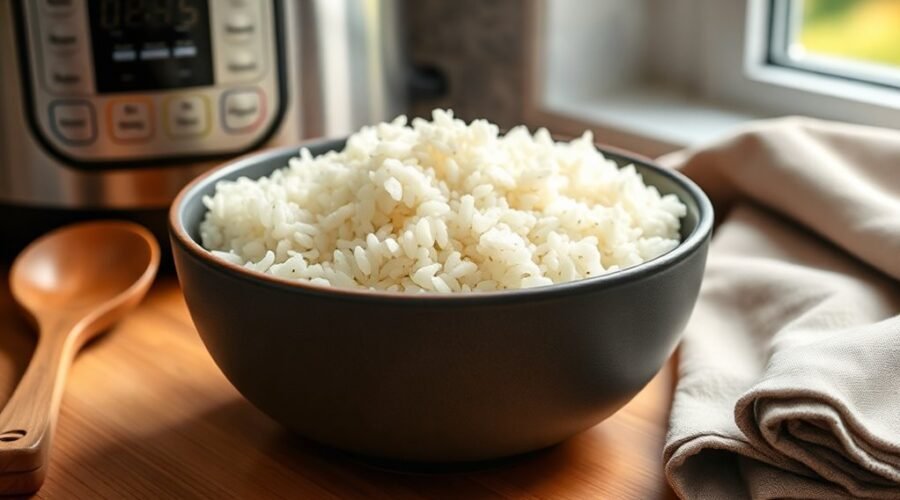
To cook fluffy Instant Pot long grain white rice with distinct, separate grains, use a 1:1 rice-to-water ratio, pressure cook on High Pressure for 3 to 4 minutes, and finish with a 10-minute Natural Pressure Release (NPR). Unlike softer Jasmine or extra-long aged Basmati, standard American long-grain white rice carries a balanced amylose starch profile that stays firm and non-clumping when rinsed and drained thoroughly before sealing.
Quick Answer
Rinse and drain American long-grain white rice, combine with equal volume cold water (1:1 ratio) and ½ teaspoon salt per cup, cook on High Pressure for 3 minutes (for firmer grains) or 4 minutes (for softer grains), let pressure release naturally for 10 minutes, then vent any remaining steam and fluff with a fork.
American Long-Grain White Rice vs. Jasmine & Basmati: Amylose Starch Differences
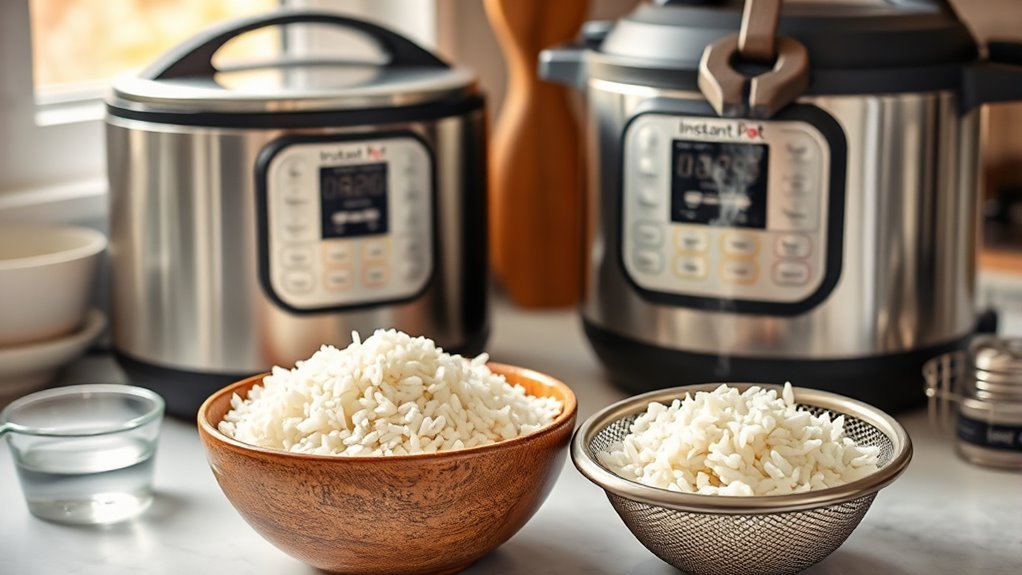
Not all long-grain white rice behaves the same under pressure. Rice texture depends largely on the ratio of two starch molecules inside the kernel: amylose (straight-chain starch that resists sticking and yields firm, separate grains) and amylopectin (branched starch that creates softness and cling). Because the Instant Pot traps moisture at high heat, small differences in amylose content determine whether a batch turns out airy or sticky.
| Long-Grain Variety | Amylose Profile | Instant Pot Ratio | High Pressure + NPR | Cooked Texture |
|---|---|---|---|---|
| American Long-Grain White | Intermediate–High (~20–25%) | 1:1 | 3–4 min + 10 min NPR | Firm, neutral, light, separate grains |
| Thai Jasmine White | Low (~12–20%) | 1:1 (well drained) | 3 min + 10 min NPR | Floral, tender, slightly clingy |
| Aged White Basmati | Intermediate–High (~20–26%) | 1:1 to 1:1.25 | 4–5 min + 10 min NPR | Nutty, elongated, very dry and separate |
If you want a complete multi-grain overview covering brown, wild, and short-grain varieties alongside white rice, see our Instant Pot Rice Recipe: Ratios, Times & Steps. For exact liquid charts across every rice type, check our Instant Pot Rice to Water Ratio guide.
Rinsing Instant Pot Long Grain White Rice: Texture vs. Enriched Nutrition
Milling polishes the outer bran off white rice and leaves fine starch dust on the surface of each kernel. When heated under pressure, that loose starch gelatinizes into a sticky paste that glues grains together and can cling to the stainless-steel inner pot.
- When to rinse: Rinse whenever you want dry, separate grains for bowls, pilafs, or next-day fried rice. Place dry rice in a fine-mesh strainer, swirl under cold running water 3 to 4 times until the runoff turns mostly clear, and shake well to drain.
- Drain thoroughly before measuring water: Clinging rinse water adds hidden liquid to a tight 1:1 ratio. Let the strainer sit over the sink for 1 to 2 minutes before transferring rice to the pot.
- Enriched rice trade-off: Most U.S. supermarket long-grain white rice is enriched with surface coatings of iron, folic acid, niacin, and thiamin. Rinsing washes away part of that added coating. If retaining enrichment matters more than maximum grain separation, skip rinsing and add 1 teaspoon of neutral oil or butter to reduce clumping.
Step-by-Step: 1:1 Ratio, 3–4 Min High Pressure + 10 Min NPR
Follow this streamlined sequence for 1 to 2 cups of dry American long-grain white rice in a standard 6-quart Instant Pot (use the exact same measuring cup for both rice and water):
- Measure dry rice first: Scoop 1 or 2 level cups of dry long-grain white rice before rinsing so moisture never skews your volume.
- Rinse and drain (recommended): Rinse in a fine-mesh strainer under cool water until mostly clear, then shake and drain for 1 to 2 minutes.
- Combine at a 1:1 ratio: Add the drained rice and an equal volume of cold water (1 cup water per 1 cup rice) to the inner pot. Stir in ½ teaspoon salt and an optional 1 teaspoon oil or butter per cup, ensuring all grains sit submerged below the waterline.
- Seal and set High Pressure: Close the lid, confirm the silicone sealing ring is seated cleanly, and set the valve to Sealing. Select Pressure Cook / Manual on High Pressure for 3 minutes (slightly firmer, ideal for fried rice or saucy curries) or 4 minutes (classic tender-fluffy side dish).
- Complete a 10-minute Natural Pressure Release: When the beep sounds, leave the lid closed for exactly 10 minutes while residual steam finishes hydrating the grain cores.
- Vent, open, and fluff gently: Switch the valve to Venting to release any remaining pressure, open the lid away from your face, and lift the rice from the outer edges with a fork or rice paddle to vent surface steam.
Pro Tip: Turn off Keep Warm before starting or open the pot promptly after the 10-minute NPR. Leaving white rice on Keep Warm for 30+ minutes dries out the bottom layer and can form a tough crust.
Pros and Limitations of Pressure-Cooking Long-Grain White Rice
- Pros: Hands-off cooking with no boil-overs; consistent 1:1 ratio with minimal evaporation; fast active cook time (about 20–25 minutes total including pressurization and NPR); easily scales without changing the cook timer.
- Limitations: Very small batches (under 1 cup dry rice) can trigger a Burn notice in 6-quart or 8-quart pots because the liquid layer is too shallow—for small portions, batch-scaling up to 6 cups, or Pot-in-Pot steaming, follow our Instant Pot Rice Cooking Tips guide. Also, the built-in “Rice” preset typically runs on Low Pressure for 12 minutes, which can produce softer results than manual High Pressure.
Quick Troubleshooting Checklist
| Issue | Likely Cause | Fix for Next Batch |
|---|---|---|
| Gummy or clumped grains | Unrinsed starch or excess rinse water left in strainer | Rinse 3–4 times and drain for 2 full minutes before adding water |
| Crunchy or chalky center | Used Quick Release too early or older, drier rice crop | Always complete the full 10-min NPR; step up from 3 to 4 min High Pressure |
| Wet or mushy finish | Used stovetop 1:2 ratio instead of 1:1 | Stick strictly to 1:1; fluff immediately after NPR to release trapped steam |
| Sticking on pot bottom | Keep Warm left on too long or dry grains stuck before sealing | Disable Keep Warm, add 1 tsp oil, and let rest 2–3 minutes uncovered before scooping |
USDA Food Safety: Cooling, Storing & Reheating Cooked Rice
Dry rice commonly carries dormant spores of Bacillus cereus, a bacterium that survives boiling and pressure cooking. When cooked rice sits in the temperature danger zone (40°F to 140°F), those spores germinate and can produce heat-stable toxins that reheating will not eliminate.
USDA Food Safety Rule: Per USDA FSIS Leftovers & Food Safety guidelines, refrigerate cooked rice within 2 hours of cooking (or within 1 hour if ambient temperature is above 90°F). Discard any rice left at room temperature longer than 2 hours.
- Cool rapidly: Spread leftover rice in a shallow container (under 2 inches deep) rather than leaving it packed in the warm Instant Pot insert, then refrigerate at 40°F (4°C) or below.
- Storage window: Eat refrigerated rice within 3 to 4 days, or freeze in airtight portions for longer storage.
- Safe reheating: Add 1 tablespoon of water per cup of rice, cover loosely, and reheat thoroughly to an internal temperature of 165°F (74°C). Reheat only the portion you plan to eat once.
Key Takeaways
- American long-grain white rice has intermediate-to-high amylose starch, producing firmer, more separate grains than lower-amylose Jasmine rice.
- Use a strict 1:1 ratio of well-drained rinsed rice to cold water in the Instant Pot.
- Cook on High Pressure for 3 to 4 minutes followed by a mandatory 10-minute Natural Pressure Release.
- Cool leftover rice in shallow containers and refrigerate within 2 hours to prevent Bacillus cereus growth.
Frequently Asked Questions
Why does American long-grain white rice use a 1:1 ratio in the Instant Pot instead of 1:2?
A stovetop saucepan loses water through steady steam evaporation, so it requires roughly 2 cups of water per cup of rice. An Instant Pot cooks inside a sealed chamber with minimal evaporation, so a 1:1 ratio of drained rice to water hydrates the starch without turning the grains mushy.
Should I rinse enriched American long-grain white rice before pressure cooking?
Rinsing washes off loose surface starch so the cooked grains stay light and separate, which is ideal for pilafs, stir-fries, and side dishes. Keep in mind that rinsing enriched U.S. white rice also removes some added surface vitamins (such as iron and B vitamins). If you skip rinsing, expect a slightly tackier finish and be sure to stir the bottom before sealing.
How does American long-grain white rice differ from Jasmine and Basmati in the Instant Pot?
American long-grain white rice typically has intermediate-to-high amylose starch, giving a firm, neutral, separate grain in 3 to 4 minutes at High Pressure. Jasmine rice has lower amylose and higher amylopectin, so it finishes softer and slightly clingier at 3 minutes. Aged Basmati has slender, high-amylose grains that often benefit from 4 to 5 minutes at High Pressure or a brief pre-soak.
Can I use Quick Release instead of a 10-minute Natural Pressure Release?
Avoid immediate Quick Release for white rice. Venting rapidly causes starchy foam to sputter through the steam valve and leaves the exterior of the grains wet while the cores remain slightly underdone. A 10-minute Natural Pressure Release lets residual heat finish gelatinizing the starch evenly.
How long can cooked Instant Pot long-grain white rice sit out safely?
Per USDA Food Safety and Inspection Service guidelines, refrigerate cooked rice within 2 hours of cooking (or within 1 hour if the room temperature exceeds 90°F). Bacillus cereus spores can survive cooking and multiply rapidly in the 40°F to 140°F danger zone, producing heat-resistant toxins that reheating will not destroy.
Sources
- USDA Food Safety and Inspection Service: Leftovers and Food Safety — 2-hour cooling rule, 40°F–140°F danger zone, and 165°F reheating target.
- Ohio State University Extension: Bacillus cereus Foodborne Illness — spore survival and toxin formation in cooked rice.
- Harvard T.H. Chan School of Public Health: Rice — long-grain vs. medium-grain starch and texture properties.
- Pressure Cook Recipes: Instant Pot Rice Method — 1:1 ratio, 3-minute High Pressure, and 10-minute natural release testing.



[…] differently under pressure. If you are cooking fluffy, separate long-grain rice instead, follow our Instant Pot long-grain white rice guide or check our all-purpose Instant Pot rice recipe. For Calrose, Japanese short-grain, and sushi […]