Gerber baby food can contain trace amounts of arsenic, lead, cadmium, or mercury because these elements occur in soil, water, and air and may be absorbed by crops before they reach a factory. Farming, ingredient sourcing, and processing can sometimes add exposure too. Detection alone does not prove that a product is unsafe; the metal, amount, serving size, and repeated exposure all matter.
Quick Answer
Gerber baby food may contain heavy metals because fruits, vegetables, and grains can absorb naturally occurring or pollution-related elements from soil and water. Gerber says it tests ingredients and finished foods to reduce these contaminants, but no farming or manufacturing process can remove every trace. Parents can lower repeated exposure by serving a varied diet and checking product-specific test results.
Key Takeaways
- Arsenic, lead, cadmium, and mercury can enter food through soil, water, air, agricultural inputs, and processing.
- A detectable result is not the same as a recall or proof of immediate harm; exposure depends on concentration, portion size, and how often the food is eaten.
- The FDA has final lead action levels for several packaged baby-food categories and a separate inorganic-arsenic action level for infant rice cereal.
- Gerber says it tests crops, ingredients, water, and finished products, but its quality-check figures are company claims and do not replace product-specific results.
- Diet variety, varied grains, safe water, age-appropriate foods, and recall checks are practical ways to reduce repeated exposure without removing nutritious foods unnecessarily.
Note: This article provides general food-safety information, not medical advice. Ask your child’s pediatrician about individual nutrition needs or possible lead testing.
Why Can Gerber Baby Food Contain Heavy Metals?
The term heavy metals is commonly used for arsenic, lead, cadmium, and mercury, although the FDA often calls them toxic elements. They are not ingredients intentionally added to plain baby-food purées. They can be present because crops and animals are exposed to them in the environment.
The main pathways include:
- Soil: Plants may take up elements that occur naturally in rock and soil or that remain from past industrial activity, pesticides, fertilizers, or contaminated dust.
- Water: Irrigation or processing water can contribute contaminants if the source is affected.
- Air and dust: Deposited particles can settle on crops or soil.
- Crop biology: Some plants absorb certain elements more readily than others. Rice is especially efficient at taking up arsenic, while root vegetables grow in direct contact with soil.
- Processing and ingredients: Spices, mineral ingredients, equipment, or other components can occasionally introduce additional contamination.
These pathways apply to organic and conventional crops, as well as ingredients used in homemade and commercial baby food. They explain why a laboratory may detect a metal even when a manufacturer follows food-safety controls.
Why Are Heavy Metals a Concern for Babies?
Babies and toddlers eat more food relative to their body weight than adults, and their brains and organs are still developing. Long-term exposure to toxic elements is therefore a public-health concern. Lead is the clearest example: the CDC states that no safe blood lead level in children has been identified and that even low blood levels can affect learning, attention, and development.
Risk is not determined by a simple “detected” or “not detected” label. It depends on the specific element, its chemical form, the amount in the food, portion size, frequency of use, exposure from other foods and water, and the child’s overall health and nutrition.
The practical goal is to reduce repeated exposure as much as possible while keeping a varied, nutrient-dense diet.
Older reports are often quoted without context. A 2019 Healthy Babies Bright Futures investigation detected at least one of four toxic elements in 95% of the 168 baby foods it tested. That finding described a specific sample from 2019; it does not mean that 95% of every baby food sold today is unsafe, nor does it provide a current Gerber-wide contamination rate.
What FDA Action Levels Apply to Baby Food?
FDA action levels are concentrations at which the agency may consider enforcement, together with other evidence. They are not guarantees that every serving below a level has zero risk, and the FDA says its baby-food lead levels are not intended as a shopping guide for consumers.
| Toxic element | Current federal status for baby food |
|---|---|
| Lead | The FDA’s January 2025 final guidance sets 10 parts per billion (ppb) for packaged fruits, most vegetables, mixtures, yogurts, custards or puddings, and single-ingredient meats; 20 ppb for single-ingredient root vegetables; and 20 ppb for dry infant cereals. See the FDA lead guidance. |
| Inorganic arsenic | The FDA has a 100 ppb action level specifically for inorganic arsenic in infant rice cereal. See the FDA infant rice-cereal guidance. |
| Cadmium | As of July 21, 2026, the FDA’s Closer to Zero page does not list a final general action level for cadmium in packaged baby food. |
| Mercury | There is no broad final mercury action level for packaged baby foods. Fish is the main dietary mercury concern, so families should follow current FDA and EPA fish advice. |
This uneven regulatory picture is why statements such as “Gerber meets all FDA heavy-metal limits” can be misleading. The FDA has category-specific action levels for lead and infant rice cereal arsenic, but not one universal federal maximum covering all four elements in every baby food.
How Gerber Says It Tests and Reduces Heavy Metals
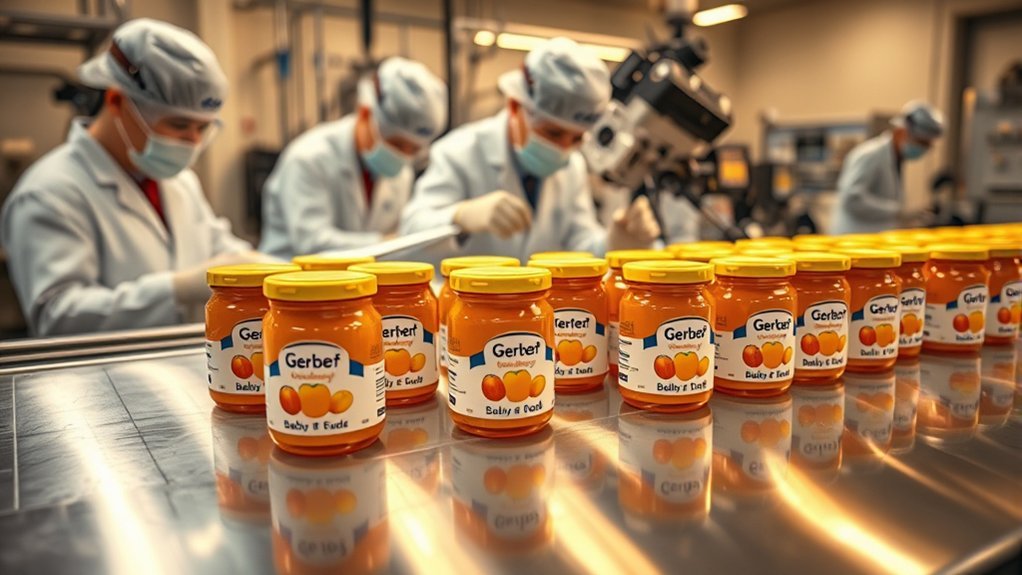
Gerber says it tests crops, water, ingredients, and finished products and that its foods must pass more than 100 quality checks. The company also says it regularly tests for more than 500 toxins and contaminants in ISO-accredited laboratories. These figures describe Gerber’s own quality program; they should be presented as manufacturer statements rather than independent proof that every product has the same metal level.
According to Gerber, its controls include:
- setting ingredient and finished-product specifications;
- working with growers and suppliers on field selection and agricultural practices;
- checking water, crops, incoming ingredients, and finished foods;
- rejecting or managing ingredients that do not meet company requirements; and
- using accredited laboratories and updated analytical methods.
Gerber also participates in Clean Label Project programs, but certification applies to select products or product groups, not automatically to every Gerber item. A certification can add information, but parents should still check the exact product and batch when test results are available.
How to Check a Gerber Product’s Heavy-Metal Test Results
California Assembly Bill 899 changed baby-food transparency. Manufacturers must test final baby foods sold in California for arsenic, cadmium, lead, and mercury at least monthly and publish identifying information and results. Starting in 2025, qualifying labels also use a QR code or other machine-readable code that connects consumers with the manufacturer’s results.
- Find the package details. Note the product name, UPC, size, lot or batch code, and best-by date.
- Scan the package QR code when present, or use Gerber’s product test-results tool.
- Match the exact production information. Results from another flavor, size, or lot may not describe the package you have.
- Read the units. Results are usually listed in ppb. A value should be compared with the FDA action level for that element and food category, when one exists.
- Do not treat “below the reporting limit” as absolute zero. It means the laboratory did not quantify the element above its stated reporting threshold.
Pro Tip: Save a photo of the lot code and best-by date before discarding an empty package. Those details are useful for checking test results, recalls, or questions to the manufacturer.
AB 899 is a testing-and-disclosure law; it does not create maximum limits for all four elements. The California Department of Public Health’s AB 899 FAQ explains the testing, website, and labeling requirements.
Which Baby-Food Ingredients Deserve Extra Variety?
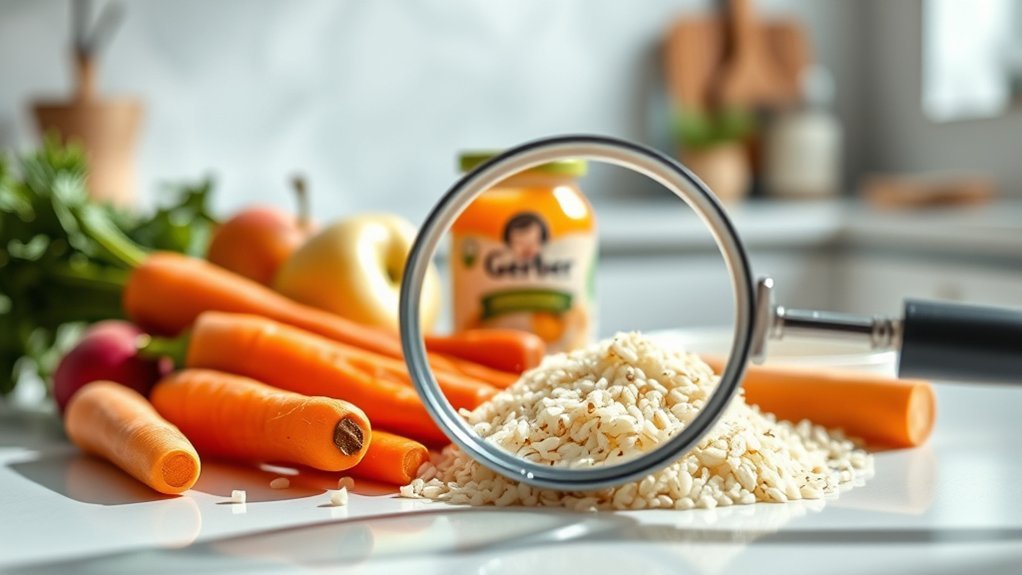
No single ingredient must be banned from a healthy child’s diet solely because it can contain a toxic element. The better approach is to avoid serving the same higher-exposure food at most meals.
- Rice and rice-based snacks: Rice tends to absorb more arsenic than many other grains. Rotate oatmeal, barley, quinoa, multigrain cereal, and other age-appropriate grains.
- Root vegetables: Sweet potatoes, carrots, and similar foods grow in soil and may have higher lead or cadmium levels than some other produce. Keep them in rotation rather than using one as a daily staple.
- Fruit juice: Juice is not needed for infants and can add sugar while replacing more nutritious foods. Follow your pediatrician’s age guidance.
- Fish: Fish provides valuable protein and omega-3 fats, but species differ in mercury. Choose lower-mercury fish and follow current FDA and EPA serving advice.
Washing produce under running water can remove soil and surface dust. Peeling may reduce contaminants on the outside. These steps do not remove metals already absorbed into the plant, so ingredient variety and source control remain important.
Is Homemade Baby Food Safer Than Store-Bought?
Homemade baby food is not automatically lower in heavy metals. The same produce, grains, spices, and water can contain toxic elements before they enter a home kitchen. Commercial foods have formal manufacturing controls and finished-product testing, while homemade food gives caregivers direct control over ingredients and preparation.
Each option has strengths and limits:
| Option | Advantages | Limits |
|---|---|---|
| Store-bought | Standardized processing, lot tracking, quality programs, and required labeling or disclosure in applicable markets. | Metal levels vary by ingredient and batch; company testing claims still require transparent results and oversight. |
| Homemade | Control over ingredients, texture, variety, and added salt or sugar. | No routine laboratory testing; safety depends on ingredients, water, hygiene, storage, and age-appropriate preparation. |
The safest practical plan is not “all homemade” or “all packaged.” It is a varied diet made from safe water and age-appropriate foods, with careful preparation and attention to recalls and product information.
How Parents Can Reduce Heavy-Metal Exposure
- Serve variety across food groups. Rotate fruits, vegetables, grains, and protein foods instead of relying on one pouch, cereal, or purée every day.
- Vary grains. Use oatmeal, barley, and other grains alongside rice cereal. Rice cereal does not need to be a baby’s first or only cereal.
- Use safe drinking and cooking water. If your home uses a private well or has known plumbing concerns, ask the local health department about appropriate testing.
- Wash produce and prepare it safely. Rinse under running water, remove visible soil, peel when appropriate, cook to a safe texture, and refrigerate leftovers promptly.
- Support good nutrition. Offer age-appropriate iron-rich foods and sources of calcium and vitamin C. Good nutrition supports development, but it is not a substitute for removing a known exposure source.
- Choose fish carefully. Follow FDA and EPA advice for lower-mercury fish and child-size portions.
- Check product results and recalls. Use the exact lot information when available and review the FDA recall database if a safety alert is reported.
The American Academy of Pediatrics offers additional practical advice in its guide to reducing heavy-metal exposure from baby food.
Warning: If your child ate a recalled food linked to elevated lead, or you have another reason to suspect lead exposure, stop using the product and contact the child’s healthcare provider. Children can have lead exposure without obvious symptoms, and a blood lead test is the best way to assess it.
What Parents Should Know About Gerber Products
Gerber’s published quality program and product test-result system provide useful information, but they do not justify a blanket claim that every Gerber food is metal-free. The more accurate conclusion is:
- trace toxic elements can occur in Gerber foods for the same environmental reasons they occur in other foods;
- Gerber says it uses sourcing, testing, and quality controls to reduce levels;
- the exact result can vary by food and production lot;
- FDA action levels apply differently by element and food category; and
- parents can reduce repeated exposure through diet variety and product-specific checks.
Current recall information should always come from the FDA or the manufacturer. The FDA-posted 2025 Gerber Soothe N Chew recall was for a choking hazard, not heavy-metal contamination. Do not assume that a general news story about baby-food metals means a particular Gerber package has been recalled.
Frequently Asked Questions
Are there regulations governing heavy-metal levels in baby food?
Yes, but they are not one universal limit for every metal and product. The FDA has final lead action levels for several packaged baby-food categories and a 100 ppb inorganic-arsenic action level for infant rice cereal. As of July 21, 2026, the FDA has not published broad final baby-food action levels for cadmium or mercury. California AB 899 separately requires testing and public disclosure of arsenic, cadmium, lead, and mercury.
Can heavy-metal exposure from baby food affect long-term health?
Repeated exposure to toxic elements can contribute to health risks, and young children are especially vulnerable. Lead can affect learning, attention, and development. Risk depends on the metal, dose, duration, and all exposure sources, so a single detectable food result does not by itself diagnose harm.
What specific heavy metals does Gerber test for?
Gerber states that it tests products for arsenic, cadmium, lead, and mercury and also screens for many other contaminants. California AB 899 requires those four elements to be tested in covered final baby-food products sold in the state.
How often does Gerber update its safety practices?
Gerber says it updates methods and works with outside laboratories, but there is no single public schedule covering every safety-practice change. For covered California products, final-product testing must occur at least monthly, and applicable results must be disclosed for consumers.
Have Gerber products been recalled for heavy-metal contamination?
The original article did not provide evidence of a Gerber recall specifically caused by heavy metals. The prominent FDA-posted Gerber recall in 2025 involved Soothe N Chew teething sticks and a choking hazard. Check the FDA recall database and Gerber notices for the latest product- and lot-specific information.
Does a detectable result mean the baby food is unsafe?
Not automatically. Modern laboratories can detect very small concentrations. Interpretation requires the element, chemical form, ppb result, food category, serving size, and frequency of use. Compare the exact result with any applicable FDA action level and discuss unusual exposure concerns with a pediatrician.
Should parents stop serving rice cereal or root vegetables?
Usually no. Rice cereal and root vegetables can be part of a varied diet. Rotate grains and produce rather than relying on one item at most meals, and follow pediatric guidance for age, texture, portions, and nutrition.
Conclusion
Gerber baby food can contain heavy metals because crops and other ingredients may pick up toxic elements from the environment before manufacturing begins. Gerber says it uses supplier controls and extensive testing to reduce them, but “tested” does not mean “metal-free,” and levels can vary by product and lot. The most useful steps are to serve a varied diet, rotate grains and produce, use safe water, check product-specific results and recalls, and speak with a pediatrician when a known exposure is suspected.
Sources
- U.S. Food and Drug Administration: Lead action levels for processed foods intended for babies and young children — current category-specific lead guidance.
- U.S. Food and Drug Administration: Inorganic arsenic in infant rice cereal — 100 ppb action level and scope.
- U.S. Food and Drug Administration: Closer to Zero — current federal program status for lead, arsenic, cadmium, and mercury.
- California Department of Public Health: AB 899 Frequently Asked Questions — monthly testing, disclosure, and QR-code requirements.
- American Academy of Pediatrics: Heavy Metals in Baby Food — practical exposure-reduction guidance for families.
- Centers for Disease Control and Prevention: Testing for Lead Poisoning in Children — when to discuss blood lead testing with a healthcare provider.