A coffee maker “cup” is usually a carafe or reservoir-capacity marking, not the same as an 8-fluid-ounce U.S. measuring cup or the mug you drink from. Many automatic drip brewers use approximately 5 fluid ounces per marked cup, but the definition varies by model. Check your brewer’s manual or measure its reservoir before converting the markings.
Quick Answer
One coffee maker cup is commonly about 5 fluid ounces, while a U.S. measuring cup is 8 fluid ounces. Therefore, a 12-cup brewer based on 5-ounce markings represents about 60 fluid ounces, or 7.5 measuring cups. Always confirm the cup definition for your exact brewer.
Key Takeaways
- A coffee maker cup is a manufacturer-defined capacity marking, not a universal serving size.
- Many drip brewers use a 5-fluid-ounce cup, making a 12-cup capacity about 60 fluid ounces when that convention applies.
- A U.S. measuring cup is exactly 8 fluid ounces, so coffee-maker markings and kitchen-cup measurements are not interchangeable.
- If your brewer uses another value, such as 6 fluid ounces per marked cup, use that number instead of assuming 5 ounces.
- Finished beverage volume can be lower than the water added because coffee grounds, the filter, and the brewer retain some liquid.
- For consistent drip coffee, weighing the water and coffee is more reliable than relying only on cups or scoops.
At a Glance
| Time Required | 1–2 minutes to check or measure your brewer |
| Difficulty | Easy |
| Tools Needed | Brewer manual or 8-ounce measuring cup; digital scale optional |
| Cost | No cost with measuring tools you already own |
How Big Is a Coffee Maker Cup?
There is no single universal size for a “coffee maker cup.” The number printed beside a brewer’s reservoir or carafe is a capacity label defined by the manufacturer. It does not necessarily represent an 8-ounce kitchen measuring cup or one full drinking mug.
A 5-fluid-ounce increment is common in automatic drip machines. For example, Cuisinart describes one current 12-cup model as holding twelve 5-ounce cups, and a Hamilton Beach manual states that its brewer measurements are based on a 5-ounce cup.
That does not mean every coffee maker follows the same system. Other machines can use different marked-cup volumes, while single-serve brewers may identify brew sizes directly in fluid ounces. The manual or specifications for your exact model are the best authority.
A 12-cup brewer based on 5-ounce markings represents 60 fluid ounces—the same nominal volume as 7.5 standard U.S. measuring cups.
Power your essentials anywhere with a 999Wh pure sine wave power station delivering up to 1000W continuous with 2000W surge. It supports fast charging via USB-C PD 60W and USB-A QC 18W, plus simultaneous output for multiple devices through AC, USB, wireless, and car/DC ports. Recharge using AC, car, or solar with a built-in MPPT controller and dual cooling fans, while the upgraded battery management system protects against surges, short circuits, and overheating.

Please refer to user guide or user manual or user guide (provided below in PDF) before first use

SEMI-TRANSPARENT WATER RESERVOIR holds up to 5 cups of water capacity with a level indicator to always ensure you have enough water ready for brewing.
How Coffee Maker Cups Differ From Measuring Cups
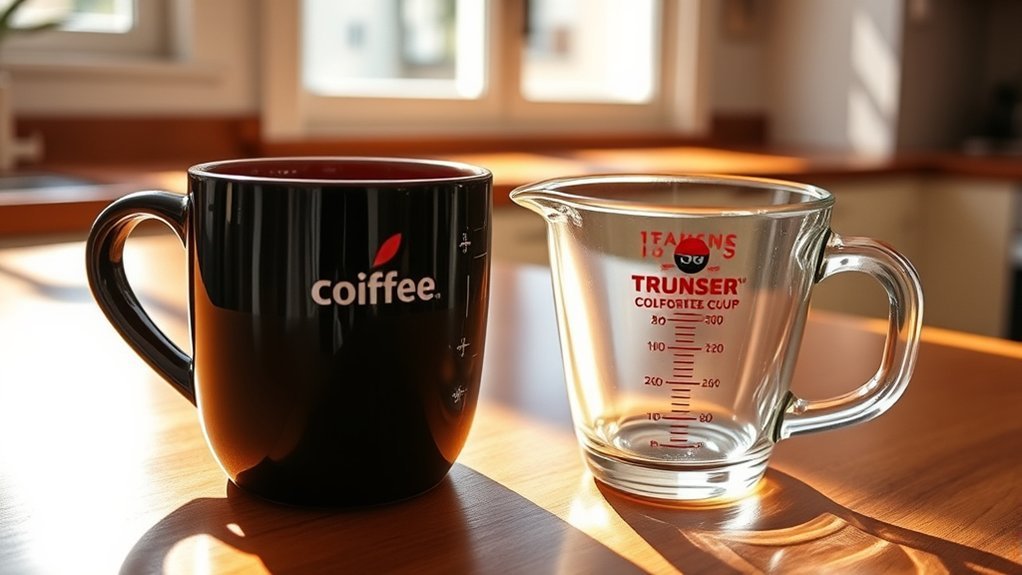
The word cup can refer to several different measurements:
- Coffee maker cup: A manufacturer-defined increment used on a reservoir or carafe. About 5 fluid ounces is common on many drip brewers, but it is not universal.
- U.S. measuring cup: Exactly 8 U.S. fluid ounces. The current NIST measurement table lists this as approximately 237 milliliters.
- Coffee mug: A drinking vessel with no fixed standard capacity. Mug sizes can vary substantially.
- Serving: The amount one person pours, which may be smaller or larger than any of the measurements above.
Note: Fluid ounces measure liquid volume. Ounces used for coffee grounds normally refer to weight. Writing “60 fluid ounces of water” and “3.5 ounces of coffee by weight” helps prevent a major measurement mistake.
Coffee Maker Cup Size Conversion Chart

The following chart applies only when a brewer uses 5 fluid ounces per marked cup. Use it as a quick reference, then confirm the actual cup definition or total capacity in your model’s documentation.
| Carafe Marking | Nominal Fluid Ounces | Approx. Milliliters | 8-Ounce Measuring Cups | Approx. 10-Ounce Mugs Before Brewing Loss |
|---|---|---|---|---|
| 4 cups | 20 fl oz | 591 mL | 2.5 cups | 2 mugs |
| 6 cups | 30 fl oz | 887 mL | 3.75 cups | 3 mugs |
| 8 cups | 40 fl oz | 1,183 mL | 5 cups | 4 mugs |
| 10 cups | 50 fl oz | 1,479 mL | 6.25 cups | 5 mugs |
| 12 cups | 60 fl oz | 1,774 mL | 7.5 cups | 6 mugs |
| 14 cups | 70 fl oz | 2,070 mL | 8.75 cups | 7 mugs |
The mug count above is based on nominal water capacity before brewing. The finished pot will normally contain less liquid because some water remains in the grounds, filter, basket, or internal parts of the machine.
Use This Formula for Any Coffee Maker Cup Size
If your brewer does not use 5-ounce cups, you can calculate its capacity without relying on a generic chart:
- Total nominal fluid ounces: marked cups × manufacturer’s fluid ounces per cup.
- U.S. measuring cups: total fluid ounces ÷ 8.
- Approximate milliliters: total fluid ounces × 29.57.
For example, if a 12-cup brewer defines each marked cup as 6 fluid ounces, its nominal capacity is 72 fluid ounces. That equals 9 standard 8-ounce measuring cups, or approximately 2.13 liters.
Note: Do not apply the 60-ounce “12-cup” calculation to a machine unless its manual, specifications, or measured reservoir confirms a 5-ounce cup basis.
How to Check Your Coffee Maker’s Actual Capacity
Do not rely only on the advertised cup count when you need an exact serving volume. Use one of these methods:
- Read the product manual. Look for wording such as “cup equals approximately 5 ounces,” reservoir capacity, carafe capacity, or milliliters per cup.
- Check the product specification page. A manufacturer may list total ounces or liters even when the product name only says “10-cup” or “12-cup.”
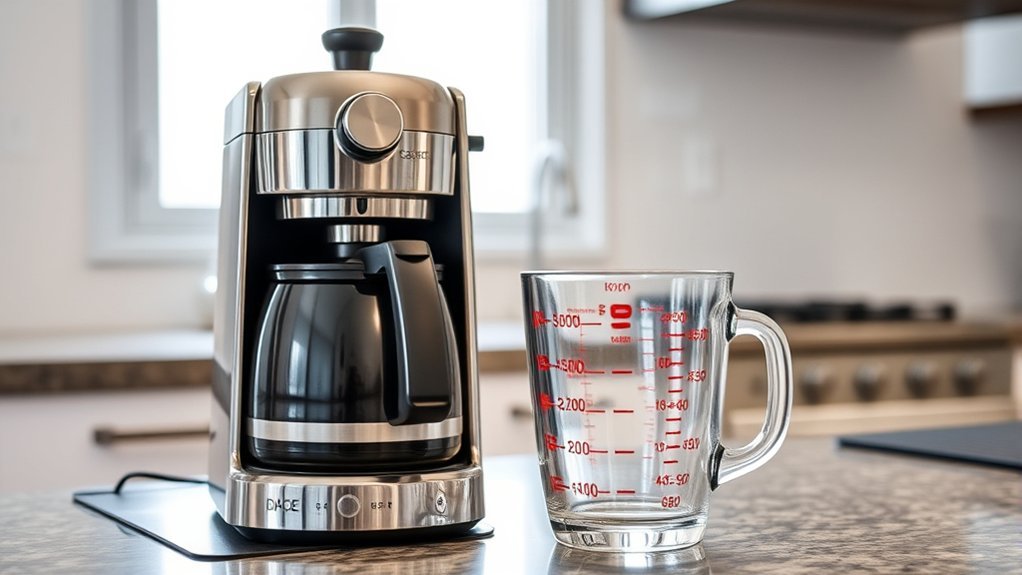
- Measure the reservoir. Add water with an 8-ounce measuring cup until it reaches the highest safe fill line. Record the total.
- Test one marked interval. Measure how much water is needed to move from one numbered carafe or reservoir line to the next.
- Measure finished yield. Run a normal batch and measure the brewed coffee after dripping stops if actual serving volume is important.
Pro Tip: Write your brewer’s measured total capacity and preferred coffee dose on a removable label inside a cabinet. You will not need to repeat the conversion each morning.
How Much Coffee Should You Use?
A brew ratio compares the weight of dry coffee with the weight of water. A 1:18 ratio means 1 gram of coffee for every 18 grams of water. Because one milliliter of water weighs approximately one gram under normal kitchen conditions, the calculation is straightforward when both ingredients are measured with a digital scale.
A practical starting range for automatic drip coffee is about 1:17 to 1:18. The BUNN brewing-control material includes 1:17 and 1:18 among its weight-based brewing ratios. These numbers are starting points rather than a universal rule, so adjust the dose to suit your brewer, coffee, and taste.
| Water Added | Approximate Water Weight | Coffee at 1:18 | Coffee at 1:17 |
|---|---|---|---|
| 5 fl oz | 148 g | 8 g | 9 g |
| 6 fl oz | 177 g | 10 g | 10 g |
| 8 fl oz | 237 g | 13 g | 14 g |
| 10 fl oz | 296 g | 16 g | 17 g |
| 12 fl oz | 355 g | 20 g | 21 g |
| 40 fl oz | 1,183 g | 66 g | 70 g |
| 50 fl oz | 1,479 g | 82 g | 87 g |
| 60 fl oz | 1,774 g | 99 g | 104 g |
Warning: Do not exceed the brew basket’s stated capacity simply to reach a target ratio. Too many grounds, an overly fine grind, or an incorrectly seated filter can cause the basket to overflow. Follow the limits in your brewer’s manual.
How to Measure Coffee and Water Consistently
Use a Digital Scale When Possible
Weighing both ingredients removes much of the uncertainty caused by different bean densities, grind sizes, scoops, and spoon-filling methods.
- Place the empty reservoir or a separate water container on the scale.
- Tare the scale to zero.
- Add the desired weight of water.
- Divide the water weight by 17 or 18 to calculate a starting coffee dose.
- Weigh the ground coffee separately before adding it to the filter.
For example, 1,020 grams of water divided by 17 equals 60 grams of coffee. At 1:18, the same amount of water would use about 57 grams.
Measure Without a Scale
You can still brew consistently without weighing every batch:
- Use the scoop and recipe supplied with the machine when available.
- Level each scoop instead of using rounded or heaped scoops.
- Use the same grind setting, scoop, coffee, and carafe line each time.
- Record how many level scoops produced the taste you preferred.
- If possible, weigh one scoop once so you know its approximate mass for that coffee.
A tablespoon is a fixed volume, but the weight of coffee inside it is not fixed. Roast level, grind size, and how densely the grounds fill the spoon can all change the mass.
Adjust the Brew Strength
Change one variable at a time so you can tell which adjustment helped:
- For stronger coffee: Try about 5% more coffee while keeping the water amount unchanged.
- For milder coffee: Try about 5% less coffee.
- For sour or thin coffee: A slightly finer grind may improve extraction before you make a large dose change.
- For bitter or drying coffee: Try a slightly coarser grind and make sure the brewer and carafe are clean.
The ratio controls concentration, but grind size, brew time, water distribution, roast, freshness, and the brewer itself also affect the result. The Specialty Coffee Association’s standards program treats equipment and brewing performance as part of a broader technical system rather than reducing coffee quality to one ratio.
Why Brewed Output Is Less Than the Water Added
If you add 60 fluid ounces of water, you should not assume you will pour exactly 60 fluid ounces of finished coffee. Some liquid remains with the wet grounds and filter, while a smaller amount can remain in the brew basket, tubing, or reservoir.
The difference changes with:
- The mass of dry coffee used
- Grind size and coffee-bed depth
- Paper, cloth, or permanent filter type
- How completely the basket drains
- Water retained inside the machine
- Steam and minor evaporation
Researchers can quantify retained liquid instead of assuming one fixed loss. For example, a Scientific Reports study of full-immersion coffee followed by filtration used a liquid-retention ratio when analyzing beverage and spent-ground measurements. That experiment was not a test of every automatic drip brewer, so your machine’s actual loss is best determined by measuring one complete batch.
Note: Use the amount of water added when calculating your coffee dose. Use measured beverage output when deciding how many mugs or guests the finished batch will serve.
Decoding Coffee Maker Capacity Claims
A brewer advertised as “12-cup” may not provide twelve full mugs. On a model that uses 5-fluid-ounce increments, the nominal marked capacity is 60 fluid ounces. That equals:
- 7.5 standard 8-ounce measuring cups
- Six nominal 10-ounce mugs before brewing loss
- Five nominal 12-ounce mugs before brewing loss
- Less finished beverage if the grounds and brewer retain part of the added water
Capacity claims are most useful when you know the manufacturer’s cup definition. For planning servings, the listed fluid-ounce or liter capacity is usually more informative than the cup count alone. Cuisinart, for example, explicitly states that the double-wall coffee reservoir on its DCC-3000 holds twelve 5-ounce cups of coffee. Hamilton Beach likewise specifies a 5-ounce cup basis in a brewer manual.
Troubleshooting Inconsistent Brewing Results
The Coffee Is Too Weak
- Confirm that you did not treat each carafe cup as 8 fluid ounces when your machine uses a smaller marked cup.
- Increase the coffee dose in a small step, such as about 5%.
- Try a slightly finer grind if the water passes through too quickly.
- Check that the spray head distributes water across the coffee bed.
The Coffee Is Too Strong
- Reduce the coffee dose in a small step, such as about 5%.
- Confirm that coffee ounces were measured by weight rather than fluid volume.
- Try a slightly coarser grind if the coffee tastes bitter or drying.
The Finished Yield Is Lower Than Expected
- Remember that the cup count usually describes a nominal capacity rather than the number of full mugs you will pour.
- Check whether you used a larger-than-normal coffee dose.
- Allow the basket to finish dripping before removing the carafe.
- Inspect the brewer for scale buildup, a blocked outlet, or water left in the reservoir.
- Measure one complete batch so you can plan servings from your machine’s real output.
The Brew Basket Overflows
- Use fewer grounds if the basket is above its recommended maximum.
- Use the correct filter size and seat it flat against the basket.
- Choose a coarser drip grind if the current grind is powdery or slows drainage.
- Clean the basket outlet and showerhead according to the manual.
Frequently Asked Questions
How many ounces are in one coffee maker cup?
Many automatic drip coffee makers use approximately 5 fluid ounces per marked cup, but there is no universal brewer-cup size. Check the manual, specifications, or measured reservoir on your exact model.
Is a 12-cup coffee maker 96 ounces?
Usually not. A 12-cup brewer that uses 5-ounce markings has a nominal capacity of 60 fluid ounces. It would equal 96 fluid ounces only if the manufacturer defined each marked cup as 8 fluid ounces.
What if my coffee maker uses 6-ounce cups?
Use the manufacturer’s number instead of the common 5-ounce assumption. For example, twelve 6-ounce markings equal 72 fluid ounces, which is 9 standard 8-ounce measuring cups.
How many mugs does a 12-cup coffee maker produce?
If the machine uses 5-ounce markings, its 60-fluid-ounce nominal capacity equals six 10-ounce mugs or five 12-ounce mugs before brewing losses. Actual finished yield can be lower because the grounds and brewer retain some liquid.
Can I use a standard measuring cup to fill a coffee maker?
Yes. An 8-fluid-ounce measuring cup is useful for determining the reservoir’s true capacity. Do not assume that one measuring cup equals one numbered coffee maker cup.
Why is there less brewed coffee than the amount of water I added?
Coffee grounds and the filter retain liquid, and some water can remain inside the brew basket or machine. The exact difference depends on the coffee dose, grind, filter, drainage, and brewer design.
What coffee-to-water ratio should I use?
For automatic drip coffee, a practical starting point is about 1 gram of coffee for every 17 to 18 grams of water. Treat this as a starting range and adjust the dose in small steps after tasting the finished batch.
What happens if I mismeasure the coffee?
Too little coffee can produce a thin or weak drink, while too much can create an overly concentrated batch or exceed the filter basket’s capacity. Consistent water, coffee, grind, and scoop measurements make problems easier to correct.
Do different brewing methods use the same cup measurement?
No. Carafe markings, single-serve ounce settings, espresso servings, and other brewing systems can represent different volumes. Use the stated fluid-ounce or milliliter capacity rather than assuming the word “cup” always means the same amount.
Conclusion
A coffee maker cup should be treated as a machine-specific capacity marking. Five fluid ounces is common on automatic drip brewers, but the manual, specifications, or a measured-water test should settle the question for your model. Once you know the actual capacity, use that number for conversions, weigh coffee and water when practical, and measure finished yield when planning servings.
Sources
- NIST Handbook 44—2026, Appendix C — U.S. measuring-cup, fluid-ounce, milliliter, and gallon conversions.
- Cuisinart DCC-3000 Coffee Maker Specifications — manufacturer example of a coffee reservoir holding twelve 5-ounce cups.
- Hamilton Beach 5-Cup Coffee Maker Use and Care Guide — manufacturer example defining brewer measurements by a 5-ounce cup.
- Specialty Coffee Association Standards — current framework covering coffee equipment and brewing-performance standards.
- BUNN Coffee Basics and Brewing Control Chart — weight-based coffee-to-water ratios and brewing-control principles.
- Scientific Reports: An Equilibrium Desorption Model for the Strength and Extraction Yield of Full Immersion Brewed Coffee — research on brew ratio, filtration, and retained liquid in spent coffee grounds.