A coffee maker’s wattage tells you how much electrical power it can draw while heating water, but wattage alone does not tell you how much energy one pot will add to your bill. Common household electric coffee makers span a broad range of roughly 550 to 1,500 watts, while some espresso and specialty machines can go higher. Actual electricity use depends mainly on the machine’s rated power, active heating time, keep-warm use, and standby settings.
Quick Answer
Many household electric coffee makers are rated between roughly 550 and 1,500 watts, with full-size drip brewers commonly near 750–1,200 watts. A 1,000-watt machine heating for 10 minutes uses about 0.167 kWh, which costs roughly 3.1 cents at the June 2026 U.S. residential average of 18.34 cents per kWh.
Key Takeaways
- Check the label on your coffee maker or its manual for the actual wattage; ratings vary considerably by model.
- Watts measure power, while kilowatt-hours measure the energy that appears on your electricity bill.
- A 1,000-watt machine operating for 10 minutes uses about 0.167 kWh, not several kilowatt-hours.
- Keeping coffee hot on an electric warming plate can use as much energy as, or more energy than, a short brewing cycle.
- At 120 volts, a 1,500-watt coffee maker represents about 12.5 amps while drawing its full rated power.
- For an inverter or portable power station, check continuous AC output in watts as well as battery capacity in watt-hours.
- Actual energy use is best measured with a properly rated plug-in electricity meter and priced using the rate on your own utility bill.
At a Glance
| Time Required | About 2–5 minutes to estimate usage |
| Difficulty | Easy |
| Tools Needed | Coffee maker rating label, timer, calculator, and optionally a properly rated plug-in electricity meter |
| Cost | Usually a few cents per brewing cycle; warming and standby use can add more |
How Many Watts Does a Coffee Maker Use on Average?
There is no single wattage that applies to every coffee maker. The most dependable figure is the rated wattage printed on the appliance label, usually near the base or power cord, or listed in the owner’s manual.
An older ENERGY STAR coffee-maker scoping report documented broad input-power ranges of 550–900 watts for small automatic drip machines, 750–1,200 watts for full-size drip machines, 900–1,500 watts for capsule-style single-serve machines, and 1,000–1,500 watts for pump or fully automatic espresso machines. Those figures are useful as planning ranges, not as a current specification for every product sold today.
Current manufacturer examples also show why the model number matters. The BLACK+DECKER CM1160B 12-cup programmable coffeemaker is rated at 975 watts. Keurig’s official Classic Series information lists the K55 brewer at 120 volts and 1,500 watts.
| Coffee Maker Type | Useful Planning Range | What Affects Actual Use |
|---|---|---|
| Compact drip brewer | Roughly 550–900 watts | Water volume, heating time, and whether it has a warming plate |
| Full-size drip brewer | Roughly 750–1,200 watts | Batch size, brew duration, and keep-warm time |
| Single-serve pod brewer | Roughly 900–1,500 watts | Initial heating, reheating, cup size, reservoir temperature, and auto-off settings |
| Espresso machine | Often around 1,000–1,500 watts; some models are higher | Boiler or thermoblock warm-up, pumps, grinder, and steam use |
Note: A 1,500-watt rating does not mean the appliance continuously draws exactly 1,500 watts whenever it is plugged in. Heating elements cycle, brewing ends after a short period, and standby electronics normally use much less power.
Watts tell you how fast a coffee maker can use electrical energy. Runtime tells you how much energy accumulates on your electricity bill.
Do Manual Coffee Makers Use Electricity?
A French press, pour-over cone, AeroPress-style brewer, moka pot used on a separate stove, or other manual brewing device does not use electricity by itself. The energy is consumed by whatever heats the water, such as an electric kettle, induction cooktop, gas burner, or stove.
This matters when comparing “coffee maker wattage.” A manual brewer can correctly be described as a zero-watt appliance while still requiring energy somewhere else in the brewing process.
How Much Power Does a Drip Coffee Maker Consume?
A full-size drip coffee maker commonly falls near the 750- to 1,200-watt range, but energy per pot depends on how long its heating element operates and what happens after brewing.
For example, suppose a 1,000-watt machine takes 10 minutes to brew:
- Convert minutes to hours: 10 ÷ 60 = about 0.167 hour.
- Multiply watts by hours: 1,000 × 0.167 = about 167 watt-hours.
- Convert to kilowatt-hours: 167 ÷ 1,000 = about 0.167 kWh.
At the June 2026 U.S. residential average electricity price of 18.34 cents per kWh, that brewing cycle costs approximately:
0.167 kWh × $0.1834 = about $0.031, or roughly 3.1 cents.
This example is much lower than 2.4 kWh. A 1,200-watt machine would have to draw its full rated power continuously for two hours to consume 2.4 kWh.
The warming plate can materially change the total. For example, if a warming plate averaged 80 watts for two hours, it would add another 0.16 kWh. At 18.34 cents per kWh, that hypothetical keep-warm period costs about 2.9 cents and uses almost as much energy as the 10-minute brewing example.
Pro Tip: If you drink coffee over several hours, transfer it to an insulated thermal carafe and turn off the warming plate when your coffee maker allows it. This can reduce electricity use and also avoids continuously reheating the brewed coffee.
What Is the Energy Usage of Single-Serve Coffee Makers?
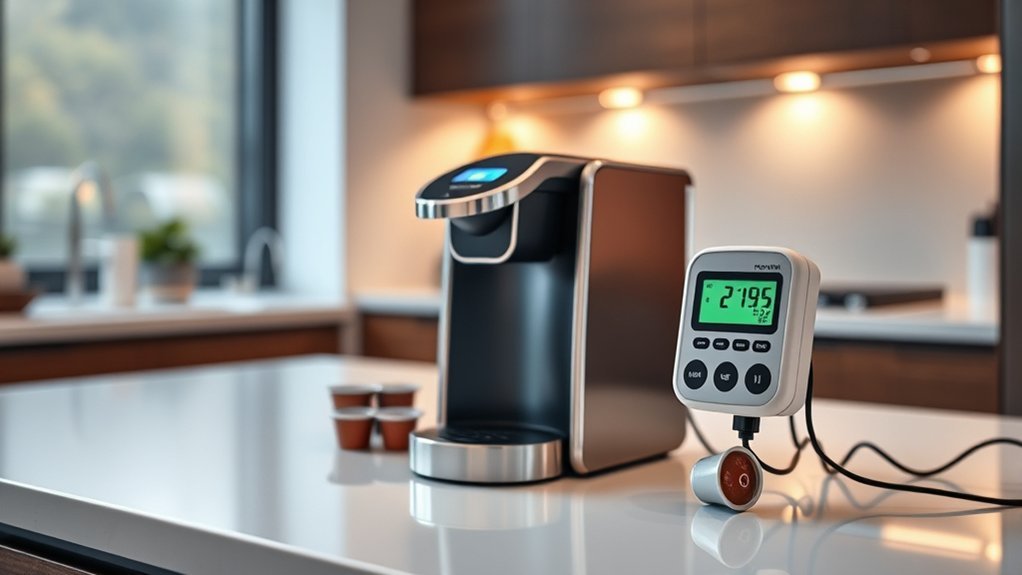
Single-serve machines can have relatively high wattage because they need to heat water quickly. That does not automatically mean one cup uses more total electricity than a full pot. The result depends on initial warm-up time, active brewing time, reheating between cups, reservoir heating, standby behavior, and the number of drinks prepared.
Consider a 1,500-watt single-serve brewer operating at its full rated power for three minutes:
1,500 watts × 3/60 hour ÷ 1,000 = 0.075 kWh.
At 18.34 cents per kWh, that mathematical example costs about 1.4 cents. If the machine remains hot between cups, takes longer to preheat, or keeps an internal reservoir warm for hours, total daily use will be higher.
| Example | Calculation | Energy | Cost at 18.34¢/kWh |
|---|---|---|---|
| 1,000W drip brewer for 10 minutes | 1,000 × 10/60 ÷ 1,000 | About 0.167 kWh | About 3.1¢ |
| 1,500W pod brewer for 3 minutes | 1,500 × 3/60 ÷ 1,000 | 0.075 kWh | About 1.4¢ |
| Hypothetical 80W warming plate for 2 hours | 80 × 2 ÷ 1,000 | 0.160 kWh | About 2.9¢ |
These are mathematical examples, not measured averages for every machine. A plug-in electricity meter provides a more accurate result for your specific brewer because the heating element may cycle instead of drawing full nameplate wattage for the entire period.
How to Calculate Electricity Usage for Your Coffee Maker
Use the following formula:
Energy in kWh = wattage × operating hours ÷ 1,000
Then calculate cost:
Electricity cost = kWh × your electricity rate
- Find the wattage. Check the rating label, manual, or manufacturer’s specifications.
- Time the active cycle. Include preheating and brewing. Measure steaming separately if you use an espresso machine.
- Convert minutes to hours. Divide the number of minutes by 60.
- Calculate kWh. Multiply watts by hours, then divide by 1,000.
- Add warming and standby energy. Calculate these separately if the machine stays powered after brewing.
- Apply your utility rate. Use the price per kWh shown on your electricity bill whenever possible.
What If the Label Lists Volts and Amps Instead of Watts?
If the appliance label gives voltage and current but not wattage, you can make a basic power estimate with:
Watts ≈ volts × amps
For example, a 120-volt appliance labeled at 10 amps corresponds to approximately:
120 volts × 10 amps = 1,200 watts.
For inverter or generator sizing, use the manufacturer’s stated wattage when one is available because real AC loads can be more complicated than the simple volts-times-amps estimate.
How Many Amps Does a Coffee Maker Use?
For a simple 120-volt estimate:
Amps ≈ watts ÷ volts
| Rated Wattage | Approximate Current at 120V |
|---|---|
| 900 watts | 7.5 amps |
| 1,200 watts | 10 amps |
| 1,500 watts | 12.5 amps |
This calculation helps explain why high-wattage coffee makers can be demanding loads even though they run for only a few minutes. Avoid operating several high-power appliances on the same circuit unless the circuit and connected equipment are designed for the combined load.
How to Measure Actual Electricity Use
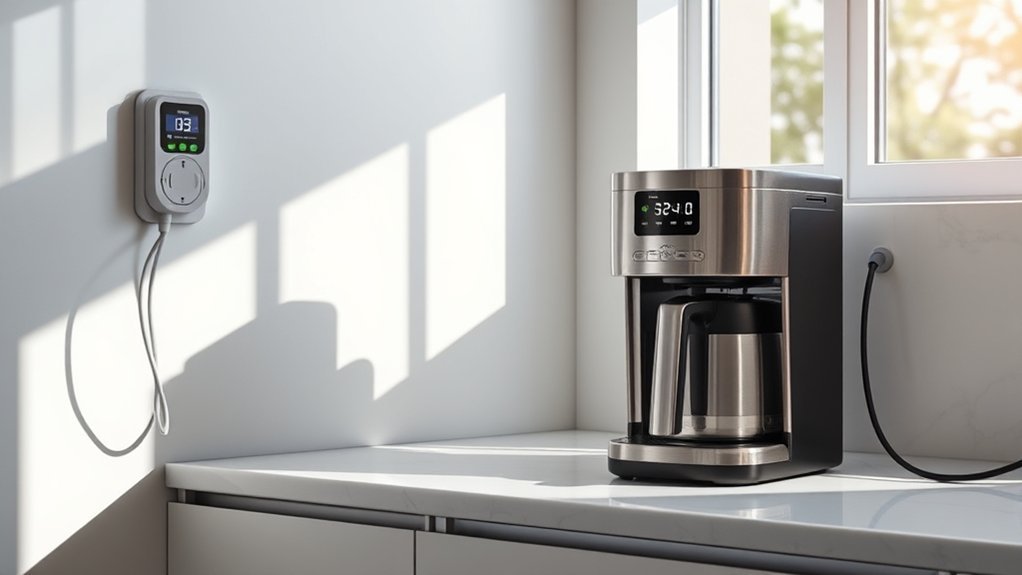
A plug-in electricity meter is more accurate than estimating from the nameplate because it records heater cycling, standby power, and changing demand throughout a normal brewing session.
- Plug a properly rated meter into a suitable grounded wall outlet.
- Plug the coffee maker into the meter.
- Reset the meter’s accumulated kWh reading.
- Run the machine as you normally would, including any warming time.
- Record the total kWh after one brewing cycle, one day, or several days.
- For a multi-day test, divide the total by the number of days or brewing cycles to find an average.
Warning: Use only a meter, extension cord, inverter, power strip, or adapter that is specifically rated for the coffee maker’s voltage and current. Do not use damaged cords, undersized wiring, loose outlets, or ungrounded plug converters.
Understanding Daily and Monthly Energy Costs
The latest U.S. Energy Information Administration data available as of September 2, 2026 reports an average residential electricity price of 18.34 cents per kWh for June 2026. The data was released on August 26, 2026. Your own rate may be higher or lower, so use the rate on your utility bill whenever possible.
Here are transparent once-daily examples:
| Daily Scenario | Daily Energy | 30-Day Energy | 30-Day Cost |
|---|---|---|---|
| One 1,000W, 10-minute drip cycle | About 0.167 kWh | About 5.00 kWh | About $0.92 |
| One 1,500W, 3-minute pod cycle | 0.075 kWh | 2.25 kWh | About $0.41 |
| Drip cycle plus a hypothetical 80W plate for 2 hours | About 0.327 kWh | About 9.80 kWh | About $1.80 |
These examples show why one monthly figure cannot apply to every drip coffee maker. Brew frequency, preheating, and keep-warm time often matter more than a modest difference in rated wattage.
How Much Does Standby Power Cost?
Some programmable coffee makers draw power for a clock, display, wireless connection, control board, or heated reservoir while they are not actively brewing. Other simple switch-operated models may draw little or no measurable power when switched off.
The Lawrence Berkeley National Laboratory standby-power resource explains that products containing electronics may consume electricity in standby and compiles measurements from laboratory and academic sources. Because standby demand differs by model, measuring your own coffee maker is more useful than assuming a universal value.
For a simple example, suppose a coffee maker averages exactly 1 watt of standby draw continuously:
1 watt × 24 hours × 365 days ÷ 1,000 = 8.76 kWh per year.
At 18.34 cents per kWh, that equals about $1.61 per year. A machine with true zero-watt shutoff would use no standby energy, while a machine that keeps water hot internally could consume considerably more.
Key Factors Influencing Coffee Maker Energy Use
- Nameplate wattage: Higher wattage means the appliance can draw power at a faster rate, but it does not automatically mean higher energy use per cup.
- Water volume: Heating a full carafe generally requires more total energy than heating one cup.
- Preheating time: Espresso and pod machines may draw substantial power before coffee begins flowing.
- Warming-plate duration: Keeping a glass carafe hot for one or two hours can add meaningful energy use.
- Thermal design: An insulated carafe stores heat without continuously powering a warming plate.
- Standby settings: Clocks, displays, tank heaters, and wireless features may use electricity between brews.
- Number of brews: Several single cups may use more energy than one batch if the machine repeatedly reheats.
- Scale buildup: Mineral deposits can interfere with normal heating and water flow. Follow the manufacturer’s descaling schedule rather than assuming a specific energy penalty.
Tips to Save on Energy Costs With Your Coffee Maker
- Brew only what you will drink. Heating a full pot wastes water, coffee, and energy when most of it is discarded.
- Batch several cups when practical. One larger brew may avoid repeated warm-up cycles.
- Use a thermal carafe. It keeps coffee warm without continuously powering a hot plate.
- Enable auto-off. Follow your manufacturer’s instructions because shutoff timing differs by model.
- Turn off continuous reservoir heating when your machine allows it. Some single-serve systems provide energy-saving settings.
- Unplug a high-standby model during long periods of non-use. Do not repeatedly unplug a machine if its manual advises otherwise or if doing so causes unwanted settings to reset.
- Descale as directed. Proper maintenance supports normal heating and water flow.
- Measure before replacing. A plug-in meter can show whether buying a new machine would save enough electricity to matter.
Do not focus only on peak wattage. A 1,500-watt machine that heats for two minutes can use less total energy than a 900-watt machine that heats much longer and then keeps a warming plate running for hours.
Common Coffee Maker Power Mistakes
- Confusing watts with watt-hours. A 1,500-watt rating is a power requirement, not 1.5 kWh of energy per cup.
- Assuming full wattage is drawn continuously. Heating elements often cycle or switch off after brewing.
- Ignoring the warming plate. A lower-power heater can still consume meaningful energy if it runs for hours.
- Sizing a power station from surge output alone. A coffee maker needs adequate continuous AC output, not merely an impressive short-duration peak figure.
- Forgetting other loads. A grinder, refrigerator, microwave, kettle, lights, or chargers can reduce the power available to the coffee maker.
Which Solar Generators Are Best for Coffee Makers?
There is no single best portable power station for every coffee maker. The right size depends first on your brewer’s wattage and then on how many brewing cycles you want from the battery.
The term solar generator is commonly used for a battery power station that can be recharged from compatible solar panels. The battery can normally power a coffee maker without panels attached as long as it has enough stored charge and the inverter can support the appliance.
A portable power station must meet two separate requirements:
- Continuous AC output in watts: This determines whether the power station can safely run the coffee maker.
- Battery capacity in watt-hours: This helps determine how many brewing cycles the battery can support.
The Jackery models named in the original article remain useful examples, although product lineups and availability change. Official specifications available in 2026 include:
- Explorer 1000 Plus: 1,264Wh capacity and 2,000W total AC output according to Jackery’s current support information.
- Explorer 2000 Plus: 2,042.8Wh capacity and 3,000W AC output.
- Explorer 2000 v2: 2,042Wh capacity with 2,200W rated AC output and 4,400W surge peak.
- Explorer 3000 Pro: 3,024Wh capacity and 3,000W output.
Jackery’s current U.S. buying guide also lists newer models, including the Explorer 1000 v2. Model names therefore matter less than checking the exact continuous output, capacity, outlet voltage, and manual before purchase.
All four examples above have enough rated output for many household coffee makers, but a large 2–3kWh battery may be unnecessary when coffee brewing is the only planned load.
Note: A power station rated at exactly the same wattage as a high-power appliance leaves little margin. For a 1,500-watt coffee maker, a unit with more than 1,500 watts of continuous AC output is generally a more comfortable choice when the manufacturer permits the load.
How to Estimate the Number of Brews
Battery manufacturers use different assumptions for inverter losses. For conservative planning, you can use about 80% of the battery’s rated watt-hour capacity:
Estimated brews = battery watt-hours × 0.8 ÷ watt-hours used per brew
Using the earlier 0.167-kWh, or approximately 167Wh, drip example:
1,264Wh × 0.8 ÷ 167Wh = about 6 brewing cycles.
This is only an estimate. Battery temperature, battery age, inverter efficiency, other connected devices, and the coffee maker’s actual heater cycling can change the result.
Warning: A battery power station does not create carbon monoxide while supplying electricity, but a fuel-powered portable generator does. The CDC says fuel-powered generators should be operated outside, more than 20 feet from windows, doors, and vents. Never operate one inside a home, tent, garage, or other enclosed space.
How to Choose the Right Generator for Your Coffee Maker
- Read the coffee maker’s rating label. Do not size the power source from a generic online average.
- Check continuous AC output. The power source must support the coffee maker’s actual requirement during operation.
- Do not rely on surge wattage. A high surge or peak number does not compensate for inadequate continuous output.
- Allow operating margin. Avoid running a power station at its absolute limit, especially while other devices are connected.
- Check watt-hour capacity. A high-output unit with a small battery may run the brewer but support only a limited number of cycles.
- Add simultaneous loads. Include refrigerators, lights, grinders, kettles, microwaves, and chargers that may operate at the same time.
- Confirm outlet voltage and waveform. Follow the coffee maker and inverter or power-station manufacturers’ requirements.
- Review temperature limits. Battery power stations may reduce output or stop operating in extreme heat or cold.
Using a Coffee Maker With a Vehicle Inverter
A high-power coffee maker should not normally be connected through an ordinary 12-volt accessory or cigarette-lighter socket unless the vehicle and inverter manufacturers specifically approve that load.
At 1,500 watts, the theoretical battery-side current at 12 volts is already 125 amps before inverter losses:
1,500 watts ÷ 12 volts = 125 amps.
Because an inverter is not 100% efficient, actual battery-side current can be higher. That level of current requires a properly sized inverter, heavy battery cables, correct over-current protection, adequate ventilation, and a battery and charging system designed for the load. High-output inverters commonly connect directly to a battery rather than through an accessory socket.
Warning: Do not improvise high-current vehicle wiring. Follow the inverter and vehicle manufacturers’ installation instructions, and use a qualified installer when cable sizing, fusing, battery capability, or alternator capacity is uncertain.
Frequently Asked Questions
Can I use a coffee maker with a car inverter?
Yes, if the inverter, wiring, battery system, and vehicle are designed for the load. Many full-size coffee makers require far more power than an ordinary 12-volt accessory socket can safely provide, so a high-output inverter may require direct, correctly fused battery wiring.
What is the standby power consumption of a coffee maker?
It varies by model. Clocks, displays, control boards, wireless features, and heated reservoirs can use electricity between brewing cycles, while a simple brewer may draw little or no measurable power when switched off. A plug-in electricity meter is the best way to check your machine.
Do coffee makers consume energy when they are not brewing?
Some do. A clock, display, control board, wireless connection, or heated reservoir may continue drawing power. A simple switch-operated machine may use little or no measurable electricity after it is turned off.
How does brewing time affect energy consumption?
At the same average power draw, a longer heating cycle consumes more energy. Brew time alone is not enough to compare machines because a higher-wattage model may heat faster and its heating element may cycle on and off.
Are energy-efficient coffee makers available?
Yes. Useful features include automatic shutoff, controllable reservoir heating, low standby draw, smaller batch settings, and an insulated thermal carafe. When possible, compare measured energy use rather than judging efficiency only by peak wattage.
How can I measure the actual energy used per pot?
Connect the coffee maker to a properly rated plug-in electricity meter, reset the accumulated kWh reading, and run a complete cycle. Include the warming period if you normally use it. The measured kWh total is more useful than assuming the machine draws its nameplate wattage continuously.
What size portable power station do I need for a 1,500-watt coffee maker?
Choose a unit whose continuous AC output can support the coffee maker, preferably with reasonable margin rather than relying on a short-duration surge rating. Battery capacity determines how many cycles you can brew: divide usable watt-hours by the measured watt-hours consumed per brewing cycle.
Does the warming plate use much electricity?
It can. A warming plate normally draws less power than the main brewing heater, but it may operate for one or two hours. Its longer runtime can make its total energy use similar to or greater than a short brewing cycle.
How many amps does a 1,500-watt coffee maker use?
At 120 volts, a simple watts-divided-by-volts calculation gives about 12.5 amps: 1,500 ÷ 120 = 12.5. Use the appliance label and manufacturer’s electrical specifications for the exact requirement.
Can a 1,000-watt inverter or power station run a coffee maker?
Only if the coffee maker’s required operating power is within the inverter’s continuous-output rating and all manufacturer requirements are met. A 1,000-watt power source should not be used for a coffee maker rated at 1,200 or 1,500 watts merely because the inverter advertises a higher short-duration surge number.
Conclusion
Common household electric coffee makers span a broad range of roughly 550 to 1,500 watts, with many full-size drip brewers near 750–1,200 watts and single-serve machines often reaching 1,500 watts. Wattage tells you the appliance’s power requirement; the figure that affects your electricity bill is energy use in kilowatt-hours.
A 1,000-watt machine drawing full power for 10 minutes uses about 0.167 kWh, which costs roughly 3.1 cents at the June 2026 U.S. residential average electricity price. Warming plates, heated reservoirs, repeated reheating, and standby electronics can add to that total.
For the most accurate answer, check your machine’s rating label and measure a normal brewing session with a properly rated plug-in electricity meter. When using an inverter or portable power station, verify continuous AC output, outlet voltage, battery capacity, and the load from any other connected appliances. A coffee maker may need high power for only a few minutes, but the power source must safely support that demand while it is operating.
Sources
- U.S. Energy Information Administration — Electric Power Monthly — June 2026 U.S. residential electricity-price data released August 26, 2026.
- ENERGY STAR — Coffee Makers Market and Industry Scoping Report — broad input-power ranges by coffee-maker type used as planning references.
- BLACK+DECKER — CM1160B 12-Cup Programmable Coffeemaker — current manufacturer specification confirming the 975-watt rating.
- Keurig — Classic Series Brewer Information — manufacturer information confirming the K55’s 120-volt, 1,500-watt rating.
- Jackery — Portable Power Station Buying Guide — current capacity and output information for portable power stations, supplemented by individual product/support specifications.
- Centers for Disease Control and Prevention — Carbon Monoxide Safety — safe outdoor placement requirements for fuel-powered portable generators.