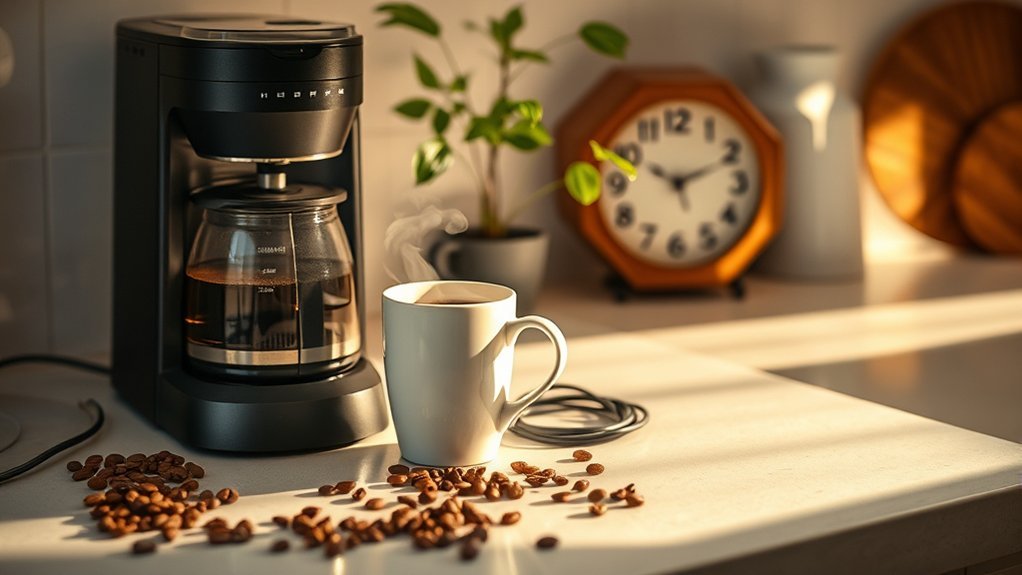

A BPA-free coffee maker can help you reduce contact with one specific chemical used in some polycarbonate plastics and epoxy resins. However, “BPA-free” does not automatically mean plastic-free, free from every bisphenol, or independently certified as safe. The best choice is a machine with clear material documentation for the exact model, a well-designed hot-water path, and appropriate electrical-safety testing.
Quick Answer
Choose a BPA-free coffee maker with a model-specific manufacturer statement, documented food-contact materials, replaceable parts, and a UL or ETL electrical-safety mark. Stainless steel, borosilicate glass, verified ceramic, and clearly documented BPA-, BPS-, and BPF-free plastics can all be reasonable choices when used and maintained as directed.
Key Takeaways
- “BPA-free” does not necessarily mean plastic-free or free from related compounds such as BPS and BPF.
- Check every part in the water and coffee path, including the reservoir, tubing, valves, showerhead, brew basket, lid, seals, and carafe.
- SCA certification covers brewing performance, while UL and ETL marks address electrical safety. Prop 65 is a warning system, not a safety certification.
- Trust documentation for the exact model number rather than broad brand claims or product descriptions copied by retailers.
- Follow the owner’s manual for descaling. Some manufacturers allow diluted vinegar, while others specifically advise against it.
Understanding BPA and Its Risks in Coffee Makers
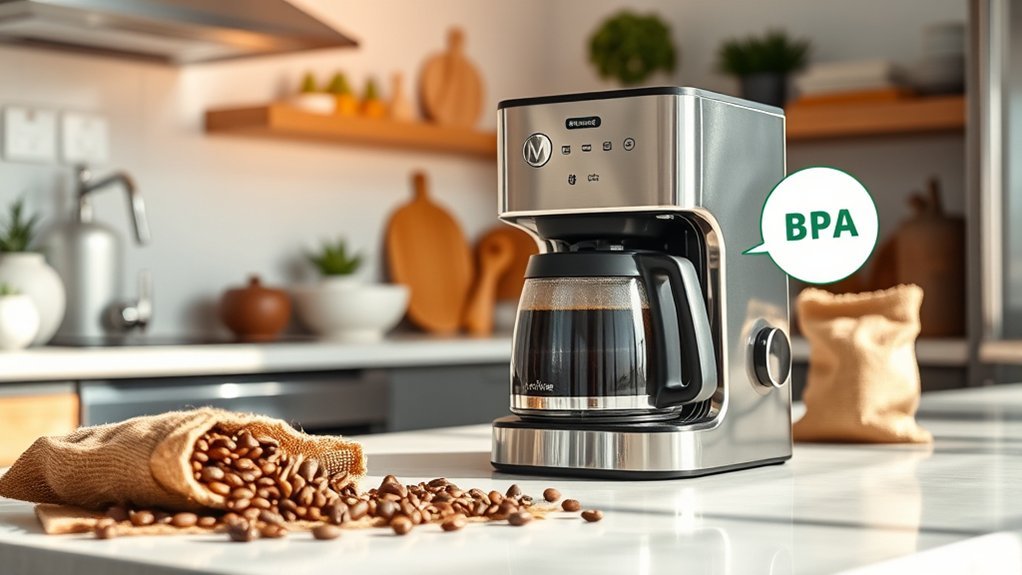
Bisphenol A, or BPA, is used to produce certain polycarbonate plastics and epoxy resins. In food-contact products, small amounts of a material can sometimes migrate into food or beverages. Temperature, contact time, condition, and the type of material can affect migration.
Scientists and regulators continue to evaluate the possible effects of BPA exposure. The U.S. Food and Drug Administration currently states that the available evidence supports the safety of BPA for approved food-contact uses at current exposure levels. At the same time, the National Institute of Environmental Health Sciences continues to support research into BPA’s potential endocrine, developmental, and metabolic effects.
This distinction matters. Choosing a BPA-free machine can be a reasonable precaution, but it should not be presented as a way to prevent cancer, heart disease, infertility, or another medical condition.
A BPA-free label answers one question. It does not prove that a coffee maker is plastic-free, bisphenol-free, independently certified, or suitable for every use.
Power your essentials anywhere with a 999Wh pure sine wave power station delivering up to 1000W continuous with 2000W surge. It supports fast charging via USB-C PD 60W and USB-A QC 18W, plus simultaneous output for multiple devices through AC, USB, wireless, and car/DC ports. Recharge using AC, car, or solar with a built-in MPPT controller and dual cooling fans, while the upgraded battery management system protects against surges, short circuits, and overheating.

Pour Over Coffee: Manual Pour Over Coffee Maker allows you to brew an excellent cup of Coffee in minutes

Superior Filtration: A solid filtration system in a coffee maker ensures a refined taste and robust flavor mouthfeel. Our 4-filter sieve system has an improved piston plate and 80 mesh filter that extracts the earthy, rich taste of residue-free coffee. This 1000 ml/34 Oz beaker makes 4 cups of creamier & tastier coffee.
Why Choose BPA-Free Materials for Your Coffee Maker?
The main reason to seek a BPA-free coffee maker is to reduce unnecessary contact with BPA-containing food-contact materials, especially where hot water repeatedly touches the same reservoir, tubing, valve, or brew basket.
A BPA-free choice may also offer practical benefits when it uses durable materials such as stainless steel or borosilicate glass. These materials can resist staining, scratching, odor retention, and wear better than some low-cost plastics. However, material quality, manufacturing controls, and proper maintenance matter as much as the name of the material.
Note: “BPA-free” does not necessarily mean BPS-free or BPF-free. A manufacturer that voluntarily identifies all three compounds provides more useful information than a label that mentions BPA alone.
Essential Materials for Coffee Makers: Glass, Stainless Steel, Porcelain, and Verified Plastics

No single material guarantees that an entire coffee maker is safe or plastic-free. Most electric machines combine several materials, so inspect the complete water and coffee path rather than judging the appliance by its exterior housing.
- Borosilicate glass: This type of glass is commonly chosen for carafes and manual brewers because it handles temperature changes better than ordinary glass. Confirm that the product is rated for hot beverages, and replace any carafe that is cracked, deeply scratched, or chipped.
- Food-grade stainless steel: Stainless steel is durable, easy to clean, and useful for boilers, thermal carafes, filter assemblies, and exterior housings. It can reduce plastic contact, but a stainless exterior does not prove that the internal reservoir or tubing is metal. Claims that stainless steel can never release trace metals under any condition should also be avoided.
- Porcelain or ceramic: These materials can work well in pour-over brewers and carafes when they come from a reputable manufacturer and are clearly labeled for food and hot-beverage use. The FDA advises extra caution with antique, damaged, decorative, handmade, or poorly documented pottery because improperly made glazes may release lead or cadmium.
- Documented food-contact plastic: Plastic is not automatically unsafe. Look for a written statement covering the exact model and, ideally, all components that touch water or coffee. A stronger declaration identifies the plastic as free from BPA, BPS, BPF, and phthalates.
- Food-contact silicone: Gaskets, seals, and valves are often made from silicone. Check that these parts are intended for high-temperature food contact and can be replaced if they become cracked, sticky, swollen, or permanently stained.
Warning: Do not use a ceramic brewer or carafe marked “decorative,” “not for food use,” or with a damaged food-contact glaze. Do not continue using cracked glass, warped plastic, or deteriorated seals around hot water.
How to Identify BPA-Free Plastics in a Coffee Maker
A BPA-free logo on a box is a useful starting point, but it does not tell you which parts were evaluated or whether the claim covers every component that touches hot water.
Use this checklist before buying:
- Match the exact model number. Product suffixes can indicate different markets, colors, revisions, or included accessories. Verify the number on the manufacturer’s website or manual.
- Read the materials statement. Look for wording that covers food-contact parts, the water path, or the entire product—not only the carafe, travel cup, or exterior housing.
- Inspect the hot-water path. Check the reservoir, internal tubing, heating chamber, valves, showerhead, brew basket, lid, carafe, and dispensing spout.
- Review replacement-part listings. Manufacturers often provide clearer material descriptions for replacement reservoirs, lids, baskets, and seals than they do on the main sales page.
- Ask for written confirmation. When the product page is vague, contact the manufacturer with the exact model number and ask which food-contact components contain plastic and whether they contain BPA, BPS, or BPF.
- Do not rely on appearance or odor. You cannot confirm BPA content by looking at, smelling, or touching a plastic component.
Pro Tip: Save a PDF or screenshot of the manufacturer’s material statement when you purchase the machine. Product pages can change, and the document gives you a reference when ordering replacement parts later.
What Certifications and Labels Mean for Coffee Maker Safety

Different marks evaluate different parts of a coffee maker’s design. None of them should be treated as a universal “chemical-free” seal.
- UL or ETL listing: These marks indicate that a product has been independently evaluated against applicable electrical-safety standards. They are important for an appliance that combines electricity, heat, and water, but they do not automatically establish that every plastic component is BPA-free. See the official explanations from UL Solutions and Intertek.
- NSF certification: NSF programs can evaluate food-contact materials, cleanability, sanitation, construction, and performance under a named standard or protocol. NSF lists NSF P387 as a protocol for home coffee makers. Confirm the exact model in the applicable NSF directory rather than relying on a logo in an advertisement.
- SCA Certified Home Brewer: The Specialty Coffee Association program evaluates brewing quality, consistency, extraction, and performance. It is useful for identifying capable brewers, but it is not a BPA-free certification.
- Proposition 65 warning: California Proposition 65 requires warnings for certain exposures to listed chemicals. According to the official Proposition 65 FAQ, a warning does not mean that a product violates a safety or health standard. Prop 65 is therefore a disclosure system, not a product-safety certification.
- Manufacturer BPA-free statement: This is a product claim rather than an independent certification. It is most useful when it identifies the exact model, the covered components, and related compounds such as BPS and BPF.
The FDA regulates food-contact substances and evaluates authorized uses, but consumers should not expect a whole coffee maker to carry a general “FDA-approved appliance” badge. Look for specific material documentation and independent electrical-safety marks instead.
BPA-Free Coffee Makers and Models to Consider
The models below appeared in the original recommendations, but their public documentation does not support identical claims. Treat this as a verification guide rather than a universal ranking.
Key Features to Consider
- Documented food-contact materials: Give more weight to a model-specific statement than to a retailer’s general “safe materials” description.
- Complete water-path design: A glass carafe or stainless housing does not tell you what is inside the reservoir, tubing, valves, or brew basket.
- Electrical-safety listing: Check the product label or manufacturer documentation for an applicable UL, ETL, or equivalent mark.
- Replaceable parts: Reservoirs, brew baskets, lids, seals, and carafes should be obtainable without replacing the entire appliance.
- Cleaning requirements: Confirm that you can safely access and clean the components that regularly hold water, coffee oils, or milk.
What the Manufacturers Currently Confirm
| Model | Documented claim | What to know |
| Moccamaster Cup-One | The manufacturer describes its materials as metal plus BPA-, BPS-, BPF-, and phthalate-free plastic. | This is a strong, model-specific declaration, but the brewer is not plastic-free. |
| Cuisinart DCC-3200 Series | Cuisinart states that the DCC-3200 product is BPA-free. | Retail suffixes such as P1 or NAS may vary. Match the exact model and current manual before purchasing. |
| Melitta 1-Cup Pour-Over Cone | Melitta explicitly labels this plastic pour-over cone as BPA-free. | It is an affordable manual option, but the published description does not state that it is BPS- or BPF-free. |
| Breville Bambino Plus | Breville documents components such as the stainless-steel portafilter, milk jug, and steam system. | The public product page does not clearly state that the entire machine or complete water path is BPA-free. Obtain written confirmation before making that claim. |
| Mr. Coffee 12-Cup Models | Mr. Coffee sells several different 12-cup designs with different features and components. | “Mr. Coffee 12-cup” is not a precise model. Verify the complete model number and request a material statement for food-contact parts. |
How to Verify a Model Before Buying
Open the manufacturer’s product page and manual, search for “BPA,” “materials,” “food contact,” and “replacement parts,” and confirm that the documentation matches the model number on the retailer’s listing. When the information is missing, contact the manufacturer rather than assuming that a metal exterior or glass carafe means there is no plastic in the water path.
Maintenance Tips for a BPA-Free Coffee Maker
BPA-free materials can still collect mineral scale, coffee oils, mold, and residue. They can also crack, warp, scratch, or deteriorate when cleaned incorrectly.
Clean Removable Parts After Use
- Unplug the machine and allow hot parts to cool before disassembly.
- Discard used grounds and filters promptly.
- Wash the carafe, brew basket, reusable filter, drip tray, and removable lid according to the manual.
- Use warm water, mild dish soap, and a nonabrasive sponge unless the manufacturer specifies another method.
- Rinse away all soap and allow enclosed parts to dry before reassembly.
- Never immerse the powered base, cord, plug, heating assembly, or other electrical components in water.
Descale According to the Owner’s Manual
Descaling frequency depends on water hardness, use, internal design, and whether the machine has a clean or descale indicator. There is no universal schedule or mixture for every coffee maker.
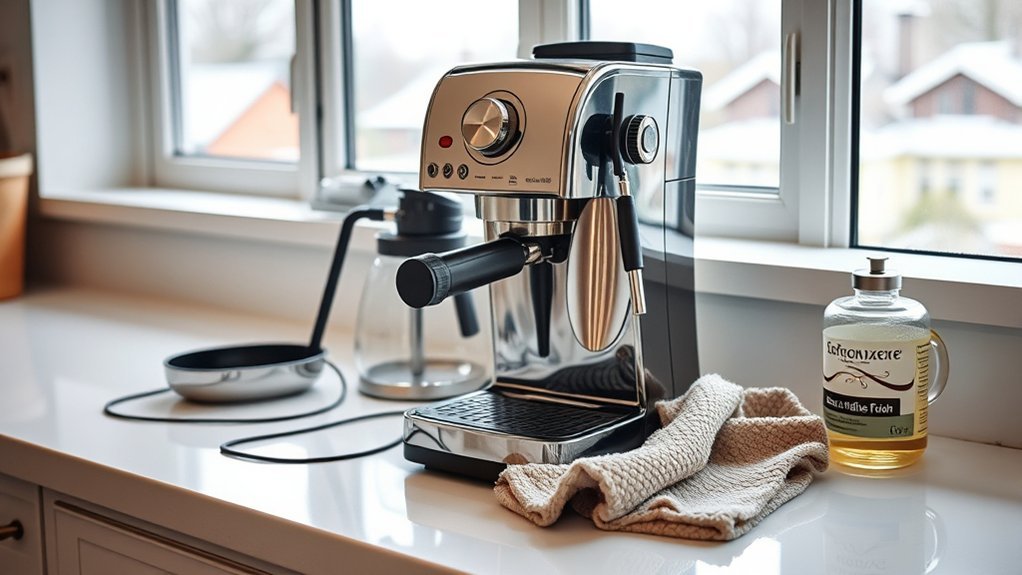
For example, Cuisinart allows diluted white vinegar for many models and provides model-dependent ratios. In contrast, Moccamaster advises against vinegar and recommends an approved descaling product.
Warning: Never combine vinegar, bleach, descaler, ammonia, or another cleaning agent. Use only one manufacturer-approved method, ventilate the area, and complete every required fresh-water rinse before brewing coffee.
Replace Damaged Components
Stop using a removable component if it is cracked, warped, melted, sticky, deeply scratched, or no longer seals correctly. Persistent odor, cloudiness, or staining does not prove that a part contains BPA, but it can show that the component is worn or difficult to clean.
Order replacement parts using the exact model number. Do not substitute a random reservoir, gasket, tube, or brew basket that has not been approved for the machine’s temperature and food-contact requirements.
How Material Choices Affect Coffee Flavor and Quality
The material in a coffee maker can influence heat stability, durability, cleaning, and odor retention. It is less accurate to claim that one material automatically creates better-tasting coffee.
- Temperature control: Metal boilers and thermal carafes can help maintain temperature, while glass allows you to see the coffee level and condition of the carafe.
- Retained oils and odors: Scratched plastic, dirty silicone, reusable filters, and neglected carafes can retain coffee oils. Smooth, accessible parts are easier to clean thoroughly.
- Brewing consistency: Heater control, water distribution, grind size, coffee-to-water ratio, and brew time usually affect extraction more directly than the carafe material.
- Storage time: Coffee left on a hot plate can develop cooked or bitter flavors. A clean thermal carafe may preserve flavor longer without continued heating.
Clean water, fresh coffee, a suitable grind, stable brewing temperature, and regular maintenance remain the most important factors in cup quality.
Best Cleaning Practices for BPA-Free Coffee Maker Materials
- Glass: Let hot glass cool before washing, avoid sudden temperature changes, and replace it if chipped or cracked.
- Stainless steel: Use a soft cloth or sponge. Remove coffee oils promptly and avoid steel wool or harsh abrasive powder that can damage the finish.
- Plastic: Use mild soap and nonabrasive tools. Do not expose a component to a dishwasher, boiling water, or concentrated cleaner unless its instructions expressly allow it.
- Porcelain and ceramic: Inspect the food-contact glaze for chips or deep cracks. Do not use decorative pottery or items labeled as unsuitable for food.
- Silicone seals: Remove and wash them only when the manual permits. Replace seals that are swollen, sticky, brittle, torn, or unable to hold a tight fit.
Always give the manufacturer’s instructions priority over general online cleaning advice. A method that is appropriate for a basic drip brewer may damage an espresso machine, pod system, thermal carafe, valve, or specialty coating.
Frequently Asked Questions
Are all BPA-free coffee makers safe for daily use?
A BPA-free label addresses only BPA. Daily-use suitability also depends on the machine’s electrical listing, complete food-contact materials, condition, cleaning requirements, and correct operation. Verify the exact model and follow its manual.
How can I verify a coffee maker’s material safety?
Check the exact model page, owner’s manual, product label, and replacement-part listings. Look for a written BPA-free or bisphenol-free statement covering food-contact components, plus an applicable UL or ETL electrical-safety mark. Contact the manufacturer when the water-path materials are not listed.
What are the signs of damaged plastic in a coffee maker?
Replace plastic parts that are cracked, warped, melted, sticky, deeply scratched, or unable to seal properly. Odor or discoloration can indicate wear or residue, but neither one proves that the plastic contains BPA.
Do stainless-steel coffee makers retain flavors?
Clean stainless steel usually retains little flavor, but coffee oils and residue can remain on any neglected surface. Wash the carafe and accessible brewing parts regularly with a nonabrasive cleaner approved by the manufacturer.
Can I use a BPA-free coffee maker for other hot beverages?
Use the machine only for beverages and functions identified in its manual. A hot-water dispenser may be suitable for tea or cocoa, but putting milk, broth, spices, or another liquid in a water reservoir can clog the machine and create sanitation problems.
Does BPA-free also mean BPS-free and BPF-free?
No. A BPA-free claim does not automatically exclude bisphenol S or bisphenol F. Look for a broader bisphenol-free statement or a manufacturer declaration that specifically names BPA, BPS, and BPF.
Is a Proposition 65 warning a failed safety test?
No. Proposition 65 is a California exposure-warning law, not a product-certification test. A warning does not by itself mean that the coffee maker violates a federal or state product-safety standard.
Conclusion
Choosing a BPA-free coffee maker starts with documentation, not assumptions. Check the exact model, identify every material in the hot-water path, understand what each certification actually covers, and confirm that replacement parts are available.
Stainless steel, borosilicate glass, properly made ceramic, and documented food-contact plastics can all be practical options. The best machine is one whose materials are clearly disclosed, whose electrical safety has been independently evaluated, and whose cleaning instructions you can follow consistently.
Sources
- U.S. Food and Drug Administration — BPA in Food-Contact Applications — current FDA position and food-contact migration oversight.
- National Institute of Environmental Health Sciences — Bisphenol A — BPA uses, exposure routes, migration, and ongoing health research.
- National Toxicology Program — Biological Activity of BPA Structural Analogues — research on BPS, BPF, and other BPA alternatives.
- NSF — Home Products and Appliance Certification — applicable certification protocols, including NSF P387 for coffee makers.
- Specialty Coffee Association — Certified Home Brewers — brewing-quality, performance, and consistency testing.
- California Proposition 65 Warnings — Frequently Asked Questions — official explanation of what a Proposition 65 warning does and does not mean.