In the United States, breastfeeding laws protect your right to nurse in public in all 50 states and give most working parents federal rights to pump breast milk on the job. Under the federal PUMP for Nursing Mothers Act (PUMP Act), most employers must provide reasonable break time and a private, non-bathroom space to pump for up to one year after a child’s birth, while state laws tracked by the NCSL cover public nursing, indecency exemptions, and additional workplace or jury duty protections.
Legal disclaimer: This guide summarizes general U.S. federal and state breastfeeding protections for educational purposes and is not legal advice. Laws and exemptions vary by state, industry, and country—consult an employment attorney, state labor agency, or the U.S. Department of Labor for guidance on your specific situation.
Overview of U.S. Federal and State Breastfeeding Laws
U.S. protections work across two layers: federal laws establish a nationwide baseline for workplaces, federal buildings, and airports, while state laws add broader coverage (such as longer pumping durations, paid breaks, or public-space enforcement):
| Setting | Key Law / Policy | What It Covers | Main Limitations / Notes |
|---|---|---|---|
| Public & Private Locations | State Laws (All 50 States, D.C., PR, USVI) | Right to breastfeed wherever you are otherwise authorized to be; many states also exempt breastfeeding from public indecency laws. | Enforcement mechanisms and penalties for interference vary by state. |
| Workplace Pumping | Federal PUMP Act (FLSA, effective Dec. 2022) | Reasonable break time and a clean, private, non-bathroom space (shielded from view and intrusion) for 1 year after birth; covers most hourly and salaried workers. | Employers with fewer than 50 employees may claim an undue hardship exemption; specific exemptions apply to certain airline, rail, and motorcoach crew members. |
| Federal Public Buildings | Fairness for Breastfeeding Mothers Act (2019) | Requires covered public federal buildings with public restrooms to provide a clean, private, non-bathroom lactation room with a chair, flat surface, and outlet. | Applies to covered federal public buildings; limited cost/construction exclusions exist. |
| U.S. Airports & Security | Friendly Airports for Mothers (FAM) Acts & TSA Rules | Large, medium, and small hub U.S. airports must provide accessible, private, non-bathroom lactation rooms; TSA exempts breast milk and pumps from the 3.4 oz limit. | Amenities vary by terminal; allow extra time for separate TSA liquid screening. |
Breastfeeding Laws in Public Places
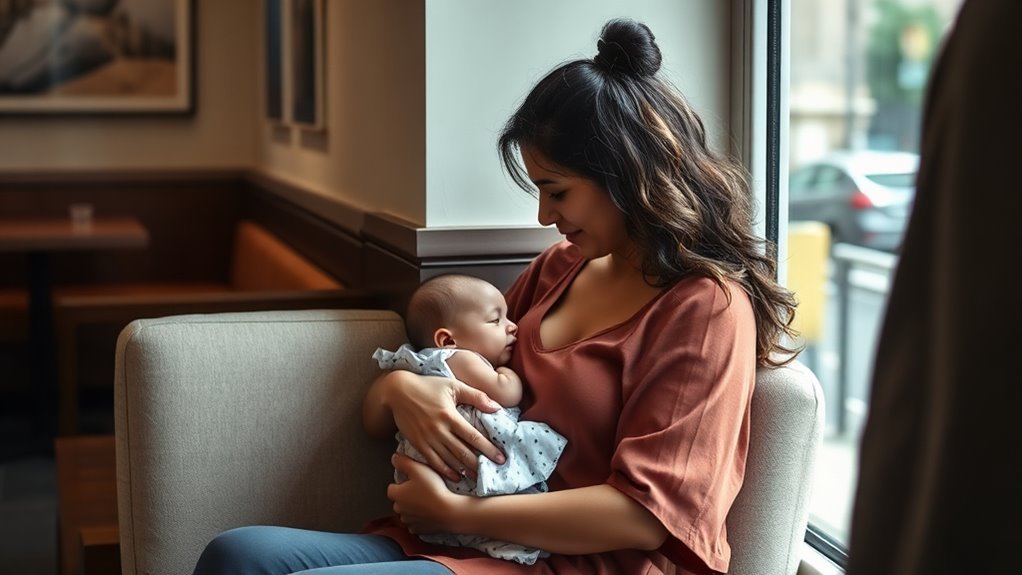
According to the National Conference of State Legislatures (NCSL), all 50 states, the District of Columbia, Puerto Rico, and the U.S. Virgin Islands expressly protect a parent’s right to breastfeed in any public or private place where they have a legal right to be—including restaurants, stores, parks, and transit areas. You are not legally required to use a nursing cover or move to a restroom.
Many states also explicitly exempt breastfeeding from public indecency or lewdness statutes. If a business employee asks you to cover up or leave, calmly explain that public breastfeeding is protected by state law and ask to speak with a manager.
Breastfeeding Laws at Work: The Federal PUMP Act
Before December 2022, federal pumping protections under the Fair Labor Standards Act (FLSA) left out millions of salaried employees, teachers, and nurses. The PUMP for Nursing Mothers Act (PUMP Act) closed most of that gap. Under U.S. Department of Labor (DOL) guidance, covered employees are entitled to:
- Reasonable break time each time you need to express milk for up to one year after your child’s birth (frequency and duration depend on your individual needs).
- A functional, private space that is not a bathroom, shielded from view and free from intrusion by coworkers or the public. Remote employees are also eligible to take pump breaks on the same basis as on-site workers.
- Pay rules: Dedicated pump breaks can be unpaid if you are completely relieved of work duties, but they must be paid if you use employer-provided paid breaks or keep working while pumping.
- Protection against retaliation: Employers cannot discipline, demote, or fire you for requesting pump breaks or reporting a violation.
As you prepare to return to work after your postpartum checkup, submit your lactation space and schedule needs to HR in writing a few weeks ahead of your return date. If your family later combines pumping with formula, our guide on how to switch baby formula can also help smooth out feeding transitions.
Breastfeeding Laws for Air Travel and Airports
Flying with breast milk or a nursing infant is supported by two key federal frameworks:
- TSA 3-1-1 Liquid Exemption: Per official TSA guidelines, breast milk, breast pumps, and ice/freezer/gel packs used to keep milk cold are medically necessary and exempt from the 3.4 oz (100 mL) liquid rule. You do not need to be traveling with your baby to carry breast milk in your carry-on. Separate milk from your bag at security and inform the TSA officer; you may request alternative screening instead of X-ray.
- Airport Lactation Rooms (FAM Acts): Under the Friendly Airports for Mothers Act and FAM Improvement Act, large, medium, and small hub U.S. airports must maintain clean, private, accessible, non-bathroom lactation spaces with seating, a flat surface, and an electrical outlet in passenger terminals.
How to Handle a Breastfeeding Law Violation (Step by Step)
- Document everything right away: Write down the date, time, location, names/titles of anyone involved, and save any emails, texts, or written workplace policies.
- Give written notice for workplace space issues: Under the PUMP Act, employees generally must notify their employer of a space violation and give the employer 10 days to come into compliance before filing a private lawsuit for space-related remedies (though you can contact the DOL Wage and Hour Division directly and retaliation claims do not require a waiting period).
- File a formal complaint or seek legal advice: For workplace violations, contact the U.S. Department of Labor Wage and Hour Division (WHD) (1-866-487-9243) or your state labor department. For public-space interference, check your state civil rights agency or a local lactation advocacy organization.
Breastfeeding Laws Outside the United States
Outside the U.S., legal protections vary widely by country and province. Countries such as the UK, Canada, and Australia have strong anti-discrimination protections for nursing in public, while workplace pumping rules differ significantly around the world. Before international travel, check local government travel guidance, airline policies, and destination cultural norms so you know what accommodations to expect.
Frequently Asked Questions
Is breastfeeding in public legal in all 50 U.S. states?
Yes. According to the National Conference of State Legislatures (NCSL), all 50 U.S. states, the District of Columbia, Puerto Rico, and the U.S. Virgin Islands have laws expressly allowing mothers to breastfeed in any public or private location where they are otherwise authorized to be.
Does the federal PUMP Act require employers to pay for pumping breaks?
Under the Fair Labor Standards Act (FLSA) as amended by the PUMP Act, employers are not required to pay for dedicated pumping breaks if the employee is completely relieved from duty. However, if you use already-paid breaks to pump, or if you continue working while pumping, that time must be paid.
Do small businesses have to follow the PUMP Act?
Employers of all sizes are covered by the PUMP Act, but employers with fewer than 50 employees nationwide may be excused from providing break time or space only if they can prove compliance would impose an undue hardship (significant difficulty or expense). Some states also enforce stricter workplace lactation laws regardless of company size.
Can I bring more than 3.4 ounces of breast milk through TSA airport security?
Yes. The Transportation Security Administration (TSA) classifies breast milk as a medically necessary liquid exempt from the 3-1-1 liquid rule. You may carry reasonable quantities over 3.4 oz (100 mL), along with ice packs and pump equipment, in your carry-on—even if your baby is not traveling with you. Notify the TSA officer at screening.
Are nursing parents exempt from jury duty?
It depends on your state. Many U.S. states and territories allow breastfeeding parents to postpone or be excused from state jury duty upon request, though eligibility and documentation rules vary by jurisdiction. Check your local court summons or state statute for exact procedures.