You can use softened water in many coffee makers, but it is not automatically the best choice for either coffee flavor or every machine. A household ion-exchange softener removes most scale-forming calcium and magnesium and replaces them with sodium or potassium. That usually lowers limescale risk, but it also changes the water chemistry that affects extraction and taste.
Quick Answer
Softened water can reduce limescale, but it is not automatically the best water for a coffee maker. Check your model’s manual first because some manufacturers advise against softened or very low-mineral water. For flavor, use clean water with balanced minerals and alkalinity while staying within your brewer’s water requirements.
Key Takeaways
- A household ion-exchange softener normally replaces calcium and magnesium with sodium or potassium, reducing hardness-related scale.
- Softened water is different from naturally soft, carbon-filtered, distilled, reverse-osmosis, and salt-free conditioned water.
- Coffee-maker requirements vary by model, so the owner’s manual takes priority over a universal water rule.
- Hardness, alkalinity, pH, sodium, and total dissolved solids measure different parts of water chemistry.
- When softened water tastes flat or your machine advises against it, consider suitable filtered tap water, a tested blend, or properly remineralized water.
Understanding Softened Water and Its Composition
“Soft water” and “softened water” do not always mean the same thing. Naturally soft water starts with low levels of calcium and magnesium. Softened water has been treated to reduce those hardness minerals.
Most whole-home softeners use cation exchange. Water passes through resin that captures calcium and magnesium and releases sodium or potassium ions in their place. The treated water forms less hardness scale, but much of the original bicarbonate alkalinity may remain.
Note: A basic carbon filter is not the same as a water softener. Carbon filtration can reduce chlorine, odors, and selected contaminants while leaving most calcium, magnesium, and alkalinity in the water.
Distilled water and reverse-osmosis water are also different. Those treatments remove a much broader range of dissolved substances. They should not be grouped with sodium- or potassium-softened water because their mineral content and effects on coffee can be very different.
Softener vs. Salt-Free Water Conditioner
A true ion-exchange softener removes hardness ions from the water. Some products marketed as salt-free conditioners or scale-control systems work differently and may leave calcium and magnesium in the water while changing how deposits form. If your home uses a conditioner rather than an ion-exchange softener, do not assume the water chemistry described for sodium-softened water applies to it.
How to Tell Whether Your Kitchen Tap Is Actually Softened
A whole-house softener does not always feed every cold-water tap. Some homes have an unsoftened kitchen drinking-water line or a bypass connection.
- Check the softener plumbing or installation paperwork to see which fixtures are connected.
- Test the cold kitchen water for total hardness.
- If possible, test an untreated tap or the water entering the softener for comparison.
- Do not use TDS alone to decide whether water has been softened. Sodium can replace calcium and magnesium without causing a dramatic drop in total dissolved solids.
Can You Use Softened Water in a Coffee Maker?
Many conventional drip coffee makers can physically brew with softened water. The lower calcium and magnesium content usually reduces calcium-carbonate scale in hot-water passages. Whether it is the best long-term choice depends on the brewer’s instructions, the final water chemistry, and how the coffee tastes.
Check the water section of your exact owner’s manual before making softened water your default. Manufacturers do not all use the same water requirements.
| Coffee Maker Type | Softened-Water Consideration |
|---|---|
| Basic drip brewer | Often able to brew with softened water, but the manual still controls and flavor may change when calcium and magnesium are very low. |
| Single-serve or pod brewer | Follow the manufacturer’s water recommendation closely. Some brands specifically advise against softened water. |
| Automatic espresso machine | The machine may have a hardness setting, an approved filter, or model-specific water limits. Configure and maintain it according to the manual. |
| Manual pour-over or French press | There is little machine-related scale concern, so taste becomes the main issue. Compare softened water with moderately mineralized water. |
Manufacturer Water Guidance: Two Useful Examples
Keurig support guidance advises against softened and distilled water and recommends following the brewer’s water and descaling instructions. That is a brand-specific recommendation and should not automatically be applied to every coffee maker.
The Breville Barista Express Impress BES876 manual instructs users to fill the tank with cold potable tap water and says not to use highly filtered, demineralized, or distilled water because it may affect coffee taste. This is a different warning from Keurig’s softened-water guidance, which shows why the exact manual matters.
Warning: Do not assume that water is approved simply because it is safe to drink or low in scale-forming minerals. Follow the water requirements for your exact brewer, especially with pod machines, plumbed-in equipment, and automatic espresso systems.
How Softened Water Affects Coffee Flavor
Water influences what dissolves from coffee grounds and how the finished cup balances acidity, sweetness, bitterness, aroma, and body. The result depends on more than whether the water is described as hard or soft.
Calcium, Magnesium, and Extraction
Calcium and magnesium can interact with compounds released from coffee during brewing. Replacing most of these divalent minerals with sodium or potassium changes the extraction environment. Depending on the coffee, roast, recipe, and alkalinity, the cup may seem thinner, sharper, flatter, more bitter, or simply different from the same coffee brewed with moderately mineralized water.
This does not mean harder water is always better. Excessive hardness raises limescale risk and can contribute to a dull or heavy cup. The practical goal is balanced water that works for both the coffee and the equipment.
Hardness Is Not the Same as Alkalinity
Hardness mainly reflects calcium and magnesium. Alkalinity measures the water’s ability to neutralize acids and is commonly associated with bicarbonate. Two samples can have similar hardness but different alkalinity, or similar alkalinity with very different hardness.
High alkalinity can mute the bright acidity of coffee. Very low alkalinity can make acidity more prominent. A standard sodium-ion-exchange softener removes hardness ions but does not necessarily remove the bicarbonate responsible for much of the alkalinity. That is one reason fully softened water can still taste unbalanced even though it produces little hardness scale.
How Sodium Affects Coffee Taste
The amount of sodium added by a sodium-regenerated softener depends largely on the hardness of the incoming water and the way the system is configured. The harder the untreated water, the more hardness ions must be exchanged and the more sodium can appear in the softened water.
At modest concentrations, you may not notice a distinct sodium taste. At higher levels, the water or coffee can taste salty, rounded, muted, or simply different. Sodium concentration alone does not reveal hardness, alkalinity, pH, or overall brewing suitability, so those measurements should be considered separately.
The best brewing water is not simply “hard” or “soft.” It must balance coffee flavor with the scale, corrosion, filtration, and water requirements of the brewer.
Pros and Cons of Using Softened Water in Coffee Makers
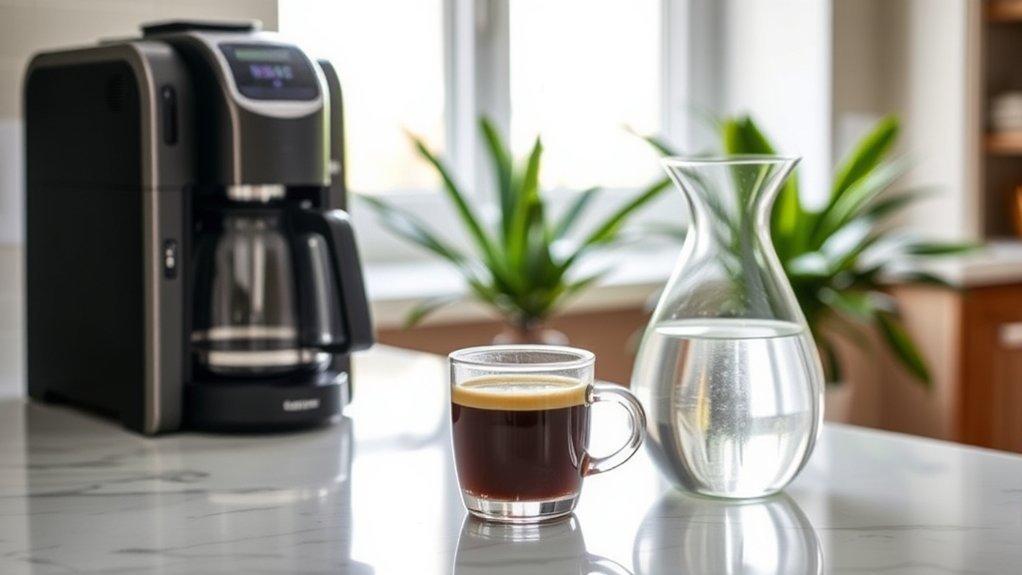
Softened water can be useful when the untreated supply is very hard, but lower scale risk does not automatically mean better coffee or universal machine compatibility.
| Potential Advantages | Potential Disadvantages |
|---|---|
| Reduces calcium- and magnesium-related limescale | May remove more calcium and magnesium than you prefer for coffee flavor |
| May reduce hardness-related descaling demand | Adds sodium or potassium rather than removing every dissolved substance |
| Can protect hot-water passages when the original water is very hard | May conflict with the water recommendation for a particular brewer |
| Convenient when the entire home already uses a softener | Can leave relatively high alkalinity even after most hardness has been removed |
Softened Water vs. Other Brewing Waters
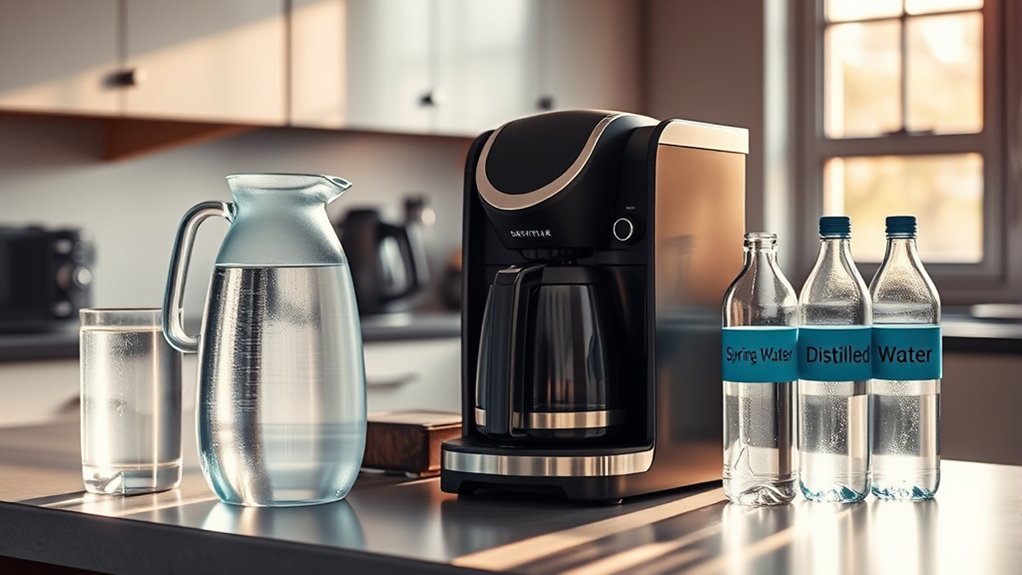
No water category is automatically ideal. Its usefulness depends on the actual chemistry, taste, cleanliness, and the coffee maker’s requirements.
| Water Type | What It Does | Coffee Consideration |
|---|---|---|
| Ion-exchange-softened water | Replaces calcium and magnesium with sodium or potassium | Low hardness-scale risk, but flavor and machine compatibility vary |
| Carbon-filtered tap water | Reduces chlorine, odors, and selected contaminants while usually retaining most hardness | Often practical when the untreated hardness and alkalinity are already reasonable |
| Spring or bottled water | Composition varies by source, treatment, and brand | Check the mineral analysis because some bottled waters are quite hard or alkaline |
| Distilled or reverse-osmosis water | Removes most dissolved minerals | Often more useful for coffee after controlled remineralization, but the machine manual comes first |
| Naturally soft water | Starts with low calcium and magnesium without sodium or potassium ion exchange | Can taste different from household-softened water even when total hardness is similar |
Testing Water Quality for Brewing Coffee
A basic water test can tell you more than the labels “hard,” “soft,” or “filtered.” Test the same water that will actually enter the coffee maker, after any household softener or filter.
Test Hardness and Alkalinity Separately
Use a suitable drop-test kit, photometer, or test strips that report total hardness and alkalinity in milligrams per liter or parts per million as calcium carbonate. Hardness mainly reflects calcium and magnesium, while alkalinity describes the water’s buffering capacity.
A conductivity or TDS meter can be useful for comparing one water sample with another, but it cannot tell you whether the reading comes from calcium, magnesium, sodium, bicarbonate, chloride, sulfate, or another dissolved substance. Two samples with a similar TDS reading can behave differently in coffee.
Measure pH as Supporting Information
pH can provide useful background information, but it should not replace hardness and alkalinity testing. A near-neutral pH does not tell you how strongly the water will buffer coffee acids or how much scale-forming calcium and magnesium it contains.
If the water has a noticeable chlorine or other off-odor, use an appropriate certified filter or another safe water source. Coffee is mostly water, so an unpleasant odor in the brewing water can carry into the cup.
Run a Side-by-Side Taste Test
- Brew one batch with your current softened water.
- Brew a second batch with suitable unsoftened filtered water or properly remineralized water.
- Use the same coffee, dose, grind, water temperature, batch size, and brew method.
- Let both samples cool slightly before judging them.
- Compare aroma, acidity, sweetness, bitterness, body, clarity, and aftertaste.
Pro Tip: Ask someone else to label the cups so you can taste them blind. A blind comparison makes it easier to judge the water itself rather than choosing the sample you expect to prefer.
Choosing the Best Water for Brewing Coffee
A practical decision order is simple: check the coffee-maker manual first, test the water second, and then use taste to choose between the water options that remain compatible with the machine.
For Moderate Untreated Water
If your unsoftened tap water has moderate hardness, acceptable alkalinity, and no objectionable odor, carbon-filtered tap water is often a simple choice. It can improve taste by reducing chlorine and odors without intentionally replacing calcium and magnesium with sodium.
For a Home With a Whole-House Softener
Look for an unsoftened cold-water tap at the kitchen sink or another approved bypass point. If the untreated water tastes good and is not excessively hard, you can filter it for chlorine or odors and use it for coffee.
If the untreated water is extremely hard, blending it with softened water can lower hardness while restoring some calcium and magnesium to the final water. Test the blend rather than relying on one universal mixing ratio.
For Reverse-Osmosis or Distilled Water
Do not assume nearly mineral-free water is automatically best. Some coffee makers advise against demineralized or distilled water, and very low-mineral water can produce a different flavor balance. If your machine permits it, use a controlled brewing-water remineralization method rather than guessing at mineral additions.
Can You Mix Softened Water With Regular Tap Water?
Yes. If both sources are safe to drink and your coffee maker permits the resulting water, blending softened and unsoftened water can reduce the hardness of the untreated supply while restoring part of the calcium and magnesium removed by the softener.
Measure the hardness and alkalinity of both sources first. Make a small blend in a clean food-safe container, test the final water, and brew a sample. Adjust gradually based on taste and the machine’s water requirements.
Do not use untreated water that has a contamination problem or is not safe to drink. Household water softening is primarily a hardness treatment and should not be treated as a substitute for proper drinking-water treatment or disinfection.
Mineral Additives to Improve Coffee Flavor
Remineralization can improve coffee made with distilled or reverse-osmosis water, but it should be controlled. Calcium, magnesium, bicarbonate, and other ions affect different parts of the water profile, so adding one mineral does not automatically create balanced brewing water.
Use a tested coffee-water recipe or a product specifically intended for remineralizing brewing water. Follow its dosing directions and prepare the water in a separate food-safe container before it enters the coffee maker.
Warning: Do not pour dry Epsom salt, baking soda, calcium salts, or other mineral powders directly into a coffee maker. Incorrect dosing can create unpleasant flavors, deposits, corrosion risk, or water outside the manufacturer’s specifications.
Maintaining Your Coffee Maker With Softened Water
Softened water may reduce hardness-related scale, but it does not stop coffee oils, grounds, dust, residue, or microbial films from collecting on removable or wet parts. Routine cleaning is still necessary.
| Maintenance Task | Recommended Timing |
|---|---|
| Rinse the brew basket and carafe | After each use |
| Wash removable parts | According to the manual; clean sooner if oily residue, grounds, or odor appears |
| Replace the reservoir filter | At the interval specified for that brewer and filter |
| Descale | When prompted or at the interval in the manual, adjusted for actual hardness and use |
If the brewer becomes slow or noisy, produces less water than expected, displays a flow warning, or develops visible white deposits, follow the manufacturer’s troubleshooting and descaling procedure. Softened water can reduce hardness scale, but it does not make cleaning or descaling permanently unnecessary.
Troubleshooting Common Problems
Water chemistry is only one possible cause of poor coffee-maker performance. Grounds, dirty needles, a poorly seated reservoir, an old filter, incorrect dose or grind, scale, and worn parts can produce similar symptoms.
| Problem | What to Check |
|---|---|
| Coffee tastes flat or muted | Compare with moderately mineralized water and check both hardness and alkalinity. |
| Coffee or water tastes salty | Stop using that water for coffee until you have checked the softener settings, source-water hardness, and sodium level or spoken with the installer. |
| Pod bursts or basket overflows | Check pod condition, grind size, coffee dose, needles, basket cleanliness, flow restrictions, and the manufacturer’s water instructions rather than assuming softened water is the only cause. |
| Brewer reports no water | Confirm the reservoir is filled and seated correctly, inspect any float or filter specified in the manual, and follow the model’s troubleshooting procedure. Use only water approved for that brewer. |
| White scale appears | Test the water leaving the softener. The system may be bypassed, depleted, misadjusted, or allowing hardness leakage. |
Debunking Myths About Softened Water in Coffee Brewing
- Myth: Softened water and distilled water are the same. Softened water exchanges selected hardness ions. Distillation removes nearly all dissolved minerals.
- Myth: Softened water always causes scale. Properly softened water normally reduces calcium- and magnesium-related limescale.
- Myth: Softened water never needs testing. Test the final water because incoming hardness, softener settings, bypass valves, and resin condition can change the result.
- Myth: A TDS meter shows whether water is good for coffee. TDS reflects overall conductivity or estimated dissolved solids, not the identity and balance of individual ions.
- Myth: Bottled or spring water is always better. Mineral composition varies widely among bottled waters.
- Myth: The lowest possible hardness is always best for the machine. Follow the model’s water requirements rather than chasing zero hardness.
- Myth: Any salt-free water conditioner produces softened water. Some conditioners manage scale without actually removing calcium and magnesium, so their treated water should not automatically be treated as ion-exchange-softened water.
Frequently Asked Questions
Can softened water cause mineral buildup in my coffee maker?
Properly softened water normally reduces calcium- and magnesium-related limescale. It can still contain sodium, potassium, bicarbonate, silica, and other dissolved substances, and it does not prevent coffee-oil or ground-coffee residue. Continue cleaning and follow the manufacturer’s descaling schedule.
Will using softened water void my coffee maker’s warranty?
Warranty terms and water requirements vary by model. Check the exact manual and warranty language. Some manufacturers advise against particular types of softened, distilled, demineralized, or highly filtered water, so there is no reliable universal warranty answer.
Can I mix softened water with regular tap water?
Yes, if both sources are safe to drink and the final water meets your coffee maker’s requirements. Blending can restore some calcium and magnesium while lowering the hardness of the untreated water. Test the final blend for hardness and alkalinity rather than relying on a fixed ratio.
How does softened water compare with distilled water for brewing?
Softened water retains many dissolved substances but replaces much of its calcium and magnesium with sodium or potassium. Distilled water contains very little dissolved mineral content. Either can produce disappointing coffee when the resulting chemistry is poorly balanced, and some coffee makers advise against one or both types.
Is coffee made with softened water safe to drink?
If the original water is safe to drink and the household softener is correctly installed and maintained, softened water is commonly used in homes. However, sodium-regenerated softeners can raise sodium levels, especially when the incoming water is very hard. If you follow a medically prescribed sodium restriction, ask your clinician about your personal limit and consider an unsoftened drinking-water tap.
Is potassium-softened water better for coffee?
Potassium-regenerated softening avoids adding sodium in the same way as a sodium-regenerated system, but it still removes most calcium and magnesium and may leave much of the original alkalinity. Coffee flavor can therefore still differ from coffee brewed with moderately mineralized unsoftened water.
Does a carbon water filter remove hardness?
Most basic activated-carbon filters are designed mainly to reduce chlorine, odors, and selected contaminants rather than remove substantial calcium and magnesium. Check the filter’s certified performance claims instead of assuming that carbon filtration softens water.
Do I still need to descale a coffee maker if I use softened water?
Usually, yes. Softened water can greatly reduce hardness-related scale, but the actual maintenance schedule depends on the brewer, the final water chemistry, and how often you use it. Follow the machine’s descale indicator or the interval in its manual instead of assuming softened water eliminates descaling forever.
How can I tell if my kitchen tap bypasses the water softener?
Check the plumbing or softener installation information and compare the hardness of the kitchen cold water with water known to be untreated. A hardness test is more useful than TDS alone because ion exchange can lower calcium and magnesium while replacing them with sodium.
What is the best water for a coffee maker?
Use clean, fresh, odor-free water that meets your machine manufacturer’s requirements and has a balanced combination of hardness and alkalinity. Moderately mineralized filtered tap water or properly remineralized reverse-osmosis water often works well, but your machine manual, water test, and taste comparison provide the most reliable answer.
Conclusion
You can use softened water in some coffee makers, and it can substantially reduce hardness-related limescale when the untreated water is hard. The tradeoff is that ion exchange removes calcium and magnesium, adds sodium or potassium, and may leave much of the water’s alkalinity in place. That can change coffee flavor, and some manufacturers specifically recommend other types of water.
Start with your coffee maker’s manual. Then test hardness and alkalinity instead of relying on the words “softened,” “filtered,” or a TDS number alone. If softened water produces disappointing coffee or conflicts with the manufacturer’s instructions, try a suitable unsoftened filtered tap, a tested blend, or properly remineralized water.
Sources
- U.S. Environmental Protection Agency — Cation Exchange Water Softeners — explains how household ion-exchange softeners replace calcium and magnesium with sodium or potassium.
- Specialty Coffee Association — The Quest for Coffee Perfection — SCA-hosted sponsored partner content from BRITA discussing softening, alkalinity, demineralization, mineralization, and coffee flavor.
- Specialty Coffee Association — Coffee Water Testing Parameters — identifies separate measurements used to evaluate brewing-water chemistry, including hardness, alkalinity, pH, sodium, magnesium, chloride, and other parameters.
- Keurig Support — Water Guidance for Keurig Brewers — provides manufacturer-specific guidance concerning softened and distilled water.
- Breville Barista Express Impress BES876 Instruction Manual — instructs users to use cold potable tap water and cautions against highly filtered, demineralized, or distilled water.
- Minnesota Department of Health — Home Water Softening — covers household softener operation, sodium considerations, maintenance, and unsoftened drinking-water options.