

Seeing a faint line on pregnancy test strips that shows real dye color (pink or blue) and appears within the package’s reading window—typically 3 to 10 minutes—usually means a positive result with early, low levels of the pregnancy hormone hCG. By contrast, a colorless, grayish, or streaky mark that shows up after the test dries past the reading window is usually an evaporation line, not a positive. To confirm an unclear result, retest in 48 hours using first-morning urine or request a clinical blood test.
Medical disclaimer: This article is for informational purposes only and is not medical advice. Always confirm unclear home pregnancy test results with a healthcare provider, and seek urgent care immediately for severe abdominal pain, heavy bleeding, dizziness, or shoulder pain.
Faint Line on Pregnancy Test: Positive vs. Evaporation vs. Indent Line
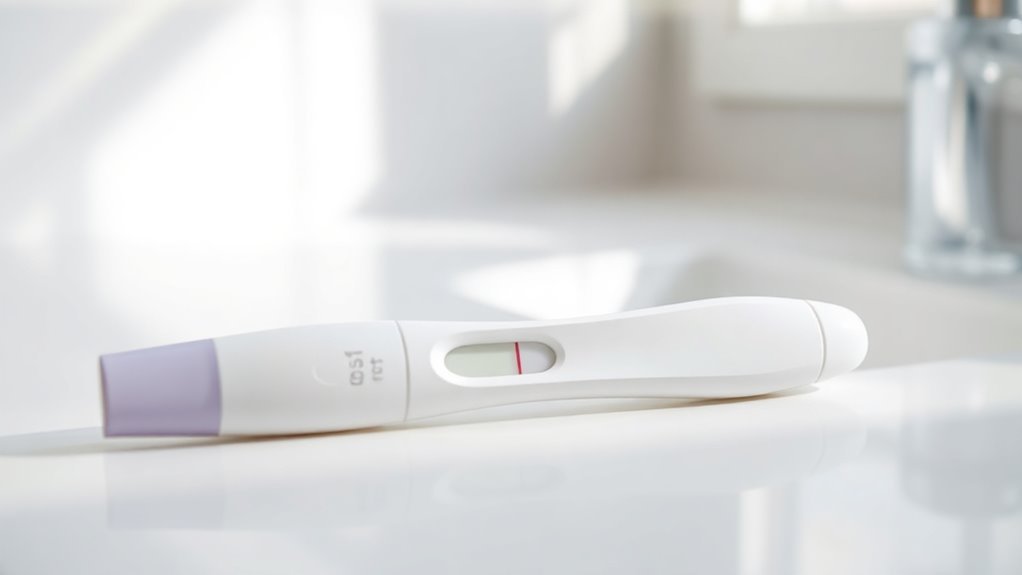
As medical references including Medical News Today note, timing and color are the two most reliable clues for telling a true faint positive apart from a drying artifact:
| Feature | Faint Positive Line | Evaporation Line | Indent Line |
|---|---|---|---|
| When It Appears | Within the printed reading window (usually 3–10 minutes) | After the reading window expires, as urine dries on the strip | Visible as a faint groove even before or after liquid touches the strip |
| Color | Has visible pink or blue dye matching the test’s ink | Colorless, pale gray, or watermark-like | Colorless shadow or slight indentation in the paper |
| Meaning | hCG detected in urine (usually early pregnancy) | Negative / invalid after-window artifact; ignore and retest | Manufacturing groove where dye would collect; not a positive |
Why a True Positive Line Can Look Faint
- Testing very early: Right after implantation, human chorionic gonadotropin (hCG) starts at low levels and typically rises rapidly every 48 to 72 hours in early pregnancy. Testing several days before a missed period often yields a pale line.
- Diluted urine: Drinking a lot of water or testing later in the day lowers the concentration of hCG in your urine. If you tested late in the day, see our guide on whether you can take a pregnancy test in the evening.
- Brand sensitivity and dye type: Different test strips detect different minimum hCG thresholds (measured in mIU/mL). Pink-dye tests are often easier to read cleanly than blue-dye tests, which some users find more prone to faint dye runs.
- Early pregnancy loss (chemical pregnancy): A chemical pregnancy happens when an embryo implants briefly enough to produce detectable hCG but stops developing very early, causing a faint positive followed by a negative test and a period shortly afterward.
- Fertility medications containing hCG: Trigger shots used in fertility cycles can remain detectable in urine for days, producing a temporary positive line unrelated to a new pregnancy.
How to Retest for a Clearer Answer (Step by Step)
- Wait 48 hours before testing again: Retesting a few hours later rarely gives a clearer answer because hCG needs time to rise.
- Use first-morning urine: Your first bathroom trip after waking provides the most concentrated urine sample of the day. (Tracking your cycle closely? Our guide on when to take an ovulation test explains how timing differs for LH vs. hCG.)
- Check expiration dates and lay the test flat: Expired or moisture-damaged strips can malfunction. Set a timer immediately after dipping or holding the test in the stream.
- Read strictly within the window—then discard: Check the result at the exact minute listed in the instructions, take a timestamped photo if you want a record, and throw the test away so you are not tempted to inspect a dried evaporation line later.
When to Contact a Healthcare Provider
Schedule an appointment with a doctor, OB-GYN, or clinic if:
- Your test lines stay faint, fail to darken over several days, or alternate between faint positive and negative.
- You have missed your period, have irregular cycles, or recently underwent fertility treatment and need a quantitative serum (blood) hCG test.
- Seek urgent medical care right away if a positive or faint positive test is accompanied by severe or one-sided abdominal/pelvic pain, heavy vaginal bleeding, dizziness, fainting, or shoulder-tip pain, which can be warning signs of an ectopic pregnancy or other urgent complication.
Frequently Asked Questions
Does a faint colored line within the reading window mean I am pregnant?
In most cases, yes. A faint pink or blue line that appears within the manufacturer’s reading window (typically 3 to 10 minutes) indicates that the test detected human chorionic gonadotropin (hCG) in your urine. Retest in 48 hours with first-morning urine or confirm with a healthcare provider.
Can medications cause a faint positive pregnancy test?
Most everyday medications—such as antibiotics, pain relievers, and birth control pills—do not cause false-positive pregnancy tests. However, fertility treatments containing synthetic hCG (such as a trigger shot) can produce a faint positive if you test too soon after the injection.
Can a faint line on a pregnancy test mean twins?
No. A home pregnancy test cannot tell you whether you are carrying twins or a singleton, and line darkness does not diagnose pregnancy viability or multiples. Only a clinical ultrasound can confirm twins.
Are digital pregnancy tests more accurate than line tests?
Digital tests are not necessarily more sensitive than standard line strips—in fact, some early-detection pink-dye strips detect slightly lower hCG levels. However, digital tests remove the guesswork of interpreting faint lines by displaying a clear text result.
Should I keep a used pregnancy test to check it again later?
No. Re-reading a dried pregnancy test after the instructed time window is one of the most common reasons people mistake an evaporation line for a positive. If you want to compare progression over several days, take a clear photo within the official reading window and then discard the test.



[…] mark means the same thing. For a broader overview of evaporation marks vs. positives, see our faint line on a pregnancy test positive vs. evap breakdown. Use the comparison below to evaluate an ultra-faint result right […]