A coffee maker does not have a fixed expiration date. European consumer survey data puts the broad average at about 6.5 years, but the useful life of an individual machine can be much shorter or much longer. Its type, water quality, maintenance, brewing volume, repairability, and replacement-parts support all affect how long it remains practical to use.
Quick Answer
About six to seven years is a reasonable broad benchmark for a home coffee maker, based on European consumer survey data. More detailed data puts pad/capsule machines at about 5.5 years and espresso machines at about 7 years 2 months. These are observed averages, not expiration dates.
Key Takeaways
- European survey data provides an overall coffee-machine average of about 6.5 years, not a guaranteed lifespan for every machine.
- The same EEA dataset reports about 5.5 years for pad/capsule machines and about 7 years 2 months for espresso machines.
- Water hardness, scale, coffee residue, heat cycles, pumps, seals, electronics, and parts availability all affect longevity.
- Weak or bitter coffee does not automatically mean the machine is worn out; clean it and check the beans, grind, dose, water, filter, and brewing conditions first.
- Follow the maintenance light and model manual rather than using one universal descaling or gasket-replacement schedule.
- Stop using a machine with a damaged cord, smoke, sparking, a burning odor, serious electrical leakage, or an active safety recall that requires owners to stop using it.
At a Glance
| Broad Lifespan Benchmark | About 6.5 years on average in Euroconsumers survey data reported by the European Environment Agency; individual results vary widely |
| Pad/Capsule Benchmark | About 5.5 years in the EEA’s detailed Euroconsumers data |
| Espresso-Machine Benchmark | About 7 years 2 months in the same EEA dataset |
| Routine Care | Empty grounds or pods, rinse approved removable coffee-contact parts, wipe spills, and clean milk components after use as directed |
| Descaling Schedule | Follow the model manual, maintenance light, water hardness, and brewing volume; Keurig recommends every 3–6 months for many of its brewers |
| Replace or Stop Using Immediately When | A recall requires it, the cord is damaged, the machine sparks or smokes, or water reaches electrical components |
How Long Should You Expect Your Coffee Maker to Last?
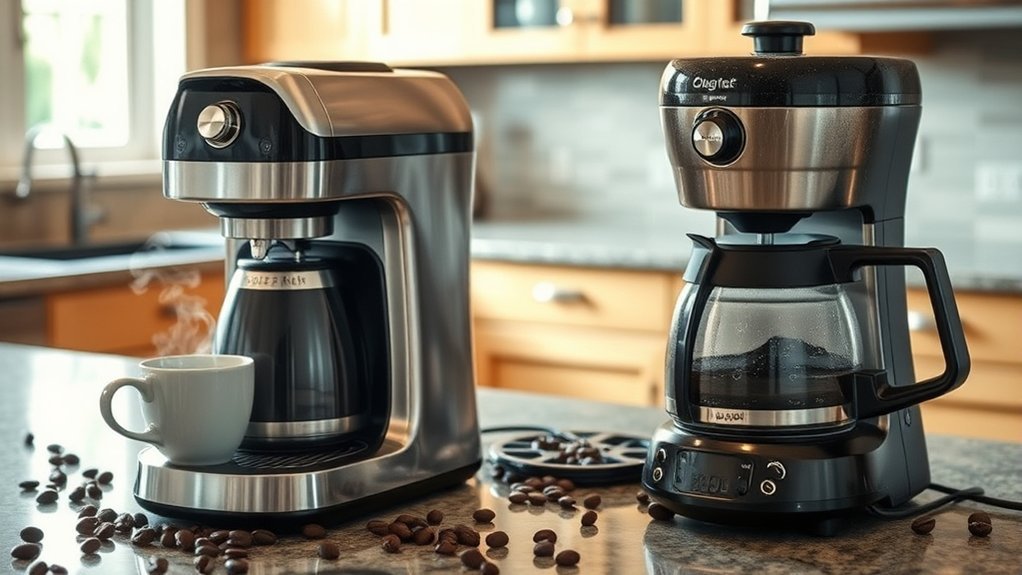
A useful evidence-based benchmark comes from the European Environment Agency’s product-lifespan analysis. Using Euroconsumers survey data from Belgium, Italy, Portugal, and Spain, the EEA reports that coffee machines lasted an average of nearly six years and six months, or about 6.5 years.
That figure is an observed consumer-use average, not a warranty, engineering design life, or expiration date. It also does not prove that every drip, pod, or espresso machine should last exactly 6.5 years. A simple brewer with few electronic parts may survive many years, while a machine with a failed control board may become uneconomical to repair much sooner.
Note: The EEA says the Euroconsumers respondents were members of consumer organizations in four European countries and are not representative of the entire population. The lifespan figures are based on how long respondents used their previous appliance before replacing it, regardless of the reason for replacement. Treat the numbers as useful real-world benchmarks, not universal durability ratings.
Age is only one clue. A safe, repairable machine that still heats, pumps, and brews consistently does not need replacement just because it has passed an average lifespan.
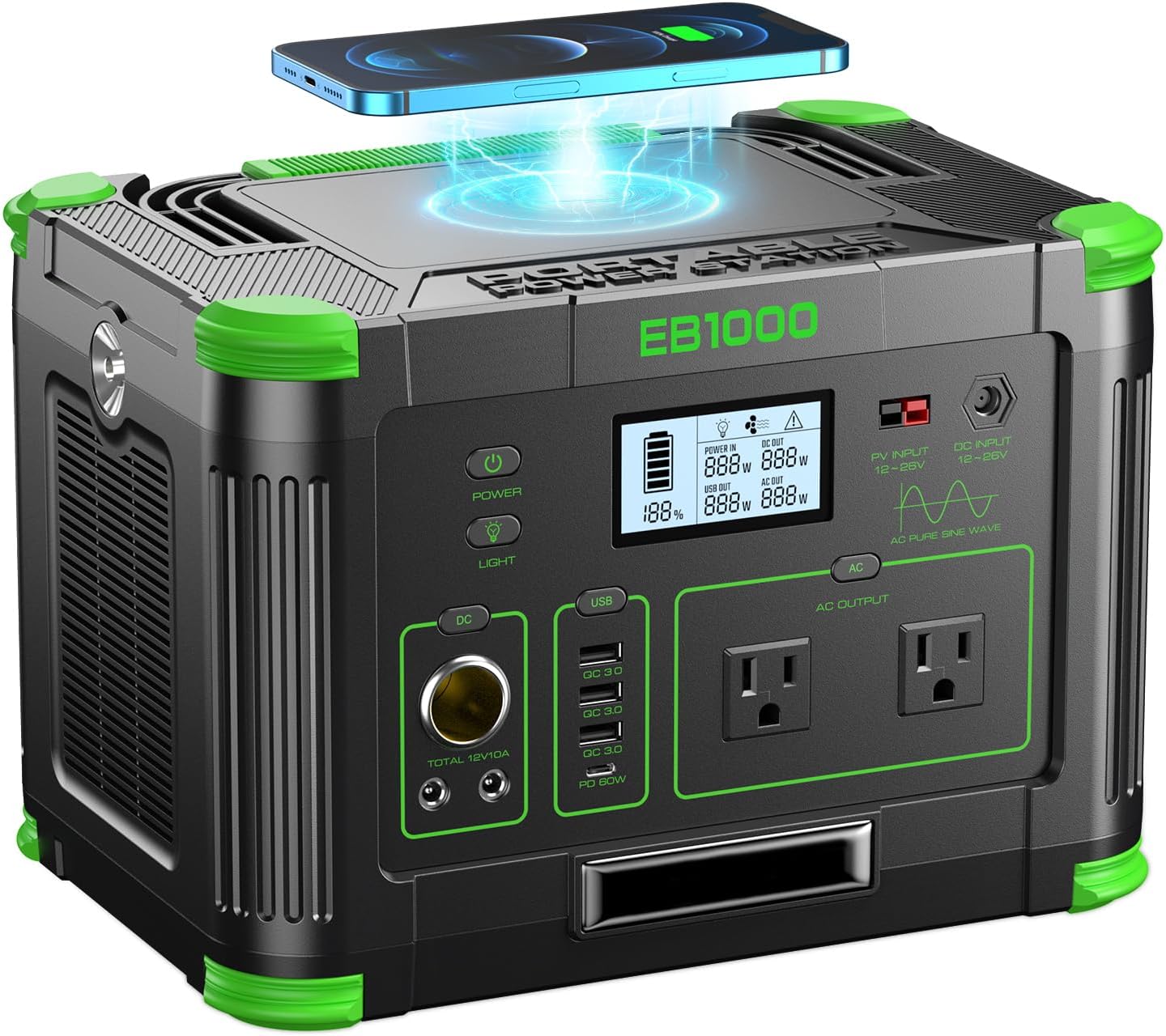
Power your essentials anywhere with a 999Wh pure sine wave power station delivering up to 1000W continuous with 2000W surge. It supports fast charging via USB-C PD 60W and USB-A QC 18W, plus simultaneous output for multiple devices through AC, USB, wireless, and car/DC ports. Recharge using AC, car, or solar with a built-in MPPT controller and dual cooling fans, while the upgraded battery management system protects against surges, short circuits, and overheating.
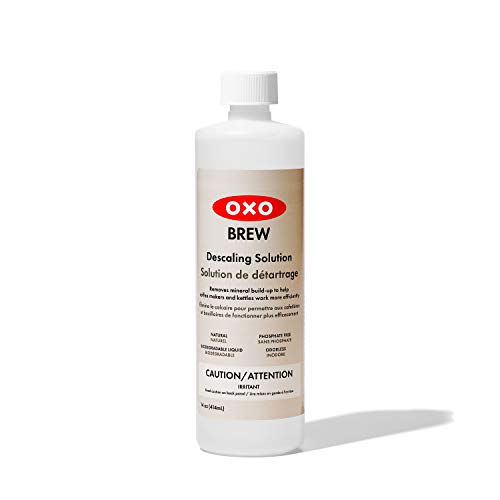
Helps keep your coffee makers and kettles working efficiently and using less energy

INCLUDES: 4 Keurig Rinse Pods, 1 Descale Solution, and 2 Water Filter Cartridge Refills
How Coffee Maker Type Affects Longevity
The EEA’s more detailed appliance-lifespan data reports an average of about 5.5 years for pad/capsule coffee machines and about 7 years 2 months for espresso machines. Comparable figures for every other brewer type are not provided in that dataset, so unsupported lifespan estimates should not be treated as equally reliable.
| Machine Type | What Affects Its Service Life | Typical Failure Points |
| Drip coffee maker | Simple models have fewer moving parts, but heating circuits and warming plates experience repeated heat cycles. The cited EEA dataset does not provide a separate drip-only average. | Scale, clogged water paths, thermostat failure, heating-element failure, cracked reservoirs, damaged carafes, and worn switches |
| Single-serve or pod brewer | The EEA reports about 5.5 years for pad/capsule machines in its survey data. Pumps, puncture needles, valves, seals, sensors, and pod compatibility add possible failure points. | Slow flow, clogged needles, scale, pump problems, seal leaks, sensor errors, and discontinued compatible pods |
| Home espresso machine | The EEA reports an average of about 7 years 2 months for espresso machines. Serviceable pumps, valves, boilers, group seals, and controls can support continued use when parts and technicians remain available. | Scale, pump wear, valve failure, leaks, worn group seals, steam-wand clogs, and electronic faults |
| Commercial brewer | Built for frequent service but dependent on scheduled preventive maintenance, suitable water treatment, replacement parts, and professional repairs. There is no single reliable lifespan figure for all commercial brewers. | Valves, pumps, boilers, heating controls, water-treatment systems, switches, and high-use seals |
| Manual brewer | Pour-over brewers, French presses, and many moka pots have few or no electrical components, so their service life is often limited by physical wear or replaceable parts rather than electronics. | Broken glass, worn filters, damaged handles, corroded metal, and replaceable moka-pot gaskets |
Factors That Influence Coffee Maker Longevity
Your machine’s service life depends on more than its age. Construction, heat, water quality, cleaning, storage, brewing volume, replacement parts, and access to qualified repair all matter.
Build Quality and Repairability
A higher price does not automatically guarantee a longer life. More useful indicators include a replaceable carafe, removable reservoir, accessible seals, available pumps or valves, published manuals, responsive support, and an authorized repair network.
Machines that are sealed shut or depend on a discontinued electronic board may be difficult to repair even when the original failure is small. Before buying, check whether the manufacturer sells common replacement parts and provides support after the warranty expires.
Usage Frequency and Storage
Daily brewing does not automatically extend a coffee maker’s life. Each brew adds another heating, pumping, switching, and cooling cycle. Heavier use therefore increases the number of operating cycles accumulated by components such as pumps, heaters, switches, valves, and seals.
Infrequent use is not automatically damaging either. Problems can develop when water, coffee oils, grounds, pods, or milk residue remain in the machine during storage. Before a long period of non-use, clean removable parts, empty the reservoir and drip tray, follow any system-emptying procedure in the manual, and allow washable parts to dry.
Water Hardness and Mineral Scale
Hard water contains higher levels of dissolved calcium and magnesium. When hard water is heated, mineral deposits can form inside water lines and on heating surfaces. The U.S. Geological Survey notes that scale can reduce equipment life, increase heating costs, lower heating efficiency, and restrict water flow.
USGS classifies water hardness approximately as follows: 0–60 mg/L as CaCO₃ is soft, 61–120 mg/L is moderately hard, 121–180 mg/L is hard, and more than 180 mg/L is very hard. Your local water utility, a suitable hardness test, or the machine’s water-setting procedure can help you determine how aggressively scale may develop.
A pitcher or refrigerator filter may improve chlorine taste without removing much hardness. Check what your filter actually reduces. Use potable water that meets your machine manufacturer’s instructions, and do not assume distilled, demineralized, reverse-osmosis, or fully softened water is suitable for every brewer. Some manufacturers specifically discourage water with too little mineral content for certain machines.
Cleaning and Maintenance Practices
Cleaning and descaling are not the same task. Cleaning removes coffee oils, grounds, milk residue, and surface soil. Descaling targets mineral deposits inside the water path.
Wash the carafe, brew basket, reusable filter, drip tray, and other approved removable parts as directed. Espresso machines may also need the portafilter, basket, group head, and steam wand cleaned frequently. Breville’s maintenance guidance, for example, treats group-head, steam-wand, descaling, filter, grinder, and water-tank maintenance as separate tasks with different intervals.
Descaling frequency should come from your model manual, maintenance indicator, water hardness, and brewing volume. Keurig currently recommends descaling every three to six months for its compatible brewers, but that interval should not be applied automatically to every brand or machine.
Heat, Environment, and Electrical Wear
Warming plates, boilers, thermoblocks, pumps, switches, and control boards experience repeated heating and cooling. Keep ventilation openings clear, do not place the brewer where steam continually reaches cabinets or electronics, and operate it on a stable, dry surface.
Electronic controls can also be damaged by unsuitable electrical conditions. Use the outlet, voltage, grounding arrangement, and other electrical setup specified in the machine manual. Do not improvise with an extension cord, adapter, or power device unless it is suitable for the appliance and permitted by the manufacturer’s instructions.
Should You Clean, Repair, or Replace Your Coffee Maker?
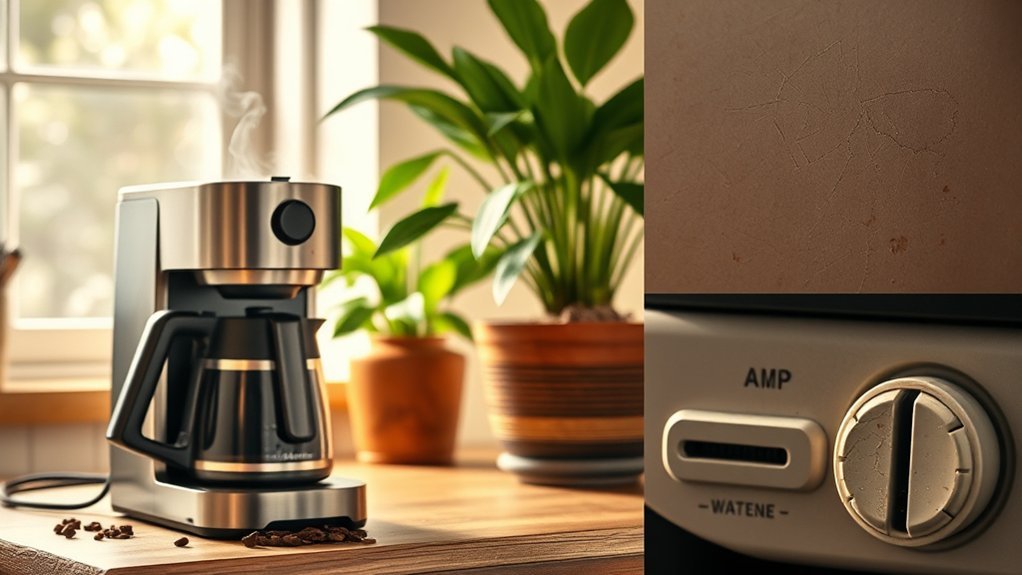
A bad-tasting cup or slow brew is not enough by itself to justify replacement. Begin with safe cleaning and basic troubleshooting. Then consider repair costs, parts availability, warranty status, age, recurring failures, and safety.
Warning: Stop using and unplug the coffee maker if it has a damaged cord or plug, produces smoke or sparks, smells like burning insulation, overheats abnormally, shows melted or deformed housing, or leaks into the electrical base. Do not open mains-voltage components unless you are qualified. Check the U.S. Consumer Product Safety Commission coffee-maker recall list before arranging a repair or continuing to use a machine with a safety concern.
Clean or Descale First When
- The brew cycle is slower than normal.
- The machine produces less coffee than the selected amount.
- The coffee tastes stale, oily, bitter, or unusual.
- Water flow sputters or becomes uneven.
- The machine displays a clean or descale light.
- The carafe, basket, pod needle, group head, or steam wand has visible residue.
Use only the cleaning method and descaler allowed by the manufacturer. Vinegar is permitted for some machines and cleaning procedures but is not the correct choice for every brewer. The wrong chemical, concentration, or procedure may affect seals, sensors, finishes, odors, or warranty coverage.
Repair May Make Sense When
- The machine is still covered by its warranty.
- The problem is caused by a replaceable carafe, reservoir, basket, valve, seal, pump, switch, or other available part.
- An authorized or qualified service center supports the model.
- The housing, cord, and main electrical system remain safe.
- The repair cost is reasonable compared with a suitable replacement.
- The machine otherwise meets your brewing needs.
Replacement May Make More Sense When
- A safety recall instructs owners to stop using or destroy the machine.
- The cord, heating system, control board, pressure system, or electrical base is unsafe.
- Water repeatedly reaches electrical components.
- Several major components have failed in a short period.
- The required part is discontinued or unavailable.
- Qualified repair approaches the price of a suitable replacement.
- The machine cannot maintain dependable performance after cleaning, descaling, and proper troubleshooting.
- Compatible pods, filters, carafes, or other required supplies are no longer available.
Common Symptoms and What They Usually Mean
| Symptom | Check First | Possible Repair or Replacement Sign |
| Weak, sour, or watery coffee | Fresh beans, grind size, dose, water amount, filter position, spray head, and scale | Persistent low brewing temperature or incomplete water delivery after maintenance and correct setup |
| Bitter or burnt coffee | Old residue, too-fine grounds, too much coffee, stale beans, or coffee left too long on a warming plate | Uncontrolled overheating or a faulty temperature-control component |
| Slow or noisy water flow | Descaling, reservoir seating, clogged needles, filters, air in the water path, and the model’s priming procedure | A worn pump, valve, flow meter, or blocked internal tube that approved service cannot clear |
| Leaks | Overfilled reservoir, incorrectly seated tank, damaged carafe, drip tray, accessible seals, and loose removable parts | Internal boiler, hose, valve, pressure-system, or electrical-base leakage |
| Lukewarm coffee | Preheating, batch size, cold carafe, scale, selected temperature, and measurement method | A failed thermostat, sensor, thermoblock, boiler, or heating element |
| Intermittent power or error codes | Outlet, reservoir position, doors, trays, required cleaning, and the model’s approved reset procedure | Damaged wiring, switches, sensors, thermal fuses, or control boards |
How to Check Brewing Temperature
The Specialty Coffee Association Certified Home Equipment program evaluates brewers against established brewing-quality, consistency, and performance standards. A range around 195–205°F (91–96°C) is commonly referenced for hot drip-coffee extraction, but it should not be treated as a universal pass/fail specification for every brewer or beverage mode.
For a basic consistency check, preheat the carafe or cup when appropriate, run the same normal batch on repeated tests, and measure the brewed coffee promptly with an accurate food thermometer. Do not place your fingers or thermometer where hot water, steam, moving parts, or electrical components can cause injury.
A low reading does not automatically prove heater failure. A cold carafe, small batch, measurement delay, scale, selected brew mode, machine design, and thermometer accuracy can all affect the result. Compare repeated measurements with the operating information in your specific model manual rather than diagnosing a machine from one generic temperature number.
How to Make Your Coffee Maker Last Longer
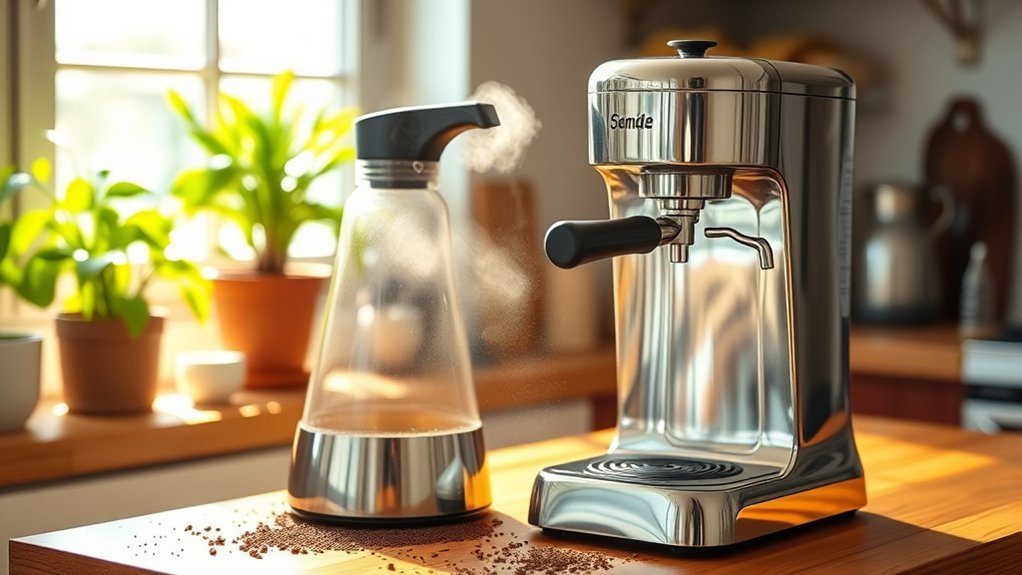
- Empty used coffee promptly. Remove wet grounds, paper filters, pods, and spent capsules after the machine has cooled enough to handle safely.
- Clean coffee-contact parts. Wash the carafe, brew basket, reusable filter, drip tray, pod holder, portafilter, and other approved removable parts according to the manual.
- Clean milk systems promptly. Purge and wipe steam wands as directed after use. Refrigerate or clean removable milk containers according to the manufacturer’s instructions.
- Descale on the correct schedule. Follow the maintenance light and manual. Harder water and heavier use can require more frequent scale management.
- Use the correct water. Use potable water allowed by the manufacturer. Confirm whether your filter reduces hardness rather than only improving taste and odor.
- Inspect accessible seals. Replace a seal when the manual schedules it or when it becomes cracked, flattened, stiff, loose, or leaky. Do not replace every gasket automatically at an arbitrary interval.
- Keep vents and surfaces clear. Give the machine room to release heat and steam, and operate it on a level, dry surface.
- Do not ignore small leaks. A reservoir or seal leak can become a larger problem. Stop using the machine if water enters its electrical base.
- Prepare it for storage. Empty water, clean residue, dry removable parts, and use the manufacturer’s system-emptying procedure when one is provided.
- Keep the model and purchase information. The model number, serial number, receipt, and manual make warranty claims, recall checks, parts orders, and repairs easier.
Pro Tip: Record each descaling date on your phone or calendar. Also note the water-hardness setting, filter-change date, and any recurring error code. A simple maintenance history can reveal whether a problem follows routine mineral buildup or points to a developing component failure.
Note: A warranty period is not the machine’s expected lifespan. It describes the manufacturer’s repair or replacement obligations under stated conditions, not the date on which the appliance should fail.
Lower-Maintenance Alternatives to an Automatic Coffee Maker
If repeated pump, heater, sensor, or pod-system repairs are frustrating, a simpler brewing method may better fit your needs. Manual equipment often has fewer electrical components and may be easier to clean, maintain, or keep in service with basic replacement parts.
- Single-cup machines: Convenient and consistent, but they still contain pumps, heaters, seals, needles, or electronics depending on the design. Check pod and replacement-part availability before buying.
- Pour-over brewers: Offer control over water flow and brew time with no built-in pump, heater, or control board. A separate kettle becomes the main electrical appliance when you use an electric one.
- French presses: Have few parts and can remain useful for a long time when the carafe and filter assembly remain serviceable. Glass models require careful handling.
- Moka pots: Produce concentrated coffee without an electric pump. Inspect the pot and safety components according to the manufacturer’s instructions and replace the gasket or filter when worn.
- Cold-brew systems: Use room-temperature or cold water and usually contain no built-in heater. Their main equipment needs are thorough cleaning, sound containers, and proper food handling of the brewed coffee.
How to Estimate Your Coffee Maker’s Remaining Life
No checklist can predict the exact date a coffee maker will fail, but these questions can show whether the machine is still a good candidate for continued use:
- Does it complete a full brew cycle without leaking, overheating, or displaying recurring errors?
- Does cleaning or descaling restore normal flow and taste?
- Can it heat and deliver water consistently enough for your brewing method and model specification?
- Are the carafe, reservoir, filters, seals, pumps, and other common parts still available?
- Does the manufacturer or an independent qualified shop still service the model?
- Is the power cord, plug, housing, and electrical base undamaged?
- Is the machine free of an active safety recall that requires owners to stop using it?
- Would a repair cost meaningfully less than a suitable replacement?
- Does the machine still meet your capacity, speed, and beverage needs?
A well-functioning older machine can remain useful. A newer machine with an unsafe electrical fault, unavailable control board, repeated internal leak, or unsupported pressure-system problem may already be at the end of its practical service life.
Frequently Asked Questions
Can I repair my coffee maker instead of replacing it?
Often, yes. A carafe, reservoir, basket, accessible seal, switch, valve, or pump may be replaceable. Check the warranty, recall status, parts supply, service availability, and repair quote first. Stop using the machine and seek qualified service when the fault involves mains wiring, a damaged cord, overheating, pressure components, or water entering the electrical base.
What coffee maker brands last the longest?
No brand guarantees the longest life across every model. Compare the specific machine’s warranty, parts availability, repair network, published manuals, removable components, long-term owner feedback, and history of supporting older models. A serviceable design can be more meaningful than the logo alone.
How often should I clean my coffee maker?
Empty grounds or pods and clean approved coffee-contact parts regularly, often after each use when the manual calls for it. Perform deeper cleaning according to the manufacturer’s instructions. Descaling follows a separate schedule based on the model, maintenance light, water hardness, and brewing volume.
Does hard water shorten a coffee maker’s life?
It can. Heated hard water can leave calcium-based scale on heating surfaces and inside water paths. Scale may slow flow, reduce heating efficiency, and contribute to premature problems when it is not removed according to the manufacturer’s instructions.
Should I descale my coffee maker with vinegar?
Only when the model’s instructions permit that method. Some manufacturers publish vinegar-based cleaning or descaling procedures for certain brewers, while other machines specify an approved descaling product. Follow the instructions for your exact model rather than assuming one chemical works safely in every machine.
Are some coffee makers designed for heavy use?
Yes. Commercial and office brewers may use components intended for repeated brewing, but they still require preventive maintenance, suitable water treatment, cleaning, and timely repair. Confirm that the machine’s rated use matches the number of daily brews you expect.
Does a longer warranty mean the coffee maker will last longer?
Not necessarily. A warranty explains which defects the manufacturer will address and for how long. It does not promise the machine’s total service life. Still, clear warranty terms, authorized service, and post-warranty parts support are useful signs when comparing machines.
When should I replace a coffee maker immediately?
Stop using it immediately when a recall requires it or when the machine has a damaged cord, smoke, sparking, a burning odor, melted housing, severe overheating, uncontrolled pressure, or water reaching electrical parts. Unplug it if doing so is safe and follow the manufacturer or recall instructions.
Can a coffee maker last 10 years or longer?
Yes. An average lifespan is not a maximum. A machine can remain useful for 10 years or longer if its components remain safe and functional and cleaning, maintenance, parts, and repairs are still practical. Age alone is not a reason to discard a coffee maker that continues to work safely and consistently.
Do pod coffee makers last as long as espresso machines?
Not on average in the cited European survey data. The EEA reports about 5.5 years for pad/capsule machines and about 7 years 2 months for espresso machines. Those are observed averages from a specific consumer survey, however, so an individual pod machine can outlast the average and an individual espresso machine can fail earlier.
Conclusion
A coffee maker’s age can help you plan, but it should not make the decision for you. About 6.5 years is a useful broad benchmark from European consumer survey data, while the same EEA data reports about 5.5 years for pad/capsule machines and 7 years 2 months for espresso machines. None of these figures is a deadline. Continue using a safe machine that brews consistently and can still be maintained or repaired. Clean, descale, and troubleshoot ordinary performance problems before replacing it, but stop using the machine when you find a serious electrical hazard, dangerous leak, overheating problem, uncontrolled pressure issue, or active recall that instructs owners to stop.
Sources
- European Environment Agency — Product Lifespans: Monitoring Trends in Europe — supports the approximately 6.5-year observed average for coffee machines in Euroconsumers survey data.
- European Environment Agency — Evolution in Average Lifespans of Household Appliances — supports the approximately 5.5-year pad/capsule and 7-year-2-month espresso-machine figures and explains the survey methodology and limitations.
- U.S. Geological Survey — Hardness of Water — explains calcium and magnesium hardness, water-hardness classifications, mineral scale, equipment-life effects, and heating-efficiency loss.
- Keurig — Descaling Solution and Maintenance Guidance — supports the three-to-six-month descaling recommendation used as a Keurig-specific example.
- Breville — Cleaning and Maintenance — supports separating frequent coffee-contact cleaning from other periodic maintenance tasks.
- Specialty Coffee Association — Certified Home Equipment — explains third-party evaluation of home brewers against brewing-quality, consistency, and performance standards.
- U.S. Consumer Product Safety Commission — Coffee Maker and Teapot Recalls — supports checking current safety recalls and following stop-use instructions when applicable.