Coffee can stay on a warming plate for longer than 30 minutes, and there is no scientifically established point at which plain black coffee suddenly becomes undrinkable. Holding time does change its aroma, acidity, and other sensory qualities, but the amount of change varies with the coffee, carafe, plate temperature, and your own taste. If you will not drink the pot reasonably soon, moving it to a preheated thermal carafe avoids continued heating.
Quick Answer
There is no scientifically proven 30-minute cutoff. A 2023 study found sensory changes as drip coffee was held for 15 minutes to 3 hours, yet coffee professionals showed no overall preference for 30-minute coffee over 180-minute coffee. Drink it while you enjoy the flavor, and use a thermal carafe when you want to avoid continuous hot-plate heat.
Key Takeaways
- Treat 30 minutes as a practical freshness benchmark, not a universal spoilage or flavor deadline.
- A 2023 study detected sensory changes during up to three hours of holding, but its coffee-industry panel did not prefer the 30-minute sample over the 180-minute sample overall.
- Continuous heat can promote evaporation and aroma loss, although the sensory effect depends on the roast, carafe, temperature, and holding time.
- A vacuum-insulated carafe keeps coffee warm without an active heating element, making it useful when you want to avoid continued hot-plate heating.
- Consumer research found strong temperature acceptance for black coffee tasted at about 136°F to 151°F.
- Coffee containing milk, cream, or another perishable ingredient needs separate food-safety precautions.
- Follow your coffee maker’s automatic-shutoff and warming-plate instructions; never bypass a safety feature.
At a Glance
| 30-Minute Mark | A useful freshness benchmark, not a scientific spoilage cutoff. |
| Research Holding Period | Drip coffee has been sensory-tested after holding periods ranging from 15 minutes to 3 hours. |
| Preferred Tasting Range | About 136°F to 151°F produced strong temperature acceptance in a large black-coffee consumer study. |
| Longer Holding | Consider a preheated vacuum-insulated carafe if you want to retain heat without continuously heating the coffee. |
| Coffee With Dairy | Refrigerate perishable drinks within two hours, or within one hour above 90°F, unless they are reliably held at a safe temperature. |
Understanding the Impact of Warming Plates on Coffee Freshness
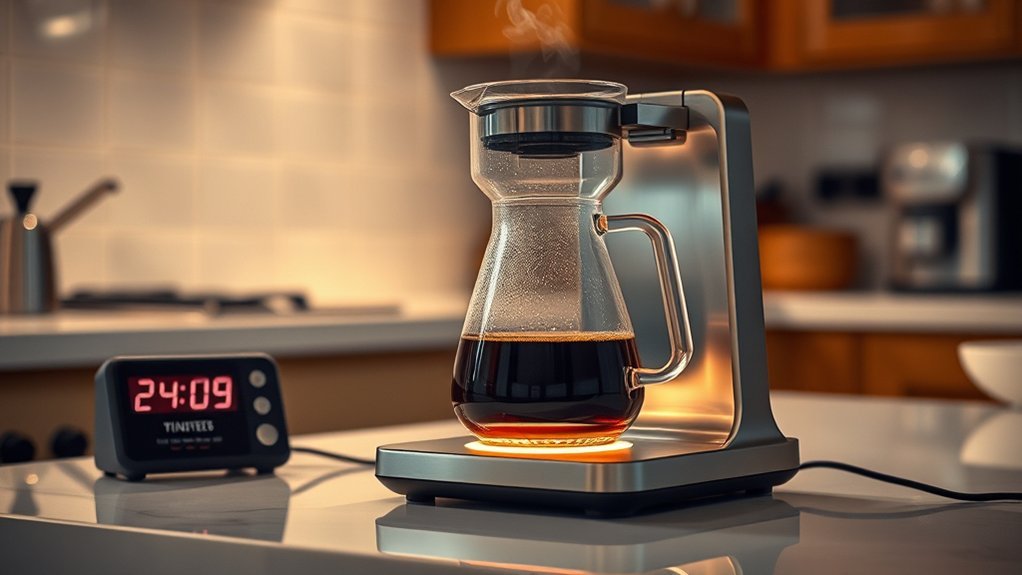
When coffee remains on a warming plate, the plate does more than replace lost heat. It keeps exposing the brewed coffee to an elevated temperature, while time continues to change the aroma and sensory profile.
A 2023 study on post-brew holding time and carafe type tested light-, medium-, and dark-roast drip coffee held for 15 minutes to 3 hours. The researchers compared glass carafes on hot plates with insulated holding systems and found that holding time and carafe conditions could change sensory characteristics.
The results were more nuanced than a simple rule that old coffee always tastes worse. More sensory attributes decreased than increased over time, suggesting that loss of volatile aroma compounds is an important quality concern. Sourness and acidity also changed for some roast levels. However, a panel of 93 coffee-industry professionals showed no overall preference for coffee held 30 minutes versus coffee held 180 minutes.
Fresh coffee contains volatile compounds that contribute to its aroma. As coffee sits, some of these compounds escape or change. A warming plate can also encourage evaporation, especially when a lid is open or only a small amount of coffee remains. Depending on the brewer and coffee, the result may eventually seem stronger, flatter, harsher, more acidic, or less aromatic.
Thirty minutes is not a magic cutoff. It is better treated as a practical freshness checkpoint: taste the coffee, consider how much longer you need to hold it, and avoid unnecessary continuous heating when a thermal carafe will do the job.
The rate of change is not identical for every pot. It depends on the warming-plate temperature, coffee volume, carafe material, lid design, roast level, brew strength, holding time, and room conditions.
Best Practices for Keeping Your Coffee Hot and Tasty
If you expect to finish the pot reasonably soon, a warming plate is convenient. If the coffee must remain hot much longer, a thermal carafe can be useful because it retains existing heat without continually supplying more heat from below.
That does not mean a thermal carafe automatically produces better-tasting coffee in every situation. The 2023 holding study found that the effect of carafe type varied with roast and sensory attribute. The practical advantage of an insulated carafe is that it avoids active heating while reducing heat loss.
Insulated Container Benefits
A double-wall, vacuum-insulated carafe or travel mug slows heat transfer to the surrounding environment. Actual performance depends on the product, capacity, lid, starting temperature, fill level, and ambient conditions, so check the manufacturer’s heat-retention specifications instead of assuming every insulated container performs the same way.
A close-fitting lid reduces heat loss and evaporation. It can also help preserve more aroma compared with leaving coffee exposed in an open container.
Pro Tip: If you know a batch will be held for a while, transfer it soon after brewing rather than waiting until only a small amount remains on the hot plate. Preheating the insulated carafe first reduces the initial temperature drop.
Mug Preheating Techniques
A cold mug or carafe absorbs heat as soon as coffee touches it. To reduce that initial temperature drop, fill the container with hot water for one or two minutes, empty it, and then add the coffee.
For better heat retention:
- Use a mug or carafe with a close-fitting lid.
- Choose a container that is reasonably well matched to the amount of coffee you are holding.
- Keep the lid closed between pours.
- Use an insulated travel mug when drinking slowly.
- Preheat the container immediately before filling it.
Ceramic and thick glass mugs can hold heat reasonably well when preheated, but a vacuum-insulated mug generally slows heat loss more effectively.
How Long Can Coffee Safely Stay on the Warming Plate?
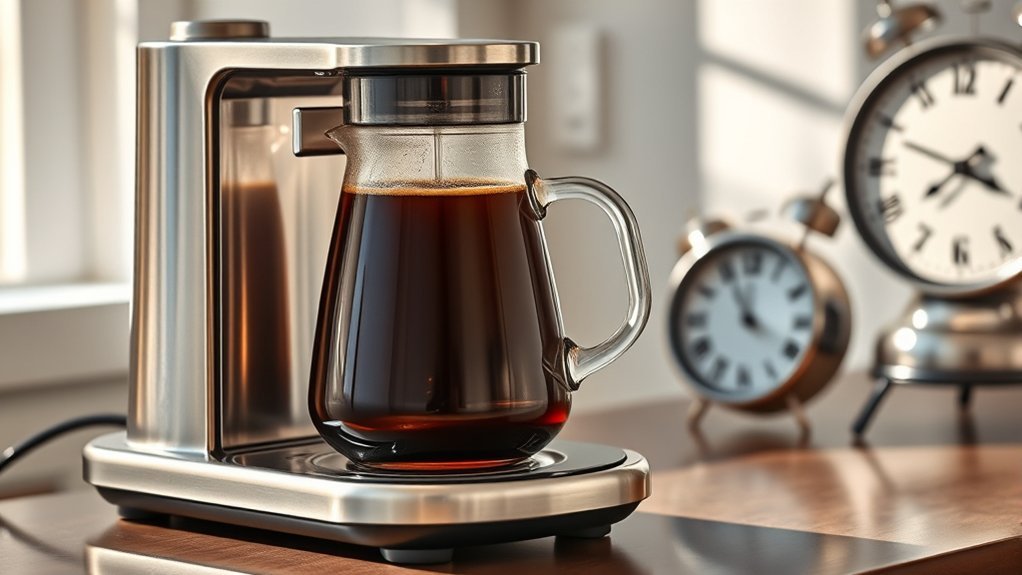
There is no evidence-based minute at which plain black coffee suddenly becomes unsafe or unacceptable. For flavor, 30 minutes works better as a checkpoint than a deadline. Some coffee may taste noticeably different by then, while another batch may remain enjoyable much longer.
A Practical Warming-Plate Timeline
- 0 to 30 minutes: Coffee is relatively fresh from the brew cycle, and this is a reasonable period in which to judge its original aroma and balance.
- 30 to 60 minutes: The coffee may still taste perfectly acceptable. Check for aroma loss, increased concentration from evaporation, or changes in acidity and bitterness.
- 1 to 3 hours: Research confirms that measurable sensory changes can occur during this period, although those changes do not guarantee that you will dislike the coffee. In the 2023 study, professionals did not show an overall preference for the 30-minute sample over the 180-minute sample.
- Beyond 3 hours: The cited holding study did not test longer periods. Do not invent a flavor or safety guarantee beyond the evidence. Follow your brewer’s automatic-shutoff instructions and use a thermal carafe or brew a fresh batch when prolonged holding is needed.
A nearly empty glass carafe may change more quickly than a full one because a small amount of liquid has less thermal mass and a larger proportion of the remaining coffee may be exposed to evaporation and continued heat.
What Does the 30-Minute Rule Really Mean?
The 30-minute figure often appears as a quality-control or freshness recommendation. The Batali study notes that some retail establishments discard brewed coffee after holding periods that can be as short as 30 minutes, but the researchers did not establish 30 minutes as a universal sensory limit.
Use the number as a reminder to check quality rather than as a rule that forces you to throw away otherwise acceptable black coffee.
Plain Coffee Versus Coffee With Dairy
The freshness discussion above primarily concerns plain black coffee. Thirty minutes is not a food-safety deadline for black coffee.
Coffee containing milk, cream, refrigerated plant milk, protein drinks, or another perishable ingredient requires more caution. The USDA food-safety guidance for perishables uses a two-hour limit at ordinary room temperatures and a one-hour limit when the surrounding temperature is above 90°F. Foods intended for safe hot holding should generally remain at or above 140°F.
Warning: Do not assume that an ordinary household coffee-maker warming plate provides verified food-safe hot holding for coffee containing dairy or another perishable ingredient. Follow the ingredient label, consume the drink promptly, or refrigerate it within the applicable safety window.
Coffee Maker and Hot-Plate Safety
Warming-plate temperatures and automatic-shutoff times vary by model. The National Coffee Association’s current drip-coffee guidance recommends considering safety features such as automatic shutoff to prevent overheating and following the manufacturer’s instructions for use, cleaning, storage, and maintenance.
Do not bypass an automatic shutoff merely to keep coffee warm longer. If your machine offers adjustable warming-plate temperatures, use the lowest setting that keeps the coffee comfortably warm and follow the limits in the manual. A lower setting may reduce unnecessary heating, but it does not stop normal aroma changes over time.
Do not touch the warming plate until it has cooled. Keep the brewer away from the edge of the counter, and position the carafe handle where it cannot be pulled or knocked over.
Signs Your Coffee Has Cooled Below Your Preferred Range
Do not use 180°F as a threshold for coffee being “too cold.” A temperature of 180°F is considerably hotter than the range associated with the strongest temperature acceptance in a large black-coffee consumer study.
The study found that consumer temperature acceptance was strongest across approximately 58°C to 66°C, or 136°F to 151°F, for the black coffees tested. Preferences still varied from person to person.
Your coffee may feel too cool when:
- It no longer provides the warmth you personally expect.
- The aroma seems faint because much of it has already dissipated.
- Its acidity, sweetness, bitterness, or roast character feels less balanced to you.
- It tastes flat after sitting uncovered.
- You repeatedly feel the need to reheat each serving.
Cooling itself is not always bad. Moderate cooling can make some flavor characteristics easier to notice because extremely hot coffee is harder to sip comfortably and can mask subtle sensory differences.
Effective Alternatives to Warming Plates for Keeping Coffee Hot
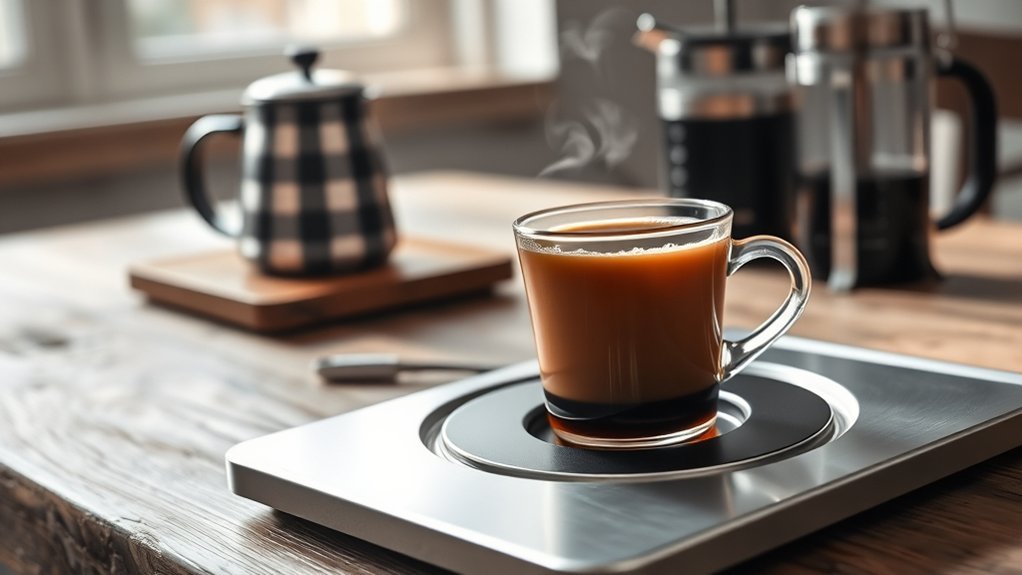
A thermal carafe is one of the most practical alternatives for a full pot. Preheat it, empty the water, transfer the coffee, and keep the lid closed. This keeps the coffee warm without an active hot plate.
Other options include:
- Vacuum-insulated travel mug: Useful for one or two servings and slow sipping.
- Small-batch brewing: Make only what you expect to drink soon so less coffee needs to be held.
- Low-temperature mug warmer: Slows cooling for one cup, although it still applies heat and can change flavor over time.
- Covered ceramic mug: A lid can reduce evaporation and heat loss.
- Temperature-controlled mug: Maintains a selected temperature according to the device’s operating limits.
Note: A mug warmer is not the same as an insulated container. It continues adding heat. Use it according to the manufacturer’s directions and do not leave an electrical warming device operating unattended.
The Science of Coffee Cooling and Flavor Loss
Coffee changes because of both time and temperature. Heat influences how quickly volatile compounds escape and how chemical reactions proceed, while the temperature of the drink also changes the way you perceive acidity, sweetness, bitterness, aroma, and body.
Temperature Impact on Flavor
Very hot coffee can seem less expressive because it is difficult to sip comfortably and evaluate subtle flavors. As it cools into a comfortable range, sweetness, acidity, and individual flavor notes may become easier to notice.
That does not mean holding coffee hot indefinitely improves it. Continued heating allows more time for aroma compounds to escape and for water to evaporate.
Research specifically on stored brewed Arabica coffee found that volatile-compound changes were generally slower when brews were stored at 4°C than at 25°C. The researchers also observed loss of aroma intensity and freshness during storage. This supports the basic quality principle that cooler storage slows some staling reactions, but it does not establish a household food-safety duration for leftover coffee.
The practical goal is therefore not to keep coffee as hot as possible. It is to maintain a temperature you enjoy while limiting unnecessary exposure to heat and air.
Cooling Mechanisms Explained
Coffee loses heat in several ways:
- Conduction: Heat moves from the coffee into the mug, carafe, table, or another surface.
- Convection: Moving air carries heat away from the container and liquid.
- Evaporation: Water vapor leaves the exposed surface and carries heat with it.
- Radiation: The hot container releases thermal energy to its surroundings.
A wide, uncovered mug generally cools faster than a covered container because more liquid is exposed to the air. A small amount of coffee also changes temperature faster than a large volume under similar conditions.
Optimal Serving and Drinking Temperature Range
Brewing temperature, carafe temperature, serving temperature, and drinking temperature are not interchangeable terms. Coffee is brewed hotter than the temperature at which most people comfortably drink it because heat is lost during brewing, pouring, and serving.
In the 2022 consumer study, black coffee tasted between 58°C and 66°C, or approximately 136°F and 151°F, produced strong temperature acceptance. At the upper end of the tested temperatures, particularly around 70°C to 71°C, more participants considered the drink too hot, and the researchers found no improvement in overall liking from serving it hotter.
Warning: Coffee and coffee-making equipment can cause serious burns. Let very hot coffee cool before taking a full sip, and use extra care when serving children, older adults, or anyone with reduced heat sensitivity.
Tips for Enjoying Fresh-Tasting Coffee After Brewing
Small changes in your routine can preserve more aroma without requiring special equipment:
- Brew only the amount you expect to drink.
- Use 30 minutes as a convenient point to check whether hot-held coffee still tastes the way you want.
- Transfer a batch to a preheated thermal carafe when you want to keep it warm without continued hot-plate heat.
- Keep the lid closed between pours.
- Use clean equipment so old coffee oils do not add stale or bitter flavors.
- Rinse and wash the carafe after each use.
- Do not mix freshly brewed coffee with an old, repeatedly heated remainder.
If your coffee maker leaves baked coffee residue on the plate or carafe, unplug the machine and allow it to cool before cleaning it according to the manufacturer’s instructions.
When to Brew Fresh Coffee vs. Drinking Leftovers
Freshly brewed coffee normally provides the best opportunity to experience its original aroma. Brewing a new, smaller batch is a sensible choice when old coffee tastes harsh, flat, stale, overly concentrated, or otherwise unpleasant to you.
Leftover plain black coffee can still be used when it was prepared and handled cleanly. If you intend to save it rather than continue hot holding, transfer it to a clean, covered container and refrigerate it. Research on stored brewed coffee indicates that lower storage temperatures slow some changes in volatile compounds, although refrigeration cannot restore aromas that have already escaped.
To reheat refrigerated coffee:
- Pour only the amount you plan to drink into a microwave-safe mug or small saucepan.
- Heat it gradually rather than boiling it.
- Stir it so the temperature is more even.
- Check the temperature before drinking.
- Avoid repeatedly heating and cooling the same serving because repeated temperature changes can further reduce quality.
Coffee containing dairy or another perishable ingredient should be discarded if it has exceeded the applicable food-safety window. Smell and appearance alone cannot prove that a perishable drink is safe.
Frequently Asked Questions
Can I reuse coffee left on the warming plate?
Plain black coffee may still be drinkable after sitting on a warming plate. There is no universal 30-minute discard rule. Let a small sample cool to a comfortable temperature and judge the flavor. Brew fresh coffee when the old batch tastes stale, harsh, overly concentrated, or unpleasant.
What happens if coffee is left on too long?
Holding coffee for a long time can change its aroma, acidity, and other sensory characteristics. Volatile aromas may be lost and water can evaporate. The exact result depends on the roast, carafe, warming temperature, amount of coffee, and holding time.
How can I tell coffee is burnt?
Hot-held coffee is often described as burnt or scorched when it develops a harsh aroma, strong bitterness, reduced sweetness, little fresh aroma, or a cooked character. Actual sensory changes vary, so your own taste is a better guide than a fixed number of minutes.
Does coffee quality vary by brewing method?
Yes. Brewing method, grind size, roast, water chemistry, filter type, extraction, and holding method can all affect acidity, bitterness, aroma, body, and clarity. Any brewed coffee can also change as it sits and loses volatile aroma compounds.
Is there a best time to drink brewed coffee?
There is no single scientifically proven time limit that suits every coffee. Thirty minutes is a useful freshness checkpoint, but a 2023 sensory study found that coffee professionals did not show an overall preference for 30-minute coffee over coffee held for 180 minutes. Drink it at the time and temperature you enjoy most.
Is 30 minutes a food-safety limit?
No. Thirty minutes is primarily a freshness benchmark for plain coffee, not a food-safety deadline. Food-safety concerns are more important when milk, cream, or another perishable ingredient has been added.
How long can coffee with milk sit out?
For coffee containing perishable dairy or another refrigerated ingredient that is not being reliably hot-held or kept cold, follow the USDA two-hour rule. Reduce the limit to one hour when the surrounding temperature is above 90°F.
Is reheating coffee safe?
Plain black coffee that was handled cleanly and refrigerated can be reheated, although its flavor may be less fresh. Heat only the amount you need and check the temperature before drinking. Reheating does not make improperly stored coffee containing dairy safe.
Can I leave coffee on the warmer until the automatic shutoff?
Only within the operating limits specified by your coffee maker’s manufacturer. An automatic shutoff is an appliance-safety feature, not a guarantee that coffee will taste fresh until the machine turns itself off. Never bypass the shutoff to extend holding time.
Is a thermal carafe always better than a warming plate?
Not in every sensory comparison. Research shows that carafe effects can vary with roast and holding conditions. A thermal carafe’s main practical advantage is that it slows heat loss without continuously heating the coffee, making it useful when you want to avoid prolonged hot-plate exposure.
Conclusion
Coffee does not cross a universal quality or safety boundary after 30 minutes on a warming plate. Research shows that its sensory profile changes during holding, but those changes do not always reduce overall liking. In one study, coffee-industry professionals did not show an overall preference for coffee held 30 minutes instead of 180 minutes.
Use 30 minutes as a convenient freshness checkpoint rather than a strict discard rule. If you want to keep a batch hot without continued heating, transfer it to a preheated thermal carafe. Keep flavor, food safety, and appliance safety separate: plain coffee has no 30-minute spoilage rule, drinks containing perishable ingredients need appropriate temperature control, and your brewer should always be operated within its manufacturer’s instructions.
Sources
- Batali et al., The Effect of Post-Brew Holding Time and Carafe Type on the Sensory Properties of Drip Brew Coffee — supports the 15-minute-to-3-hour holding research, sensory changes, carafe comparisons, aroma-loss discussion, and the finding that professionals did not prefer 30-minute coffee over 180-minute coffee overall.
- Ristenpart et al., Impact of Beverage Temperature on Consumer Preferences for Black Coffee — supports the 58°C to 66°C consumer-acceptance range and the distinction between brewing, serving, and tasting temperatures.
- Changes in Volatile Compounds and Overall Aroma Profile During Storage of Coffee Brews at 4 and 25°C — supports the discussion of volatile changes and slower staling-related changes in refrigerated brewed coffee.
- USDA Food Safety and Inspection Service: Leftovers and Food Safety — supports the two-hour rule for perishable ingredients, the one-hour rule above 90°F, and safe hot/cold holding principles.
- National Coffee Association: Drip Coffee Guide — supports following manufacturer operating and cleaning instructions and considering safety features such as automatic shutoff.