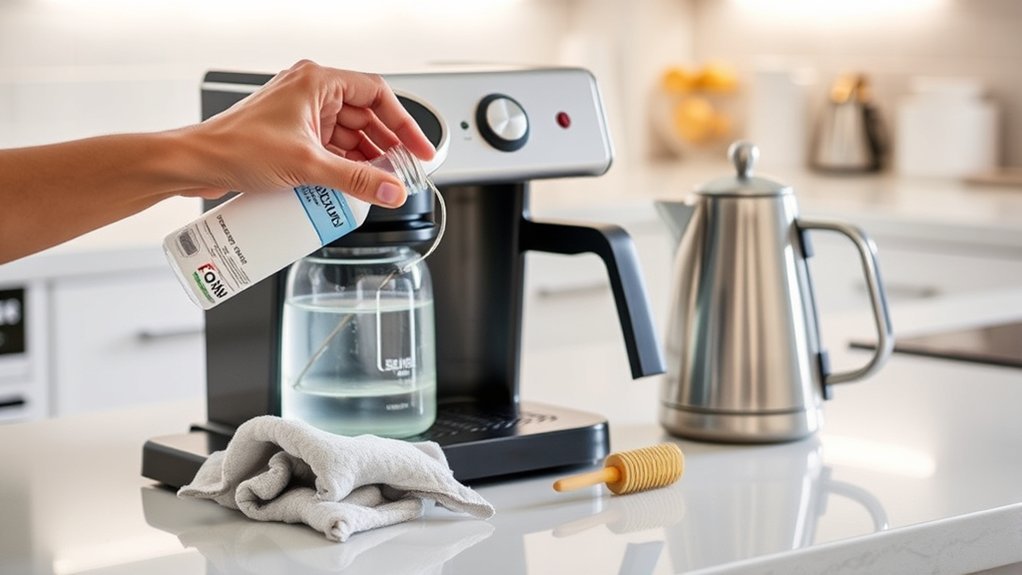
Cleaning a coffee maker involves several different maintenance jobs. Routine washing removes coffee oils, grounds, and residue from accessible parts, while descaling targets mineral deposits inside the water system. The safest method depends on your machine, so check the owner’s manual before using vinegar, baking soda, a commercial descaler, or any other cleaning product.
Quick Answer
Wash the carafe, brew basket, lid, and other approved removable parts with warm, soapy water. Wipe the exterior with a damp cloth. Descale the internal water system only with the solution and procedure approved for your model, then complete every required fresh-water rinse cycle before brewing coffee again.
Key Takeaways
- Routine cleaning removes coffee grounds, oils, spills, and residue; descaling targets mineral deposits inside the water system.
- Wash approved removable coffee-contact parts frequently and let them dry completely before reassembly.
- Do not assume vinegar is safe for every coffee maker. Some manuals allow it, while others require a manufacturer-approved descaler.
- Descaling frequency depends on the model, water hardness, brewing volume, and cleaning indicator rather than one universal schedule.
- Do not put bleach, hydrogen peroxide, or mixed household cleaning chemicals into the water reservoir unless the manufacturer expressly provides a procedure for that exact model.
At a Glance
| Time Required | About 10–20 minutes for routine washing; descaling time varies by model and may include programmed cycles, soaking, and multiple fresh-water rinses |
| Difficulty | Easy for routine cleaning; model-specific instructions are required for descaling |
| Tools Needed | Mild dish soap, soft sponge or cloth, small soft brush, fresh water, and the manual-approved descaling product when descaling is due |
| Cost | Routine washing may use supplies you already have; the cost of a manufacturer-approved descaler varies by product and machine |
Before You Start: Check the Machine and Manual
Coffee makers do not all use the same cleaning method. A standard drip machine, pod brewer, espresso machine, fully automatic machine, and grind-and-brew model may have different removable parts, cleaning tablets, descaling cycles, and chemical restrictions.
Find the model number on the base, back, or rating label. Then check the printed guide or the manufacturer’s support page. The manual should tell you:
- Which parts can be removed or placed in a dishwasher
- Whether the water filter must be removed before descaling
- Whether vinegar is permitted
- Which descaling product and dilution ratio to use
- How to start and complete the cleaning or descaling cycle
- Whether the machine requires a soaking or waiting period
- How many fresh-water rinse cycles are required
- How to reset the descale or clean indicator
Warning: Unplug the coffee maker and let it cool before removing parts, washing by hand, or wiping the housing. Never immerse the electrical base, power cord, or plug in water. Plug the machine in only when the manufacturer’s cleaning or descaling procedure requires a powered cycle.
Do not mix vinegar with bleach, hydrogen peroxide, ammonia, commercial descaler, or another cleaner. Never pour a chemical into the reservoir unless the manufacturer identifies it as safe for that model, and never add a second chemical in an attempt to neutralize the first one.
Why Cleaning Your Coffee Maker Matters
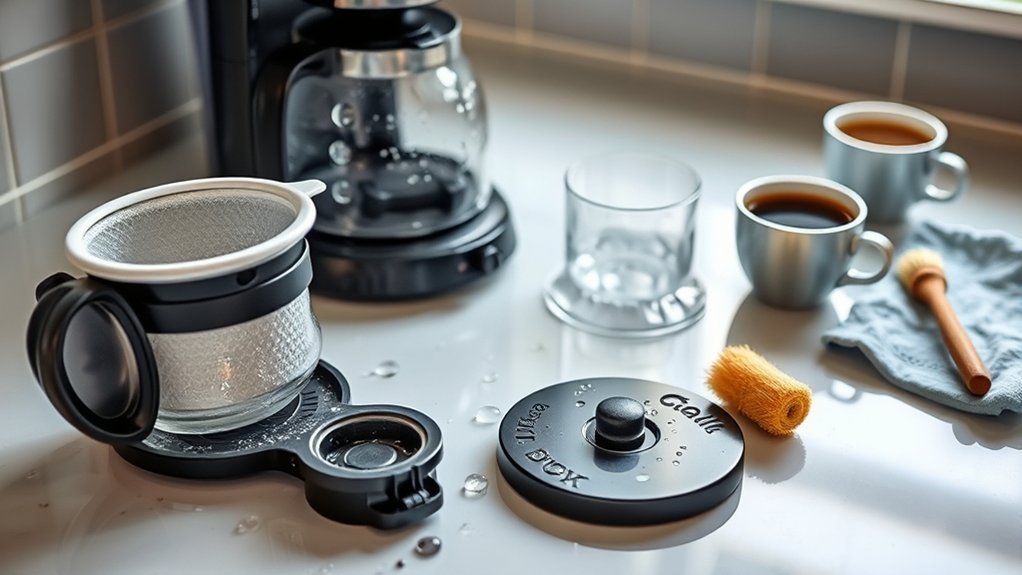
Coffee oils and fine grounds collect on the brew basket, lid, carafe, reusable filter, and other surfaces that contact brewed coffee. If they remain in place, they can create stale odors and bitter or rancid flavors.
Minerals in water can also form scale inside the reservoir, heater, tubing, and outlet. This is a different problem from coffee residue. Descaling helps remove those deposits when it is performed with a product and procedure approved for the machine.
Routine washing removes coffee residue from accessible parts. Descaling removes mineral deposits from the internal water path. A complete maintenance routine includes both jobs.
Regular care may improve flavor, reduce odors, and help prevent scale-related slowdowns. It also gives you an opportunity to inspect the cord, plug, carafe, seals, and water reservoir for damage.
Moisture left in a closed reservoir or on damp removable parts can support unwanted growth. After washing, rinse the parts well and let them dry completely before reassembly. The U.S. Environmental Protection Agency’s mold guidance recommends cleaning washable hard surfaces with detergent and water and drying them completely.
Cleaning, Descaling, and Disinfecting Are Different Jobs
Cleaning removes coffee oils, grounds, spills, and other residue from accessible surfaces. Descaling removes mineral deposits from the internal water path. Disinfecting uses chemicals or procedures intended to reduce microorganisms and is not automatically part of normal coffee-maker maintenance.
Do not treat bleach, hydrogen peroxide, or another household disinfectant as a substitute for a coffee-machine descaler. Unless the manufacturer provides an exact procedure for your model, keep those products out of the internal water system.
Essential Supplies for Effective Coffee Maker Cleaning
You usually need only a few basic supplies:
- Warm water
- Mild dish soap
- A soft sponge, microfiber cloth, or nonabrasive dishcloth
- A small, soft brush for removable crevices
- Fresh water for rinsing
- The descaling product approved in the owner’s manual
- Plain distilled white vinegar only when the manual permits it
- Baking soda for a compatible carafe soak or surface paste
Avoid steel wool, abrasive powders, harsh scouring pads, and sharp tools. They can scratch a carafe, damage a coated warming plate, puncture a screen, or harm a seal.
If your machine uses a charcoal or replaceable water filter, check whether it should be removed before descaling. KitchenAid, for example, instructs owners of certain coffee makers to remove the water filter before the descaling cycle and reinstall or replace it afterward.
Note: Filtered water may reduce mineral accumulation, but it does not eliminate the need for descaling. Follow the machine’s cleaning indicator, water-hardness guidance, and maintenance schedule.
Step-by-Step Guide to Cleaning Your Coffee Maker
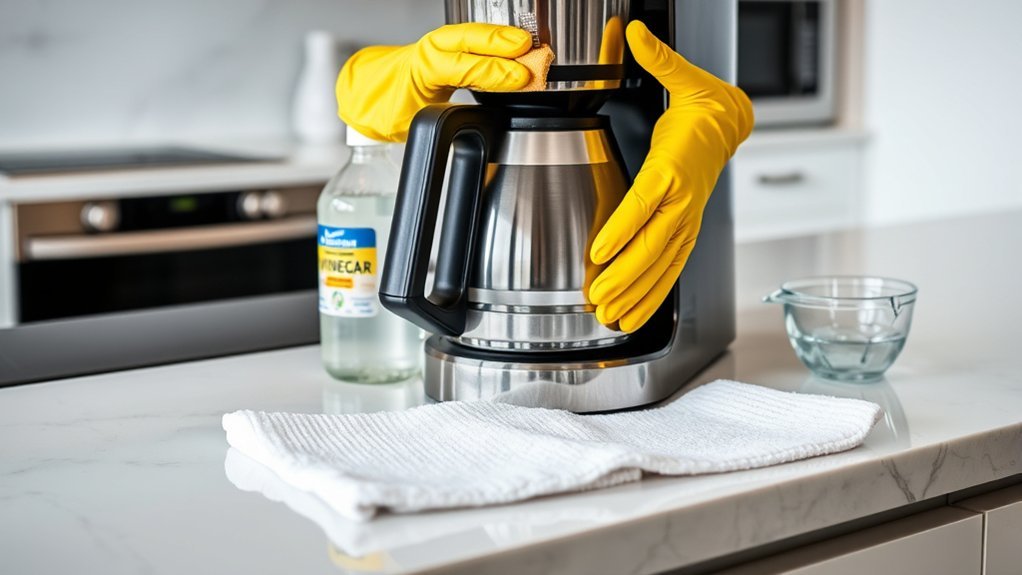
The following procedure is suitable as a general framework. Your model’s manual takes priority whenever its steps differ.
| Step | Action | Important Notes |
|---|---|---|
| 1. Empty | Discard coffee, grounds, pods, and used paper filters. | Let the machine and warming plate cool. |
| 2. Unplug | Disconnect power before hand-cleaning the machine. | Do not immerse the base, cord, or plug. |
| 3. Remove parts | Remove the carafe, lid, brew basket, reusable filter, drip tray, and other manual-approved parts. | Do not force a component that is not designed to come out. |
| 4. Wash | Wash suitable removable parts with warm water, mild dish soap, and a soft sponge. | Use a soft brush around mesh, hinges, and grooves. |
| 5. Wipe | Wipe the housing and cool warming plate with a damp cloth. | Keep water out of buttons, vents, seams, and electrical openings. |
| 6. Descale | If descaling is due, remove the water filter if directed, add the approved solution, and run the specified cycle. | Do not substitute a vinegar ratio or cleaning procedure from another brand or model. |
| 7. Rinse | Discard the used solution and run the required number of full fresh-water cycles. | Continue rinsing when the manual requires it or an approved vinegar method leaves an odor or taste. |
| 8. Dry and reassemble | Dry all removable parts and reinstall them securely. | Replace or reinstall the water filter as directed. |
Clean the Carafe and Brew Basket
Wash the carafe, lid, and brew basket after use or whenever residue is visible. Warm, soapy water is usually enough. Check the manual before placing any part in a dishwasher because heat can warp plastic components and may damage printed markings, seals, or insulated carafes.
For stains inside a compatible glass carafe, make a paste with baking soda and a small amount of water, apply it with a soft sponge, and rinse well. You can also soak the carafe with warm water and a small amount of dish soap before gently scrubbing it.
Clean the Reservoir and Exterior
If the reservoir is removable and washable, clean it according to the manual and dry it fully. For a fixed reservoir, do not reach into the machine with an abrasive tool or flood the housing. Wipe accessible surfaces with a clean, damp cloth.
Use only a lightly damp cloth on the exterior and the cool warming plate. Do not spray cleaner directly onto the machine because liquid can enter the control panel, switches, seams, or ventilation openings.
Descale the Internal Water System
Descale when the machine’s indicator appears, the manual’s interval arrives, or symptoms suggest mineral buildup. Some drip machines allow vinegar. For example, KitchenAid publishes a half-vinegar, half-water procedure for certain coffee makers, while Cuisinart publishes procedures that vary by machine and cleaning method.
Other manufacturers require a proprietary or approved descaler. De’Longhi instructs owners of the referenced fully automatic machines to use its descaler and never vinegar. Keurig also provides brewer-specific descaling procedures, so use the instructions for your exact model rather than assuming that one solution, ratio, or button sequence applies to every Keurig brewer.
Pro Tip: Take a photo of the model label and save the manufacturer’s cleaning page or manual on your phone. You will have the correct solution, ratio, button sequence, soaking time, and descale-light reset instructions when maintenance is due.
How to Properly Rinse and Reassemble Your Coffee Maker
When the descaling cycle is complete, discard the used solution as directed. Fill the reservoir with fresh water and run the number of rinse cycles specified in the manual. Certain KitchenAid instructions call for two complete fresh-water cycles, but another model or brand may require a different procedure.
Let the machine cool before handling removable parts. Wash the carafe and filter basket with warm, soapy water to remove loosened coffee oils or remaining cleaner. Rinse them thoroughly.
Dry the carafe, lid, filter basket, reservoir, and other removable parts completely. Drying helps discourage musty odors and prevents water from remaining trapped around seals or storage areas.
Reinstall the water filter if one was removed. Place each part in its correct position without forcing it. Make sure the brew basket is seated properly, the carafe lid is attached, and the drip tray or pod holder is secure.
Before brewing coffee, run an additional water-only cycle if you still detect a cleaning-product odor or taste. Do not use the machine for coffee until the rinse water is clear and free of noticeable cleaning residue.
Signs You Need to Clean or Descale Your Coffee Maker
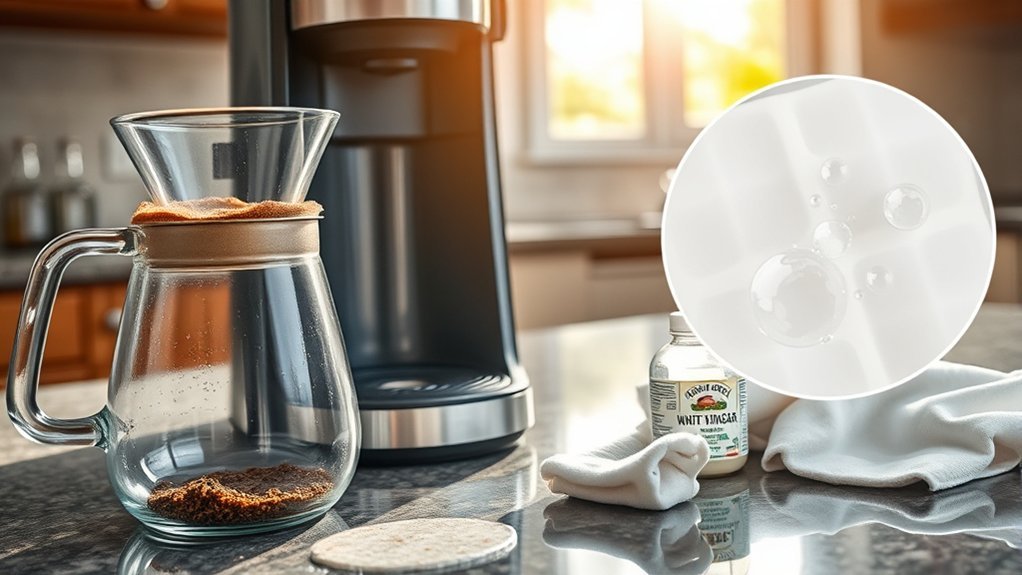
Clean accessible parts when you notice:
- Visible coffee oils, grounds, stains, or residue
- A stale, sour, or musty smell
- Bitter or unusual flavors that are not caused by the beans or water
- Residue around the lid, basket, reusable filter, drip tray, or pod holder
- Standing water left in the reservoir for an extended period
Descaling may be due when you notice:
- A clean or descale indicator light
- Longer-than-normal brew times
- Reduced water flow
- Gurgling or other unusual sounds during brewing
- Visible mineral deposits
- Smaller beverage volume than the selected setting
KitchenAid lists symptoms such as longer brewing times and unusual gurgling sounds among the signs that certain coffee makers need descaling. These symptoms can also have mechanical causes, so successful descaling does not rule out another fault.
If coffee remains lukewarm after a proper cleaning and descaling cycle, the heater, thermostat, sensor, or electrical system may need service. Stop using the machine if it leaks near electrical components, emits smoke, smells like overheated plastic, repeatedly trips a breaker, or has a damaged cord or plug.
How Often Should You Clean and Descale a Coffee Maker?
There is no single schedule for every coffee maker. Use the following routine as a starting point, then adjust it to the manual, brewing volume, water hardness, and the machine’s maintenance indicator.
| Frequency | Maintenance |
|---|---|
| After each use or daily | Discard grounds or pods, rinse or wash approved coffee-contact parts, wipe spills, and avoid leaving brewed coffee or unnecessary standing water in the machine. |
| Weekly | Wash approved removable parts more thoroughly and clean the drip tray, reusable filter, pod holder, and accessible reservoir surfaces. |
| At the manual’s interval or when prompted | Descale according to the machine instructions. Hard water and heavy use can shorten the interval. |
| Immediately | Clean spills, sour odors, visible growth, overflowing grounds, milk residue, or contamination from a foreign substance. |
Cuisinart currently suggests descaling many coffee makers every one to three months depending on water hardness. Keurig’s general descaling-product guidance recommends a three-to-six-month interval, while some brewer-specific instructions call for descaling every three months or when the machine displays a descale notice. These differences are why the manual for the exact model should control the timing.
How Water Hardness Changes the Schedule
Harder water contains more dissolved minerals that can form scale when the water is heated. If your manual provides a water-hardness setting, test-strip procedure, or different maintenance intervals for soft and hard water, use those instructions. A cleaning indicator should also be treated as a signal to check the model-specific procedure rather than simply repeating a generic vinegar cycle.
Using filtered water may reduce some mineral accumulation, but a filter does not make a machine permanently scale-free. Replace or maintain the filter at the interval specified for the brewer and continue descaling when required.
Alternative Cleaning Agents for Your Coffee Maker
Manufacturer-Approved Descaler
An approved descaling liquid, powder, or tablet is the safest default when the manual specifies one. Use the exact amount of product and water listed on the package and in the machine instructions. Do not increase the concentration to speed up the process.
Distilled White Vinegar
Plain distilled white vinegar can remove mineral deposits in machines whose manufacturers allow it. The correct concentration, cycle, and pause time vary. Do not use apple cider vinegar, balsamic vinegar, flavored vinegar, colored vinegar, or high-strength cleaning vinegar as a substitute for the exact product identified in the manual.
Do not assume vinegar is acceptable for an espresso or fully automatic machine. De’Longhi, for example, expressly tells owners of the referenced fully automatic machines to use its approved descaler and never vinegar.
Baking Soda
Baking soda is useful for deodorizing and gently scrubbing a compatible carafe or removable surface. Mix it with a small amount of water to form a paste, apply it with a soft sponge, and rinse thoroughly.
Cuisinart publishes an internal baking-soda procedure for applicable machines and specifically limits that recommendation to situations where the reservoir is removable. That does not make the method suitable for every brand or model. Powder that is not fully dissolved can remain in narrow tubing, valves, or outlets, so do not run baking soda through another machine unless its manufacturer permits the method.
Lemon Juice, Hydrogen Peroxide, and Bleach
Do not use lemon juice as a generic internal descaler. Its strength and composition are not standardized for appliance maintenance, and it can leave odor or residue. De’Longhi also warns against DIY descaling acids for its machines because unsuitable formulations can contribute to corrosion, residue, incomplete scale removal, or internal problems.
Do not pour hydrogen peroxide or chlorine bleach into a coffee maker unless the manufacturer gives a specific procedure for that exact model. Never combine either product with vinegar, another acid, ammonia, commercial descaler, or another household cleaner.
Warning: Mixing chlorine bleach with an acid such as vinegar can release dangerous chlorine gas. If incompatible cleaners have already been mixed and irritating fumes are present, leave the exposure area and seek appropriate emergency or poison-control guidance. Do not add another chemical in an attempt to neutralize the mixture.
Cleaning Different Types of Coffee Makers
Standard Drip Coffee Makers
Wash the carafe, lid, brew basket, and reusable filter regularly. Wipe the warming plate only after it is cool. When descaling is due, remove the charcoal filter if directed and run the model-approved solution through the required cleaning or brew cycle.
Single-Serve and Pod Brewers
Clean the drip tray, pod holder, funnel, and removable reservoir according to the manual. Entrance and exit needles can be sharp, so use the manufacturer’s cleaning tool or procedure rather than inserting your fingers or an unsuitable metal object. Complete the programmed descaling sequence and reset the indicator only as instructed for the model.
Espresso and Fully Automatic Machines
These machines may require separate procedures for the brew group, portafilter, shower screen, steam wand, milk system, grinder, and internal water circuit. Cleaning tablets, milk-system cleaners, and descaling products are not interchangeable. Use the product assigned to each procedure.
Milk-contact components deserve special attention because milk residue is a separate cleaning problem from mineral scale. Purge, rinse, wipe, disassemble, or wash the steam wand and milk-system parts at the frequency and in the manner specified by the manufacturer. Do not assume that running a descaling cycle also cleans the milk circuit.
Some removable brew groups are rinsed with water only. De’Longhi advises owners of certain fully automatic machines to clean the brewing unit weekly with water only and to use its approved descaler rather than vinegar for the water circuit.
Grind-and-Brew Coffee Makers
Keep water away from the grinder and motor. Brush away dry grounds only where the manual permits, and remove oily buildup from approved grinder parts with the specified tool or cleaning product. Do not pour water into a burr assembly unless the component is explicitly designed to be washed.
Troubleshooting After Cleaning
The Vinegar or Cleaner Smell Remains
Run another full reservoir of fresh water through the machine if the manual permits an additional rinse. Wash the carafe, lid, and basket again. Repeat the approved rinsing process until the water has no noticeable cleaner smell or taste. If the odor remains after the manual’s full rinse procedure, contact the manufacturer before brewing coffee.
The Coffee Maker Still Brews Slowly
Confirm that you used the correct descaling product, concentration, and complete cycle. Check the basket, outlet, pod holder, and reusable filter for accessible residue. If flow remains slow, the machine may have a blocked valve, failing pump, heater problem, or another internal fault that requires service.
The Descale Light Stays On
Many machines require the complete programmed cycle before the indicator resets. Some also require a model-specific button sequence or additional rinse step. Look up the instructions for the exact model rather than repeating random vinegar cycles.
The Coffee Maker Leaks After Cleaning
Make sure the reservoir, carafe lid, basket, drip tray, seals, and removable parts are seated correctly. Stop using the machine if water reaches the cord, plug, control panel, electrical connections, or underside of the electrical base.
There Is Visible Mold or Musty Residue
Unplug the machine. Wash accessible, manufacturer-approved hard surfaces with detergent and water, then dry them completely. Replace disposable filters and other contaminated replaceable parts.
If growth appears inside inaccessible tubing, insulation, a sealed reservoir, or another area that cannot be safely opened and cleaned, contact the manufacturer. Replacement may be safer than continued use when contamination cannot be removed.
You Added the Wrong Cleaner or Mixed Chemicals
Stop the cleaning process and do not add another chemical to the reservoir. If no fumes, splashes, or exposure occurred, contact the coffee-maker manufacturer and identify exactly what product and amount entered the machine before attempting another cycle.
If bleach was mixed with vinegar, acidic descaler, or another incompatible cleaner and irritating fumes are present, move away from the exposure area and seek appropriate emergency or poison-control guidance. Do not lean over the machine, intentionally smell the reservoir, or try to neutralize the mixture with another household product.
Final Thoughts on Coffee Maker Maintenance
A good maintenance routine is simple: remove coffee residue frequently, keep removable parts clean and dry, and descale only when the model’s instructions call for it. This approach protects flavor without exposing the machine to an incompatible chemical, an incorrect concentration, or an unnecessary cleaning cycle.
Importance of Regular Cleaning
Routine washing removes oils, grounds, and residue before they harden or create stale flavors. Periodic descaling addresses minerals that may slow water flow or affect brewing performance. Neither job completely replaces the other.
| Cleaning Benefit | Maintenance Practice |
|---|---|
| Fresher flavor | Wash the carafe, lid, basket, and reusable filter regularly. |
| Reduced mineral buildup | Descale according to water hardness, usage, the maintenance indicator, and the manual. |
| Fewer musty odors | Avoid unnecessary standing water and dry washable parts completely. |
| Earlier problem detection | Inspect the carafe, seals, cord, plug, reservoir, and housing while cleaning. |
Signs of Needed Maintenance
Bad-tasting coffee, stale odors, visible residue, slower flow, unusual brewing sounds, reduced beverage volume, and a cleaning indicator can signal that maintenance is due. Start with the cleaning or descaling procedure specified for your model.
Cleaning is not a repair for every problem. Persistent leaks, low brewing temperature, electrical odors, damaged wiring, pump failure, or repeated error messages should be evaluated through the manufacturer’s support channel.
Best Cleaning Practices
- Read the manual before putting any cleaning or descaling chemical into the reservoir.
- Clean removable coffee-contact parts frequently.
- Use soft, nonabrasive cleaning tools.
- Remove a water filter before descaling when instructed.
- Measure the approved cleaning solution accurately.
- Complete the full programmed cycle without interruption unless the instructions require a pause or soaking period.
- Run every required fresh-water rinse.
- Dry washable parts before reassembly.
- Keep milk-system cleaning separate from descaling unless the manufacturer expressly combines the procedures.
- Do not mix cleaning products.
- Stop using a machine with an electrical or unresolved leak hazard.
Frequently Asked Questions
Can I use regular vinegar instead of distilled white vinegar?
Use only plain distilled white vinegar when your coffee maker’s manual permits vinegar. Avoid apple cider, balsamic, flavored, colored, or high-strength cleaning vinegar. Some espresso and fully automatic machines prohibit vinegar entirely, so the model instructions should always take priority.
How often should I replace my coffee maker?
There is no universal replacement age. Consider replacement when the machine has an unsafe cord or plug, unresolved electrical problems, internal contamination that cannot be cleaned, repeated leaks, unavailable replacement parts, or a repair cost that no longer makes sense for the machine.
Is it safe to clean my coffee maker with bleach?
Do not put chlorine bleach into the water reservoir unless the manufacturer provides a specific procedure for your exact model. Never mix bleach with vinegar, lemon juice, an acidic descaler, ammonia, or another cleaner. Use mild dish soap on approved removable parts and the manual-approved product for the internal water system.
What should I do if my coffee maker smells bad?
Discard standing water, grounds, pods, and old filters. Wash the carafe, basket, lid, drip tray, reservoir, and other approved removable parts with warm, soapy water. Rinse and dry everything completely. If the odor appears to come from inaccessible internal parts, contact the manufacturer before using the machine again.
Can I clean my coffee maker with baking soda?
Baking soda can help clean a compatible carafe or removable surface when used as a paste or soak. Do not run it through the internal water system unless the manufacturer allows that method and provides measurements. Cuisinart publishes such a method for certain applicable machines, but it is not a universal coffee-maker procedure.
How much vinegar should I use to descale a coffee maker?
Use the ratio listed in the owner’s manual. Some KitchenAid drip machines use equal parts vinegar and water, while Cuisinart publishes different procedures and ratios. Other manufacturers prohibit vinegar. There is no safe universal vinegar amount for every coffee maker.
Can I put coffee maker parts in the dishwasher?
Only place a part in the dishwasher when the manual identifies it as dishwasher-safe. Dishwasher heat and detergent can damage some plastics, insulated carafes, seals, finishes, or printed markings. Hand-washing with warm, soapy water is the safer choice when the instructions are unclear.
Why is my coffee maker still slow after descaling?
Confirm that you completed the correct cycle with the approved solution and concentration. Clean the basket, reusable filter, pod holder, and accessible outlets. Continued slow flow may indicate a blocked valve, failing pump, heater problem, or another fault that requires manufacturer support.
Should I clean the removable parts before or after descaling?
Start by emptying the machine and cleaning obvious coffee residue from approved removable parts. Then perform the model-specific descaling cycle when it is due. After descaling, complete every required fresh-water rinse and wash removable coffee-contact parts again if the manufacturer instructs you to do so.
Do I still need to descale if I use filtered water?
Usually, yes. Filtered water can reduce some mineral accumulation, depending on the filter and your water, but it does not guarantee a scale-free machine. Continue to follow the brewer’s maintenance indicator, water-hardness setting, filter-replacement schedule, and descaling instructions.
Sources
- Cuisinart: How to Clean a Coffee Maker — removable-part care, vinegar methods, baking-soda guidance, water filters, and descaling frequency
- KitchenAid Product Help: Descale a Coffee Maker — descaling symptoms, filter removal, vinegar ratio, rinse cycles, and washing instructions
- Keurig: Descaling Solution and Brewer Maintenance Guidance — mineral-scale effects and general three-to-six-month descaling guidance
- De’Longhi: Cleaning a Fully Automatic Coffee Machine — approved descaler, vinegar restriction, brewing-unit cleaning, rinsing, and maintenance
- U.S. Environmental Protection Agency: Basic Mold Cleanup Steps — detergent cleaning, moisture control, and complete drying of washable hard surfaces
Conclusion
A clean coffee maker can produce better-tasting coffee and operate more consistently, but the correct method depends on the machine. Wash approved removable parts with warm, soapy water, wipe the housing without soaking it, keep electrical areas dry, and let washable components dry completely before reassembly.
When mineral scale needs attention, use the product, ratio, cycle, soaking time, and rinse procedure listed for your model. Vinegar is suitable for some drip machines but prohibited in other systems, especially certain fully automatic machines. Finish every descaling procedure with the required fresh-water rinses, and seek manufacturer service when leaks, electrical problems, low heat, error messages, or slow flow continue after proper maintenance.