A full pot of drip coffee usually takes longer than a single cup because the machine must heat and move more water. As a broad practical benchmark, many conventional 8- to 12-cup brewers finish a full cycle in roughly 8 to 12 minutes, although some well-designed machines are faster. Your model, batch size, starting water temperature, brew setting, and whether the brewer keeps water hot all affect the wait.
Quick Answer
A conventional full-carafe drip coffee maker often takes roughly 8 to 12 minutes from button press to finish, but this is a broad benchmark rather than a universal standard. Some brewers finish much faster. Coffee-water contact time is also shorter than the machine’s complete heat-up and brewing cycle.
Key Takeaways
- Roughly 8 to 12 minutes is a useful benchmark for many conventional full-carafe drip machines, but your manufacturer’s specification and normal baseline matter more.
- Total cycle time includes heating and final dripping, so it is not the same as coffee-water contact time.
- Small batches, single-serve machines, and brewers that keep water hot can finish sooner.
- A repeatable slowdown can point to mineral scale, restricted water flow, an incorrect filter, too much coffee, or grounds that are too fine.
- Measure your brewer under the same conditions before deciding that it is unusually slow.
At a Glance
| Time Required | One complete brew cycle; repeat once for a more reliable baseline |
| Difficulty | Easy |
| Tools Needed | Timer, owner’s manual, correct filter, and manufacturer-approved descaler if cleaning is needed |
| Cost | $0 to time the cycle; cleaning or descaling cost varies by machine and product |
Average Brew Time for Different Coffee Makers
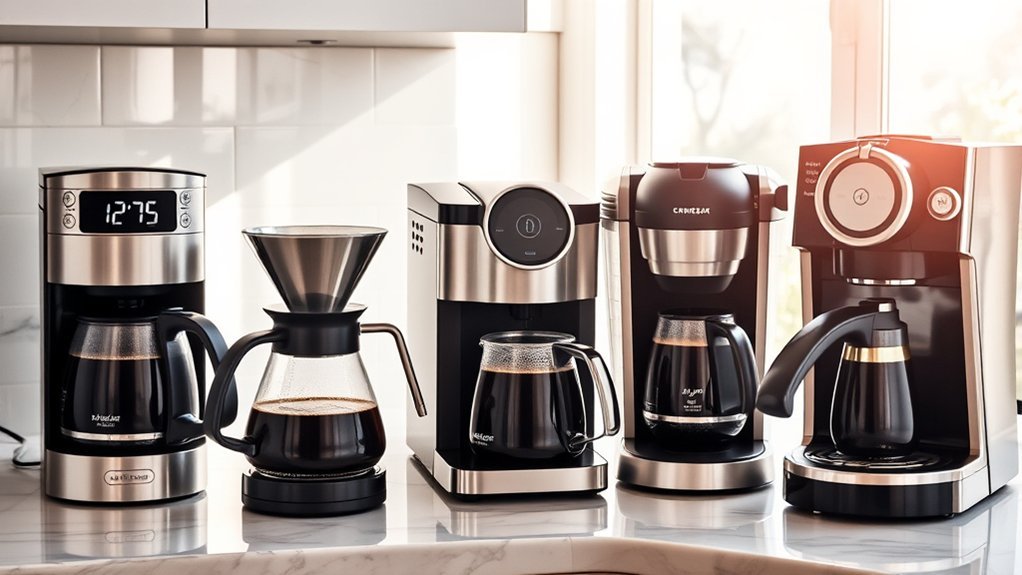
The answer to “how long does a coffee maker take?” depends on the brewer type, water volume, starting temperature, heat-up design, and selected brew mode.
KitchenAid, for example, states that its regular coffee makers take about 9 to 11 minutes for a full pot, while the referenced personal-size brewer takes approximately 4.5 minutes. Those figures are useful manufacturer examples, not standards that every coffee maker must match.
| Brewer or Method | Typical or Example Time | What the Time Includes |
|---|---|---|
| Conventional 8- to 12-cup drip machine | Often roughly 8–12 minutes for a full cycle | Heat-up, water delivery, extraction, and final dripping; model variation can be substantial |
| Compact drip machine or small batch | Usually faster than the machine’s full batch | Less water must be heated and moved, although heat-up overhead remains |
| Hot-reservoir speed brewer | About 4 minutes for some full carafes | Water is already hot before the user starts the brew |
| Single-serve pod machine | Often within a few minutes | Warm-up plus dispensing; exact time depends heavily on model and serving size |
| Espresso machine | About 20–30 seconds of extraction | Machine warm-up, grinding, dosing, and preparation are additional |
| Pour-over | About 2–4 minutes of contact | Does not include heating the kettle |
| French press | About 4 minutes of contact | Does not include water-heating time |
| Traditional cold brew | Approximately 12 hours of contact | Long, low-temperature steeping; specialized rapid cold-brew machines can work differently |
A coffee maker can have about five minutes of coffee-water contact even when the complete button-to-finish cycle takes considerably longer.
What Counts as Brew Time?
Manufacturers, coffee organizations, reviewers, and consumers may use the phrase “brew time” for different parts of the process. Before comparing two numbers, identify what the stopwatch includes.
- Heat-up time: How long the machine needs to bring water to its operating temperature.
- First-drip time: The delay between pressing Brew and the first coffee reaching the carafe or cup.
- Contact time: The period in which brewing water interacts with the coffee bed.
- Drip-out time: The final stage when brewed coffee continues leaving the basket after active water delivery slows.
- Total cycle time: The entire period from starting the machine until its completion signal or near-end of dripping.
The National Coffee Association gives approximately five minutes of coffee-water contact for drip brewing. That number should not be confused with the longer button-to-finish time quoted for some automatic brewers.
Note: The numbered “cups” on a coffee maker may be smaller than standard 8-fluid-ounce measuring cups. Compare machines by actual water capacity as well as the number printed on the reservoir.
Cold Start vs. an Already-Hot Brewer
Starting condition is one of the biggest reasons two machines with similar capacities can have very different stopwatch times.
A conventional brewer normally starts with room-temperature water and heats it after you press the button. A speed brewer may keep a tank of water hot between uses, removing most of that heat-up delay from the visible brew cycle.
For example, the BUNN CSB3T Speed Brew keeps water hot in an internal stainless-steel tank and is advertised to brew a 50-ounce, 10-cup carafe in about four minutes. That does not mean every cold-start brewer should also complete a full pot in four minutes.
Does Half a Pot Take Half the Time?
Not necessarily. A smaller batch normally finishes sooner because the machine has less water to heat and deliver, but some of the process has fixed overhead. Heating the brewer, pre-wetting the coffee bed, programmed bloom pauses, and final dripping do not always shrink in direct proportion to water volume.
Many machines also change their water-delivery pattern when a small-batch, strong, bold, or specialty mode is selected. Compare batches using the same mode before judging whether a particular cycle is unusually slow.
What Does SCA Certification Say About Brew Time?
The Specialty Coffee Association Certified Equipment program evaluates home brewers for brewing quality, consistency, and performance. Brew time is considered together with water temperature, extraction, beverage strength, and other performance measures.
This is another reason not to judge a machine from one button-to-finish stopwatch number. A brewer can heat for part of its total cycle while still delivering an appropriate period of water-to-coffee contact once extraction begins.
How to Measure Your Coffee Maker’s Cycle
- Let the machine return to the same starting condition you normally use, such as fully cool for a typical morning cold-start test.
- Fill the reservoir to your normal level and install the correct filter.
- Add your usual amount of coffee at the same grind setting.
- Start the timer when you press the Brew or Start button.
- Record the time when the first coffee reaches the carafe.
- Record the time when the machine signals completion or active water delivery stops.
- Wait until dripping has nearly stopped and record the final cycle time.
- Repeat the test on another brew using the same water volume, coffee dose, grind, filter, and mode.
These measurements give you a useful baseline for your own brewer. A repeatable, noticeable increase beyond its normal variation is more meaningful than comparing your machine with an unrelated model online.
The Importance of Brew Time for Flavor
Brew time affects extraction, but it never works alone. Grind size, water flow, coffee dose, water volume, temperature, filter geometry, and how evenly water reaches the grounds all influence the finished cup.
The National Coffee Association’s drip-coffee guidance describes approximately five minutes of coffee-water contact. That does not mean every automatic machine should complete its entire heating and dripping cycle in five minutes.
If water moves through the grounds unusually quickly, the drink can taste thin, sharp, or underdeveloped. Excessively restricted flow can produce a harsh or overly intense cup. Taste and repeatability are better guides than time alone because a long cycle is not automatically over-extracted and a short cycle is not automatically under-extracted.
Research from UC Davis reinforces that point. In a Scientific Reports study of drip-brewed coffee, researchers compared brewing at 87°C, 90°C, and 93°C while adjusting other variables so brew strength and extraction yield could be matched. Under those controlled conditions, temperature itself had little appreciable sensory effect compared with the influence of final strength and extraction.
Key Factors That Affect Your Coffee Maker’s Brew Time
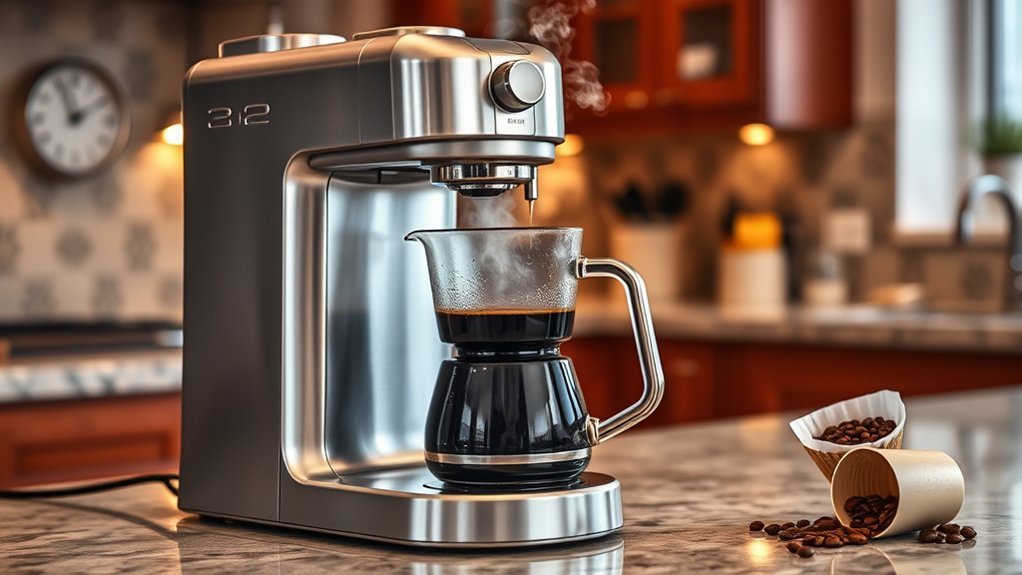
A coffee maker’s cycle depends on much more than heating-element wattage. Water volume, grind resistance, programmed flow, scale, and filter setup can all change the time it takes to finish.
Water Temperature Impact
Hot filter coffee is commonly brewed with water around the low-to-mid 90s Celsius. The National Coffee Association, for example, lists 93 ± 3°C for pour-over and French press brewing, while certified automatic brewers are also evaluated for controlled brewing temperature.
Cooler water extracts soluble material more slowly. Hotter water speeds extraction, but it does not automatically create bitter coffee. Grind, dose, flow, roast, contact time, final strength, and extraction all matter.
Do not modify a coffee maker’s thermostat, wiring, or internal heater to change brewing temperature. If the drink is consistently lukewarm, use the manufacturer’s troubleshooting procedure or arrange qualified service.
Grind Size Selection
A medium grind is a sensible starting point for most automatic drip coffee makers, although the ideal setting depends on the basket, filter, coffee dose, batch size, and machine.
- Too fine: Fine particles can increase resistance, slow drainage, contribute to filter overflow, and create an overly intense or harsh cup.
- Too coarse: Water can move through too easily, leading to weak or underdeveloped coffee.
- Uneven grind: A mixture of fine dust and large particles makes extraction less even.
- Correct adjustment: Move only a small amount finer or coarser, then compare both taste and drainage.
If the basket nearly overflows, try a slightly coarser grind, verify that the filter fits correctly, and confirm that you have not exceeded the brewer’s maximum coffee dose.
Coffee-to-Water Ratio
A practical home-drip starting range is roughly 1 gram of coffee for every 15 to 18 grams of brewing water. The exact ratio is a taste choice rather than a mandatory rule. For reference, SCA brewer testing has historically started around 55 grams of coffee per liter of water, or roughly 1:18, before adjustments for the brewing system.
Under the water-per-coffee convention, 1:15 produces a stronger starting recipe than 1:18 because each gram of coffee is paired with less water.
The ratio mainly controls beverage strength, but a very heavy coffee dose also creates a deeper bed that can slow drainage. Use a scale when practical and do not pack or tamp coffee in an automatic drip basket.
Batch Size, Filter, and Brew Mode
A full reservoir generally takes longer to heat and empty than a small batch. However, the relationship is not perfectly proportional because the machine still has fixed heat-up and control stages.
“Bold,” “strong,” or “rich” settings may intentionally pulse or slow the water to increase contact time. A longer cycle can therefore be normal when those modes are active.
A folded, undersized, doubled, or incorrectly seated filter can restrict flow. Paper filters should fit the basket without blocking the outlet. If your machine includes a permanent filter, do not add a paper filter unless the manual permits that combination.
Mineral Scale and Water Flow
Minerals left behind by heated water can accumulate in tubing, valves, heaters, and spray openings. As deposits build, water movement may become slower or noisier.
KitchenAid lists longer brewing times among the signs that a coffee maker may need to be cleaned and descaled. Follow the instructions for your own model because approved products, dilution, and rinse procedures vary.
How Brewing Temperature Affects Coffee Quality
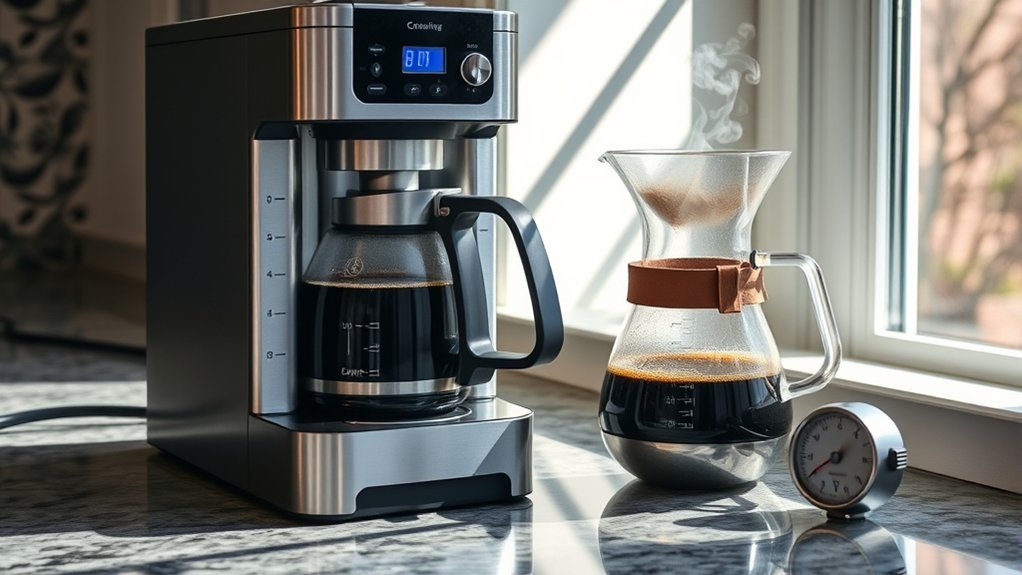
Brewing temperature changes how quickly soluble compounds move from the coffee grounds into water. It is an important part of a recipe, but it should not be treated as a stand-alone quality score.
- Cooler water generally extracts more slowly and may work better with a finer grind or longer contact period.
- Hotter water generally extracts faster but does not automatically make coffee bitter.
- A fine grind, heavy dose, restricted flow, and high temperature together can create excessive extraction or very high strength.
- A coarse grind, light dose, rapid flow, and lower temperature can produce a weak or underdeveloped cup.
The UC Davis research cited above is useful because it separated temperature from strength and extraction. When the researchers matched brew strength and extraction yield, temperature differences across 87°C, 90°C, and 93°C had little appreciable effect on the tested sensory profile. That does not make temperature irrelevant; it means temperature influences how quickly you reach a given extraction state rather than determining flavor by itself.
Elevation adds another variable. The USDA explains that water boils at progressively lower temperatures as atmospheric pressure falls with altitude. The effect on an automatic coffee maker depends on its heater and control design, so follow manufacturer high-altitude guidance when available.
Pro Tip: Judge a coffee recipe by both time and taste. If your brewer runs at its normal speed but the coffee tastes weak, adjust the dose or grind before assuming the heating system is defective.
Tips for Optimizing Brew Time in Your Coffee Maker
The goal is not to force every brewer toward one stopwatch number. Instead, keep the machine clean and its flow repeatable, then make small recipe adjustments when the coffee needs improvement.
Maintain Machine Cleanliness
Rinse the brew basket, permanent filter, lid, and carafe after use. Coffee oils and loose grounds can restrict small openings and also produce stale flavors.
Descale the internal water path according to your owner’s manual, clean indicator, and water conditions. Hard water can produce mineral deposits faster than low-mineral water.
- Allow the machine and warming plate to cool before wiping them.
- Remove loose grounds from accessible basket outlets and spray openings.
- Use only a cleaning or descaling method allowed by your manufacturer.
- Complete every required fresh-water rinse after descaling.
- Replace built-in or removable water filters according to the manual.
Optimize Grind Size
Begin near a medium grind for a typical drip brewer. If the basket drains unusually slowly or threatens to overflow, move slightly coarser. If the water passes through rapidly and the cup tastes weak, try a slightly finer setting.
Do not make a major grind change just because the complete machine cycle looks long. A brewer can have a naturally long heat-up stage while the coffee bed itself drains normally.
Adjust Coffee Ratios
A range around 1:15 to 1:18 by weight gives you room to adjust strength to taste. For example, 60 grams of coffee could be paired with roughly 900 to 1,080 grams of brewing water, depending on the strength you prefer and the capacity of your machine.
- For a stronger drink, use somewhat more coffee or less water.
- For a milder drink, use somewhat less coffee or more water.
- Never exceed the basket’s stated capacity.
- Keep other variables steady when judging one ratio change.
Keep a Repeatable Baseline
Use the same reservoir level, coffee dose, grind setting, filter type, and brew mode when comparing cycle times. Your own repeatable baseline is more useful than a generic internet average because it reflects your exact machine and household water.
Which Coffee Makers Brew the Fastest?
The fastest option depends on whether you want an entire carafe or one serving. Speed can also come from keeping water hot before brewing, using a more powerful heating system, or brewing a smaller volume.
The BUNN CSB3T Speed Brew is advertised as brewing a 50-ounce, 10-cup carafe in approximately four minutes. Its internal tank keeps water hot, which removes much of the cold-start heating delay after the brewer is set up for normal use.
A Hamilton Beach BrewStation Summit 4846 stores brewed coffee in an internal dispensing tank rather than a traditional carafe. That design can be convenient for repeated servings, but there is no reason to assign every BrewStation or batch a single universal full-pot time. Use the specification and measured baseline for the exact model.
The Cuisinart Next-Generation Burr Grind & Brew DGB-800 combines grinding and brewing. Its total preparation time can include a grinding stage, so it should not be compared directly with a basic drip machine if the competing stopwatch test begins only when water starts moving.
For a single serving, the Nespresso Pixie has a manufacturer-listed heat-up time of approximately 25 seconds. That is specifically the warm-up specification. Capsule loading and dispensing the selected espresso or lungo volume add to the complete preparation time.
The Cuisinart Coffee Center SS-15 combines a carafe brewer with a single-serve side. Its single-serve side will normally finish one serving sooner than the carafe brewer finishes an entire pot, but timing still changes with serving size and starting conditions.
Note: A machine that keeps water hot can brew quickly after you press the button, but it may consume energy while standing ready. Consider standby behavior, capacity, convenience, and coffee quality along with stopwatch speed.
Troubleshooting Brew Time Issues
If your coffee maker suddenly takes longer than its established normal cycle, compare it under controlled conditions before assuming a component has failed.
- Confirm the comparison. Use the same water volume, filter, coffee dose, grind, and brew mode as the faster cycle.
- Check the reservoir. Make sure it is seated correctly and that any removable outlet valve works freely.
- Inspect the filter. Replace a folded, doubled, torn, collapsed, or incorrectly sized paper filter.
- Check the coffee bed. Avoid packing the grounds and try a slightly coarser grind if drainage is obviously restricted.
- Clean removable parts. Clear coffee oils and loose grounds from the basket, permanent filter, lid, and accessible spray openings.
- Descale when appropriate. Follow your manufacturer’s directions if slower flow, a clean indicator, scale, or unusual noise suggests mineral buildup.
- Run an approved water-only test. After cleaning, compare the cycle with your established baseline if the manufacturer permits brewing without coffee.
- Seek service when needed. Stop using the machine if it leaks near electrical components, smells burnt, trips a breaker, fails to heat, or develops abnormal mechanical noises.
Warning: Unplug the coffee maker and let it cool before cleaning accessible components. Do not open the appliance housing, reach into a grinder, or work around internal wiring. Follow the manual when handling hot water and descaling chemicals.
Common reasons a previously normal brew cycle becomes slow include:
- Mineral scale inside the water path
- Blocked spray openings or basket outlets
- Coffee ground too finely for the brewer
- Too much coffee in the basket
- An incorrectly installed or unsuitable filter
- A strong or bold mode that intentionally slows delivery
- A developing valve, pump, thermostat, heater, or other component problem
Small variations can happen because of starting water temperature, batch size, electrical supply, or machine temperature. A persistent change under otherwise identical conditions is the more useful warning sign.
Tips for Achieving the Perfect Brew Every Time
Consistency matters more than chasing one exact time. Establish a recipe that tastes good, keep the machine clean, and adjust only one important variable at a time.
| Brewing Variable | Starting Point | Adjustment |
|---|---|---|
| Water temperature | Low-to-mid 90s °C is common for hot filter brewing | Use an automatic machine as designed; troubleshoot or service it if it consistently fails to heat correctly |
| Grind size | Medium for many drip machines | Slightly coarser for restricted drainage; slightly finer for very fast flow and weak coffee |
| Coffee-to-water ratio | Roughly 1:15 to 1:18 by weight as a flexible home starting range | Use less water per gram of coffee for a stronger starting recipe and more for a milder one |
| Total cycle time | Use your machine’s repeatable normal baseline | Investigate a persistent unexplained slowdown under equivalent conditions |
| Cleaning | Rinse removable brewing parts after use | Descale according to the owner’s manual, clean indicator, and water conditions |
Fresh water, an appropriate grind, the correct filter, a measured coffee dose, and regular cleaning will usually do more for repeatable results than trying to force every brew into one universal time range.
Frequently Asked Questions
Can brew time affect caffeine content in my coffee?
Yes. Contact time can affect extraction, but caffeine in the finished drink also depends on coffee dose, bean type, serving size, grind, temperature, pressure, and brewing method. A machine that takes longer to complete its cycle does not automatically produce substantially more caffeine.
Do different coffee types require different brew times?
Yes. Espresso commonly uses about 20–30 seconds of coffee-water contact, pour-over about 2–4 minutes, French press about 4 minutes, and drip coffee roughly 5 minutes of contact. Traditional cold brew may steep for about 12 hours. Heating and preparation can add extra time.
Will altitude affect my coffee maker’s brew time?
It can. Higher elevation lowers atmospheric pressure and the boiling point of water, which changes brewing conditions. The effect on total cycle time depends on the machine. Follow manufacturer guidance for high-altitude use instead of modifying internal temperature controls.
How often should I clean my coffee maker for a normal brew time?
Rinse the basket, permanent filter, carafe, and other removable brewing parts after use. Descale according to your owner’s manual or when a clean indicator, slower flow, unusual noise, or mineral buildup suggests that cleaning is needed. Water hardness can change how quickly scale develops.
Do I need to adjust brew time for coffee grind size?
With most automatic drip machines, you adjust the grind rather than directly programming contact time. Move slightly coarser if the basket drains too slowly and slightly finer if water moves through rapidly and the coffee tastes weak. Keep the dose and water volume unchanged while testing.
Why is my coffee maker gradually taking longer?
A gradual slowdown commonly points to mineral deposits, blocked spray openings, coffee residue, restricted drainage, or an unsuitable filter. Clean and descale the brewer according to its manual. If it remains much slower than its established baseline, the machine may need service.
Does the strong or bold setting take longer?
It often can. Some brewers slow or pulse water to increase contact with the coffee grounds. Compare strong-mode timing with earlier brews made on the same setting rather than comparing it with the regular mode.
Can I remove the carafe or stop the machine before brewing finishes?
Use pause-and-serve only as your manual directs and return the carafe promptly. Coffee collected early in a cycle may have a different strength from the fully mixed pot. Leaving the carafe out too long can also cause the basket to fill or overflow when a drip-stop valve remains closed.
Conclusion
Many conventional full-carafe drip coffee makers take roughly 8 to 12 minutes from a cold button press to completion, but that range is a practical benchmark rather than a universal requirement. Some brewers finish much faster because of their heating system, batch size, or design. A shorter coffee-water contact period can also occur inside a longer total machine cycle.
For troubleshooting, your own repeatable baseline is more useful than an arbitrary target. If the same machine begins taking noticeably longer with the same batch, grind, filter, dose, and setting, inspect the coffee bed and filter, clean accessible parts, and descale according to the manual. Consistent flow and balanced flavor matter more than simply making the stopwatch number smaller.
Sources
- National Coffee Association — Drip Coffee — drip brewing contact time, basic brewing process, and cleaning guidance
- Specialty Coffee Association — Certified Equipment — current home-brewer certification program and performance-testing context
- KitchenAid — Automatic Coffee Maker Brew Times and Temperatures — manufacturer full-pot and personal-brewer timing examples
- BUNN — CSB3T Speed Brew Platinum — four-minute 10-cup/50-ounce manufacturer claim and hot-water-tank design
- Scientific Reports — Brew Temperature and the Sensory Profile of Drip Coffee — UC Davis research on temperature, brew strength, extraction yield, and sensory results
- USDA Food Safety and Inspection Service — High-Altitude Cooking — atmospheric pressure, elevation, and water boiling-point changes