Mineral scale can slow a drip coffee maker, restrict water flow, and affect brewing performance, especially when your tap water is hard. The safest approach is to use the correct descaler dose and follow your coffee maker’s manual. The procedure below is specifically for a standard automatic drip coffee maker using a 28-gram packet of Urnex Dezcal Descaling Powder.
Quick Answer
For a standard automatic drip coffee maker, dissolve one 28-gram packet of Urnex Dezcal Descaling Powder in 32 ounces, or 1 liter, of lukewarm water. Brew the full solution, discard it, and then brew three full tanks of fresh water. Check your machine manual before starting or removing a water filter.
Key Takeaways
- This method is for a standard automatic drip coffee maker, not a pod brewer or espresso machine with its own descale program.
- Use one 28-gram packet of Urnex Dezcal powder with 32 ounces, or 1 liter, of lukewarm water.
- Dissolve the powder completely before pouring it into the reservoir.
- Brew the full descaling solution, discard it, and complete three full fresh-water rinse cycles.
- Urnex currently recommends using its household Descaling Powder every three months for best results, but your machine manual, descale indicator, and water hardness should also guide your schedule.
- Wear gloves and eye protection, avoid powder and solution splashes, and use Dezcal by itself rather than combining it with another cleaner.
- Follow your coffee maker’s manual whenever its instructions differ from this general drip-machine procedure.
At a Glance
| Time Required | About 45–90 minutes, depending on brew speed and reservoir size |
| Difficulty | Easy |
| Tools Needed | Urnex Dezcal powder packet, 32-ounce measuring container, lukewarm water, clean carafe, gloves, eye protection, and the coffee maker manual |
| Cost | The cost of one single-use powder packet; retail prices vary |
Why Regular Descaling Keeps Your Coffee Maker Running Smoothly
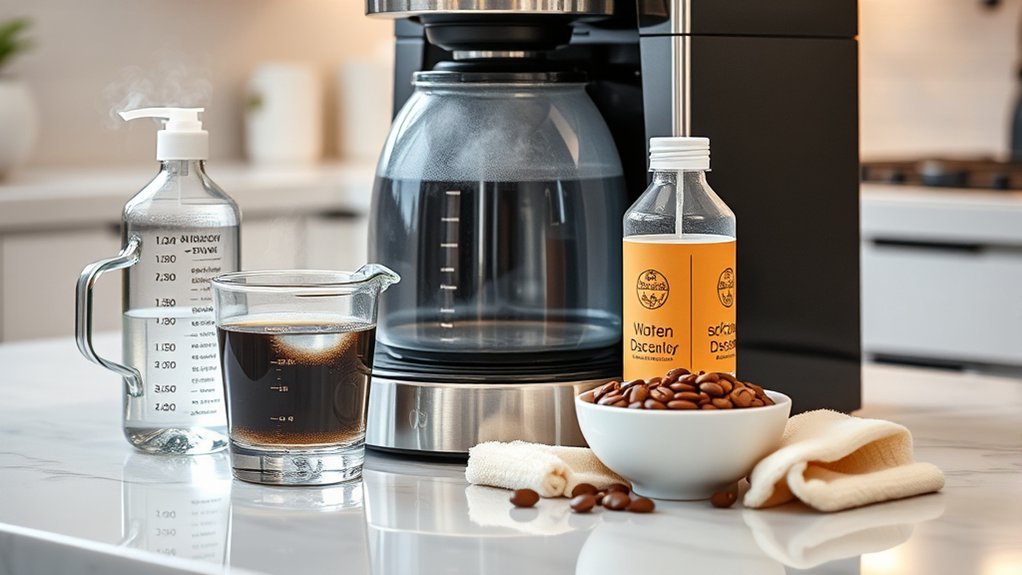
Water hardness comes mainly from dissolved calcium and magnesium. When hard water is heated, some of those minerals can form solid deposits inside tubing, heating surfaces, valves, and sprayheads. The U.S. Geological Survey explains that heated hard water can form calcium-carbonate scale.
A small amount of scale may not produce an obvious problem. As deposits grow, however, you may notice slower brewing, unusual pumping or heating sounds, lower output, uneven spray from the showerhead, or a descale warning on machines equipped with one.
Descaling dissolves mineral deposits. It is different from washing the carafe and brew basket, which removes coffee oils, grounds, stains, and loose residue. A complete maintenance routine includes both jobs.
For Urnex Dezcal household powder in a standard drip coffee maker, remember four numbers: one 28-gram packet, 32 ounces of lukewarm water, one descaling brew, and three fresh-water rinse cycles.
Before You Start: Confirm the Product and Machine Type
The instructions in this guide match the Urnex household Coffee and Espresso Machine Descaling Powder supplied as 28-gram single-use packets. Urnex also sells commercial powder, liquid, and tablet products with different concentrations or dosing directions. Do not apply the 28-gram household-packet ratio to another product format.
Note: This full-solution brewing method is intended for a standard automatic drip coffee maker. Pod brewers, capsule machines, pump espresso machines, and fully automatic espresso machines often require a model-specific descale mode. Urnex tells espresso-machine owners to follow their machine’s descaling instructions.
Locate the model number on the bottom, back, or data label of your machine and check the maintenance section of its manual. Manufacturer instructions take priority if they specify another descaler, dose, soak period, button sequence, water-filter step, or rinse procedure.
Note: The household Urnex directions are written around a full 32-ounce, or 1-liter, prepared solution. If your coffee maker cannot hold that amount at once or requires a dedicated descale program, do not guess at a smaller packet dose. Follow the exact model instructions or contact the manufacturer.
Warning: Urnex’s Dezcal Safety Data Sheet classifies the product as causing serious eye irritation. Wear suitable gloves and eye protection, avoid breathing dust or splashing the solution, and wash your hands after handling it. Keep the packet and prepared solution away from children and pets. Do not swallow it. Use Dezcal by itself rather than adding vinegar, bleach, or another cleaner to the mixture. Keep your face and hands away from hot liquid leaving the machine during brewing.
Essential Supplies for Descaling Your Coffee Maker
Gather everything before starting so you do not have to leave the machine unattended during a cycle:
- One 28-gram packet of Urnex Dezcal Descaling Powder
- 32 ounces, or 1 liter, of lukewarm water for the descaling mixture
- Enough fresh water for three full-reservoir rinse cycles, plus extra water if another rinse is needed
- A clean measuring pitcher or container that holds at least 32 ounces
- The coffee maker’s clean carafe
- Protective gloves and eye protection
- The coffee maker’s user manual or official support instructions
Do not pour dry powder directly into the coffee maker. Dissolving it separately helps prevent undissolved granules from settling in the reservoir or entering a narrow water path.
Pro Tip: Mix the powder in a clear pitcher and stir until you can no longer see granules on the bottom. Use lukewarm water as specified by Urnex rather than boiling water.
Using Urnex Dezcal: An Effective Guide
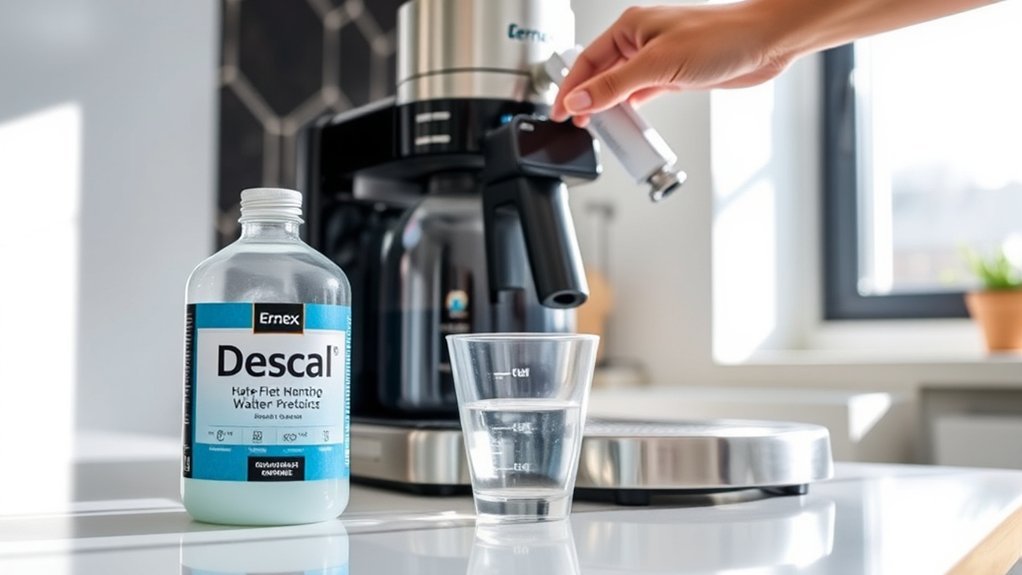
The current Urnex household powder directions for a drip coffee maker are straightforward: dissolve one 28-gram packet in 32 ounces of lukewarm water, pour it into the reservoir, brew the full prepared solution, discard it, and then brew three full tanks of fresh water.
| Step | Action | Important Detail |
|---|---|---|
| 1 | Prepare the machine | Remove coffee grounds and any disposable paper filter. Handle a tank or charcoal water filter according to the machine manual. |
| 2 | Mix the solution | Dissolve one 28-gram packet in 32 ounces, or 1 liter, of lukewarm water. |
| 3 | Fill the reservoir | Pour in the fully dissolved solution without adding coffee. |
| 4 | Brew the full solution | Keep the carafe in place and let the prepared solution run through the normal brew path. |
| 5 | Discard the used solution | Handle the carafe carefully because the collected liquid may be hot. |
| 6 | Rinse three times | Brew three full reservoirs of fresh water, discarding the water after each cycle. |
Your Easy Step-by-Step Guide to Descaling
- Read the machine manual. Confirm that the manufacturer permits this type of descaler and does not require a proprietary product or special descale mode.
- Let the machine cool. Do not begin immediately after brewing if the carafe, warming plate, or internal water is still very hot.
- Empty the coffee maker. Discard coffee grounds and remove any disposable paper filter. Wash loose grounds from the basket so they do not mix with the descaler.
- Check the removable water filter. Some manufacturers instruct you to remove a charcoal or tank filter before descaling. Other designs handle filters differently, so follow the manual rather than guessing.
- Dissolve the powder separately. Add one 28-gram packet of Urnex Dezcal powder to 32 ounces, or 1 liter, of lukewarm water in a measuring pitcher. Stir until the powder is fully dissolved.
- Pour the solution into the reservoir. Keep the empty brew basket and clean carafe correctly seated so the machine can route liquid normally.
- Run one complete brew cycle. Brew the full prepared solution without coffee. Do not drink or reuse the liquid collected in the carafe.
- Discard the used solution carefully. Avoid splashing your face or skin, and remember that the liquid and carafe may be hot.
- Rinse the reservoir and carafe. Remove any visible residue before filling the tank with fresh water.
- Run three full fresh-water cycles. Refill and brew a complete reservoir each time. Discard the rinse water after every cycle.
- Perform a final check. After the three required rinses, inspect the reservoir and carafe and check for any unusual chemical odor. Do not taste rinse water as a test. If an unusual odor or visible residue remains, run another full fresh-water cycle before brewing coffee.
Warning: Stop the cycle if the machine leaks, overflows, produces smoke, gives off an electrical odor, or repeatedly shuts itself off. Unplug it only after it is safe to approach, let it cool, and consult the manufacturer rather than forcing more solution through it.
How Often Should You Descale a Coffee Maker?
For its household Descaling Powder, Urnex currently recommends descaling every three months for best results. Treat that as a useful product-specific baseline rather than a rule that overrides your coffee maker’s manual.
Your ideal schedule also depends on four factors:
- The machine manual or descale indicator: Follow the model-specific schedule first.
- Water hardness: Hard or very hard water can create scale more quickly than soft water.
- Brewing frequency: A machine used several times each day may accumulate deposits sooner than one used occasionally.
- Water treatment: Do not assume that a built-in or replaceable water filter removes hardness. Filter performance depends on its design, and the machine may still require regular descaling.
As another manufacturer example, Keurig states that descaling should generally take place every three to six months. Some individual Keurig manuals instead specify every three months or when a descale alert appears. This is why the instructions for your exact machine matter.
How to Check Your Water Hardness
You do not have to guess whether your tap water is hard. Check your local water utility’s water-quality report, use the hardness test strip supplied with some coffee machines, or use a drinking-water hardness test kit. Results are commonly expressed as milligrams per liter, or parts per million, as calcium carbonate.
The U.S. Geological Survey commonly classifies water hardness this way:
| Hardness as CaCO3 | USGS Classification |
|---|---|
| 0–60 mg/L | Soft |
| 61–120 mg/L | Moderately hard |
| 121–180 mg/L | Hard |
| More than 180 mg/L | Very hard |
If your machine lets you program a water-hardness level, enter the measured result according to its manual. De’Longhi, for example, explains that the hardness setting is used to help determine when some machines need descaling.
Signs Your Coffee Maker May Need Descaling
- The brew cycle takes longer than usual.
- The machine produces less coffee than the amount of water added.
- Water drips slowly or sprays unevenly.
- You hear louder heating, pumping, or gurgling sounds.
- The coffee temperature or extraction seems less consistent.
- A descale light, maintenance symbol, or on-screen message appears.
- Visible white or chalky residue forms around the reservoir, sprayhead, or hot-water outlet.
A strange flavor alone does not prove that scale is the cause. Old coffee oils, stale water, a dirty carafe, a worn water filter, coffee freshness, or other residue can also affect taste.
What to Expect After Descaling Your Coffee Maker

If scale was restricting the water path, you may notice faster or steadier flow, more even spray over the coffee bed, and a brew volume closer to the amount selected. Removing deposits from heating surfaces may also help the machine operate more consistently.
Flavor may improve when scale was interfering with water temperature or flow, but descaling is not a cure for every taste problem. Continue cleaning the carafe, lid, brew basket, reusable filter, and accessible showerhead areas according to the machine manual to remove coffee oils and residue.
Do not expect a guaranteed reduction in energy use or a guaranteed extension of the machine’s lifespan. The practical benefit is removing mineral deposits that can restrict water flow and contribute to scale-related performance problems.
If the machine remains slow, noisy, or unable to move water after one correctly completed descaling cycle, stop repeating the chemical treatment. A blocked valve, failed pump, damaged heater, sensor fault, or another mechanical problem may require manufacturer support or repair.
Troubleshooting Common Descaling Problems
The Powder Will Not Dissolve
Do not pour clumped powder into the reservoir. Use lukewarm—not boiling—water and stir the mixture in a separate pitcher until you can no longer see undissolved granules. Replace the mixture if the packet or solution has been contaminated.
The Machine Will Not Pump the Solution
Turn the machine off and allow it to cool. Confirm that the reservoir is seated correctly, the carafe is in position, and the brew basket’s drip-stop valve is not stuck. Do not repeatedly run a dry or silent pump. Contact the manufacturer if water cannot move through the machine.
The Coffee Maker Overflows
Stop the cycle. Check that the carafe lid, brew basket, and drip-stop mechanism are positioned correctly. Clean loose grounds or debris from the basket before trying a fresh-water test. Do not continue running descaler while the machine is overflowing.
A Sour or Chemical Odor Remains
Run one or more additional full reservoirs of fresh water. Wash the carafe and removable basket with warm water and dish soap, rinse them completely, and confirm that no prepared solution remains in a removable reservoir or separate water chamber. Do not taste rinse water to check for descaler.
The Descale Light Stays On
Some machines turn off the alert only after you complete a dedicated descale mode or model-specific button sequence. Running a normal brew cycle may clean part of the water path without resetting the electronic indicator. Look up the exact model’s reset procedure rather than holding random buttons.
Performance Does Not Improve
One correctly completed cycle should normally be sufficient for routine maintenance. Repeating acidic cycles back-to-back without manufacturer instructions can be unnecessary. Seek support if the machine still has poor flow, leaks, error codes, or heating problems.
Descaling Versus Cleaning a Coffee Maker
| Maintenance Task | What It Removes | Typical Areas |
|---|---|---|
| Descaling | Mineral deposits caused by water | Internal water path, heating surfaces, valves, reservoir outlet, and sprayhead passages |
| Routine cleaning | Coffee oils, grounds, stains, dust, and loose residue | Carafe, lid, brew basket, reusable filter, warming plate, and exterior |
Descaler should not be treated as a sanitizer or as a replacement for washing removable food-contact parts. Follow the manual’s cleaning instructions and allow washable parts to dry fully before reassembly.
Top Benefits of Regularly Maintaining Your Coffee Maker
Regular descaling and routine cleaning address two different sources of poor performance. When both are completed correctly, they can help you:
- Maintain a clearer water path and more consistent brew volume.
- Reduce scale-related restrictions in tubing and heating areas.
- Avoid old coffee oils and residue that can affect aroma and taste.
- Spot leaks, damaged seals, or slow flow before the problem becomes more severe.
- Follow the maintenance conditions recommended by the machine manufacturer.
- Keep the reservoir, carafe, basket, and accessible water outlets in cleaner working condition.
Maintenance cannot reverse a failed pump, cracked hose, damaged heating element, or electronic fault. Its value is prevention and restoring performance when removable mineral deposits or residue are part of the problem.
Frequently Asked Questions
How often should I descale my coffee maker?
Urnex currently recommends using its household Descaling Powder every three months for best results. Your coffee maker’s manual or descale indicator should take priority, and harder water or heavy use may affect how quickly scale returns.
Can I use vinegar instead of Urnex Dezcal?
Only use vinegar if the manufacturer of your exact coffee maker allows it. Do not add vinegar to the Dezcal mixture or substitute vinegar while following the Urnex procedure described in this guide.
Can I use this procedure for an espresso or pod machine?
Not unless the machine manual gives the same directions. Espresso, pod, capsule, and bean-to-cup machines often use a dedicated descale mode that controls the outlets, timing, and rinse process. Follow the exact instructions for your model.
How much Urnex Dezcal powder should I use?
For the 28-gram single-use household Urnex packet covered in this guide, dissolve one packet in 32 ounces, or 1 liter, of lukewarm water. Do not use this ratio for a commercial bulk package, Dezcal liquid, tablets, or another descaler.
How many fresh-water rinse cycles are required?
Urnex’s current household drip-coffee-maker directions call for three full fresh-water brew cycles after the used descaling solution is discarded. If an unusual chemical odor or visible residue remains, run an additional fresh-water cycle.
Should I remove the coffee maker’s water filter?
Check the machine manual. Some models instruct you to remove a charcoal or tank filter before descaling, while other designs handle filters differently. Always remove coffee grounds and any disposable paper coffee filter before the descaling brew.
Why is the descale light still on after I finish?
The machine may require a dedicated descale mode or model-specific reset sequence. A normal brew cycle can move solution through the machine without clearing its electronic maintenance alert. Consult the official instructions for the exact model.
Will descaling improve the taste of my coffee immediately?
It may help if mineral buildup was affecting water temperature or flow. However, stale water, old coffee oils, dirty removable parts, a worn water filter, grind size, and coffee freshness can also affect taste. Clean and maintain those areas separately.
What if my reservoir holds less than 32 ounces?
Do not automatically reduce the packet dose or invent a new concentration. The household packet directions are written for a 28-gram packet mixed with 32 ounces, or 1 liter, of water. If your machine cannot accept that solution as directed, use the model-specific descaling instructions.
Does using a water filter mean I can stop descaling?
No. A water filter does not automatically remove the calcium and magnesium responsible for hardness. Filter performance depends on its design, so continue following the coffee maker’s maintenance schedule and descale alerts unless the manufacturer specifically says otherwise.
Conclusion
To descale a standard drip coffee maker with a 28-gram household packet of Urnex Dezcal powder, dissolve the packet in 32 ounces, or 1 liter, of lukewarm water. Brew the full solution, discard it safely, and complete three full fresh-water rinse cycles.
Urnex currently recommends using the household powder every three months for best results, but the most important step is confirming that the procedure matches your machine. Pod brewers and espresso machines may require a guided program, multiple outlets, different dosing, or a separate reset procedure. With the correct product, dose, safety precautions, rinse process, and model-specific instructions, descaling can remove mineral deposits without relying on vague or conflicting advice.
Sources
- Urnex Coffee and Espresso Machine Descaling Powder — household packet size, 28-gram dose, 32-ounce water volume, drip-machine procedure, three rinse cycles, and three-month recommendation
- Urnex Safety Data Sheets — current access point for Dezcal Powder safety and handling information
- U.S. Geological Survey: Hardness of Water — calcium, magnesium, hardness classifications, and scale formation when hard water is heated
- Keurig Descaling Solution Guidance — manufacturer example recommending a three-to-six-month descaling interval
- De’Longhi Fully Automatic Espresso Maker Descaling FAQ — model-specific procedures and the effect of water hardness on descaling frequency
- De’Longhi Water Hardness Setup FAQ — using a hardness test and machine hardness setting to help determine descaling timing