You can measure coffee grounds without a scale and still make consistently good coffee. Use a standard measuring tablespoon, measure the water separately, and keep every spoonful level rather than heaped or packed. Once you have a repeatable starting point, adjust the dose gradually to match your preferred strength.
Quick Answer
To measure coffee grounds without a scale, use a standard level tablespoon and a known water volume. Start with about 2 to 2 1/2 level tablespoons per 8 fl oz (237 mL), then adjust by about 1/2 tablespoon after tasting. Keep each spoonful loose and level. For espresso, follow the basket or machine instructions.
At a Glance
| Time Required | About 2 minutes |
| Difficulty | Easy |
| Tools Needed | Measuring tablespoon or known-size coffee scoop, liquid measuring cup, and brewer |
| Cost | $0 if you already have measuring utensils |
How to Measure Coffee Grounds Without a Scale: Quick Guide
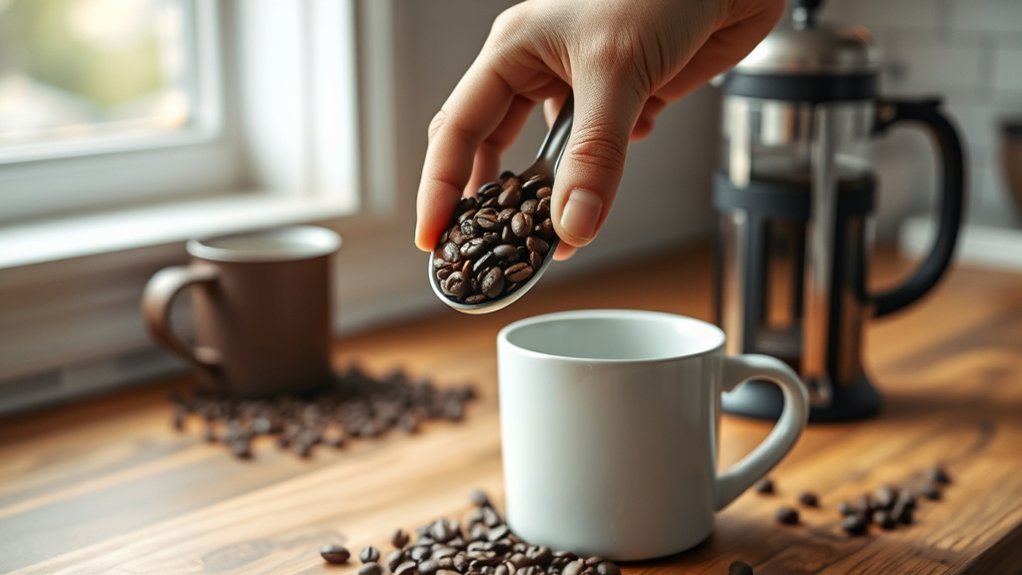
A scale remains the most accurate way to measure coffee, but household volume measurements can work well when you use them consistently. The National Coffee Association gives a broad drip-coffee range of 1 to 2 tablespoons of ground coffee for every 6 fl oz of water. Texas A&M AgriLife gives a simple no-scale shortcut of 1 tablespoon per 4 fl oz. Those references overlap at 1 1/2 to 2 tablespoons per 6 fl oz, which is the focused starting range used in the chart below.
- Measure the water first. Use a liquid measuring cup or another container with known fluid-ounce or milliliter markings.
- Use a standard measuring tablespoon. A U.S. measuring tablespoon holds 15 mL, according to the 2026 NIST Handbook 44 measurement tables.
- Fill the spoon loosely. Scoop the grounds without shaking, pressing, or tamping them into the spoon.
- Level the top. Sweep a straight edge across the spoon so every serving is measured the same way.
- Brew and taste. If the coffee is too mild, add about 1/2 tablespoon next time. If it is too strong, remove about 1/2 tablespoon.
The method is working when two brews made with the same coffee, water amount, spoon, and brewer taste similar. If results still swing from one brew to the next, first check that every spoonful was level and the water volume stayed the same.
Note: A U.S. measuring cup contains 8 fl oz, or approximately 237 mL. Coffee-maker carafe markings may use a smaller manufacturer-defined “coffee cup,” so check the machine manual before using those markings as an 8-fluid-ounce measurement.
Repeatability matters more than pretending a tablespoon is a scale: use the same level scoop, the same water measure, and the same brewing method each time.
Coffee Grounds Without a Scale: Starting Chart
The following amounts are practical household starting points, especially for drip coffee. The lower end follows the Texas A&M no-scale shortcut of 1 tablespoon per 4 fl oz, while the upper end stays within the National Coffee Association’s drip guidance. The amounts are shown as ranges because one tablespoon of one coffee may not weigh the same as one tablespoon of another. For pour-over, treat the chart as an approximation and use the method-specific guidance below.
| Water | Starting Amount | Adjustment |
|---|---|---|
| 6 fl oz / 177 mL | 1 1/2 to 2 level tablespoons | Use the upper end for a stronger cup |
| 8 fl oz / 237 mL | 2 to 2 1/2 level tablespoons | Try 3 tablespoons for a distinctly stronger brew |
| 10 fl oz / 296 mL | 2 1/2 to 3 level tablespoons | Adjust by 1/2 tablespoon |
| 12 fl oz / 355 mL | 3 to 4 level tablespoons | Start near the middle of the range |
| 16 fl oz / 473 mL | 4 to 5 level tablespoons | Increase gradually rather than heaping the spoon |
Weight ratios and spoon measurements solve slightly different problems. Texas A&M AgriLife describes 1:15 as a useful middle-of-the-road weight ratio and recommends 1 tablespoon of coffee per 4 fl oz of water as a simple no-scale shortcut. That equals 2 level tablespoons per 8 fl oz and anchors the lower end of this chart. Do not treat tablespoons as an exact gram conversion, because roast, grind size, settling, and packing all change how much coffee fits into the same volume.
Can You Use the Coin Method for Espresso Without a Scale?
The coin method does not measure an espresso dose. At most, it is a rough headspace check for whether a tamped puck may be contacting the shower screen, and the result changes with basket depth, group-head design, screws, and coin thickness. For dose setting, the filter basket’s stated capacity and the machine manufacturer’s instructions are more useful.
For example, the Breville Barista Touch manual specifies approximate basket doses of 8–10 g for the 1-cup basket and 15–18 g for the 2-cup basket and uses the Razor dose-trimming tool to set puck depth. Other machines can use different baskets and dose ranges, so there is no universal coin rule.
Warning: Never brew with a coin inside the portafilter and never force the portafilter to lock. If your machine provides a basket capacity, fill line, dosing tool, or tamp-depth guide, use that procedure instead.
Preparing Your Coffee for Accurate Dosing
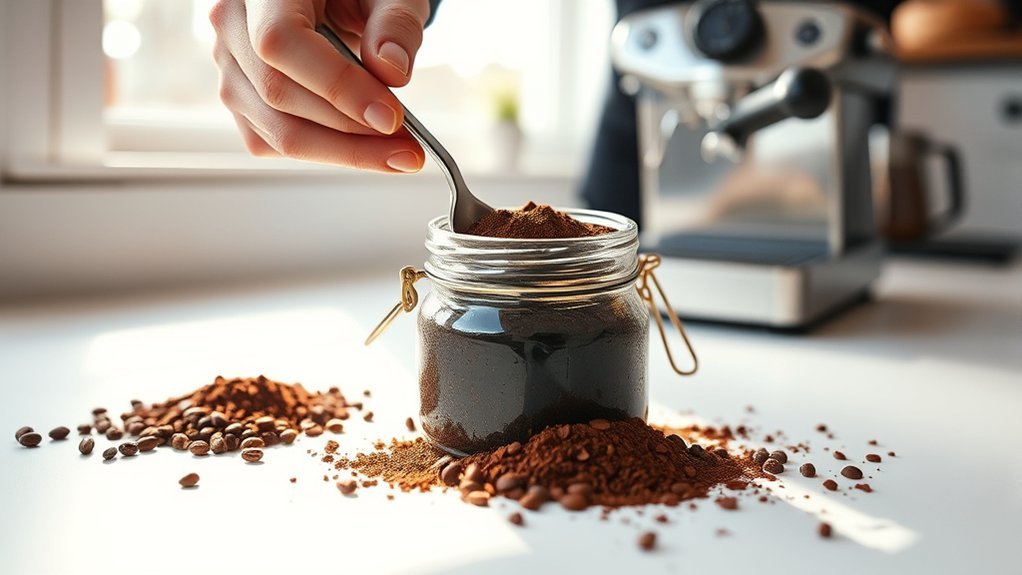
Volume measurements become more dependable when you control how the grounds fill the spoon. Keep the coffee, grind, spoon, and water measure consistent while testing, then change one variable at a time.
- Use the same coffee while testing. Changing beans, roast level, and grind at the same time makes the results difficult to compare.
- Grind close to brewing time when possible. This helps preserve aroma, but grind uniformity depends on the grinder. The National Coffee Association recommends a burr grinder when consistent particle size is a priority.
- Measure ground coffee rather than whole beans. A tablespoon of whole beans and a tablespoon of grounds are not interchangeable.
- Do not pack the spoon. Compression increases the amount of coffee in the same volume.
- Level every spoonful. Heaped spoons make repeatable adjustment nearly impossible.
- Measure water separately. Use a liquid measuring cup rather than estimating from the mug’s apparent size.
Pro Tip: The next time you have access to a kitchen scale, weigh one level spoonful of your usual coffee three times and calculate the average. That gives you a useful personal conversion for that bean, grind, and spoon.
Top Mistakes to Avoid When Measuring Coffee Without a Scale
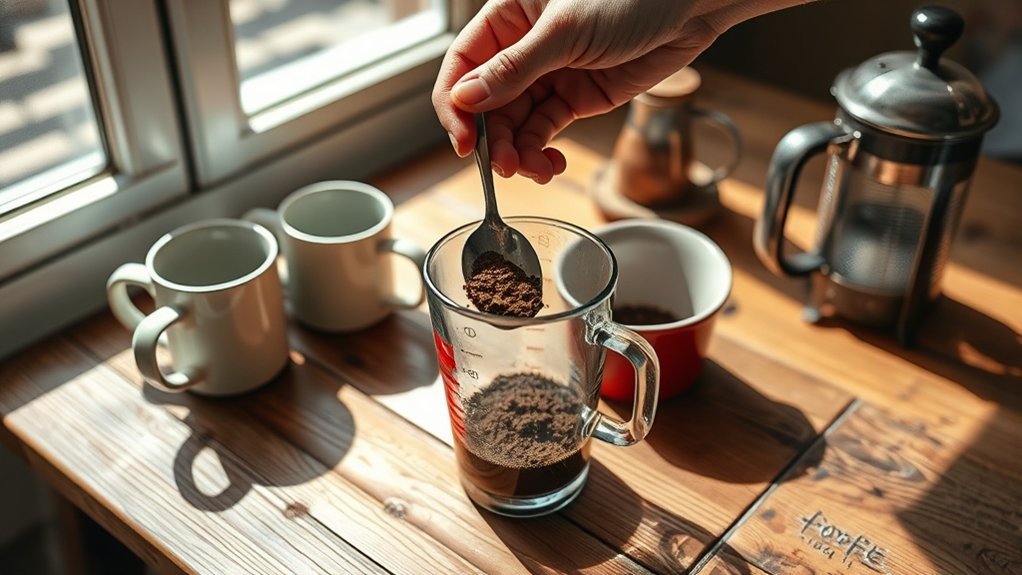
Most inconsistent cups come from changing the measuring technique from one brew to the next. Level spoonfuls, a known water volume, and one change at a time make problems much easier to diagnose.
- Calling 225 mL an 8-fluid-ounce cup: A U.S. 8-fluid-ounce measuring cup is approximately 237 mL. A 225 mL water dose is valid, but it should not be labeled as exactly 8 fl oz.
- Using a dinner spoon: Household eating utensils are not standardized measuring tablespoons.
- Switching between level and heaped spoonfuls: Choose level spoonfuls so adjustments are measurable.
- Packing the grounds: Pressing grounds into the spoon increases the dose unpredictably.
- Assuming every coffee has the same density: Roast level, grind size, and settling change how much coffee fits into a spoon.
- Confusing coffee-maker cups with measuring cups: Read the machine manual or measure the reservoir yourself.
- Changing several variables at once: Do not change dose, grind, temperature, and brew time together when troubleshooting.
- Using the coin test as a flavor test: It checks possible clearance, not extraction quality.
Alternative Methods for Measuring Coffee Grounds
A measuring tablespoon is the simplest no-scale option, but it is not the only standardized measure you can use. Measuring teaspoons, verified coffee scoops, quarter-cup measures, and brewer markings can all work when you know their actual capacity.
Use a Measuring Teaspoon
If you have a measuring teaspoon but no tablespoon, use 3 level teaspoons for every 1 tablespoon. The USDA measurement conversion table lists 1 tablespoon as 3 teaspoons. That means an 8 fl oz starting dose of 2 to 2 1/2 tablespoons becomes 6 to 7 1/2 level teaspoons.
Use a Coffee Scoop
Many coffee scoops hold approximately 2 tablespoons, but scoop sizes are not universal. Fill the scoop with water and pour it into a measuring tablespoon to verify its capacity before relying on it. For a deeper scoop-to-tablespoon and scoop-to-gram explanation, see the coffee scoop size guide.
Use a Quarter-Cup Measure
One U.S. quarter-cup measure equals 4 measuring tablespoons. This can be faster for larger batches:
- 1/4 cup grounds = 4 tablespoons
- 1/2 cup grounds = 8 tablespoons
- 3/4 cup grounds = 12 tablespoons
Keep the grounds loose and level rather than compressing them into the cup.
Use Brewer or Basket Markings
Some brewers provide a scoop, fill line, filter-basket mark, or recipe designed for that appliance. These instructions may be more repeatable than a generic chart, especially for espresso and single-serve systems.
Pre-Portion Coffee
Once you find an amount you like, divide several future servings into small airtight containers. This preserves your chosen volume and reduces measurement differences on busy mornings.
How Do You Measure Coffee for a Full Pot Without a Scale?
Measure the coffee maker’s actual water volume instead of assuming that every numbered “cup” equals 8 fl oz. Once you know the water volume, scale the same recipe you use for one mug.
Simple formula: total water in fluid ounces ÷ 8 × 2 to 2 1/2 = approximate number of level tablespoons. For example, 40 fl oz of water works out to about 10 to 12 1/2 tablespoons, while 60 fl oz works out to about 15 to 19 tablespoons. These are volume estimates, so stay within your brewer’s basket capacity and adjust after tasting.
If your carafe only shows numbered cups, check the manual or measure the reservoir once with a liquid measuring cup. For more detail on why carafe “cups” differ from household cups, see what “12-cup” means on a coffee maker.
Does the Measurement Change by Brewing Method?
Yes. A spoon measurement that works for drip coffee should not automatically be applied to every method.
- Drip coffee: The National Coffee Association gives a volume-based starting range of 1 to 2 tablespoons per 6 fl oz of water. Use a medium grind and follow the machine’s capacity instructions.
- Pour-over: The NCA gives a weight ratio of 1:13 to 1:16. Without a scale, use the tablespoon chart only as an approximation and keep the dose steady while adjusting grind or pouring technique separately.
- French press: The NCA gives a broad weight ratio of 1:10 to 1:16 and recommends a coarse grind. A tablespoon remains only an approximation because coarse grounds occupy volume differently from finer grounds.
- Cold brew: The NCA’s concentrate-style guidance is much stronger at about 1:4 to 1:5 by weight. Do not apply the hot-coffee tablespoon chart automatically to cold brew.
- Espresso: The NCA uses a roughly 1:2 ratio of dry coffee to brewed espresso by weight. Without a scale, follow the filter basket’s capacity and machine manual rather than trying to convert that ratio to tablespoons.
The National Coffee Association’s brewing guides separate drip, pour-over, espresso, French press, and cold brew because each method uses different ratios, grind sizes, equipment, and techniques.
Why Consistent Coffee Measurements Matter
Consistent measurements give you a stable baseline. Once the water and coffee amounts stay the same, you can identify whether a flavor problem comes from the dose or another brewing variable.
- Repeatable strength: The same amount of coffee and water produces a more predictable concentration.
- Easier troubleshooting: You can adjust one variable instead of guessing what changed.
- Less waste: Gradual adjustments prevent repeatedly discarding overly strong or weak batches.
- Better comparison: Keeping the recipe steady makes differences between beans and roasts easier to notice.
Consistent dosing does not guarantee identical flavor. Water temperature, contact time, grind size, filter type, water composition, and coffee freshness also affect the result.
Tips for Experimenting With Coffee Ratios
Start with one repeatable recipe and make small changes instead of jumping between unrelated ratios. Record the water and level spoonfuls so you can tell which adjustment actually improved the cup.
- Record the water amount. Write it in fluid ounces or milliliters.
- Record the number of level spoonfuls. Note the exact spoon or scoop used.
- Change only one variable. Adjust the dose by about 1/2 tablespoon while keeping the grind and water amount steady.
- Describe the result. Use simple terms such as weak, strong, sour, bitter, thin, or balanced.
- Repeat the successful recipe. A result is more useful when you can reproduce it.
A 1:15 ratio is a useful weight-based starting point for many brewed coffees, but ratios from about 1:13 to 1:20 may be used depending on the brewer and desired strength. Texas A&M AgriLife identifies 1:15 as a reasonable middle point, while the Harvard Nutrition Source gives the simpler household guideline of 1 to 2 tablespoons per 6 fl oz. If you later switch to a scale, the coffee-to-water ratio guide explains how to calculate a repeatable gram-based recipe.
Troubleshooting Coffee Measured by Tablespoon
Treat strength and extraction as separate problems. First confirm the coffee dose and water amount, then adjust grind or contact time only when the flavor points to under- or over-extraction.
Coffee Tastes Weak or Watery
- Add about 1/2 tablespoon of coffee at the next brew.
- Confirm that the water measurement did not increase.
- For drip or pour-over, consider a slightly finer grind if water is passing through unusually quickly.
- Check that the filter fits correctly and is not folding over.
Coffee Tastes Too Strong
- Remove about 1/2 tablespoon at the next brew.
- Add a small amount of hot water to the finished cup if you need an immediate correction.
- Confirm that the spoonfuls were level rather than heaped or packed.
Coffee Tastes Bitter or Dry
Too much coffee can produce a concentrated cup, but bitterness may also come from a grind that is too fine, excessive contact time, stale residue in the brewer, or coffee held too long on a hot plate. Change one factor at a time.
Coffee Tastes Sour or Thin
A sour or hollow cup can indicate insufficient extraction rather than simply too little coffee. Depending on the method, try a slightly finer grind, a longer contact time, or a more even pour before making a large dose change.
When to Invest in a Coffee Scale
Household measurements are adequate for many everyday drip and French press brews. A scale becomes worthwhile when small dose changes matter or you need to reproduce a recipe precisely.
Consider buying one when:
- You make espresso regularly. Small dose differences can affect headspace, flow, and shot time.
- You want repeatable pour-over recipes. Measuring both coffee and water by weight makes pouring stages easier to track.
- You switch beans often. A scale avoids the volume differences caused by roast density and grind size.
- You are troubleshooting inconsistent results. Knowing the true dose removes one major unknown.
- You make large batches. Weight is faster and more repeatable than counting many spoonfuls.
A suitable coffee scale should measure in grams, include a tare function, respond quickly, and have enough capacity for your brewer and serving vessel. A built-in timer is useful but not essential.
Key Takeaways
- Use a real measuring tablespoon and level the grounds without pressing or packing them.
- The National Coffee Association gives a broad drip range of 1 to 2 tablespoons per 6 fl oz; this guide uses 1 1/2 to 2 tablespoons per 6 fl oz as a more focused starting range.
- A U.S. 8-fluid-ounce measuring cup is about 237 mL; do not assume a coffee maker’s “cup” marking equals 8 fl oz.
- Tablespoons measure volume, not weight, so different roasts and grind sizes will not weigh exactly the same.
- For espresso, basket capacity and manufacturer dosing instructions are more useful than a universal spoon or coin rule.
Frequently Asked Questions
How do I measure coffee if I do not have a tablespoon?
Use a measuring teaspoon or another standardized measure. Three level teaspoons equal 1 tablespoon, so an 8 fl oz starting dose of 2 to 2 1/2 tablespoons equals 6 to 7 1/2 teaspoons. A quarter-cup measure equals 4 tablespoons. Avoid dinner spoons and other unmarked household objects because their capacities vary.
How do different coffee types affect tablespoon measurements?
Roast level, grind size, bean structure, settling, and packing change how much coffee fits into a tablespoon. A fine grind may settle differently from a coarse grind, while darker roasted coffee is often less dense than lighter roasted coffee. Keep the coffee and grind consistent while establishing your preferred spoon measurement.
Is the tablespoon method accurate for every brewing method?
No. It is most practical for drip coffee, French press, and other forgiving brewed-coffee methods. Pour-over benefits from weight-based measurement, and espresso is sensitive enough that the basket rating and machine manual should guide the dose.
How much coffee should I use for different cup sizes?
Start with 1 1/2 to 2 level tablespoons for 6 fl oz, 2 to 2 1/2 tablespoons for 8 fl oz, 3 to 4 tablespoons for 12 fl oz, or 4 to 5 tablespoons for 16 fl oz. Adjust each recipe by about 1/2 tablespoon after tasting.
How do I measure coffee for a full pot without a scale?
Measure the actual water volume first, then scale your tablespoon recipe. A simple starting formula is total fluid ounces divided by 8, multiplied by 2 to 2 1/2 tablespoons. For 60 fl oz of water, that is about 15 to 19 level tablespoons. Stay within the brewer’s basket capacity and adjust after tasting.
Is one coffee scoop equal to two tablespoons?
Many coffee scoops hold about two tablespoons, but the term “coffee scoop” is not a guaranteed standard size. Verify yours by filling it with water and transferring that water into a measuring tablespoon.
Does an 8-cup coffee maker hold eight 8-ounce cups?
Not necessarily. Coffee makers often use smaller manufacturer-defined cup markings. Measure the full reservoir with a liquid measuring cup or check the owner’s manual before calculating the number of tablespoons needed.
Conclusion
To measure coffee grounds without a scale, use level, unpacked spoonfuls and a known amount of water. Start with about 2 to 2 1/2 tablespoons for an 8-fluid-ounce cup, taste the result, and adjust by roughly 1/2 tablespoon at a time. For larger batches, measure the actual reservoir volume and scale the same ratio instead of assuming the coffee maker’s numbered cups equal 8 fl oz.
For espresso, do not treat a coin indentation as a universal dose measurement. Follow the filter basket’s capacity and the machine manufacturer’s guidance. A scale is the best upgrade when you want precise ratios, repeatable pour-over recipes, or reliable espresso adjustments.
Sources
- NIST Handbook 44 — Appendix C, General Tables of Units of Measurement — U.S. fluid-ounce, measuring-cup, tablespoon, and milliliter conversions.
- National Coffee Association — Drip Coffee Guide — household coffee-to-water guidance, grind recommendations, and brewing variables.
- National Coffee Association — Brewing Guides — method-specific guidance for pour-over, French press, espresso, and cold brew.
- Harvard T.H. Chan School of Public Health — Coffee — general recommendation of 1 to 2 tablespoons per 6 ounces of water.
- Texas A&M AgriLife — Coffee Measurement and Ratio Guidance — practical 1:15 ratio and household measurement discussion.
- Specialty Coffee Association — Coffee Standards — research-based standards for brewers, grinders, espresso equipment, and coffee evaluation.
- Breville Barista Touch Instruction Manual — manufacturer-specific filter basket and espresso dosing guidance.
- USDA Agricultural Research Service — Measurement Conversion Tables — tablespoon, teaspoon, cup, and fluid-ounce equivalents.