Filtered water can help prevent mineral scale, but only when the treatment system is designed to reduce hardness or has a verified scale-reduction claim. Standard sediment and carbon filters may improve clarity, taste, or odor, yet they usually do not remove the dissolved calcium and magnesium that cause hard-water scale. The right solution starts with testing your water and identifying the exact treatment technology.
Quick Answer
Filtered water prevents mineral scale only when the system actually reduces hardness or is certified to limit scale formation. Ordinary sediment and carbon filters do not remove dissolved calcium and magnesium. Test your water, choose a certified softener, conditioner, or membrane system, and maintain it according to the exact model instructions.
Key Takeaways
- Test hardness before buying equipment. Use a hardness result in mg/L as calcium carbonate or grains per gallon; a handheld TDS meter is not a hardness test.
- A basic sediment or carbon filter usually does not remove dissolved hardness minerals, even if it improves clarity, taste, or odor.
- Ion-exchange softeners remove calcium and magnesium. A certified salt-free conditioner may reduce scale adhesion without lowering the measured hardness number.
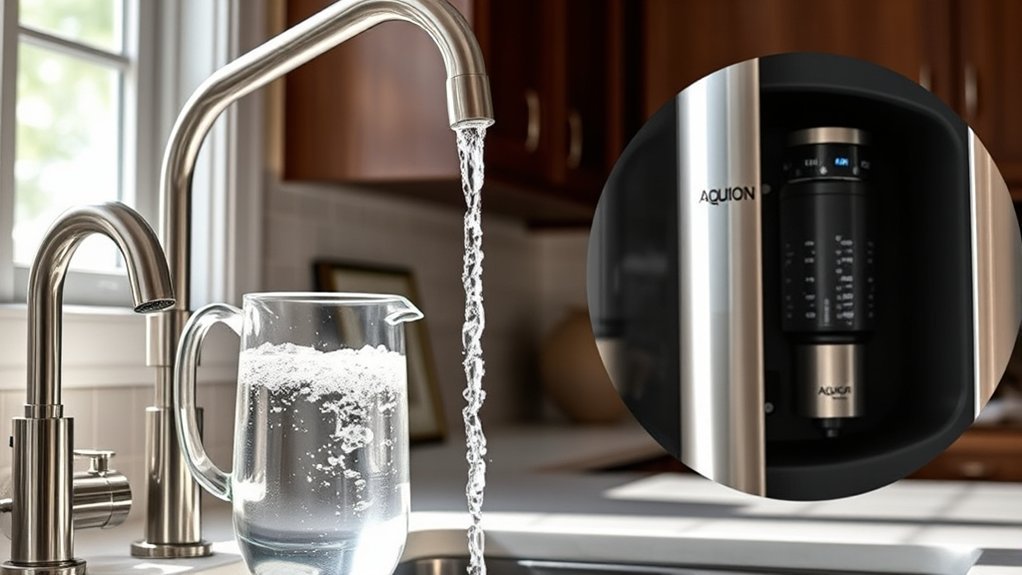
- Verify the exact Aquion-branded model, technology, certification, capacity, installation instructions, and maintenance schedule before relying on any performance claim.
- For a new softener, compare demand-initiated regeneration, water efficiency, salt efficiency, local discharge rules, and the exact NSF/ANSI 44 certification.
- Remove existing deposits with a manufacturer-approved descaling method. White vinegar works on many fixtures, but it should never be mixed with chlorine bleach.
At a Glance
| Time Required | About 15–30 minutes to review a water report or run a hardness test; installation time varies by system and plumbing layout. |
| Difficulty | Easy to assess and compare; moderate to advanced for plumbing installation. |
| Tools Needed | Water-quality report or hardness test, model manual, performance data sheet, towels, bucket, and model-specific plumbing tools if do-it-yourself installation is permitted. |
| Cost | Varies widely by technology, capacity, plumbing changes, certification, replacement media, salt use, wastewater, and professional labor. |
What Mineral Scale Is and Why It Forms
Water hardness is caused primarily by dissolved calcium and magnesium. When hard water is heated, evaporates, or becomes concentrated inside equipment, some dissolved minerals can form solid deposits. These chalky deposits are commonly called limescale or mineral scale.
The U.S. Geological Survey explains that scale can narrow pipes, reduce water flow, coat heating surfaces, and shorten the useful life of water-using equipment. Hot-water systems, kettles, coffee makers, humidifiers, ice machines, dishwashers, and showerheads are common trouble spots.
Scale formation is not controlled by one factor alone. Hardness, alkalinity, pH, water temperature, evaporation, and the concentration of dissolved minerals can all affect whether deposits form. A pH above 7 does not automatically mean that scale will occur.
Water Hardness Ranges
| Classification | mg/L as Calcium Carbonate | Approximate Grains per Gallon |
|---|---|---|
| Soft | 0–60 mg/L | 0–3.5 gpg |
| Moderately hard | 61–120 mg/L | About 3.6–7.0 gpg |
| Hard | 121–180 mg/L | About 7.1–10.5 gpg |
| Very hard | More than 180 mg/L | More than about 10.5 gpg |
Note: A regional hardness map is useful for general context, but it cannot replace a current result for your home. Check your utility’s water-quality report or use an appropriate test. Private-well owners should use a qualified laboratory when contamination—not just hardness—is a concern.
How to Test Water Hardness Correctly
Use a utility water-quality report, a hardness test strip, a drop-titration hardness kit, or a laboratory result that reports hardness as calcium carbonate. One grain per gallon is about 17.1 mg/L as calcium carbonate, so you can convert between the two units when comparing a test result with a product specification.
Do not use a handheld total dissolved solids (TDS) meter as a substitute for a hardness test. TDS reflects the overall dissolved ionic content and cannot tell you how much of that reading is calcium and magnesium. This matters after ion-exchange softening because sodium or potassium replaces hardness ions, so the TDS reading may remain similar even when the water is properly softened.
Hardness Is Not the Same as Water Contamination
Hard water is generally considered a nuisance and maintenance issue rather than a health hazard. It can leave spots, soap residue, and scale, but hardness alone does not tell you whether water contains lead, arsenic, nitrate, bacteria, PFAS, or other contaminants.
A softener or scale conditioner should not be presented as a complete water purifier. Select treatment for the exact problem shown by your water report or test results, and verify that the chosen system has a certified claim for that problem.
Can Filtered Water Prevent Mineral Scale?
It depends on what “filtered water” means. A cartridge that catches sand, rust, or sediment can protect small openings from particles, but dissolved calcium and magnesium normally pass through it. Activated carbon can improve taste and odor and reduce certain certified contaminants, but a standard carbon filter is not a hardness-removal system.
The EPA WaterSense Guide to Selecting Water Treatment Systems states that ordinary filtration does not remove dissolved minerals. To reduce hardness or scale, you need a technology intended and verified for that purpose.
Water-Treatment Options Compared
| Technology | Removes Hardness? | How It Helps | Main Limitations |
|---|---|---|---|
| Sediment filter | No | Captures suspended sand, rust, and other particles that may clog equipment. | Dissolved calcium and magnesium usually pass through. |
| Activated-carbon filter | Usually no | Can improve taste and odor and reduce specifically certified contaminants. | Not a substitute for a softener or certified scale-reduction device. |
| Ion-exchange softener | Yes | Exchanges calcium and magnesium for sodium or potassium ions, reducing measured hardness and scale formation. | Requires regeneration, salt or potassium, drainage, and maintenance; local restrictions may apply. |
| Salt-free scale conditioner | Usually no | May alter or inhibit scale-forming behavior so deposits are less likely to adhere. | Performance varies; water may still test hard. Look for a verified scale-reduction claim. |
| Reverse osmosis | Yes, at the treated outlet | Reduces many dissolved minerals and contaminants through a membrane. | Usually point-of-use, produces reject water, and needs prefilters and membrane service. |
| Distillation | Yes | Leaves most hardness minerals behind when water is boiled and condensed. | Slow, energy-intensive, and normally limited to drinking-water quantities. |
| Polyphosphate scale inhibitor | No | Can bind or interfere with minerals to reduce deposits in a specified application. | Does not soften water; suitability, dosage, certification, and cartridge life are model-specific. |
A filter’s name or appearance does not prove that it controls hardness. The performance data sheet and certified reduction claim are what matter.
What to Know About Aquion-Branded Water-Treatment Systems
Pentair completed its acquisition of Aquion in February 2019. Aquion’s current product information still covers a broad range of water-treatment equipment, including conditioners, filters, drinking-water purifiers, reverse-osmosis systems, and disinfection equipment. That means the name “Aquion” alone does not identify the treatment technology or prove a scale-reduction claim.
Before describing an Aquion-branded system as salt-free, maintenance-free, whole-house, under-sink, or capable of removing hardness, locate the label and record the complete model number. Then compare it with the current manual, performance data sheet, and certification listing for that exact model.
Verify These Details for the Exact Model
- Treatment process: sediment filtration, carbon adsorption, ion exchange, membrane treatment, scale conditioning, or a combination.
- Certified claim: the standard and the exact hardness, scale, or contaminant reduction listed for that model.
- Installation point: point-of-use under a sink, appliance-specific, or point-of-entry for the whole home.
- Rated service flow: the flow the unit can treat without excessive pressure loss.
- Capacity: gallons, grains of hardness, media volume, or another model-specific rating.
- Operating limits: allowable pressure, temperature, water chemistry, and disinfectant exposure.
- Required connections: bypass, drain, backwash line, air gap, electrical outlet, storage tank, or dedicated faucet.
- Service schedule: cartridge replacement, regeneration, salt filling, membrane replacement, sanitation, or media service.
- Warranty conditions: approved installation, pretreatment, maintenance records, and excluded water conditions.
Note: Do not assume an Aquion-branded unit lasts seven years without service. A media tank, cartridge, softener, and reverse-osmosis system can have completely different maintenance requirements.
How to Choose the Right Scale-Prevention System
1. Test the Water
Start with your utility’s current water-quality report or a hardness test at the point where treatment will be installed. For private wells, use a qualified laboratory when you need to evaluate bacteria, nitrate, arsenic, iron, manganese, pH, or other concerns in addition to hardness.
Record hardness in mg/L as calcium carbonate or grains per gallon. Also note iron, manganese, sediment, chlorine or chloramine, pH, total dissolved solids, and any contaminant you expect the system to treat.
2. Define the Treatment Goal
Choose the smallest treatment scope that solves the actual problem:
- Protect one coffee maker or ice machine: consider appliance-specific scale treatment or properly designed point-of-use RO.
- Reduce spots and scale throughout the home: compare a whole-house softener with a certified scale conditioner.
- Improve drinking-water taste: a carbon filter may help, but it will not usually solve hardness.
- Remove a health-related contaminant: select a system certified for that exact contaminant rather than assuming a hardness system will remove it.
3. Check Independent Certification
The NSF water-treatment standards guide explains that certification applies to specific technologies and claims. Useful standards include:
- NSF/ANSI 44: residential cation-exchange water softeners.
- NSF/ANSI 58: reverse-osmosis drinking-water treatment systems.
- NSF/ANSI 42: aesthetic effects such as specified taste, odor, or chlorine reduction—not hardness removal by itself.
- NSF/ANSI 53: specified contaminants with health effects.
- IAPMO/ANSI Z601-2025: the current IAPMO standard for scale-reduction devices intended for residential and similar water-heating applications.
Certification to one standard does not mean the system removes every contaminant. Check the exact model listing and performance data sheet for the claimed reduction.
4. Size the System for Flow and Capacity
A system must handle both daily water use and peak flow. An undersized softener may regenerate too often, while an undersized filter or conditioner can reduce pressure or allow untreated water to pass during high demand.
For an ion-exchange softener, sizing commonly considers household water use, hardness, iron, usable resin capacity, and the desired time between regenerations. For a conditioner or filter, compare the rated service flow, pressure drop, cartridge capacity, and inlet-water limits.
5. Compare Maintenance, Salt, and Water Use
Ion-exchange softeners use salt or potassium and water during regeneration. EPA’s 2026 guidance recommends demand-initiated regeneration instead of fixed-time regeneration. Its current home-maintenance guidance suggests looking for replacement systems that use about 4 gallons of water or less per 1,000 grains of hardness removed and achieve at least 3,500 grains of hardness exchange per pound of salt. The May 2026 EPA softener guide also explains the separate NSF/ANSI 44 voluntary efficiency criteria, so verify the exact certified rating rather than relying on marketing language.
Check local wastewater, plumbing, and septic-system requirements before purchase because softener brine discharge is restricted in some jurisdictions. Reverse-osmosis systems also produce reject water; if you are buying a point-of-use RO unit, a WaterSense-labeled model is designed to limit treatment water waste. Cartridge filters create less wastewater during normal use but require regular replacement. Salt-free conditioners may need media or cartridge service even when they do not regenerate.
Pro Tip: Compare the annual operating cost, not just the purchase price. Include salt, cartridges, membranes, testing, sanitation, electricity, wastewater, and professional service.
How to Install a Water Conditioner or Softener Safely
Installation details vary too much to use one generic Aquion procedure. An under-sink cartridge, whole-house conditioner, ion-exchange softener, and reverse-osmosis system have different plumbing, sanitation, drainage, and commissioning requirements.
Warning: Use the exact model manual and follow local plumbing, electrical, drainage, and backflow rules. Hire a licensed plumber or qualified water-treatment professional when installation requires cutting supply pipes, adding a drain, changing electrical service, modifying a pressure system, or working near a water heater.
General Installation Steps
- Identify the model and read the full manual. Confirm the system type, flow direction, operating limits, required clearances, and included fittings before shutting off water.
- Select an accessible location. Leave enough room to operate a bypass, replace cartridges, add salt, remove a membrane, inspect for leaks, and service the unit.
- Confirm the plumbing layout. Whole-house hardness treatment is usually placed after the main shutoff and any required sediment or iron pretreatment but before the water heater. Follow the manual rather than relying on a universal layout.
- Check drainage and power. A regenerating softener may need a secure drain line with an approved air gap. Some systems also require a grounded electrical outlet.
- Shut off and depressurize the line. Turn off the water, open a downstream faucet, and verify that pressure has been relieved before opening plumbing.
- Install the bypass and connections. Observe inlet and outlet arrows. Support pipes so the equipment does not carry their weight.
- Flush or sanitize as directed. New carbon, resin, membranes, tanks, and plumbing may require flushing, soaking, or sanitation before use.
- Program and commission the system. Enter hardness, capacity, regeneration, blending, or flush settings only as directed for the model.
- Restore water slowly. Open valves gradually to limit water hammer and trapped air.
- Check for leaks and verify performance. Inspect every connection, test treated-water hardness or scale performance where applicable, and record the startup date and settings.
Note: Excessive water pressure should be corrected for plumbing safety and equipment protection, but a pressure-reducing valve is not a replacement for hardness treatment.
Routine Maintenance for Reliable Scale Prevention
There is no universal three-month, six-month, twelve-month, or seven-year service interval for every water-treatment system. Follow the model manual, rated capacity, indicator, pressure drop, water test, and local water conditions.
Maintenance by Technology
- Sediment and carbon filters: replace cartridges when the manufacturer’s capacity is reached, the indicator calls for service, or flow and pressure drop show that the cartridge is loaded.
- Ion-exchange softeners: maintain the salt level, break up salt bridges, inspect the brine tank, use the specified salt, review regeneration frequency, and test treated-water hardness.
- Salt-free conditioners: replace cartridges or media according to the model rating and verify that inlet-water conditions remain within specification.
- Reverse-osmosis systems: change prefilters and postfilters, monitor production and water quality, sanitize the system, and replace the membrane when performance shows it is needed.
- Polyphosphate cartridges: replace them before the media is exhausted and do not exceed the specified flow, temperature, or application limits.
Keep a Simple Service Record
Record the installation date, model number, test results, settings, salt additions, cartridge changes, sanitation, leaks, repairs, and changes in flow or taste. A service record makes it easier to spot declining performance before scale damages an appliance.
Verify Performance With the Right Test
- Ion-exchange softener: test hardness before and after the unit. A properly operating softener should produce a much lower treated-water hardness result according to its design and settings.
- Salt-free scale conditioner: do not judge it by expecting the hardness number to fall. Verify that the model has a scale-reduction claim for the intended application and monitor scale behavior, service life, and inlet-water conditions.
- Reverse osmosis: follow the manufacturer’s method for checking membrane performance and water quality. Conductivity or TDS can help track an RO membrane trend, but a low TDS reading is not a complete safety test.
- Sediment or carbon filter: use pressure drop, flow, rated capacity, and the certified contaminant or aesthetic claim. Do not treat a normal hardness reading after the filter as a failure if the product was never designed to remove hardness.
How to Remove Existing Limescale Safely
A treatment system can reduce future deposits, but it does not instantly remove scale that is already attached to fixtures, heating elements, tubing, or appliance parts.
Faucets, Aerators, and Showerheads
The EPA WaterSense home-maintenance guidance recommends inspecting fixtures for calcium buildup and using white vinegar or another suitable cleaner to remove deposits that restrict flow.
- Check the fixture manufacturer’s care instructions.
- Remove the aerator or showerhead if it is designed for removal.
- Soak the scaled part in white vinegar for a short period appropriate for the material.
- Brush loosened deposits with a soft, non-scratching brush.
- Rinse thoroughly and reinstall the part.
- Replace damaged washers, screens, or aerators rather than forcing blocked parts.
Coffee Makers, Kettles, Dishwashers, and Other Appliances
Follow the appliance manufacturer’s descaling procedure. Some manufacturers permit diluted vinegar, while others require citric acid or a branded descaler because vinegar can affect seals, coatings, metals, or taste.
Warning: Never mix vinegar, citric acid, or another acidic descaler with chlorine bleach. The combination can release dangerous chlorine gas. Rinse equipment fully between unrelated cleaning products.
Do not rely on a vinegar-and-baking-soda mixture as a primary descaler. The visible fizz is a neutralization reaction that reduces the acidity needed to dissolve calcium carbonate.
Signs Your Scale-Prevention System Is Not Working
| Symptom | Possible Cause | What to Check |
|---|---|---|
| White deposits return quickly | Exhausted cartridge or media, bypass left open, incorrect softener setting, excessive hardness, or unsuitable technology | Model setting, bypass position, service date, inlet hardness, treated-water hardness, and certified claim |
| Low flow after treatment | Clogged cartridge, undersized equipment, fouled media, closed valve, or installation restriction | Pressure before and after the system, filter condition, valve position, and rated service flow |
| Water remains hard after a softener | Salt bridge, empty brine tank, failed regeneration, resin exhaustion, incorrect hardness setting, or internal bypass | Salt level, regeneration history, settings, injector, brine draw, and treated-water test |
| Salty taste after regeneration | Incomplete rinse, drain restriction, incorrect programming, or valve problem | Drain flow, rinse cycle, settings, and manual troubleshooting procedure |
| Leaks around the unit | Loose fitting, damaged O-ring, cracked housing, unsupported pipe, pressure spike, or frozen component | Shut off water, depressurize, contain the leak, and inspect or call a professional |
| RO production drops | Loaded prefilter, fouled membrane, low feed pressure, cold water, or tank-pressure problem | Filter dates, feed pressure, membrane performance, tank pressure, and waste-to-product flow |
When to Seek Professional Help
Call a licensed plumber or qualified water-treatment professional when:
- Several fixtures have low flow or recurring clogs.
- A whole-house unit leaks, floods, repeatedly regenerates, or fails to draw brine.
- You cannot identify the model or obtain the correct manual.
- The installation requires pipe cutting, drainage, backflow protection, electrical work, or changes near a water heater.
- Your water pressure exceeds the equipment rating or changes sharply across the system.
- Scale returns despite a verified operating system and correct maintenance.
- Private-well water has an odor, color, bacterial result, or contaminant concern that requires laboratory testing and targeted treatment.
Visible scale on one removable aerator is often a cleaning task. Repeated pressure loss throughout the home can indicate extensive deposits, a clogged treatment unit, a failing valve, or another plumbing problem that surface cleaning will not solve.
Frequently Asked Questions
Does all filtered water prevent mineral scale?
No. Standard sediment and carbon filters normally do not remove dissolved calcium and magnesium. Scale control requires a softener, reverse-osmosis system, distiller, or a conditioner with a verified scale-reduction claim suitable for your water and application.
What is the difference between a water softener and a water conditioner?
An ion-exchange softener removes calcium and magnesium by exchanging them for sodium or potassium ions. A salt-free conditioner generally leaves the minerals in the water but may change or inhibit the way scale forms. Conditioned water can still test as hard.
How often should I replace my water filter?
Use the exact model’s instructions, rated gallon capacity, service indicator, pressure drop, and water-quality conditions. A universal three-, six-, or twelve-month rule is not reliable for every cartridge or treatment system.
Can filtered water improve the taste of coffee and other beverages?
It can when the system reduces substances that cause unwanted taste or odor. Mineral content also affects beverage extraction, so completely demineralized water is not automatically best for every drink or appliance. Follow the equipment manufacturer’s water specification.
Is filtered or softened water safe for pets?
Water from a safe drinking-water source that is treated and maintained correctly is generally suitable for many pets, but one filter cannot be assumed to remove every contaminant. Ask a veterinarian about animals with kidney, heart, urinary, or sodium-sensitive conditions.
Can mineral scale affect my health?
Ordinary water hardness and limescale are generally considered nuisance and maintenance issues rather than health hazards. They do not show whether the water contains harmful microbes or chemicals. Test for health-related contaminants separately and use treatment certified for the specific concern.
Can I use vinegar to remove limescale?
White vinegar can dissolve calcium deposits on many removable fixtures, but check the manufacturer’s instructions first. Some appliances and finishes require a different descaler. Never mix vinegar or another acid with chlorine bleach.
Does lowering water pressure prevent limescale?
Not by itself. Excessive pressure should be corrected to protect plumbing and equipment, but hardness, alkalinity, temperature, evaporation, and mineral concentration are more direct causes of scale. Use an appropriate treatment system rather than a pressure valve as the main scale remedy.
Is an Aquion water-treatment system maintenance-free for seven years?
Do not assume so without the exact model documentation. Aquion-branded equipment can use different treatment technologies, and each model can have its own cartridge, media, regeneration, sanitation, or inspection schedule. The model manual and performance data sheet should control maintenance.
Sources
- EPA WaterSense Guide to Selecting Water Treatment Systems — treatment types, filtration limitations, certification, point-of-use and point-of-entry guidance.
- EPA Guide to Selecting and Maintaining a Water-Efficient Water Softener — hardness effects, softener operation, sizing, efficiency, regeneration, and maintenance.
- U.S. Geological Survey: Hardness of Water — hardness definitions, classification ranges, and scale effects.
- NSF Standards for Water Treatment Systems — standards for filters, softeners, reverse osmosis, and certified reduction claims.
- EPA WaterSense Home Maintenance — softener maintenance and current efficiency guidance, plus calcium-buildup cleaning on faucets and showerheads.
- IAPMO Current American National Standards — current IAPMO/ANSI Z601-2025 scope for scale-reduction devices.
Conclusion
Filtered water can reduce mineral-scale problems only when the treatment method matches the water chemistry and intended use. A standard sediment or carbon cartridge may protect equipment from particles or improve taste, but it normally will not remove dissolved hardness. Test hardness with the right method—not a TDS meter—then compare a certified softener, scale conditioner, reverse-osmosis system, or other appropriate technology.
For an Aquion-branded system, use the exact model number rather than relying on broad claims about salt, installation location, mineral removal, or a seven-year service life. Follow the current manual, verify the exact certification and performance claim, install the equipment safely, and test or monitor performance using the method appropriate for that technology. That approach protects plumbing and appliances without promising more than the system can deliver.