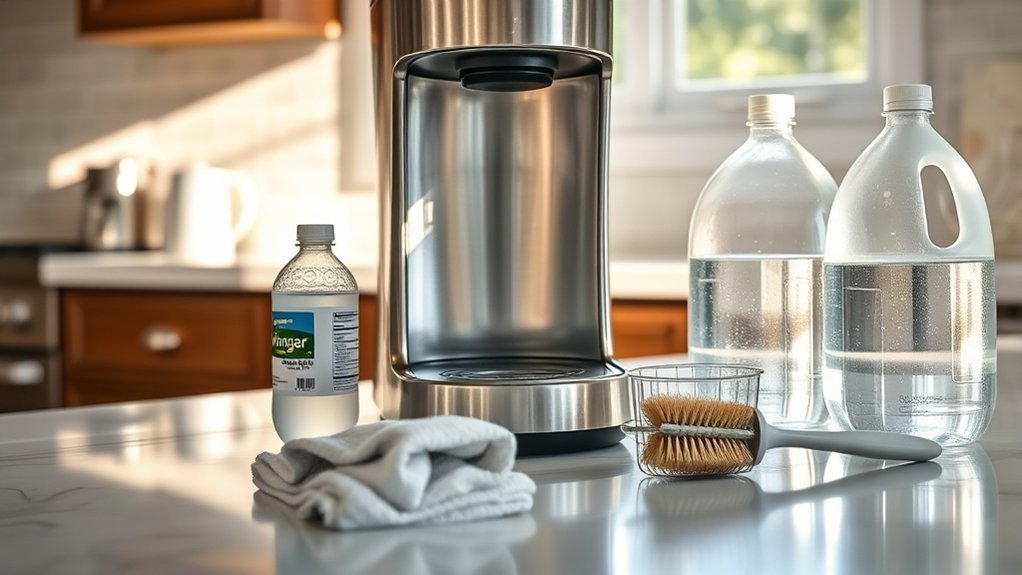
CLR can remove mineral scale from some standard automatic drip coffee makers, but it is not safe or approved for every machine. Before pouring any cleaner into the reservoir, check your coffee maker’s manual and CLR’s current coffee-maker-specific instructions. If your brewer is not clearly compatible, use the manufacturer’s recommended descaler instead.
Quick Answer
Use CLR only in a compatible standard automatic drip coffee maker. Mix one part standard CLR Calcium, Lime & Rust Remover with eight parts water, run one complete brew cycle, discard the solution, then run at least two complete cycles of clear cold water. Never use it in an excluded machine or mix it with another cleaner.
Key Takeaways
- Check the brewer manual before using CLR; approval for one drip maker does not mean it is safe for another.
- Use CLR’s coffee-maker-specific 1:8 dilution, not the product’s general surface-cleaning dilution.
- CLR says not to use this method in espresso machines or coffee makers that hold water permanently.
- CLR does not recommend its Calcium, Lime & Rust Remover for Gevalia, Keurig, or Cuisinart coffee makers.
- Run at least two complete cold-water rinse cycles after the CLR cycle.
- Never mix CLR with bleach, vinegar, detergent, or another household cleaner.
- Wash coffee oils from removable parts with dish soap when permitted; descaling mineral deposits and washing coffee residue are separate jobs.
At a Glance
| Time Required | About 25–45 minutes, depending on brew-cycle length and whether extra rinses are needed |
| Difficulty | Easy, once compatibility has been confirmed |
| Tools Needed | Measuring cup, protective gloves, eye protection if splashing is possible, carafe, clean cold water, and dish soap for removable parts |
| Cost | The amount of standard CLR needed for one compatible brew cycle, plus clean water |
Warning: Do not use CLR in an espresso machine, a brewer that holds water permanently, or a machine whose manual prohibits it. CLR also says its Calcium, Lime & Rust Remover is not recommended for Gevalia, Keurig, or Cuisinart coffee makers. Never mix CLR with bleach, vinegar, detergent, or another household cleaner. Work in a well-ventilated area, wear protective gloves, use eye protection when splashing is possible, and keep the product away from children, pets, coffee, and food.
Before Using CLR, Confirm That Your Coffee Maker Is Compatible
The most important step happens before you measure the solution. Read your brewer’s cleaning or descaling section and confirm that the manufacturer allows a compatible descaling method. If the manual specifically requires a different descaler or does not give you enough information to establish compatibility with CLR, use the manufacturer-approved product instead.
The current CLR coffee-maker instructions apply to regular automatic drip coffee makers. CLR says not to use the product in:
- Espresso machines
- Coffee makers that hold water permanently
- Gevalia coffee makers
- Keurig coffee makers
- Cuisinart coffee makers
- Any machine whose manual requires an incompatible or different descaling process
CLR also lists material restrictions for surfaces such as aluminum, copper, brass, galvanized metal, natural stone, and painted, coated, or sealed finishes. Because some internal brewer materials are hidden from view, the model manual—not guesswork—should determine whether the cleaner is suitable.
Use the Coffee-Maker-Specific CLR Directions
CLR’s normal hard-surface cleaning directions are not the same as its coffee-maker procedure. General surface cleaning may use a stronger dilution, while the dedicated coffee-maker directions call for one part CLR to eight parts water. Do not substitute the generic surface-cleaning concentration for the 1:8 coffee-maker mixture.
Note: These instructions refer to standard CLR Calcium, Lime & Rust Remover used according to CLR’s coffee-maker guidance. Do not assume that CLR 2X, a spray formula, an industrial product, or another CLR formula uses the same dilution or is approved for your brewer. Check that formula’s directions and your coffee-maker manual first.
If CLR Splashes on Your Skin or Eyes
The CLR Calcium, Lime & Rust Remover Safety Data Sheet identifies skin and eye irritation hazards. If the standard product gets on your skin, wash the area thoroughly with soap and water. If it gets in your eyes, rinse cautiously with water for several minutes, remove contact lenses if they are easy to remove, and continue rinsing. Seek medical advice if irritation persists, and follow the current product label and SDS for exposure instructions.
Signs Your Coffee Maker Needs Cleaning
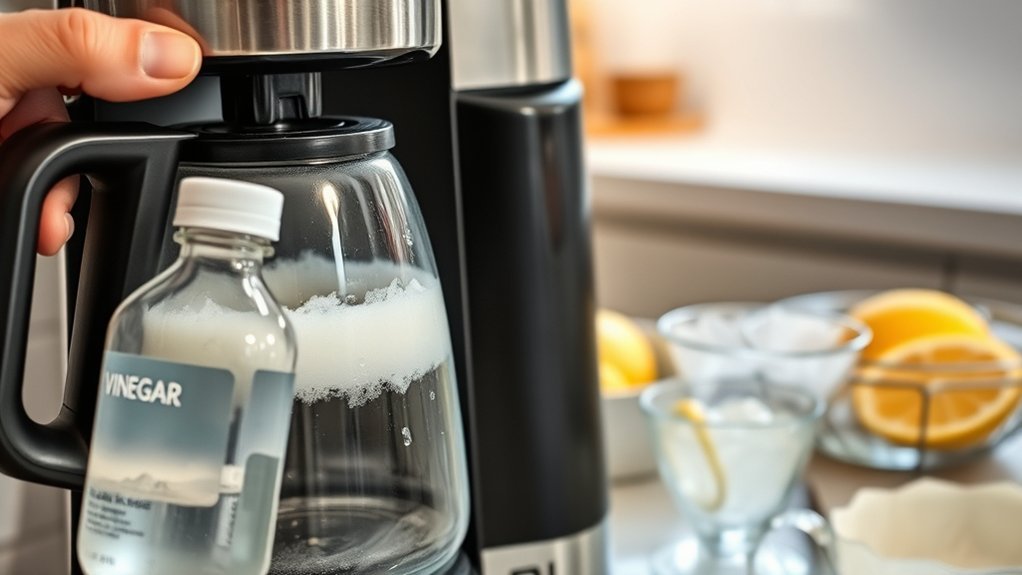
A change in brewing performance can indicate scale, coffee residue, or another maintenance problem. Common signs include:
- A noticeably slower brew cycle
- Sputtering, uneven water flow, or unusual brewing sounds
- Visible white or chalky deposits near water-contact areas
- Less water reaching the carafe than expected
- A manufacturer descaling alert
- Stale, bitter, or unusual coffee flavor
Hard-water scale can restrict water flow and interfere with brewer performance, while off flavors may also come from coffee oils on the basket, lid, reusable filter, or carafe.
An error message is not proof that scale is the cause. Check the manual before running a chemical cleaner because a blocked valve, damaged pump, misplaced filter, clogged water path, or electrical fault may require different service.
What Causes Mineral Buildup in Your Coffee Maker?
Mineral scale forms mainly when water containing dissolved calcium and magnesium is repeatedly heated or evaporated. The U.S. Geological Survey’s water-hardness guidance explains that hard water can leave solid mineral deposits in household equipment.
Hard Water Minerals
The harder your water is, the faster scale may form. Deposits can coat internal tubing and heated surfaces, restrict water flow, lengthen brewing time, and interfere with normal brewer performance.
Water hardness is commonly expressed as milligrams per liter of calcium carbonate:
- Soft: 0–60 mg/L
- Moderately hard: 61–120 mg/L
- Hard: 121–180 mg/L
- Very hard: More than 180 mg/L
Your local water utility may publish a hardness report. Private-well users can have their water tested when the hardness level is unknown.
Infrequent Cleaning Habits
Scale thickens gradually when descaling is delayed. The correct interval depends on the brewer, water hardness, water-filter system, and frequency of use. Follow the model manual rather than assuming every machine needs the same one-, three-, or six-month schedule.
Coffee Oil Accumulation
Coffee oils do not create hard-water scale. They are a separate residue left by brewed coffee and grounds. Oils commonly collect on the brew basket, showerhead, carafe, lid, and reusable filter, where they can become stale and affect flavor.
Wash removable coffee-contact parts with warm water and mild dish soap if the manual permits it. Do not pour dish soap into the internal water system or combine it with CLR.
How to Effectively Clean Your Coffee Maker Using CLR
Proceed only after confirming that your brewer is a compatible regular automatic drip coffee maker and that its manufacturer does not prohibit the method.
- Empty the brewer. Remove all coffee grounds, paper filters, pods, and coffee from the carafe.
- Handle the water filter as directed. If the manual says to remove a charcoal or carbon filter before descaling, remove it. Do not guess, because some filters are permanent and others require replacement.
- Wash removable parts separately. Unplug the cooled machine and wash the basket, carafe, and lid with warm water and mild dish soap when allowed. Rinse them and reinstall the parts needed for brewing.
- Prepare the work area. Work in a well-ventilated location where splashes can be rinsed away promptly. Keep food, beverages, children, pets, and other cleaning products away.
- Put on protective equipment. Wear protective gloves. Use eye protection when there is a reasonable chance of splashing.
- Prepare a 1:8 solution. Mix one part standard CLR Calcium, Lime & Rust Remover with eight parts clean water. Do not use CLR’s stronger general surface-cleaning dilution for this procedure.
- Run one complete brew cycle. Pour only enough diluted solution into the reservoir for the machine’s normal cycle without exceeding its maximum-fill line, then operate the machine as if brewing coffee, without grounds.
- Discard the used solution. Do not reuse it, leave it in the carafe, or allow anyone to mistake it for a beverage.
- Rinse with cold water. Fill the brewer with clear cold water and run two complete cycles, discarding each pot.
- Run extra rinse cycles when needed. Continue with plain cold water if you notice chemical odor, foam, unusual discoloration, or another reason to suspect cleaner remains.
- Reinstall or replace the water filter. Follow the brewer manual before brewing coffee again.
Pro Tip: Place a temporary note on the machine and carafe while descaling so nobody accidentally drinks the solution or starts another brew cycle.
Preparing Your CLR Solution for Coffee Maker Cleaning
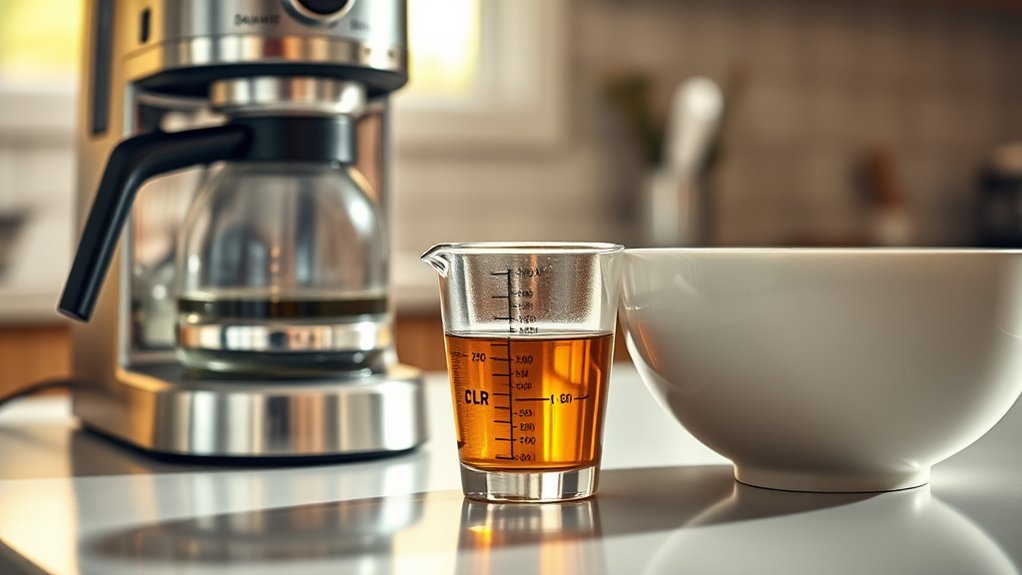
The coffee-maker ratio is one part CLR to eight parts water by volume. CLR gives 1 cup of product plus 8 cups of water as an example for a regular 10–12-cup automatic drip coffee maker.
A mixture of ¼ cup CLR and 2 cups water also has a 1:8 ratio, but its total volume is only 2¼ cups. It may not be enough for a normal cycle in a larger machine. Prepare enough diluted solution for the brewer’s approved normal cycle without exceeding its maximum-fill line.
| CLR | Water | Total Solution |
|---|---|---|
| ¼ cup | 2 cups | 2¼ cups |
| ½ cup | 4 cups | 4½ cups |
| 1 cup | 8 cups | 9 cups |
The table illustrates the 1:8 dilution math only. It does not establish that CLR is compatible with a particular brewer size or design. CLR’s published coffee-maker guidance is aimed at regular automatic drip machines, so do not use the table to improvise a procedure for an espresso machine, single-serve system, permanent-reservoir brewer, or another specialty machine.
Measure the cleaner and water in a clean utility container that will not be confused with a drinking container. Do not add vinegar, bleach, soap, descaling powder, or any other chemical.
Running the CLR Solution: Step-by-Step
Pour the correctly diluted solution into the empty reservoir without going above the brewer’s maximum-fill line. Place the empty carafe correctly and start one normal complete brew cycle. Allow the cycle to finish unless the machine leaks, overheats, produces an error, or behaves abnormally.
When the cycle ends, carefully discard the liquid. Fill the reservoir with clear cold water and run a complete cycle. Discard that water, refill the reservoir, and run a second complete cold-water cycle.
CLR’s current written coffee-maker instructions call for two full cold-water rinse cycles. If chemical odor, foam, unusual color, or another concern remains afterward, continue running complete cycles with plain cold water. Never rely on tasting rinse water to decide whether the machine is fully rinsed.
How to Know If Your Coffee Maker Is Cleaning Properly
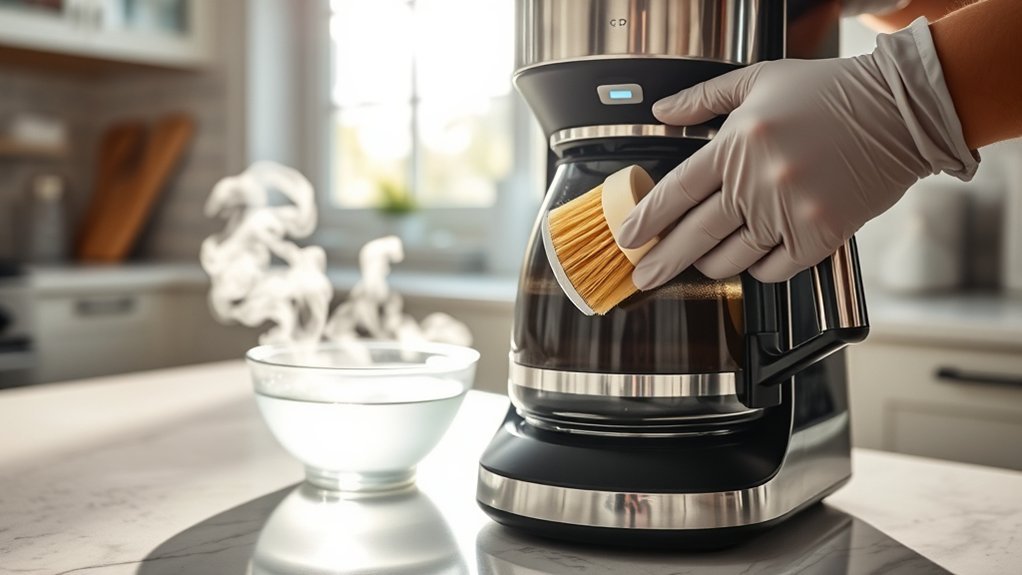
A successful descaling cycle should be followed by normal water flow and fully rinsed internal passages. Compare the machine’s performance with its behavior before cleaning.
Visual Inspection of Brew
During the plain-water rinse cycles, look for:
- Steady water flow rather than repeated sputtering
- A brew time closer to the machine’s normal range
- Clear water without foam or unusual discoloration
- No new leaks around the reservoir, basket, or carafe
- The expected amount of water reaching the carafe
If loosened mineral particles appear during an early rinse, continue running plain water until the rinse remains clear. Do not automatically repeat the CLR treatment simply because particles appear in the first rinse.
Taste Test Evaluation
Do not taste rinse water. First complete the required water cycles and confirm that the cooled water and machine have no chemical smell.
After the system is fully rinsed, brew a normal pot of coffee. A cleaner machine may produce more consistent water flow and cleaner flavor, but taste alone cannot prove that every internal deposit has been removed. Persistent bitterness may come from stale beans, grind size, brewing temperature, or coffee oils on removable parts.
The Importance of Thoroughly Rinsing Your Coffee Maker
Rinsing removes diluted cleaner and loosened scale from the water path. Skipping or shortening this step can leave an unpleasant smell or flavor and may expose the next beverage to cleaning residue.
- Run at least two complete cycles with clear cold water.
- Discard all water from each cycle.
- Continue rinsing if anything smells or looks unusual.
- Do not add coffee until the rinsing process is complete.
- Clean any splashes from the counter, carafe exterior, and surrounding surfaces.
How to Test for Residue After Cleaning
Use observation and smell rather than tasting rinse water. Let a small sample of the final rinse water cool, then inspect it in a clean glass.
| Check | Acceptable Result | If the Result Is Abnormal |
|---|---|---|
| Appearance | Clear, without foam or unusual color | Run another complete cold-water cycle |
| Odor | No chemical smell after the water cools | Continue rinsing and do not brew coffee |
| Flow | Normal, steady output | Check the manual or seek service if flow remains restricted |
If a chemical smell continues after several complete rinses, stop using the machine and contact the brewer manufacturer or CLR for product-specific guidance.
Why Regular Cleaning Improves Your Coffee’s Flavor
Scale and coffee residue affect a brewer in different ways. Mineral deposits may slow water flow or interfere with heating and normal brewer performance, while stale coffee oils can add bitter or rancid flavors.
A complete maintenance routine therefore includes both:
- Descaling: Removing mineral deposits with the product and procedure approved for the machine
- Routine washing: Cleaning removable coffee-contact parts with warm water and mild dish soap when permitted
Descaling should not be described as sanitizing. Clean and dry removable parts regularly, empty standing water when the manual recommends it, and follow the manufacturer’s hygiene instructions.
Tips for Preventing Future Mineral Buildup
Use Filtered Water
Filtered water may reduce scale when the filter actually lowers hardness minerals, but not every household filter softens water. Check the filter specifications and use the type of water allowed by your coffee-maker manual.
Do not assume distilled water is suitable for every brewer. Some coffee-maker manufacturers specifically advise against distilled water in certain models. Follow your own machine’s water requirements rather than applying one water recommendation to every brewer.
Regular Cleaning Schedule
Set a schedule based on the model manual, water hardness, and brewing frequency. Manufacturer recommendations vary. For example, Mr. Coffee advises cleaning certain coffee makers every 40–80 brews, while Keurig recommends descaling its brewers about every three to six months with its approved process.
The Keurig interval is only an example of how maintenance schedules differ. It is not permission to use CLR in a Keurig. CLR specifically says its Calcium, Lime & Rust Remover is not recommended for Keurig coffee makers.
Descale Every Few Months
A calendar reminder can help, but “every few months” is only a starting point. Descale sooner when:
- Your manual’s descale light appears
- Water flow slows noticeably
- Your water is hard or very hard
- You brew several pots each day
- The manufacturer specifies a shorter interval
Descale less often only when that schedule remains consistent with the brewer manufacturer’s guidance and the machine shows no signs that earlier maintenance is needed. Never compensate for delayed maintenance by making the CLR solution stronger.
Troubleshooting After CLR Descaling
A Chemical Smell Remains
Do not brew coffee or taste the water. Run additional complete cycles with clear cold water. If the smell remains after several cycles, stop using the machine and contact the brewer manufacturer or CLR.
The Coffee Maker Stops Mid-Cycle
Turn the machine off and follow the model manual. Allow it to cool before checking the reservoir, basket, carafe position, or any visible blockage. Do not repeatedly add CLR or force the machine to run.
Water Flow Is Still Slow
Heavy mineral deposits may not clear completely in one treatment, but a second CLR cycle is appropriate only when CLR’s instructions and the brewer manual allow it. Persistent slow flow can also indicate a failing pump, blocked valve, damaged heating system, or another internal problem that requires service.
Dark or Oily Residue Remains
Dark residue is more likely to be coffee oil or grounds than mineral scale. Wash the removable basket, lid, carafe, reusable filter, and other approved parts with warm water and mild dish soap. Do not put soap into the internal water reservoir unless the manual expressly instructs you to do so.
Frequently Asked Questions
Can I use vinegar instead of CLR?
Use vinegar only when your coffee-maker manual approves it and follow the manual’s dilution and rinse instructions. Do not mix vinegar with CLR or run the two products together.
How often should I descale my coffee maker?
Follow your model manual. The correct interval depends on water hardness, brewing frequency, filtration, and brewer design. A descale alert, slower flow, or visible scale may indicate that service is due.
Can I use CLR in a Keurig or Cuisinart coffee maker?
CLR states that its Calcium, Lime & Rust Remover is not recommended for Keurig or Cuisinart coffee makers. Use the cleaning product and procedure approved by your brewer manufacturer.
Can I use CLR in an espresso machine?
No. CLR’s coffee-maker instructions say not to use Calcium, Lime & Rust Remover in espresso machines. Follow the espresso-machine manufacturer’s descaling procedure.
Can I use CLR in a brewer that keeps water inside?
No. CLR says not to use the product in coffee makers that hold water permanently because the solution may be difficult to flush completely from the internal system.
Is mineral buildup harmful to health?
Water hardness itself is generally considered a nuisance rather than a health concern. In a coffee maker, scale is mainly a maintenance problem that can restrict flow and interfere with normal performance. Hygiene issues should be addressed separately through regular washing and drying of approved removable parts.
Does hard water affect coffee taste?
Water mineral content can influence coffee extraction and flavor, while accumulated scale may interfere with water flow and brewer performance. Filtered water that meets the brewer manufacturer’s requirements may reduce buildup and help produce more consistent results.
What should I do if I still smell CLR after rinsing?
Do not taste the water or brew coffee. Run additional complete cold-water cycles. Stop using the machine and contact the manufacturer or CLR if the odor does not disappear.
Can I use CLR 2X or another CLR formula in my coffee maker?
Do not assume that another CLR formula uses the same coffee-maker instructions. Use only a formula whose own current directions are compatible with coffee-maker use and whose use is also permitted by your brewer manufacturer. Never transfer the standard 1:8 procedure to a stronger or different product unless its directions specifically support it.
What if my coffee-maker manual does not mention CLR?
Do not treat silence as approval. If the manual does not give you enough information to confirm compatibility, use the manufacturer-recommended descaler or contact the brewer manufacturer for guidance.
Can I use the 1:8 ratio in a smaller or single-serve brewer?
Do not use the ratio alone to decide that a smaller or specialty brewer is compatible. CLR’s published coffee-maker procedure is intended for regular automatic drip machines. Check the instructions for your exact brewer before putting CLR into its water system.
Conclusion
CLR can be an effective mineral-scale remover in a compatible standard automatic drip coffee maker, but compatibility comes first. Confirm the brewer manual, follow CLR’s coffee-maker-specific 1:8 dilution rather than its general surface-cleaning directions, keep CLR separate from every other cleaner, and complete at least two full cold-water rinse cycles.
When CLR is prohibited or compatibility cannot be confirmed, choose the manufacturer-approved descaler. Wash coffee oils from removable parts separately, follow the brewer’s maintenance schedule, work with appropriate safety precautions, and never use taste as the first test for cleaning residue.
Sources
- CLR Brands: Coffee Maker Cleaning Instructions — 1:8 dilution, two rinse cycles, machine exclusions, and compatibility guidance
- CLR Calcium, Lime & Rust Remover Product Information — general product precautions, restricted materials, ventilation, and chemical-mixing warnings
- CLR Calcium, Lime & Rust Remover Safety Data Sheet — skin and eye hazards, gloves, splash protection, and exposure precautions
- U.S. Geological Survey: Hardness of Water — calcium, magnesium, hardness classifications, and scale formation
- Mr. Coffee Cleaning Guidance — example of a manufacturer-specific cleaning interval
- Keurig Descaling Guidance — example of a brand-specific approved descaling process and schedule