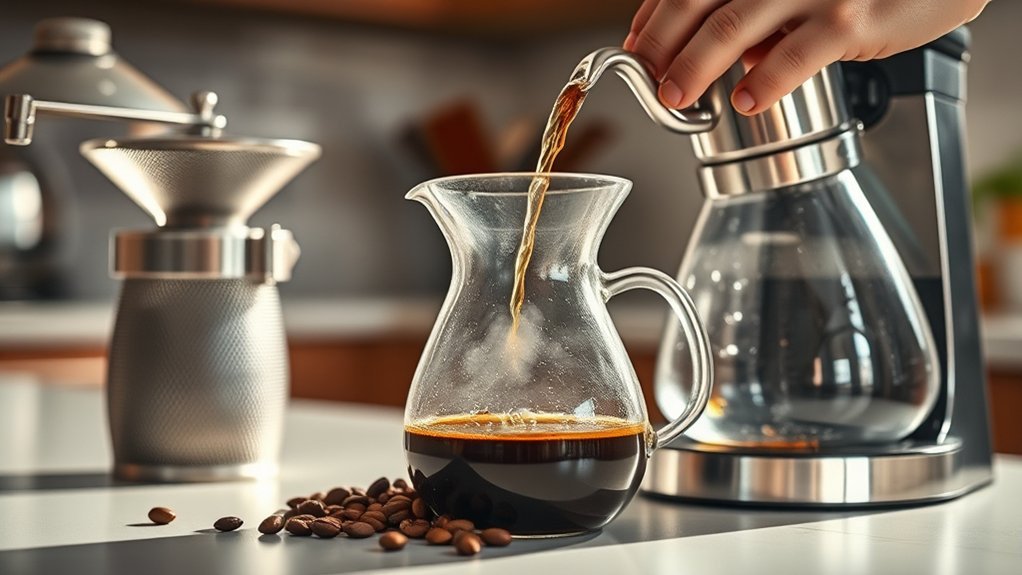
Setting the right coffee brew time is less about finding one perfect number and more about matching contact time to your brewing method. Espresso, automatic drip, pour-over, French press, and cold brew move water through coffee in different ways. Start with a proven range, measure the recipe, taste the result, and adjust one variable at a time.
Quick Answer
Start around 20–30 seconds for espresso, 2–4 minutes for pour-over, 4 minutes for French press, and about 5 minutes of contact time for automatic drip. For full-immersion cold brew, about 12 hours is a conventional starting point, although some recipes may taste fully developed after roughly 8 hours.
Key Takeaways
- Choose a target time for your brewing method instead of using one brew-time range for all black coffee.
- For espresso, a 1:2 beverage ratio in about 20–30 seconds is a useful starting point, but beverage weight and taste matter as much as the timer.
- For espresso and pour-over, a finer grind usually increases resistance and can slow the flow; a coarser grind usually speeds it up.
- For French press and cold brew, grind size changes extraction and filtration but does not control flow during the steep in the same way.
- Treat sourness, bitterness, dryness, and weakness as troubleshooting clues rather than proof of one extraction problem.
- Change one variable at a time and record the dose, water, beverage yield, grind setting, and brew time.
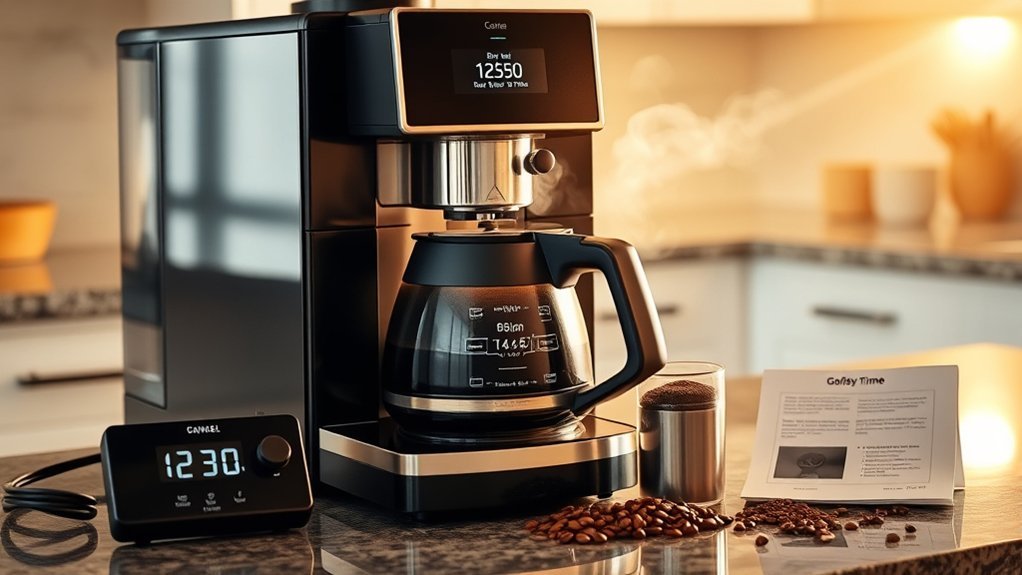
- Most programmable drip machines let you schedule when brewing starts; they do not let you directly choose the coffee-water contact time.
At a Glance
| Time Required | About 5–10 minutes to test one hot-brew recipe; roughly 8–12 hours for a full-immersion cold-brew trial |
| Difficulty | Easy to moderate |
| Tools Needed | Coffee maker or brewer, timer, digital scale, grinder, and optional thermometer |
| Cost | No added cost if you already have a timer and scale; optional equipment costs vary |
Ideal Brew Time: How Long Should Coffee Brew?
The ideal brew time depends on how water and coffee interact in your brewer. Pressure-driven espresso takes seconds, while full-immersion cold brew takes hours. Even within one method, brewer design, batch size, filter type, coffee dose, grind distribution, and technique can change the final time.
| Method | Starting Brew Time | Starting Grind | Useful Starting Ratio |
|---|---|---|---|
| Espresso | 20–30 seconds | Fine | 1:2 beverage ratio, such as 18 g in and 36 g out |
| Pour-over | 2–4 minutes, including the bloom | Medium | About 1:13 to 1:16 |
| French press | About 4 minutes | Coarse | About 1:10 to 1:16 |
| Automatic drip | Approximately 5 minutes of coffee-water contact time | Medium | About 60 g per liter, or roughly 1:16.7 |
| Cold brew concentrate | About 12 hours conventionally; taste from around 8 hours when testing shorter recipes | Coarse | About 1:4 to 1:5, then dilute to taste |
These ranges are starting points rather than pass-or-fail rules. The National Coffee Association’s espresso guide recommends a 1:2 beverage ratio and 20–30 seconds of contact time. Its current guides give different starting ranges for automatic drip, pour-over, French press, and cold brew.
Note: “Black coffee” is not a brewing method. A cup may be served black whether it was made by drip, pour-over, French press, espresso, or another process. Use the timing range for the brewer that produced it.
What Counts as Brew Time?
Brew time usually means the period when water is actively extracting soluble material from the coffee, but the exact start and end points depend on the method. This is why the total time shown by a machine is not always the same as coffee-water contact time.
- Espresso: Start timing when the pump or brew cycle begins. If the machine uses programmed pre-infusion, count it unless your recipe specifically defines shot time another way.
- Pour-over: Start when the bloom water first touches the grounds. Stop when the planned water has drained through the coffee bed.
- French press: Start when water first contacts the grounds. The main steep commonly lasts about four minutes before you press and separate the beverage.
- Automatic drip: The machine controls water delivery. The full cycle shown on a clock may be longer than the approximate contact time for any one portion of the coffee bed.
- Cold brew: Start when the grounds are fully wetted and end when you strain or otherwise separate the grounds from the beverage.
Use the same timing definition every time you test a recipe. Changing where you start the timer makes comparisons less useful.
Why Coffee Extraction Matters
Extraction is the process of dissolving soluble compounds from ground coffee into water. Brew time affects that process, but it works together with grind size, water temperature, coffee-to-water ratio, agitation, and brewer design.
Two cups can finish in the same amount of time and still taste very different. One may use a different ratio, have an uneven grind, or suffer from channeling, where water finds easier paths through part of the coffee bed. That is why time should be evaluated alongside taste, dose, final beverage weight, and repeatability.
| Extraction Clue | Possible Flavor | First Adjustment to Test |
|---|---|---|
| Espresso or pour-over flows much faster than expected | May taste thin, weak, sharply sour, or poorly developed | Try a slightly finer grind while holding dose and ratio steady |
| Espresso or pour-over flows much slower than expected | May taste dry, harsh, heavy, or excessively bitter | Try a slightly coarser grind and check for excess fines or blockage |
| Time looks reasonable but coffee tastes weak | Watery or low in intensity | Check the coffee-to-water ratio before chasing a different time |
| Time is on target but flavor is uneven | Conflicting sour, bitter, thin, or harsh notes | Improve grind consistency and water distribution |
| Results change from brew to brew | Unpredictable flavor and strength | Weigh ingredients and repeat the same technique before making another adjustment |
Do not treat one flavor word as a laboratory measurement of extraction. Research from the UC Davis coffee research group shows that brew strength, extraction yield, and roast level interact with bitterness, sourness, sweetness, thickness, and other sensory qualities in more complex ways than a simple “under-extracted versus over-extracted” rule suggests.
A timer tells you how long brewing took. It does not tell you, by itself, whether the coffee was evenly or appropriately extracted.
Can You Set Brew Time on a Coffee Maker?
Whether you can directly control brew time depends on the machine or brewer.
Automatic Drip Machines
Most automatic drip coffee makers control their heating and water-delivery cycle internally. A programmable clock normally determines when the machine starts, not how long water remains in contact with the grounds.
If the cycle is consistently too fast or too slow, check the manufacturer’s instructions first. You may be able to influence the result indirectly through grind size, coffee dose, batch size, filter placement, and cleaning. Mineral buildup can restrict water flow, so descale the machine according to its manual.
Also remember that “approximately five minutes” is a useful contact-time reference, not a promise that every machine’s complete start-to-finish cycle must end at exactly five minutes. Capacity and brewer design matter.
Semi-Automatic Espresso Machines
A semi-automatic espresso machine lets you start and stop the pump. Time the shot from pump or brew-cycle activation, but also place the cup on a scale and stop at the target beverage weight. For example, an 18-gram dose may begin with a target near 36 grams of espresso.
Some machines include programmable volumetric buttons or adjustable pre-infusion. Follow the model’s manual because the programming process and timing convention vary.
Pour-Over, French Press, and Cold Brew
Manual methods give you more direct control. For pour-over, pouring rate, grind, filter, and agitation influence the drawdown. For French press and full-immersion cold brew, you decide how long the grounds remain immersed before separating them from the liquid.
Capsule and Single-Serve Machines
Many capsule machines use preset water volumes and flow programs. Choose the correct cup-size setting and compatible capsule. Do not attempt to alter internal programming unless the manufacturer provides instructions for doing so.
Key Factors Influencing Brew Time and Extraction Quality
Grind Size and Water Flow
Finer particles provide more surface area for extraction. In immersion brewing, that can increase how quickly soluble material enters the water. In espresso and pour-over, fine particles also create more resistance inside the coffee bed, which often lengthens the shot or drawdown.
Coarser grounds usually allow water to pass through a coffee bed more quickly. They also expose less total surface area for a given mass of coffee. This is one reason espresso normally uses a fine grind while French press and cold brew commonly start coarse.
Coffee-to-Water Ratio
The ratio strongly affects beverage strength and can also affect flow when changing the amount of coffee in a basket. A heavily filled espresso basket or drip filter creates different hydraulic conditions from a lighter dose.
For filter-style brewing, Specialty Coffee Association material describes 60 grams of coffee per liter of water as a common brewing-ratio expression. That equals roughly one part coffee to 16.7 parts water.
Espresso ratios describe the finished beverage rather than all of the water entering the machine. A 1:2 espresso beverage ratio means 18 grams of dry coffee produces about 36 grams of espresso.
Water Temperature
Hotter water generally increases extraction rate, while cooler water usually requires other variables—such as time or grind—to compensate. Temperature should not be judged by itself, however.
UC Davis researchers compared drip brews prepared at 87°C, 90°C, and 93°C. When the brews were matched for final strength and extraction yield by adjusting other variables, brew temperature within that tested range had little appreciable effect on the sensory profile. The finding does not mean temperature never matters; it shows that temperature works together with the rest of the recipe.
For pour-over and French press, approximately 93°C, plus or minus 3°C, is a useful starting point supported by current National Coffee Association guidance. Automatic machines control heating internally, so use the manufacturer’s settings and avoid unsafe modifications.
Distribution, Tamping, and Agitation
Unevenly distributed espresso grounds can create channels that let water bypass part of the puck. Distribute the grounds evenly and apply a level, repeatable tamp. You do not need to finish with a spinning or polishing motion.
For pour-over, controlled pouring and gentle agitation can help saturate the coffee evenly. Too much agitation may move fine particles toward the filter and slow drainage.
Filter, Basket, and Batch Size
Paper thickness, basket shape, filter placement, and coffee dose all influence flow. A folded or collapsed filter can restrict drainage. An overfilled basket may overflow or stall, while a very small batch in a large brewer may behave differently from the batch size the machine was designed to brew.
Pro Tip: Keep a simple brew log. Record coffee dose, water amount, beverage yield, grind setting, water temperature when relevant, brew time, and a one-line taste note. Change only one main variable before the next test.
Step-by-Step: Dial In Your Brew Time
- Choose the correct method target. Start with the timing range for espresso, drip, pour-over, French press, or cold brew.
- Weigh the coffee and water. Measuring by weight is more repeatable than using scoops or judging the water level by eye.
- Select the starting grind. Begin fine for espresso, medium for drip or pour-over, and coarse for French press or cold brew.
- Start the timer consistently. For espresso, start with pump or brew-cycle activation. For pour-over, start with the first bloom water. For immersion methods, start when water and grounds meet.
- Measure the result. Record the final beverage weight or water used, total time, and taste.
- Identify the main problem. For espresso and pour-over, unexpectedly fast or slow flow may point toward a grind adjustment. For immersion methods, focus more on steep time, ratio, grind, and filtration.
- Change one variable. Make a small adjustment while keeping the other major variables steady.
- Repeat and compare. Stop adjusting when the coffee tastes balanced and the recipe is easy to reproduce.
Warning: Coffee makers, kettles, steam wands, carafes, and brewed coffee can cause burns. Keep hands clear of hot water and steam, unplug equipment before cleaning when instructed, and follow the manufacturer’s safety directions. Never place fingers near grinder burrs or blades.
The Role of Grind Size in Coffee Extraction
Grind size is often one of the easiest variables to change because it affects exposed surface area and, in flow-through methods, resistance to water.
Optimal Grind Size
There is no universal grinder number because burr geometry, calibration, and numbering systems differ. Start with the broad category recommended for the brewing method:
- Espresso: Fine, roughly similar to fine table salt
- Automatic drip: Medium
- Pour-over: Medium, then adjust for the brewer and filter
- French press: Coarse
- Cold brew: Coarse
A burr grinder generally produces a more consistent particle-size distribution than a blade grinder. Greater consistency makes it easier to repeat a recipe and reduces the mix of very fine particles and unusually large pieces.
Impact on Extraction Time
For espresso and pour-over, try grinding slightly finer when water passes through much faster than your established recipe. Grind coarser when the shot or drawdown becomes unusually slow, especially if the filter or basket is not blocked.
For French press and cold brew, grind changes do not control drainage during the steep because the coffee remains immersed. A finer grind can increase extraction rate but may also increase sediment and make filtration more difficult.
Make small adjustments. Large grinder changes can move an espresso or pour-over from fast flow to a stalled brew.
Adjusting Brew Time for Different Coffee Types
Each method needs a different adjustment strategy. Do not apply an espresso correction to drip coffee or a cold-brew correction to pour-over.
Espresso Extraction Adjustments
Begin with a consistent dose and a beverage ratio near 1:2. If 18 grams of coffee produces about 36 grams of espresso well before the 20–30-second starting range, try grinding slightly finer after confirming that the dose and puck preparation are consistent.
If the same yield takes much longer than your established target, try a slightly coarser grind. Use taste as part of the decision rather than assuming that every fast shot is automatically sour or every slow shot automatically bitter.
If the shot sprays, starts from only one side of the basket, or tastes strangely uneven, improve distribution and check that the tamp is level. Those signs can point to channeling rather than an overall grind setting that is simply too coarse or too fine.
Pour-Over and Drip Adjustments
For pour-over, count the bloom as part of the total two-to-four-minute contact-time range. The NCA suggests a bloom of roughly 30–45 seconds before continuing the main pour. If drawdown finishes much earlier than your normal recipe, try a slightly finer grind or a more controlled pour. If water remains above the coffee bed for unusually long, try a coarser grind and reduce excessive agitation.
Automatic drip machines usually have a largely fixed cycle. Start with a medium grind and the manufacturer’s recommended batch size. If brewing becomes noticeably slower over time, clean the basket and descale the machine according to the manual before changing the coffee recipe.
French Press Adjustments
Start with coarse grounds and about four minutes of immersion. If the coffee is weak, first check the coffee-to-water ratio. You can then test a modestly longer steep or a slightly finer grind while keeping the other variables stable.
If the coffee tastes unpleasantly harsh or heavy, test one change at a time: a slightly coarser grind, a shorter steep, or a different ratio. Pour the finished coffee into cups or another carafe after pressing rather than leaving it in prolonged contact with the grounds.
Cold Brew Timing Tips
For full-immersion cold brew, about 12 hours is a conventional starting point. The National Coffee Association uses approximately 12 hours in its standard method.
Shorter extraction can also work. A peer-reviewed Scientific Reports study published in August 2024 tested full-immersion coffee at 4°C, 22°C, and 92°C. Researchers found few statistically significant sensory changes after the eight-hour test point for the 4°C and 22°C brews, suggesting that some cold-brew recipes may not need the commonly assumed 12–24 hours. UC Davis summarized the findings in 2025.
That does not make eight hours a universal target. Roast level, brewing temperature, grind, ratio, and desired strength still matter. If you want to shorten your recipe, taste a sample around eight hours and compare it with the same recipe at 10 or 12 hours.
A 1:4 to 1:5 coffee-to-water ratio produces a strong concentrate in the NCA method. Dilute it with water or milk when serving. Ready-to-drink recipes use more water from the start, so identify whether a recipe makes concentrate or finished-strength coffee before comparing ratios.
Cold-Brew Safety: Use clean containers, clean filters, safe drinking water, and properly handled coffee. Keep the brewing container covered, strain the finished brew promptly, and store finished cold brew in a clean, sealed container in the refrigerator. Do not assume a long cold steep provides the same heat treatment as hot brewing.
When Brew Time Is Not the Problem
If your timer is close to the expected range but the coffee still tastes wrong, forcing the brew to run longer or shorter may make the recipe less consistent. Check the other variables first.
- Weak but normally timed: Check the coffee-to-water ratio and final beverage weight.
- Strong but normally timed: Use less coffee, more water, or an appropriate dilution rather than automatically changing the grind.
- Uneven espresso: Check distribution, basket dose, tamp level, and channeling.
- Slow drip machine: Check for mineral scale, a clogged outlet, or a collapsed filter.
- Inconsistent pour-over: Keep the pouring pattern, agitation, water amount, and filter preparation the same from brew to brew.
- Flat or unusual flavor despite a repeatable recipe: Check coffee freshness, water quality, and equipment cleanliness before changing brew time.
The goal is not to force every cup onto an exact number. The goal is to build a recipe in which time, dose, ratio, grind, and technique produce a repeatable result you enjoy.
Troubleshooting Common Brew Time Issues
| Problem | Likely Cause | What to Try |
|---|---|---|
| Espresso finishes much too quickly | Coarse grind, low dose, or uneven puck | Verify the dose and distribution, then try a finer grind if needed |
| Espresso barely flows | Very fine grind, excessive dose, or blocked basket | Check the basket and dose, then grind coarser if appropriate |
| Pour-over drains too quickly | Coarse grind, low resistance, or very fast pouring | Try a finer grind or slower, more controlled pour |
| Pour-over stalls | Fine grind, excess fines, filter restriction, or heavy agitation | Check the filter, grind coarser, and stir or swirl less |
| Drip machine has become slower | Mineral buildup, clogged outlet, or misplaced filter | Clean and descale according to the manufacturer’s manual |
| French press is weak after four minutes | Low dose, very coarse grind, cool water, or simply a lighter preferred extraction | Check the ratio first, then test a slightly finer grind or longer steep |
| Cold brew tastes harsh or too intense | Strong concentrate, long steep, fine grind, or insufficient dilution | Dilute a sample first; if needed, shorten the next steep or grind coarser |
| Time looks correct but flavor is poor | Ratio, water, temperature, coffee freshness, cleanliness, or uneven extraction | Check each variable separately instead of forcing a different brew time |
Consistent Brewing Practices for Better Flavor
Consistency makes troubleshooting possible. If the dose, water amount, tamp, pouring pattern, and starting temperature change every time, the timer cannot show which adjustment helped.
- Use a scale: Weigh the coffee and brewing water or finished beverage.
- Use the same timing point: Start the timer at the same moment for every test.
- Level the coffee bed: Distribute espresso evenly and gently level pour-over grounds before brewing.
- Keep equipment clean: Old coffee oils, blocked filters, and mineral deposits can affect both flavor and flow.
- Use consistent coffee: A different bean or roast may require a different grind setting and recipe.
- Record adjustments: Note what changed and whether the next cup improved.
Water quality also matters. Very hard water can leave mineral scale inside a machine, while unsuitable water chemistry can change how coffee tastes. Use safe drinking water and follow the brewer manufacturer’s water and descaling recommendations.
Frequently Asked Questions
How does water temperature affect brew time?
Hotter water generally increases extraction rate, while cooler water may need more time or another recipe adjustment. Temperature is only one variable. Grind, ratio, agitation, brewer design, brew strength, and extraction yield also matter, so do not judge a recipe from temperature alone.
Can I reuse coffee grounds for brewing?
You can pass water through used grounds again, but much of the readily extracted material has already entered the first brew. A second cup will normally be much weaker and may taste unbalanced. Use fresh grounds for normal coffee brewing.
What equipment is best for precise timing?
A digital scale with an integrated timer is convenient, but a kitchen scale and separate phone or kitchen timer work too. A burr grinder helps make grind changes more repeatable. A thermometer is useful for manual brewing when your kettle does not display water temperature.
How does altitude influence brewing time?
Water boils at a lower temperature as elevation increases. If that limits the water temperature available for a manual brew, you may need to experiment with grind or contact time. The effect depends on the brewer, so avoid assuming one fixed altitude correction works for every method.
Are there specific times for cold brew extraction?
About 12 hours is a common full-immersion starting point. Research published in 2024 found few sensory changes after an eight-hour test point in certain cold and room-temperature brews, so eight hours can be useful when testing a shorter recipe. Temperature, roast, grind, and ratio still affect the result.
Does a programmable coffee-maker timer change brew time?
Usually not. A programmable timer normally schedules when the brew cycle starts. The machine still controls heating and water delivery. Some advanced models offer separate strength, flow, pre-infusion, or temperature controls, so check the manual for your machine.
Should bloom or pre-infusion time count toward brew time?
Yes, when you use a recipe that measures total contact time. For pour-over, start timing when the bloom water first touches the coffee. For espresso, timing commonly starts when the pump or brew cycle activates, including programmed pre-infusion unless your machine or recipe specifically defines shot time differently.
Why does espresso taste wrong even when the shot time is correct?
Shot time is only one measurement. Dose, beverage yield, water temperature, coffee freshness, distribution, tamping, and channeling can all change flavor. Check the input and output weights and puck preparation before changing the grind simply because the flavor does not match the timer.
Is total machine cycle time the same as coffee contact time?
Not always. An automatic brewer may spend time heating water and delivering it in stages, so the full start-to-finish cycle can differ from the approximate amount of time water is contacting a particular portion of the coffee bed. Compare your machine with its manual rather than forcing the whole cycle to match one generic number.
Conclusion
Set coffee brew time by starting with the range for your method and then using taste, weight, flow, and repeatability to refine the recipe. Espresso commonly starts near 20–30 seconds, pour-over near 2–4 minutes, French press near 4 minutes, and automatic drip near 5 minutes of contact time. Full-immersion cold brew commonly starts around 12 hours, although testing from about eight hours can make sense for some recipes.
For espresso and pour-over, unusually fast flow may justify a finer grind and unusually slow flow may justify a coarser one. For French press and cold brew, adjust steep time, ratio, and grind without treating drainage speed as the main control. Most importantly, do not force a recipe to hit one exact number when ratio, water, equipment cleanliness, distribution, or coffee itself is the real issue.
A repeatable recipe that tastes good is more useful than a timer reading by itself.
Sources
- National Coffee Association: Brewing Guides — current method guidance for drip, espresso, pour-over, French press, and cold brew
- National Coffee Association: Espresso — 1:2 beverage ratio, fine grind, and 20–30-second starting time
- National Coffee Association: Cold Brew Coffee — coarse grind, 1:4 to 1:5 concentrate ratio, and approximately 12-hour conventional steep
- Specialty Coffee Association: Brewing Ratio and Water — 60 g/L filter-coffee brewing-ratio reference and the distinction between brewing ratio and espresso beverage ratio
- Batali et al., Scientific Reports — controlled drip-brew research comparing 87°C, 90°C, and 93°C at matched strength and extraction
- Liang et al., Scientific Reports — 2024 full-immersion research on brew time, temperature, roast, extraction dynamics, and shorter cold-brew timing