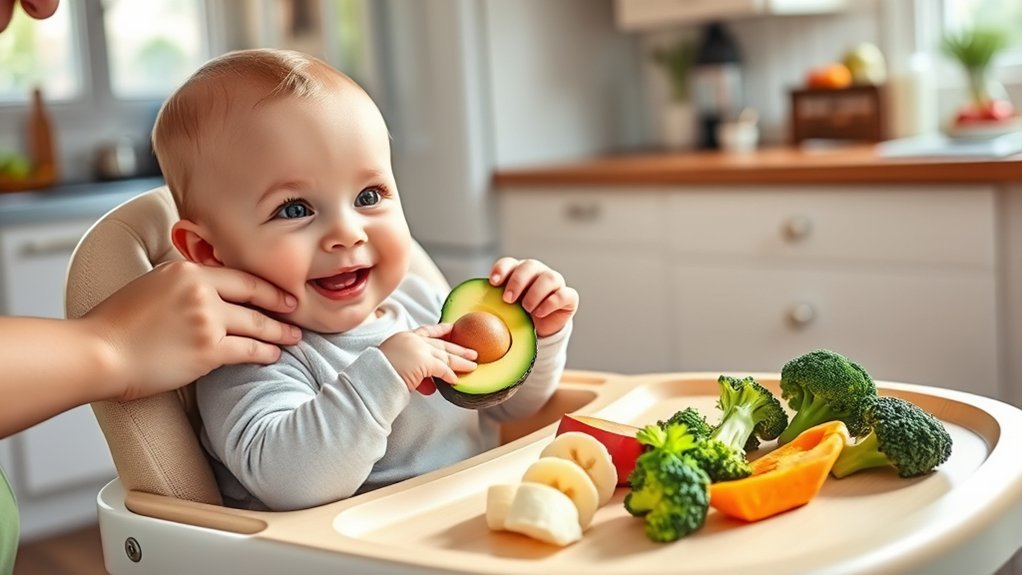
Baby-led weaning, often shortened to BLW, lets a developmentally ready baby bring soft finger foods to their own mouth instead of having every bite spoon-fed. You can use it on its own or combine it with responsive spoon-feeding. A safe start depends on readiness, close supervision, properly prepared foods, balanced nutrition, and continuing breast milk or iron-fortified infant formula throughout the first year.
Quick Answer
Start baby-led weaning at about 6 months only when your baby can sit upright with steady head and neck control, bring objects to their mouth, and swallow food instead of pushing it out. Seat them securely, offer soft graspable foods, include an iron-rich choice, supervise every bite, and continue breast milk or formula.
Key Takeaways
- Use developmental readiness, not age alone, to decide when your baby can begin self-feeding.
- Keep your baby upright and secured in a highchair, and supervise the entire meal.
- Offer foods that are soft enough to mash easily and shaped so your baby can grasp them.
- Include an iron-rich food regularly and continue breast milk or iron-fortified formula as the main nutrition through 12 months.
- Learn the difference between gagging and choking, take an infant first-aid course, and modify common choking hazards.
- Introduce allergens in safe forms once your baby is ready, unless your child’s clinician recommends a different plan.
At a Glance
| Time Required | About 5–15 minutes of preparation and a relaxed, fully supervised meal |
| Difficulty | Moderate because safe food preparation and constant supervision are essential |
| Tools Needed | Supportive highchair with harness, bib, washable mat, cup, and basic food-preparation tools |
| Cost | Usually low beyond a safe highchair; no special BLW kit is required |
Medical note: This guide provides general education, not individual medical advice. Ask your pediatrician or feeding specialist for guidance if your baby was born prematurely, has poor growth, severe eczema, a known food allergy, developmental delay, low muscle tone, or difficulty chewing or swallowing.
What Is Baby-Led Weaning?

Baby-led weaning is a way of introducing complementary foods in which your baby picks up suitable foods and feeds themselves. The word “weaning” can be confusing: starting solids does not mean that breast milk or formula should stop.
The current Dietary Guidelines for Americans state that babies may begin solid foods at about 6 months while breast milk or iron-fortified infant formula remains their main source of nutrition through 12 months.
Possible advantages of BLW include practice with hand-to-mouth coordination, exposure to different textures, participation in family meals, and opportunities to respond to hunger and fullness cues. However, BLW has not been proven to prevent obesity or to be better than responsive spoon-feeding for every baby.
You do not have to choose one method exclusively. A mixed approach can include safe finger foods, mashed foods, preloaded spoons, and responsive spoon-feeding. The goal is not strict adherence to a feeding label; it is safe, nutritious, developmentally appropriate eating.

Power your essentials anywhere with a 999Wh pure sine wave power station delivering up to 1000W continuous with 2000W surge. It supports fast charging via USB-C PD 60W and USB-A QC 18W, plus simultaneous output for multiple devices through AC, USB, wireless, and car/DC ports. Recharge using AC, car, or solar with a built-in MPPT controller and dual cooling fans, while the upgraded battery management system protects against surges, short circuits, and overheating.

A soft and comfortable cotton pad is placed on the child's abdomen to prevent the baby's abdomen from being caught by the harness.

Advanced Safety Toy Straps for Baby - Our baby toy strap is made of food-grade silicone, certified to pass a 15-pound tensile strength test. It is BPA-free, lead-free, phthalate-free, tasteless, and non-toxic. The set includes 4pcs fixed stroller accessories Leashes and 1pc bottle toy belt that you can choose from at will.
Signs Your Baby Is Ready for Baby-Led Weaning
Most babies become ready for complementary foods at about 6 months, but the calendar is only one part of the decision. According to the CDC’s solid-food readiness guidance, look for a group of developmental signs.
- Your baby can sit upright in a highchair with good head and neck control.
- Your baby brings toys or other objects to their mouth.
- Your baby reaches for or tries to grasp food.
- Your baby opens their mouth when food is offered.
- Your baby swallows food instead of automatically pushing it out with their tongue.
- Your baby can move food toward the back of their mouth to swallow.
Interest in your food by itself is not enough. A baby who cannot remain upright or control their head and neck is not ready to self-feed safely.
When to Get Professional Guidance First
Talk with your baby’s pediatrician, registered dietitian, occupational therapist, or feeding specialist before relying on BLW if your baby:
- Was born prematurely and has not reached the expected feeding milestones for their corrected age.
- Has poor weight gain or difficulty meeting calorie needs.
- Has a developmental, neurological, muscular, or structural condition that affects feeding.
- Coughs, chokes, turns blue, develops a wet or gurgly voice, or struggles to breathe during feeds.
- Has severe eczema, an egg allergy, another known food allergy, or a history of serious allergic reactions.
Create a Safe Eating Space
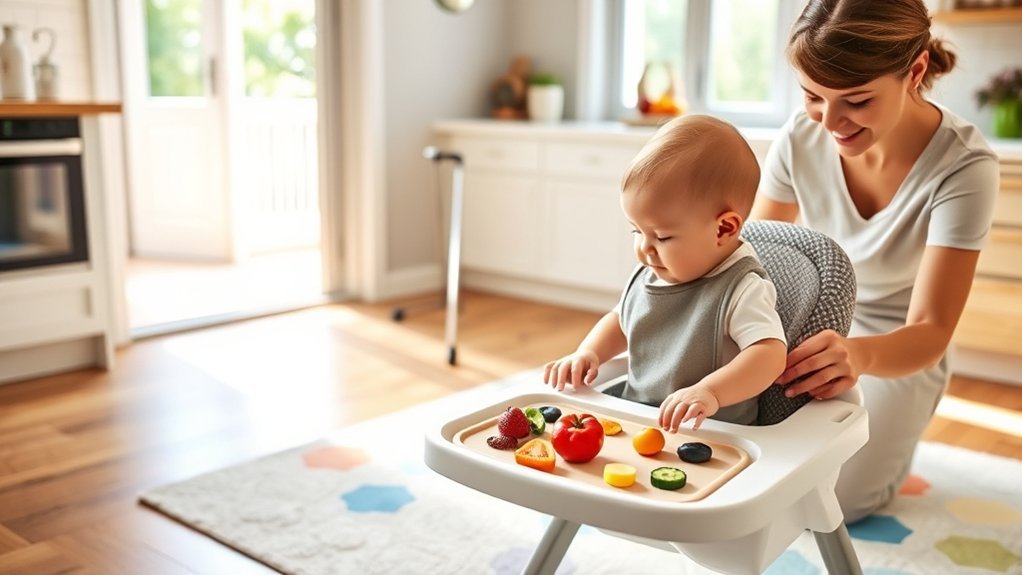
Use a stable highchair that keeps your baby upright. Fasten the harness every time, even when the chair has a tray. Your baby should not eat while reclining, crawling, walking, riding in a moving vehicle, or lying down.
- Place the highchair where you can see your baby’s face and reach them quickly.
- Remove toys, screens, and other distractions.
- Keep coins, batteries, toy parts, and other small objects out of reach.
- Use a washable mat or splat mat under the chair to reduce stress about mess.
- Eat with your baby when possible so they can watch safe chewing and family mealtime habits.
Pro Tip: Before serving a food, press it between your thumb and forefinger. For a beginner, it should flatten or break apart with gentle pressure. If you cannot mash it easily, cook it longer or choose a softer option.
Step-by-Step Guide to Starting Baby-Led Weaning
1. Confirm Your Baby Is Ready
Check for the full group of readiness signs rather than starting solely because your baby has reached a particular birthday. When you are unsure, ask your pediatrician at the six-month visit or before the first meal.
2. Choose a Low-Pressure Time
Begin when your baby is alert, comfortable, and not extremely hungry or tired. Early meals are practice. Your baby may touch, squeeze, lick, or drop more food than they swallow.
3. Seat Your Baby Upright
Secure your baby in a stable highchair and remain within arm’s reach. Do not place food in your baby’s mouth. Let them pick it up and control how quickly it enters their mouth.
4. Offer One or Two Soft Foods
Start with a small amount so the tray is not overwhelming. For an early palmar grasp, offer soft pieces long enough for part of the food to extend beyond your baby’s closed fist. As the pincer grasp develops, you can offer smaller soft pieces.
Easy starting choices include:
- Soft avocado wedges.
- Steamed broccoli with a soft stalk to hold.
- Very soft sweet-potato wedges.
- Ripe banana segments.
- Soft omelet strips made from fully cooked egg.
- Tender shredded meat pressed into a moist clump.
- Soft beans lightly mashed onto a preloaded spoon.
- Plain full-fat yogurt on a preloaded spoon.
5. Include an Iron-Rich Food Regularly
At about 6 months, babies need nutrient-dense complementary foods, including sources of iron and zinc. Try to include an iron-rich option frequently rather than serving only fruits and vegetables.
Suitable choices include tender meat, poultry, low-mercury fish with every bone removed, mashed beans or lentils, tofu, fully cooked egg, and iron-fortified infant cereal offered on a preloaded spoon.
6. Let Your Baby Control Intake
Offer the food and allow your baby to decide whether and how much to eat. Do not pressure, distract, trick, or force another bite. End the meal when your baby repeatedly turns away, closes their mouth, pushes food aside, or loses interest.
7. Continue Breast Milk or Formula
Solids complement milk feeding during the first year; they do not immediately replace it. Continue breastfeeding or offering iron-fortified infant formula according to your baby’s normal routine and your clinician’s advice.
How to Shape and Prepare Foods Safely
Food size and texture should change as your baby’s hand skills improve. A beginner usually grasps food with the whole hand, while an older baby may pick up small pieces between the thumb and forefinger.
For an Early Palmar Grasp
- Serve soft strips, wedges, florets, or larger pieces your baby can hold in a fist.
- Make pieces soft enough to mash with gentle finger pressure.
- Leave a safe “handle,” such as the soft stalk of cooked broccoli.
- Avoid loose chunks that are hard, rubbery, dry, or round.
As the Pincer Grasp Develops
- Offer smaller pieces of soft cooked vegetables, ripe fruit, pasta, beans, egg, or shredded meat.
- Continue modifying round and cylindrical foods.
- Do not assume that more teeth make whole nuts, popcorn, hard candy, or whole grapes safe.
Modify Common Choking Hazards
- Grapes and cherry tomatoes: Cut lengthwise into small pieces rather than serving whole.
- Raw apple and carrot: Cook until soft; do not offer hard chunks or coin-shaped slices.
- Nut butter: Thin smooth nut butter with warm water, breast milk, formula, yogurt, or puree. Never offer a thick spoonful.
- Meat: Cook until tender, remove skin, fat, gristle, and bones, and shred finely rather than serving firm chunks.
- Fish: Choose a lower-mercury type and check carefully for bones.
- Cheese: Use grated cheese or another soft, manageable form rather than firm cubes or string-cheese rounds.
- Sausage and hot dogs: These are high-risk choking foods and are best avoided for babies.
- Whole nuts, popcorn, hard candy, gum, marshmallows, and raw vegetable sticks: Do not offer them to babies.
Choose Nutritious First Foods
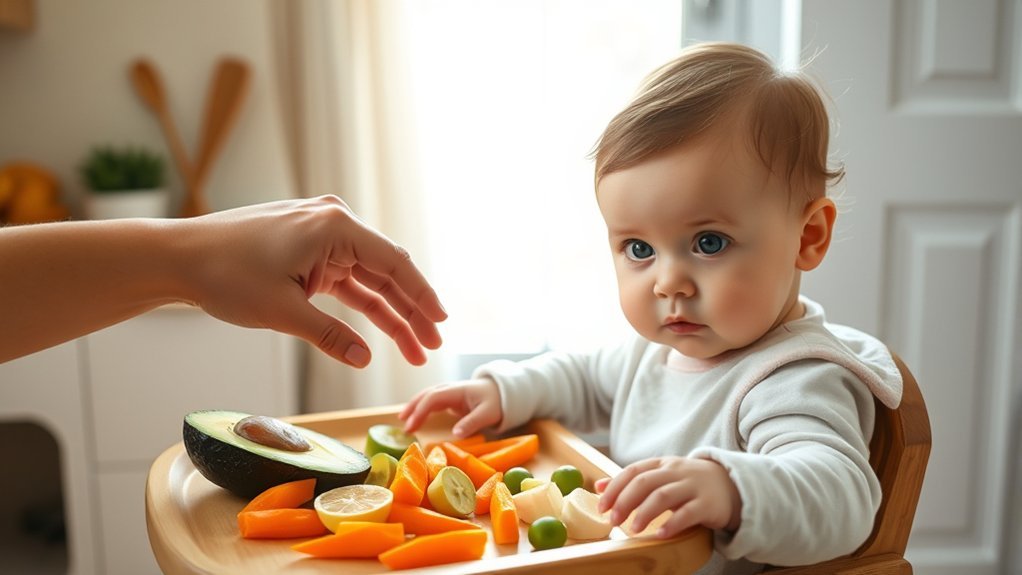
There is no required order for first foods. Aim for variety across protein foods, vegetables, fruit, grains, and pasteurized dairy foods while paying particular attention to iron, zinc, protein, and healthy fats.
Iron- and Zinc-Rich Options
- Tender shredded beef, lamb, chicken, or turkey.
- Soft low-mercury fish with all bones removed.
- Mashed lentils, chickpeas, or beans.
- Tofu strips that hold together but mash easily.
- Fully cooked egg in soft strips.
- Iron-fortified infant oat, barley, or multigrain cereal on a preloaded spoon.
Pairing plant-based iron foods with a vitamin C source can support iron absorption. Examples include lentils with soft tomato, beans with broccoli, or fortified cereal with mashed berries.
Simple First-Meal Combinations
- Soft omelet strip, avocado wedge, and steamed broccoli.
- Mashed lentils on a preloaded spoon with sweet-potato wedges.
- Tender shredded chicken, soft pear slice, and well-cooked green beans.
- Plain full-fat yogurt on a preloaded spoon with ripe banana.
- Iron-fortified oat cereal with mashed berries and smooth thinned nut butter after the allergen has been introduced safely.
Serve family foods before adding salt, sugar, hard garnishes, or spicy sauces. A baby portion does not need to be bland, but it should be soft, low in sodium, and free of choking hazards.
Introduce Allergenic Foods Safely
Once your baby is developmentally ready for solids, potentially allergenic foods can generally be introduced along with other complementary foods. The American Academy of Pediatrics advises that delaying foods such as egg, peanut, dairy, sesame, wheat, soy, fish, and shellfish does not prevent food allergy.
- Introduce the food when your baby is healthy and when you can observe them.
- Use one new allergen at a time so a reaction is easier to identify.
- Prepare it in a safe form, such as fully cooked egg, plain yogurt, or smooth peanut butter thinned until it is no longer sticky.
- Start with a small amount and watch for symptoms.
- After the food is tolerated, continue including it as part of the baby’s varied diet unless your clinician advises otherwise.
Possible allergic-reaction signs include hives, redness, swelling of the lips or face, repeated vomiting, sudden coughing, wheezing, breathing trouble, unusual sleepiness, paleness, or limpness.
Warning: Call 911 immediately for trouble breathing, swelling involving the mouth or tongue, blue or pale coloring, collapse, limpness, or symptoms affecting more than one body system. Do not give another serving of a food that may have caused a reaction until your child has been evaluated.
If your baby has severe eczema, an egg allergy, or both, ask their health care professional about the safest timing and setting for peanut introduction. The NIAID peanut-allergy prevention guidelines include specific recommendations for higher-risk infants.
Gagging vs. Choking
Gagging is a protective reflex that can happen as a baby learns to manage new textures. Choking occurs when food or another object blocks the airway. They are not the same, and choking requires immediate action.
| Sign | Gagging | Choking |
| Sound | The baby may cough, gag, sputter, or make noise. | The baby may be unable to cry, cough effectively, breathe, or make noise. |
| Air movement | Air is still moving, and coughing may help clear the food. | Airflow is blocked or severely reduced. |
| Appearance | The baby remains responsive and may look uncomfortable or upset. | The baby may appear panicked, turn blue, become limp, or lose consciousness. |
| Response | Stay close, remain calm, and let the baby work the food forward while continuing to observe. | Begin trained infant-choking first aid and call emergency services. |
Warning: A choking baby may be silent. If your baby cannot breathe, cry, or make noise, turns blue, becomes limp, or loses consciousness, call 911 and use the infant-choking and CPR skills you have been trained to perform. Do not perform a blind finger sweep.
Review the American Red Cross infant-choking guidance and take a certified infant CPR and first-aid course before or soon after starting solids.
Foods and Drinks to Avoid or Limit
The CDC’s infant-feeding safety guidance identifies several foods and drinks that should be avoided or modified.
- Honey before 12 months: Honey can cause infant botulism. This includes honey added to food, water, formula, or a pacifier.
- Cow’s milk as the main drink before 12 months: Continue breast milk or infant formula instead. Pasteurized plain yogurt and cheese can be introduced earlier in suitable forms.
- Juice before 12 months: Whole fruit provides more useful nutrients and texture practice.
- Unpasteurized foods or drinks: Avoid raw milk, unpasteurized juice, and foods made from unpasteurized dairy products.
- Fish high in mercury: Avoid shark, swordfish, king mackerel, marlin, orange roughy, Gulf of Mexico tilefish, and bigeye tuna.
- Added sugars: Babies have little room for foods that provide calories without needed nutrients.
- High-sodium foods: Limit processed meats, salty packaged snacks, and heavily salted family foods.
- Hard, round, sticky, or rubbery foods: Avoid or modify them because they can block a baby’s airway.
Observe Hunger and Fullness Cues
Responsive feeding means you choose what safe foods to offer and where the meal happens, while your baby decides whether to eat and how much.
Possible Hunger Cues
- Leaning toward or reaching for food.
- Opening the mouth when food is available.
- Showing excitement when placed in the highchair.
- Bringing food or a preloaded spoon toward the mouth.
Possible Fullness Cues
- Turning the head or body away.
- Closing the mouth when food is offered.
- Pushing food away or dropping it without returning to it.
- Slowing down, becoming distracted, or losing interest.
Do not require your baby to clear the tray or take one more bite. Appetite can vary from one meal or day to the next. Look at feeding progress, milk intake, growth, and overall well-being rather than judging success by how much food disappears during a single meal.
Troubleshoot Common Baby-Led Weaning Challenges
Your Baby Gags Frequently
Some gagging may occur while your baby learns new textures. Recheck the food’s softness, size, shape, and moisture. Avoid dry, crumbly, hard, or rubbery pieces. Contact your baby’s clinician if gagging is severe, occurs at nearly every meal, causes distress, or is accompanied by repeated coughing, choking, vomiting, breathing changes, or poor growth.
Your Baby Refuses Food
Keep the meal calm and end it without pressure. Offer the food again on another day, possibly in a different safe shape or texture. A baby may need repeated, low-pressure chances to become familiar with a new food, but there is no required number of attempts.
Your Baby Eats Very Little
Touching, licking, and tasting are normal parts of early learning. Continue milk feeds and offer nutrient-dense foods regularly. Ask your pediatrician for help if you are concerned about milk intake, wet diapers, energy, iron intake, or weight gain.
You Are Worried About Iron
Offer an iron-rich food frequently and pair plant sources with vitamin C-rich produce. Some babies, including certain breastfed or premature infants, may need an iron supplement. Do not start one without discussing the correct product and dose with your child’s health care professional.
Meals Are Too Messy
Use a washable floor mat, serve small portions, and add more only when needed. A sleeved bib and easy-to-clean highchair can help. Mess is part of sensory learning, but you do not need to place a large amount of food on the tray at once.
Your Baby Coughs or Chokes During Meals
Stop the meal and assess your baby. Seek urgent help for breathing difficulty, blue coloring, limpness, or inability to cry or make noise. Repeated coughing, choking, wet-sounding breathing, or feeding distress needs prompt evaluation by a pediatrician or qualified feeding specialist.
Frequently Asked Questions
Can I mix baby-led weaning with traditional spoon-feeding?
Yes. You can offer safe finger foods, mashed foods, preloaded spoons, and responsive spoon-feeding. Follow your baby’s cues and avoid placing food in their mouth when they are resisting. A mixed approach can be especially useful when serving foods such as yogurt, cereal, or mashed beans.
What should I do if my baby refuses to eat?
End the meal without pressure and try again another day. Make sure your baby is alert, comfortable, and not overly hungry or tired. Continue normal breast-milk or formula feeds and discuss persistent refusal, distress, or poor growth with your pediatrician.
Which foods should be avoided during baby-led weaning?
Avoid honey before 12 months, unpasteurized foods and drinks, high-mercury fish, and cow’s milk as the main drink before 12 months. Also avoid whole nuts, popcorn, whole grapes, raw hard vegetables, hard candy, thick spoonfuls of nut butter, firm meat chunks, hot dogs, and other hard, round, sticky, or rubbery choking hazards.
How long does baby-led weaning take?
There is no fixed timeline. Babies gradually improve their grasp, chewing, swallowing, and cup skills over many months. Continue offering developmentally appropriate textures while breast milk or formula remains the main nutrition through the first year.
When can I introduce allergenic foods?
Potential allergens can generally be introduced in safe forms once your baby is developmentally ready for solids, usually at about 6 months. Introduce one new allergen at a time. Ask your baby’s clinician for a specific peanut-introduction plan if your child has severe eczema, an egg allergy, or another high-risk condition.
Should solids replace breast milk or formula?
No. Solid foods are complementary during infancy. Continue breastfeeding or offering iron-fortified infant formula, which remains the main nutrition through 12 months. Milk-feeding patterns change gradually as food intake and eating skills increase.
Can a baby start baby-led weaning without teeth?
Yes, if the baby is otherwise developmentally ready. Gums can mash appropriately soft foods. Every piece should pass the gentle finger-pressure test, and hard or rubbery foods should not be offered.
Is baby-led weaning suitable for premature babies?
It depends on the baby’s corrected age, growth, posture, oral-motor skills, and medical history. A premature baby may reach feeding milestones later. Ask the baby’s pediatrician or feeding specialist to assess readiness rather than starting based only on chronological age.
Conclusion
Baby-led weaning can be a practical way to introduce solids when your baby is developmentally ready. Start with a secure upright seat, soft graspable foods, close supervision, and regular iron-rich choices. Continue breast milk or iron-fortified formula throughout the first year, follow hunger and fullness cues, and treat choking prevention as an essential skill rather than an optional extra.
A flexible approach is often the most useful. Finger foods, preloaded spoons, and responsive spoon-feeding can all support safe eating. Progress may be slow and messy at first, but consistent, low-pressure practice helps your baby build feeding skills at their own pace.
Sources
- Centers for Disease Control and Prevention: When, What, and How to Introduce Solid Foods — readiness, timing, food introduction, and preparation.
- Dietary Guidelines for Americans, 2025–2030 — milk feeding, complementary foods, nutrients, allergens, vitamin D, and added sugar.
- American Academy of Pediatrics: Baby-Led Weaning—Is It Safe? — BLW suitability, food shape, softness, and supervision.
- American Academy of Pediatrics: Introducing Common Food Allergens — allergen timing and safe peanut preparation.
- Centers for Disease Control and Prevention: Foods and Drinks to Avoid or Limit — honey, cow’s milk, raw milk, mercury, sodium, and added sugar.
- American Red Cross: Infant Choking—How to Help — choking recognition, first aid, and training.