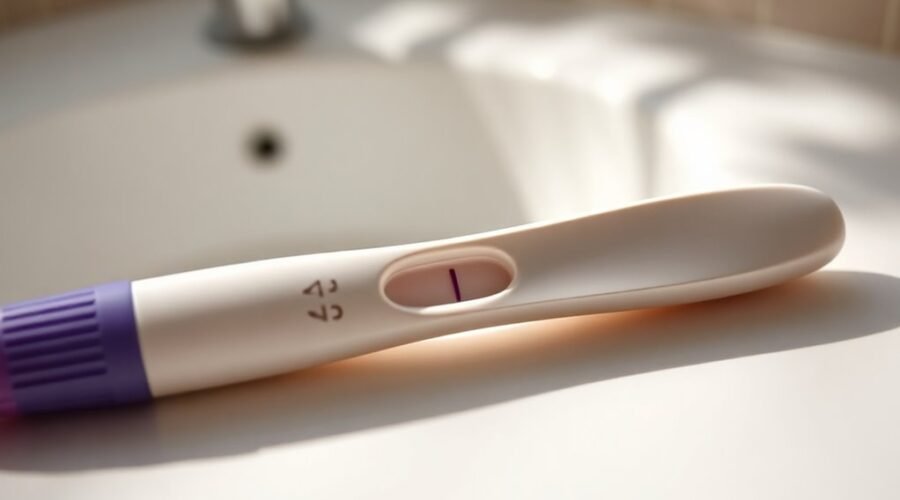
Seeing a very faint line on pregnancy test strips—often called a “squinter”—is usually an early positive result if it has real pink or blue dye color and appears within the package’s reading window (typically 3 to 5 minutes, and no later than 10 minutes). Because the pregnancy hormone human chorionic gonadotropin (hCG) typically doubles every 48 to 72 hours in early pregnancy, the most reliable next step is to retest in 48 hours using concentrated first-morning urine to see if the line darkens.
Very Faint Line on Pregnancy Test: 4 Possibilities Compared
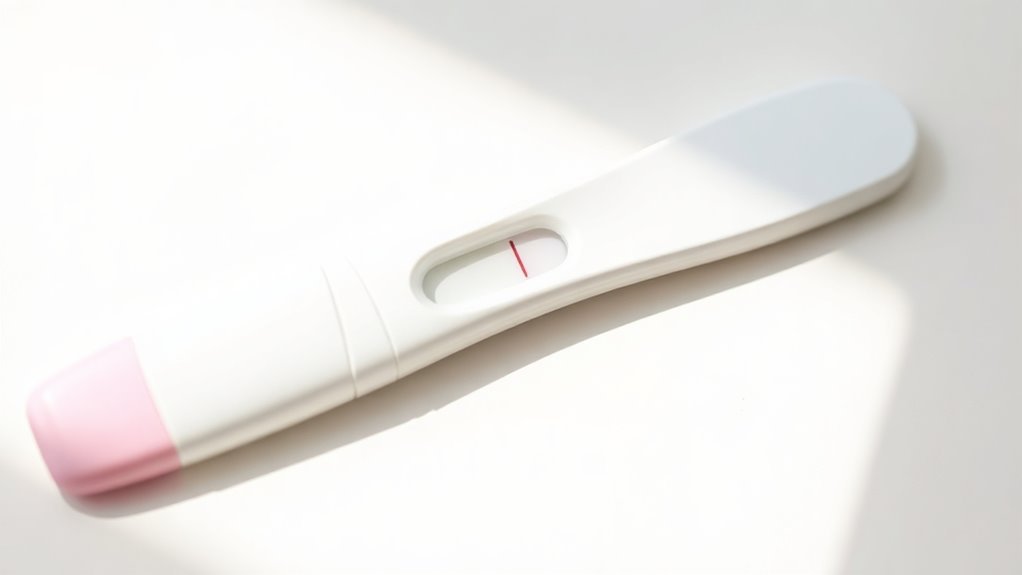
Not every barely visible mark means the same thing. For a broader overview of evaporation marks vs. positives, see our faint line on a pregnancy test positive vs. evap breakdown. Use the comparison below to evaluate an ultra-faint result right away:
| Result Type | When It Appears | Color & Width | What Happens on a 48-Hour Retest |
|---|---|---|---|
| Very Early Positive | Within the 3–5 minute read window | Faint pink or blue dye, same width as control line | Line darkens noticeably as hCG rises |
| Diluted-Urine Positive | Within the read window (often afternoon/evening) | Light colored line after heavy fluid intake | Darker when retested with first-morning urine |
| Indent Line | Sometimes visible even before urine or immediately | Colorless, white, or shadowy groove in the strip | Stays negative or shows no colored progression |
| Evaporation Line | After the 10-minute window as the strip dries | Grayish, colorless, or thin dry streak | Negative within the proper reading window |
Why Early Lines Look Barely Visible
Home urine tests detect hCG, which your body begins producing after a fertilized egg implants in the uterine lining (commonly 6 to 12 days after ovulation). Most standard home strips detect hCG around 25 mIU/mL, while some early-response tests detect lower levels. If you test a few days before your missed period, hCG may be just barely above the strip’s threshold—enough to bind a small amount of dye, but not enough for a bold line yet. You can also review how accurate home pregnancy tests are before choosing a follow-up brand.
Your 48-Hour Retesting Protocol
- Set a timer and discard after 10 minutes: Never pull a dried strip out of the trash hours later—evaporation lines are the most common source of confusion.
- Wait 48 hours instead of testing every few hours: Because hCG roughly doubles every 48 to 72 hours, retesting two days later gives a much clearer visual jump than testing twice in the same afternoon.
- Use first-morning urine: Overnight urine holds the highest concentration of hCG, especially before or right around your missed period.
- Use the same brand for progression checks: Different brands use different dye loads and sensitivity thresholds, so comparing Strip A today with Strip B tomorrow can make a normal rise look fainter.
- Consider a pink-dye or digital confirmation: Pink-dye strips are generally less prone to blue dye runs; once a pink line is clearly visible, a digital test or clinician blood test can confirm unambiguously.
Chemical Pregnancy, False Positives, and When to Call a Doctor
If a very faint line fades or disappears on subsequent tests and your period arrives a few days late, it may reflect a chemical pregnancy (a very early pregnancy loss shortly after implantation). True false positives are uncommon outside of hCG fertility shots or recent pregnancy loss—see our guide on how likely a false positive pregnancy test is for details.
Contact a healthcare provider promptly if your tests remain persistently faint without darkening, if your period is more than a week late with unclear results, or immediately if you experience severe one-sided pelvic or abdominal pain, heavy bleeding with clots, dizziness, or shoulder pain (which require urgent evaluation to rule out an ectopic pregnancy).
Frequently Asked Questions
Can medications cause a very faint line on a pregnancy test?
Most everyday medications do not cause false positives, but fertility treatments containing hCG (trigger shots) can produce a faint or positive line for up to 10 to 14 days after injection. Check with your fertility clinic for the right testing day.
Do digital pregnancy tests show very faint lines?
No. Digital tests display clear word results (Pregnant or Not Pregnant) so you do not have to squint at dye lines. However, some digital tests require slightly higher hCG levels than ultra-sensitive line strips, so an early faint strip may still read negative on a digital test for a day or two.
Why does a very faint line look darker in first-morning urine?
Urine accumulates in your bladder overnight, making hCG more concentrated when you first wake up. Testing later in the day after drinking water dilutes hCG and can make an early positive line look barely visible.
Can an expired pregnancy test show a very faint line?
Yes. Expired or moisture-damaged strips can produce unreliable faint streaks, dye runs, or false negatives because the antibody reagents degrade over time. Always check the expiration date before testing.
What if my very faint line does not get darker after 48 hours?
If a repeat test 48 to 72 hours later with first-morning urine stays equally faint, turns negative, or is followed by bleeding, it may indicate an evaporation or indent line or a very early pregnancy loss (chemical pregnancy). Contact a healthcare provider for a quantitative blood hCG test.