A drip coffee maker is an automatic brewer that heats water and distributes it evenly over ground coffee held in a filter basket. Gravity pulls the water through the coffee bed, extracting soluble flavor compounds before the finished brew drains into a carafe below. It remains the world’s most popular method for preparing consistent, hands-free batches of coffee for daily consumption.
Quick Answer
A drip coffee maker automates batch brewing by flash-heating cold water from a reservoir, lifting it through a riser tube via thermo-siphon action, and showering it over a filter filled with medium-ground coffee. The process takes 5–8 minutes and yields a clean, balanced cup with minimal hands-on effort.
Key Takeaways
- Automated Extraction: Drip machines use a one-way check valve and heating tube to deliver hot water to the coffee bed without mechanical pumps.
- Standard Serving Sizes: A coffee-maker “cup” equals 5 to 6 fluid ounces (148–177 ml), not an 8-fluid-ounce standard measuring cup.
- Golden Ratio: The Specialty Coffee Association recommends a ratio of 55 to 60 grams of coffee per liter of water (roughly 1:16 to 1:18 by weight) or 1–2 level tablespoons per 6-ounce cup.
- Optimal Grind: A uniform medium grind (similar in texture to coarse sand or kosher salt) prevents both over-extraction bitterness and basket overflow.
- Maintenance Separation: Daily washing removes stale coffee oils from carafes and baskets; descaling every 3 to 6 months dissolves calcium carbonate scale inside internal boilers.
- SCA Certification: High-performance brewers meet strict water temperature (92–96°C / 198–205°F) and brew time (4–8 minutes) standards.
At a Glance
| Time Required | 5–10 minutes total (prep + full brew cycle) |
| Difficulty | Beginner (Plug-and-play operation) |
| Tools Needed | Automatic drip machine, compatible filter (paper or metal), whole bean or ground coffee, fresh cold water; burr grinder and digital scale optional |
| Cost | $25–$80 (Entry-level), $100–$200 (Mid-range programmable), $200–$350+ (SCA-Certified specialty brewers) |
What Is a Drip Coffee Maker and How Does It Work?
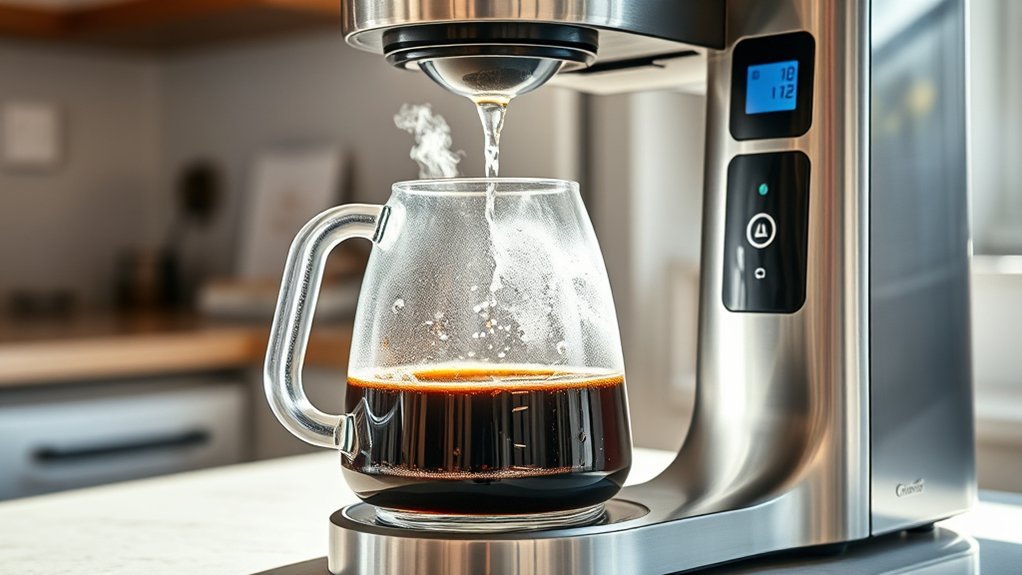
An automatic drip coffee maker simplifies brewing by automating temperature regulation, water volume delivery, and extraction timing. While manual brewing techniques require continuous physical oversight, an automatic drip machine completes the extraction cycle at the press of a single switch.
Despite their straightforward external controls, standard drip machines rely on an elegant thermodynamic principle known as a thermo-siphon bubble pump to move water upward without an electric motor:
- Gravity Feed: When cold water is poured into the reservoir, it drains through a one-way silicone or rubber check valve at the bottom and fills an aluminum heating pipe beneath the machine’s base.
- Flash Boiling & Vapor Expansion: An electric resistive heating element rapidly brings the small volume of water trapped in the tube to a boil. As steam bubbles form and expand, the one-way valve closes behind them, preventing boiling water from escaping backward into the cold reservoir.
- Thermodynamic Lift: The expanding steam bubbles push columns of heated water up a vertical riser tube toward the top of the unit.
- Dispersion & Filtration: Hot water reaches a dispersion showerhead, raining down over the coffee bed. Gravity pulls the hot water downward through the ground coffee and filter matrix, extracting solubles before collecting as finished liquid in the carafe.
To produce balanced extraction without sharp sourness or astringency, the water must hit the coffee bed at the proper temperature. The Specialty Coffee Association (SCA) Home Brewer Certification Program requires certified machines to maintain a brew bed water temperature between 92°C and 96°C (197.6°F to 204.8°F) throughout the primary brewing phase.
According to the National Coffee Association (NCA) brewing guidelines, a contact time of approximately 5 minutes between water and ground coffee produces optimal strength and flavor clarity. Total brew times scale up or down depending on reservoir volume and machine heating wattage.
For repeatable drip coffee, control the variables within your reach: grind uniformity, precise coffee-to-water ratios, filtered water quality, and prompt cleaning.
Coffee Maker “Cups” vs. Fluid Ounces
A frequent point of confusion for new coffee machine owners is carafe volume calibration. In the coffee manufacturing industry, a labeled “cup” does not correspond to the United States standard customary measuring cup (8 fluid ounces / 237 ml).
Most automatic drip manufacturers define a single cup as 5 fluid ounces (148 ml) to 6 fluid ounces (177 ml). This traditional serving size reflects a classic teacup or small diner mug rather than a modern travel tumbler.
Note: A standard “12-cup” drip coffee maker holds roughly 60 fluid ounces (1.77 liters) of water. When using 12-ounce to 16-ounce mugs, a full 12-cup pot will yield approximately 4 to 5 realistic servings.
The Components of a Drip Coffee Maker Explained
Understanding the internal anatomy of a drip coffee machine makes troubleshooting, daily operation, and routine cleaning much easier:
- Water Reservoir: The holding tank equipped with internal volume markings indicating the water level.
- One-Way Check Valve: A ball or flap valve at the base of the reservoir that allows cold water into the boiler while blocking hot water and steam from backing up.
- Heating Element: An extruded aluminum or copper tube clamped to an electric resistive heating trace, positioned below the warming plate.
- Riser Tube: A heat-resistant silicone or plastic pipe that routes hot water from the heating base up to the showerhead.
- Showerhead / Dispersion Screen: A perforated plate engineered to spread water evenly across the diameter of the brew basket to avoid localized channeling.
- Brew Basket: The removable housing that suspends the filter and coffee grounds above the carafe. Most include a spring-loaded “pause-and-serve” drip-stop valve.
- Filter Medium: Paper, woven stainless steel, or cloth that separates the grounds from the brewed liquid.
- Carafe: The receptacle that receives the brewed coffee, constructed from tempered borosilicate glass or double-wall vacuum-insulated stainless steel.
- Warming Plate: An electric hotplate located beneath glass carafes to keep liquid hot post-brew.
Filter Basket Shapes: Flat-Bottom vs. Cone
The geometry of the filter basket impacts water velocity, bed depth, and flavor profile:
- Flat-Bottom (Cupcake / Basket style): Water travels vertically through an even, shallow bed of grounds. This geometry encourages balanced extraction with sweeter, chocolatey, and nutty notes. Commonly found on high-capacity commercial and classic American residential brewers.
- Cone-Shaped (V-Shaped / #2, #4 filters): Water funnels toward a narrower central point, creating a deeper coffee bed. This shape produces longer contact times in the center and often highlights floral, fruity, and bright acidic notes in light-to-medium roasts.
- Wedge / Trapezoid: A hybrid format common in traditional European drip machines that uses flat-bottom filters with angled sides.
Paper vs. Metal Coffee Filters
The filter material determines the level of dissolved solids (TDS) and aromatic diterpenes (cafestol and kahweol) remaining in your cup.
| Filter Type | Cup Profile | Oil & Sediment Retention | Maintenance & Longevity |
|---|---|---|---|
| Paper (Bleached / White) | Crisp, bright, light body; highlights delicate origin notes | Traps nearly all insoluble micro-grounds and cafestol oils | Single-use; compostable or disposable |
| Paper (Unbleached / Brown) | Similar to bleached, but requires hot water rinsing to prevent paper taste | High retention of oils and fine sediment | Single-use; unbleached wood pulp |
| Permanent Metal Mesh | Heavy body, rich mouthfeel, similar to a French press | Allows natural aromatic oils and micro-fines to pass into the carafe | Reusable; requires daily dish soap washing to remove oil film |
Benefits of Using a Drip Coffee Maker for Your Daily Brew
While manual pour-overs and semi-automatic espresso machines offer minute tactile control, drip coffee makers deliver unbeatable efficiency, volume, and consistency for everyday use:
- Hands-Free Convenience: Once loaded, the machine handles water heating, timing, and pouring automatically, freeing up time during busy mornings.
- High Batch Capacity: A single brew cycle can produce between 20 and 60 fluid ounces of coffee—enough to serve an entire household or office without repetitive brewing steps.
- Consistent Repeatability: By automating the water delivery rate and brew temperature, the machine removes human error from the pouring process.
- Programmable Timers: Many digital models feature 24-hour auto-start programming, allowing you to wake up to a freshly brewed carafe.
- Cost Efficiency: Batch brewing with whole beans and paper filters costs roughly $0.15 to $0.40 per serving, compared to $0.75 to $1.25 per single-serve pod (K-Cup/Nespresso) and $4.00+ at commercial cafes.
How to Choose the Right Drip Coffee Maker for Your Needs
Choosing the right machine involves balancing kitchen space, batch volume, temperature stability, and your budget.
Key Features to Consider
When comparing models, pay attention to the features that directly affect extraction quality and daily use:
- Heating Element Quality: Entry-level machines use simple dual-purpose heating coils that switch to warming-plate mode, which can cause temperature fluctuations. Higher-end models feature dedicated copper boilers or precision thermo-block heaters.
- Pre-Infusion / Bloom Mode: A setting that wets the coffee bed with a small pulse of hot water and pauses for 30–45 seconds. This allows trapped carbon dioxide ($CO_2$) to escape fresh grounds, preventing uneven water flow.
- Wide Dispersion Showerheads: Multi-hole showerheads distribute water across the entire coffee bed, preventing a single hole from channeling through the center.
- Removable Water Reservoir: Simplifies refilling and cleaning by eliminating the need to pour water from the carafe into a cramped machine opening.
- Adjustable Flow Rate & Small-Batch Modes: Slows down the water pump when brewing 1–4 cups to maintain proper contact time in shallow coffee beds.
Glass vs. Thermal Carafe
The carafe material determines how your coffee stays warm after brewing:
| Carafe Type | Heat Retention Mechanism | Advantages | Tradeoffs |
|---|---|---|---|
| Glass with Warming Plate | Continuous external conduction heat from an electric base plate | Transparent level viewing; lightweight; low replacement cost | Bakes coffee after 20–30 minutes, turning volatile acids bitter and burnt; glass can crack |
| Double-Wall Thermal Stainless Steel | Passive thermal retention via an internal vacuum layer | Keeps coffee hot for 2–4 hours without altering flavor; highly durable; portable | Heavier to pour; opaque walls hide remaining volume; higher upfront machine cost |
Budget, Clearance, and SCA Certification
Price points in the automatic drip category range from basic $30 appliances to $350+ precision brewers:
- Under $50 (Budget): Basic on/off switch operation. Brewing temperatures frequently run below 90°C (194°F), producing under-extracted, sour-leaning brews. Best for casual drinkers using dark roasts.
- $50 to $150 (Mid-Tier): Programmable digital clocks, auto-pause features, strength adjustments, and improved showerhead dispersion.
- $150 to $350+ (Premium & SCA-Certified): Features precise PID-controlled heating elements that stay within the strict 92–96°C window, wide-array showerheads, and pre-infusion bloom cycles. Brands like Technivorm Moccamaster, Breville, Oxo, and Fellow dominate this tier.
Before purchasing, measure your under-cabinet clearance. Top-loading water reservoirs and upward-swinging filter baskets often require 4 to 8 inches of extra overhead space during operation.
Tips for Maintaining Your Drip Coffee Maker for Longevity
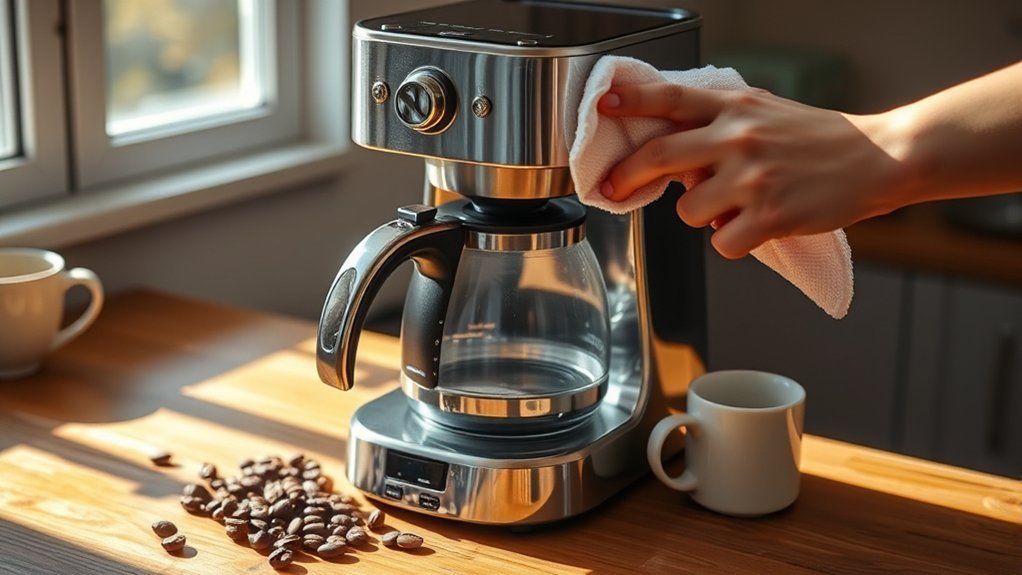
Coffee makers accumulate two distinct contaminants during regular use: coffee oil deposits on exposed surfaces and mineral scale inside internal heating elements.
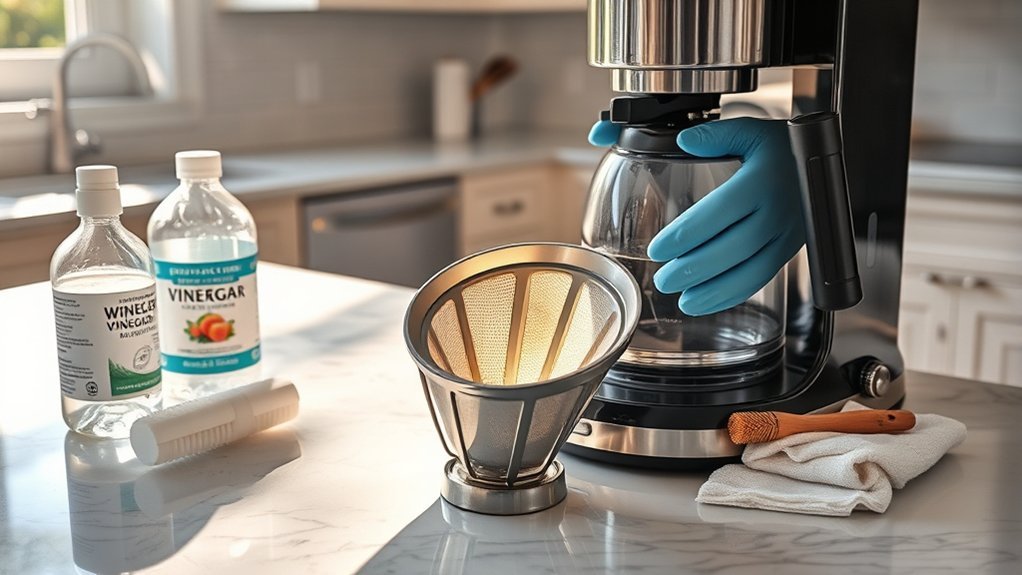
Warning: Always unplug your coffee maker and allow heating elements to cool completely before cleaning. Never submerge the electrical housing, cord, or plug in water. Avoid running cleaning cycles with household bleach or abrasive scouring pads.
Follow this maintenance schedule to keep your machine operating efficiently and your coffee tasting fresh:
- Daily (Post-Brew): Discard used grounds and paper filters immediately to prevent mold growth in the basket. Wash the carafe, lid, and brew basket with warm water and mild dish soap to strip away rancid coffee oils.
- Weekly: Wipe down the showerhead, spray area, and warming plate with a damp microfiber cloth to remove dried splashes.
- Monthly: Soak the brew basket and thermal carafe in a specialized coffee detergent solution (such as Cafiza) to dissolve stubborn, polymerized coffee stains.
- Quarterly (Every 3–6 Months): Run a complete descaling cycle to remove calcium and magnesium scale from internal boiler tubes.
Descaling Chemistry: Vinegar vs. Commercial Cleaners
Hard tap water contains dissolved calcium and magnesium carbonates that precipitate onto hot internal pipes, restricting water flow, extending brew times, and lowering brew temperatures.
- Citric Acid / Commercial Descalers: The gold standard for coffee equipment. Odorless, biodegradable powders or liquids (typically citric, sulfamic, or lactic acid) dissolve scale without leaving strong lingering scents or degrading internal silicone seals.
- White Vinegar (Acetic Acid Solution): A standard household alternative (mixed 1:1 with water). While effective at dissolving scale, vinegar produces a pungent odor that requires 3 to 4 full water flush cycles to clear, and its acidity can degrade certain synthetic rubber gaskets over time. Check your manufacturer’s manual—some brands void warranties if vinegar is used.
For model-specific procedures, consult Hamilton Beach’s official cleaning guides or your specific manufacturer’s instruction booklet.
Pro Tip: Descaling and washing serve completely different purposes. Washing with dish soap removes organic oils and prevents bitter, rancid tastes; descaling uses acids to dissolve inorganic mineral buildup inside internal metal heating lines.
Troubleshooting Common Drip Coffee Maker Issues
When extraction issues or mechanical faults happen, use this diagnostic guide to find the cause and fix it:
| Symptom | Probable Cause | Corrective Action |
|---|---|---|
| Machine will not power on | Tripped GFCI outlet, thermal fuse blown, or damaged power cord | Test outlet with another appliance; reset GFCI. If internal thermal fuse has blown from running dry, contact manufacturer support. |
| Loud sputtering & unusually slow brew cycle | Severe mineral scale buildup restricting heating tube flow | Perform an immediate descaling cycle with an active citric acid or commercial descaling agent. |
| Brew basket overflows grounds onto counter | Grind size too fine; too much coffee; filter wall collapsed; carafe pause-and-serve valve stuck | Switch to a coarser medium grind; reduce ground dose; ensure paper filter matches basket size; clean spring valve under the basket. |
| Coffee tastes weak, thin, or sour | Grind size too coarse; insufficient ground dose; brew water temperature too low ($<90^\circ\text{C}$) | Grind finer; increase coffee dose to the 1:16 ratio; pre-heat carafe with hot water; verify machine heating output. |
| Coffee tastes astringent, dry, or bitter | Grind size too fine (over-extraction); rancid coffee oil buildup; carafe left on warming plate too long | Coarsen the grind setting; clean carafe and basket with coffee detergent; pour coffee into a thermal vessel immediately after brewing. |
| Sediment / sludge at bottom of carafe | Worn or torn filter; blade grinder generating excessive micro-fines; misaligned filter paper | Use quality paper filters; switch to a burr grinder for uniform particle distribution; ensure paper edges sit flush against basket walls. |
Selecting the Best Coffee Beans for Drip Brewing
Because drip brewers filter coffee through a paper or fine mesh barrier over several minutes, choosing the right bean variety, roast, and particle size is key to a clean cup.
Coffee Bean Types: Arabica vs. Robusta
Commercial coffee is dominated by two primary botanical species:
- Coffea Arabica: Represents roughly 60–70% of global production. Grown at high altitudes, Arabica contains higher sugar and lipid content, yielding nuanced acidity, floral aromatics, and sweet flavor notes ranging from chocolate to fruit. It is the gold standard for drip brewing.
- Coffea Canephora (Robusta): Cultivated at lower altitudes with higher disease resistance. Robusta contains roughly 50% to 60% more caffeine and double the chlorogenic acid content of Arabica according to the NCA Coffee Variety Guide. Robusta produces a heavy body with deep earthy, nutty, and bitter cocoa notes, making it common in espresso blends and traditional dark breakfast roasts.
Roast Level and Grind Size Calibration
The roast level changes the bean’s density, porosity, and solubility:
- Light Roast: Dense and less soluble. Retains origin-specific floral, fruity, and citrus acidity. Best suited for high-temperature SCA-certified drip machines with a medium-fine grind setting.
- Medium Roast: Balanced sweetness, milk chocolate, caramel notes, and mild acidity. The most versatile profile for standard household drip brewers using a medium grind.
- Dark Roast: Highly porous and rapidly soluble with smoky, dark chocolate, and toasted walnut flavors. Extracts very quickly. Use a slightly coarser medium grind to avoid harsh bitterness and over-extraction.
Freshness and Optimal Storage
Whole-bean coffee reaches peak flavor 7 to 21 days post-roast, once excess $CO_2$ gas from the roasting process has had time to dissipate. Whole roasted beans stay fresh for roughly 3 to 4 weeks after opening before oxidation flattens their flavor profile.
- Grind on Demand: Ground coffee loses up to 60% of its volatile aromatic compounds within 15 minutes of grinding due to increased surface area exposure. Grind whole beans immediately before brewing with a quality burr grinder.
- Airtight Containers: Store beans in an opaque, vacuum-sealed or one-way valve container at stable room temperature.
- Avoid the Refrigerator: Cold storage exposes beans to condensation, humidity fluctuations, and food odors that degrade flavor.
Brewing the Perfect Cup of Coffee With a Drip Coffee Maker
Brewing balanced coffee consistently comes down to using precise measurements rather than guesswork.
Step-by-Step: How to Brew Drip Coffee
- Prep the Machine: Verify that the water reservoir, basket, and carafe are thoroughly clean and free of old residue.
- Add Fresh Cold Water: Pour clean, filtered cold water into the reservoir up to your desired cup marking.
- Seat the Filter: Place the correct size filter into the basket. If using unbleached paper filters, rinse briefly with warm tap water to remove residual paper dust, then discard the rinse water.
- Weigh and Grind the Coffee: Weigh whole beans on a digital scale (using the reference chart below) and grind to a uniform medium consistency (resembling table salt or coarse beach sand).
- Level the Coffee Bed: Pour grounds into the filter and gently tap the sides of the basket to create a flat, level surface. Do not tamp or compress the coffee.
- Initiate Brew Cycle: Close the reservoir lid, place the carafe securely on the base, and start the brewer.
- Serve and Enjoy: Once dripping slows to an occasional drop, swirl the carafe gently to blend the extraction layers, then pour immediately. Turn off glass warming plates within 20 minutes to prevent scorching.
Coffee-to-Water Ratio and Golden Cup Chart
The standard baseline ratio for balanced drip extraction is 1:16 to 1:18 (1 part coffee to 16–18 parts water by weight). In imperial volumetric terms, the general rule is 1 to 2 level tablespoons of ground coffee for every 6-ounce cup of water.
| Brewer “Cup” Markings | Water Volume (Fluid Oz / mL) | Coffee Dose (Grams @ 1:16.5) | Approx. Ground Coffee (Level Tbsp) |
|---|---|---|---|
| 4 Cups | 20 fl oz / 590 mL | 36 g | ~5.5 tbsp |
| 6 Cups | 30 fl oz / 887 mL | 54 g | ~8.5 tbsp |
| 8 Cups | 40 fl oz / 1182 mL | 72 g | ~11 tbsp |
| 10 Cups | 50 fl oz / 1478 mL | 90 g | ~14 tbsp |
| 12 Cups | 60 fl oz / 1774 mL | 108 g | ~16.5 tbsp |
Water Quality and Mineral Balance
Brewed coffee is approximately 98.5% water. Tap water containing high chlorine or sulfur will directly taint your cup, while overly hard water creates heavy limescale.
- Use Filtered Tap Water: A standard carbon block pitcher or refrigerator filter removes unpleasant chlorine and off-odors while leaving essential minerals intact.
- Avoid Pure Distilled or Reverse-Osmosis (RO) Water: Water needs some dissolved mineral content—specifically calcium ($Ca^{2+}$) and magnesium ($Mg^{2+}$) ions—to bond with and extract flavor compounds from ground coffee. Brewing with pure distilled water often produces a flat, sour, and hollow cup.
- Ideal Water Hardness: Aim for a total dissolved solids (TDS) target of roughly 75 to 150 ppm with neutral pH (6.5–7.5).
Drip Coffee Makers vs. Other Brewing Methods
Every coffee brewing method offers a different balance of convenience, clarity, body, and effort:
| Brewing Method | Hands-On Effort | Brew Time | Cup Profile & Body | Best For |
|---|---|---|---|---|
| Automatic Drip | Very Low (Automated) | 5–8 minutes | Clean, balanced, light-to-medium body | Multi-cup batches, busy mornings, shared homes |
| Manual Pour-Over (V60/Chemex) | High (Active manual pouring) | 3–4 minutes | Very clean, bright, pronounced acidity and clarity | Single-origin specialty coffees, single servings |
| French Press (Immersion) | Low to Medium (Manual press) | 4–5 minutes | Heavy, dense body, high oil and sediment content | Full-bodied dark roasts, bold coffee lovers |
| Espresso | High (Tamping, dial-in) | 25–30 seconds | Highly concentrated, thick crema, bold intensity | Lattes, cappuccinos, quick concentrated shots |
| Cold Brew | Very Low (Passive steep) | 12–24 hours | Very smooth, low acidity, sweet, chocolatey | Iced coffee, acid-sensitive stomachs, bulk concentrate |
Is a Drip Coffee Maker Right for You?
Drip coffee makers remain the most dependable choice when your routine calls for speed, batch volume, and hands-off simplicity.
Brewing Preferences and Styles
An automatic drip machine is your ideal brewing solution if:
- You regularly brew 2 or more mugs of coffee every morning.
- You want to prepare your brewer the night before and wake up to fresh coffee.
- You prefer the clean, sediment-free profile that paper-filtered brewing provides.
- You want consistent results without weighing, timing, or manually pouring each cup.
Conversely, consider a manual pour-over cone or a semi-automatic espresso machine if you enjoy fine-tuning variables like water flow rate, bloom duration, and extraction pressure by hand.
Convenience and Efficiency Factors
| Hardware Feature | Key Advantage | Who Needs It Most |
|---|---|---|
| Programmable 24-Hour Timer | Starts brewing automatically at a pre-set time | Commuters and busy early risers |
| Thermal Stainless Carafe | Maintains heat for hours without cooking or burning the brew | Slow sippers and home-office workers |
| Automatic Shut-Off | Disables warming plates after 2 hours to prevent fire risks | Safety-conscious households |
| Built-In Burr Grinder | Grinds fresh whole beans automatically before each cycle | Kitchens with limited countertop space |
Budget and Space Considerations
- Measure Cabinet Height: Ensure you have at least 15 to 18 inches of vertical clearance to open reservoir lids and remove brew baskets comfortably.
- Factor in Operating Costs: Paper filters cost $3 to $6 for a pack of 100, while descaling solutions add $10 to $15 per year in routine maintenance.
- Look for SCA Badging: If flavor quality is your top priority, look for the “SCA Certified Home Brewer” logo to ensure the machine maintains proper brewing temperatures and contact times.
Sources
- Specialty Coffee Association (SCA) — Certified Home Equipment Standards — official requirements for brew water temperature (92–96°C), contact time, and extraction consistency.
- National Coffee Association USA (NCA) — Drip Coffee Brewing Guide — golden coffee-to-water ratios, grind calibrations, and filtration guidance.
- National Coffee Association USA — Coffee Varieties & Origins — botanical profiles, chemical distinctions, and caffeine comparisons between Arabica and Robusta.
- Hamilton Beach Appliance Technical Support — manufacturer descaling instructions, valve care, and electrical appliance safety protocols.
Frequently Asked Questions
How long does it take to brew a full pot of drip coffee?
A standard 8 to 12-cup drip coffee maker takes roughly 5 to 8 minutes to complete a full brew cycle. The Specialty Coffee Association specifies that certified home brewers must deliver water across the coffee bed for between 4 and 8 minutes to prevent both under-extraction (sourness) and over-extraction (bitterness).
Can I use standard pre-ground grocery store coffee in a drip coffee maker?
Yes. Most commercial pre-ground coffees are milled to a versatile medium grind specifically engineered for standard flat-bottom and cone drip baskets. For best results, use pre-ground bags within 1 to 2 weeks of opening to minimize flavor loss from oxidation.
How do I program a drip coffee maker to brew automatically in the morning?
Ensure the machine’s primary clock is set to the correct local time. Add cold water to the reservoir and ground coffee to the filter basket. Press the “Program” or “Auto” button, adjust the clock to your desired wake-up time, and confirm the setting. An indicator light will illuminate showing that auto-brew mode is armed.
What is the ideal water temperature for a drip coffee maker?
The industry standard water temperature for drip extraction is 92°C to 96°C (198°F to 205°F) measured at the coffee bed. Water below 90°C (194°F) fails to extract sugars efficiently, producing a sour, weak cup, while boiling water above 98°C (208°F) extracts harsh, bitter tannins.
How often should I clean and replace the filter?
Disposable paper filters must be discarded after every single brew cycle. Permanent stainless steel mesh filters should be dumped and washed with warm dish soap after each use to remove oil residues. Permanent filters only require replacement if the mesh tears, warps, or fails to seat properly in the basket.
Why does my drip coffee taste weak or watery?
The most common causes of weak coffee are using too little ground coffee (falling below the 1:16 ratio), choosing an overly coarse grind that lets water flow through too fast, or using water that isn’t hot enough. Try increasing your coffee dose or adjusting to a slightly finer grind.
How often should I descale my drip coffee machine?
Most households should descale every 3 to 6 months. If you use hard municipal tap water (over 120 ppm mineral hardness) or brew multiple pots daily, run a descaling cycle every 4 to 6 weeks, or whenever the machine begins sputtering loudly or brewing noticeably slower.
Does a 12-cup coffee maker actually brew twelve 8-ounce mugs?
No. Coffee maker manufacturers calculate carafes in 5 to 6 fluid ounce cups. A “12-cup” carafe holds roughly 60 fluid ounces of liquid, which yields about four to five standard 12-to-16 ounce household coffee mugs.
Conclusion
A drip coffee maker remains one of the most efficient, reliable, and accessible ways to prepare high-quality batch coffee. By taking advantage of thermal siphon mechanics to automate water heating and dispersion, these machines deliver consistent, repeatable cups with minimal morning effort.
Getting the best flavor from your drip coffee maker comes down to simple daily habits: use fresh whole beans ground to a medium consistency, follow the 1:16 Golden Cup ratio, brew with filtered water, and separate routine daily washing from quarterly acid descaling. Whether you use an entry-level programmable machine or a precision SCA-certified brewer, dialling in these core variables ensures a rich, clean, and balanced cup every morning.