
Most babies can try an infant-safe form of peanut butter once they are developmentally ready for solid food, usually at about 6 months old. Babies with severe eczema, an egg allergy, or a previous food reaction need a pediatrician-guided plan and may be advised to start peanut between 4 and 6 months. Never give a baby whole peanuts, chunky peanut butter, or a thick spoonful of smooth peanut butter.
Quick Answer
Most babies can have smooth, thinned peanut butter when they are ready for solid foods, typically around 6 months. Babies with severe eczema or an egg allergy may benefit from introduction at 4 to 6 months, but their pediatrician or allergist should guide the timing, testing, and first feeding.
Key Takeaways
- Most babies can try peanut when they are developmentally ready for solids, usually at about 6 months and never before 4 months.
- Ask a pediatrician or allergist before introduction if your baby has severe eczema, an egg allergy, a previous food reaction, or a diagnosed peanut allergy.
- Use smooth peanut butter thinned with warm water, breast milk, formula, or a previously tolerated puree.
- Plan the first feeding when your baby is healthy and you can watch closely for at least two hours afterward.
- Call 911 for trouble breathing, tongue or throat swelling, pale or blue skin, sudden weakness, or other signs of a severe allergic reaction.
- Once peanut is tolerated, keep an age-appropriate form in your child’s diet regularly according to your pediatrician’s advice.
At a Glance
| Time Required | About 10 minutes to prepare and feed, followed by at least 2 hours of close observation |
| Difficulty | Easy for a low-risk, developmentally ready baby; clinician guidance is needed for higher-risk babies |
| Tools Needed | Measuring teaspoon, small bowl, spoon, smooth peanut butter, and a thinning liquid or tolerated puree |
| Cost | Low; only a small amount of peanut butter and liquid is needed |
Medical note: This guide provides general feeding and safety information. It does not replace advice from your baby’s pediatrician or allergist, especially when eczema, a known food allergy, feeding difficulty, or a previous reaction is present.
When and How to Introduce Peanut Butter to Your Baby
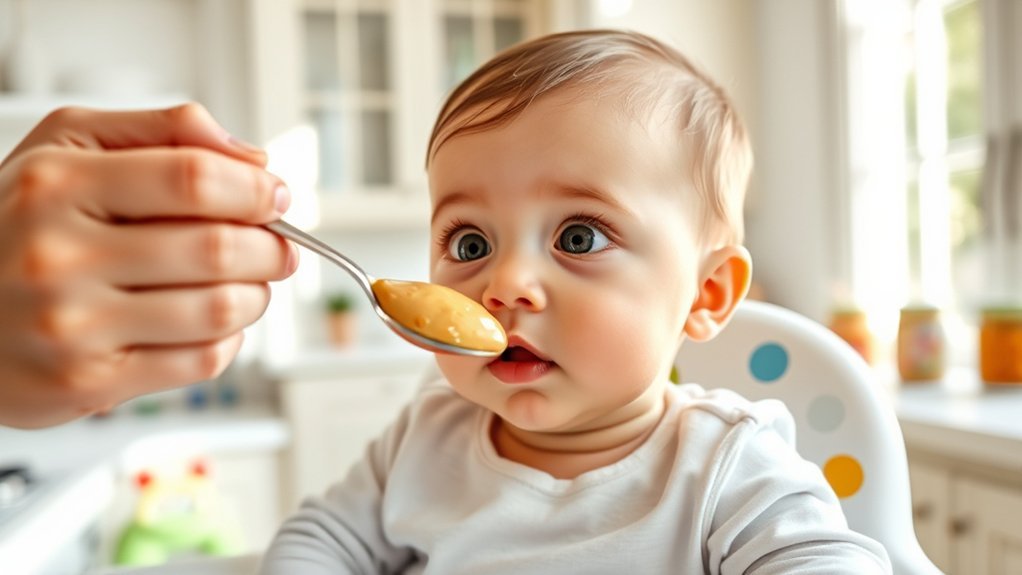
The right time depends on both your baby’s development and their allergy risk. The Centers for Disease Control and Prevention says most children begin solid foods at about 6 months. A baby should not begin solid food before 4 months.
Signs Your Baby Is Ready for Solid Food
Your baby should show several readiness signs before trying peanut butter or any other complementary food:
- They can sit upright alone or with support.
- They have steady head and neck control.
- They open their mouth when food is offered.
- They swallow food instead of pushing it back out with their tongue.
- They can move food from the front of the mouth toward the throat.
Age by itself is not enough. A 4-month-old who cannot safely manage food is not ready for peanut introduction.
Peanut Introduction Timing by Allergy Risk
| Baby’s Risk Group | Typical Guidance |
| Severe eczema, egg allergy, or both | Talk with the pediatrician or allergist before feeding peanut. The NIAID peanut-allergy prevention guidelines recommend considering age-appropriate peanut introduction as early as 4 to 6 months after evaluation. |
| Mild-to-moderate eczema | Introduce an infant-safe peanut food at about 6 months, once the baby is ready for solids. Routine testing is not usually required, but parents may discuss concerns with the pediatrician. |
| No eczema or known food allergy | Introduce peanut in an age-appropriate form when complementary foods begin, usually at about 6 months. |
A family history of allergy is worth discussing with your pediatrician, particularly when a parent or sibling has a severe peanut allergy. However, family history alone is not the main high-risk category used in the NIAID guidelines. Severe eczema and egg allergy are stronger reasons for evaluation before introduction.
Introducing peanut in an infant-safe form during the recommended window is more protective than delaying it, but the baby must first be developmentally ready to eat solid food.
How to Introduce Peanut Butter for the First Time
Choose a day when your baby is healthy. Do not plan the first feeding when your baby has a fever, is vomiting, has breathing symptoms, or is having a significant eczema flare. Offer peanut early in the day rather than just before bedtime so you have time to watch for a reaction.
What You Need
- Smooth peanut butter
- A clean measuring teaspoon
- A small bowl and infant spoon
- Warm water, breast milk, formula, or a previously tolerated smooth puree
- At least two hours when a responsible adult can remain with the baby
Step-by-Step First Feeding
- Check the texture. Use smooth peanut butter. Do not use crunchy peanut butter or peanut butter containing nut pieces.
- Measure the serving. Place about 2 teaspoons of smooth peanut butter in a bowl. This is approximately the amount used to provide 2 grams of peanut protein in guideline-based feeding examples, although brands vary.
- Thin it thoroughly. Slowly mix in 2 to 3 teaspoons of warm water, adding more if needed. Let it cool before feeding. You can also blend the peanut butter into breast milk, formula, smooth oatmeal, yogurt already tolerated, or a tolerated fruit or vegetable puree.
- Offer a tiny first taste. Put a small amount on the tip of the spoon and let your baby swallow it.
- Wait 10 minutes. Watch for hives, swelling, coughing, vomiting, unusual sleepiness, or breathing trouble.
- Continue gradually. If no symptoms appear, give the remaining thinned mixture slowly. Do not force your baby to finish it.
- Observe for at least two hours. Stay with your baby and remain alert for delayed symptoms. The NIAID home-feeding instructions recommend choosing a time when a caregiver can remain with the infant for at least two hours after feeding.
Pro Tip: Mix peanut butter into a food your baby has already eaten without a reaction. This makes it easier to identify peanut as the likely trigger if symptoms occur.
Essential Safety Tips for Introducing Peanut Butter
Safe peanut introduction depends on the form, texture, timing, and feeding environment. Keep your baby seated upright in a high chair or other secure feeding seat. Stay within arm’s reach and avoid feeding in a moving car, stroller, or reclining position.
- Use only smooth peanut butter or another infant-safe peanut product.
- Thin peanut butter until it falls easily from the spoon rather than forming a sticky lump.
- Introduce peanut when one adult can focus on the baby without distractions.
- Do not introduce several new allergens in the same meal.
- Do not rub peanut butter on the baby’s skin as a test. Skin contact cannot confirm whether peanut is safe to eat and may irritate eczema.
- Do not feed peanut to a child with a diagnosed peanut allergy unless an allergist has provided a treatment or challenge plan.
Warning: Never give a baby whole peanuts, chopped peanuts, chunky peanut butter, or a thick spoonful of peanut butter. These forms can block a young child’s airway.
How to Identify Allergic Reactions
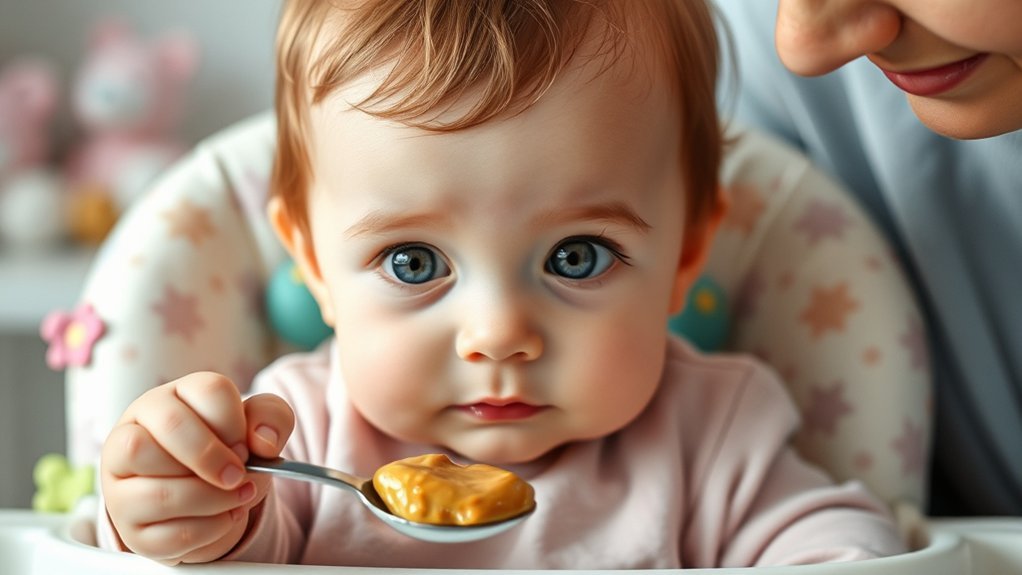
An allergic reaction can begin within minutes or several hours after peanut exposure. Symptoms may be mild at first and then become more serious, so stop the feeding as soon as you suspect a reaction.
Possible Mild Allergy Symptoms
- A few hives or areas of redness
- Mild swelling around the face or eyes
- Itching or repeated rubbing of the mouth or face
- A new runny nose or sneezing immediately after eating
- One episode of vomiting without breathing trouble or other symptoms
Stop feeding peanut and contact your child’s pediatrician promptly for instructions. Do not give more peanut to “test” whether the reaction happens again.
Emergency Allergy Symptoms
The following can signal anaphylaxis, a severe and potentially life-threatening allergic reaction:
- Trouble breathing, wheezing, persistent coughing, or noisy breathing
- Swelling of the tongue, throat, or lips
- Difficulty swallowing, sudden drooling, or a hoarse cry
- Pale, gray, or blue skin
- Sudden weakness, limpness, fainting, or unusual sleepiness
- Repeated vomiting, especially with hives, swelling, coughing, or breathing symptoms
- Symptoms affecting two or more body systems, such as hives plus vomiting
Emergency: Call 911 immediately if your baby has trouble breathing, tongue or throat swelling, pale or blue skin, sudden weakness, or other signs of anaphylaxis. If your child has prescribed epinephrine, give it immediately as directed and then call 911. Antihistamines are not a substitute for epinephrine during anaphylaxis.
The American Academy of Pediatrics provides additional guidance on recognizing and responding to anaphylaxis in infants and children.
How Much Peanut Butter Should Your Baby Eat?
The first serving should be offered slowly, beginning with a tiny taste. If it is tolerated, the remaining thinned portion can be given during the same feeding.
After successful introduction, keep peanut in your child’s diet regularly rather than offering it once and then avoiding it for months. The NIAID prevention regimen for high-risk infants uses approximately 6 to 7 grams of peanut protein each week, divided among three or more feedings. Depending on the product, about 2 teaspoons of smooth peanut butter may provide approximately 2 grams of peanut protein.
This regimen is a guideline-based benchmark, not an exact prescription for every child. Follow your pediatrician or allergist’s recommendation, particularly if your baby has eczema, another food allergy, poor growth, swallowing difficulty, or a previous reaction.
Safe Serving Ideas
- Stir thinned peanut butter into smooth oatmeal.
- Blend it with mashed banana.
- Mix it into smooth yogurt the baby has already tolerated.
- Add it to a smooth fruit or vegetable puree.
- Soften age-appropriate peanut puffs with water or puree for a younger baby who cannot safely manage the dry puff.
- For an older baby who manages finger foods, spread a very thin layer on an age-appropriate strip of soft toast.
Breast milk or infant formula should remain the main source of nutrition through the first year while complementary foods are added gradually.
Preventing Choking Hazards With Peanut Butter

Peanut butter is sticky. A thick lump can seal the airway, even when the product is labeled smooth. The CDC lists whole nuts and chunks or spoonfuls of nut butter as choking hazards for young children.
Safe Peanut Preparation Methods
- Thin smooth peanut butter with warm water, breast milk, formula, or puree.
- Stir until no sticky lumps remain.
- Use a very thin spread only when an older baby can manage the food beneath it.
- Seat the baby upright and watch continuously.
- Offer small amounts and allow time to swallow.
Peanut Forms to Avoid
- Whole or chopped peanuts
- Chunky peanut butter
- A spoonful or thick dollop of smooth peanut butter
- Peanut pieces in cookies, granola, candy, or bread
- Hard or dense foods coated with peanut butter
Gagging, Choking, or Allergic Reaction?
| Event | Common Signs | What to Do |
| Gagging | Noisy coughing, retching, watery eyes, or the tongue pushing food forward while air still moves | Stay calm and let the baby work the food forward. Do not place fingers blindly in the mouth. |
| Choking | Unable to cough, cry, or breathe; little or no sound; weak ineffective cough; pale or blue color | Call 911 and begin age-appropriate infant choking first aid if trained. |
| Allergic reaction | Hives, swelling, vomiting, wheezing, persistent coughing, breathing trouble, limpness, or symptoms in more than one body system | Stop feeding. Call 911 for severe symptoms and use prescribed epinephrine immediately. |
Consider taking an infant CPR and first-aid class before your baby begins finger foods. The American Academy of Pediatrics also provides current choking-prevention guidance for babies and children.
Nutritional Benefits of Peanut Butter for Babies
Peanut butter is an energy-dense complementary food. It provides plant protein and mostly unsaturated fat, along with smaller amounts of nutrients such as magnesium, vitamin E, niacin, iron, and zinc. These nutrients can contribute to a varied diet, but peanut butter is not a complete meal and should not replace breast milk, formula, or iron-rich foods.
When comparing products, look for:
- A smooth texture with no nut pieces
- Peanuts as the main ingredient
- No added sugar or as little added sugar as possible
- Little or no added salt
- No honey, because honey should not be given before 12 months
Note: “Natural” peanut butter may separate, leaving oil at the top and a dense layer below. Stir it completely before measuring, then thin it to an infant-safe texture.
Debunking Common Myths About Introducing Peanut Butter
Myth: Delaying Peanut Prevents Allergy
Delaying peanut beyond the period when a baby is ready for complementary foods does not prevent peanut allergy. The American Academy of Pediatrics advises against unnecessary delay and supports regular, developmentally appropriate servings once an allergenic food is tolerated.
Myth: Only Low-Risk Babies Should Start Peanut Early
Babies with severe eczema or an egg allergy have the strongest evidence-based reason to consider early peanut introduction. However, they should not be fed peanut casually without first discussing the plan with their pediatrician or allergist.
Myth: Organic Peanut Butter Is Less Allergenic
Organic peanut butter still contains peanut protein and can cause the same type of allergic reaction as conventional peanut butter. Organic certification does not make peanut butter safer for a child with peanut allergy.
Myth: Tree-Nut or Seed Butter Replaces Peanut Exposure
Almond, cashew, sunflower-seed, and sesame butters are different foods. Eating one does not expose a baby to peanut protein or establish peanut tolerance. Each can also cause its own allergic reaction and must be introduced in an age-appropriate texture.
Frequently Asked Questions
Can babies with a family history of allergies eat peanut butter?
Many can, but discuss the plan with your pediatrician when a parent or sibling has a serious food allergy. A family history by itself does not automatically mean the baby needs allergy testing. Severe eczema, an egg allergy, or a previous immediate food reaction are stronger reasons for clinical evaluation before peanut introduction.
Is organic peanut butter better for babies?
Organic peanut butter is not less allergenic. Choose a smooth product with peanuts as the main ingredient and little or no added salt or sugar. The texture and ingredient list matter more than organic certification.
How can I make peanut butter more palatable for my baby?
Thin smooth peanut butter with warm water, breast milk, or formula, or mix it into a food your baby already enjoys, such as mashed banana, smooth oatmeal, yogurt, or fruit puree. The final mixture should be smooth and easy to swallow rather than thick or sticky.
What are alternatives to peanut butter for babies?
Peanut powder mixed into puree and softened peanut puffs can provide peanut protein in infant-safe forms. Almond, cashew, sunflower-seed, and sesame butters offer variety but are separate allergens and do not replace peanut exposure. Thin every nut or seed butter before serving.
Can peanut butter cause constipation in babies?
Peanut butter is not a predictable cause of constipation. A baby’s stool pattern can change as solid foods are introduced. Offer a varied diet with age-appropriate fruits, vegetables, grains, and fluids. Contact the pediatrician if stools are consistently hard, painful, bloody, or accompanied by vomiting or a swollen abdomen.
Should I introduce peanut butter when my baby is sick?
Wait until your baby is well. A fever, cough, vomiting illness, or significant eczema flare can make symptoms harder to interpret and may complicate feeding. Choose a healthy day when you can observe your baby for at least two hours.
What if my baby has already reacted to peanut?
Do not offer peanut again unless your pediatrician or allergist tells you to. Record what the baby ate, how much was eaten, when symptoms began, and what the symptoms looked like. Call 911 for breathing trouble, tongue or throat swelling, pale or blue skin, sudden weakness, or other signs of anaphylaxis.
Sources
- American Academy of Pediatrics: When to Introduce Common Food Allergens — timing, regular intake, high-risk infants, and infant-safe peanut forms
- NIAID Addendum Guidelines for the Prevention of Peanut Allergy — risk categories, early introduction, serving amounts, and continued intake
- CDC: When, What, and How to Introduce Solid Foods — developmental readiness and allergenic-food introduction
- CDC: Choking Hazards — unsafe nut and nut-butter forms and mealtime precautions
- American Academy of Pediatrics: Anaphylaxis in Infants and Children — severe reaction symptoms, epinephrine, and emergency response
- American Academy of Pediatrics: Choking Prevention — choking signs and prevention guidance
Conclusion
Peanut butter can be introduced safely to many babies once they are developmentally ready for complementary food, usually at about 6 months. The safest approach is to choose smooth peanut butter, thin it thoroughly, begin with a tiny taste, and watch closely for at least two hours.
Babies with severe eczema, an egg allergy, a previous food reaction, or a diagnosed allergy need an individualized plan from a pediatrician or allergist. Once peanut is tolerated, continue offering an age-appropriate form regularly. Careful preparation reduces choking risk, while knowing the signs of anaphylaxis helps you respond quickly if a serious reaction occurs.