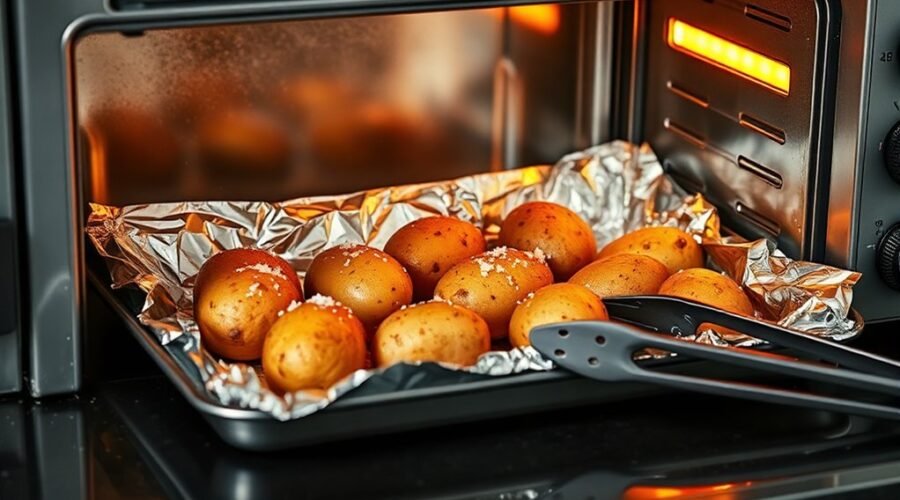
Getting restaurant-quality results when baking potatoes in a toaster oven comes down to managing airflow, oil-and-salt crust timing, and rack spacing. Bake scrubbed, dry, pierced Russets uncovered directly on the middle rack at 400°F (204°C) for 45 to 60 minutes (to 205°F–210°F internal), spacing multiple potatoes 1 to 2 inches apart—and apply oil and kosher salt either lightly upfront or during the final 10 to 15 minutes for maximum skin crunch.
Quick Answer
For the crispiest skin and fluffiest center, bake Russets bare on the center wire rack at 400°F for 40–45 minutes, brush with neutral oil and kosher salt, and finish for 10–15 minutes until the core hits 205°F–210°F. Leave 1–2 inches between spuds, drop to 375°F–400°F for sweet potatoes with a drip tray below, and never leave foil-wrapped potatoes at room temperature.
Crispy Skin vs. Fluffy Interior: Comparing Three Toaster-Oven Methods
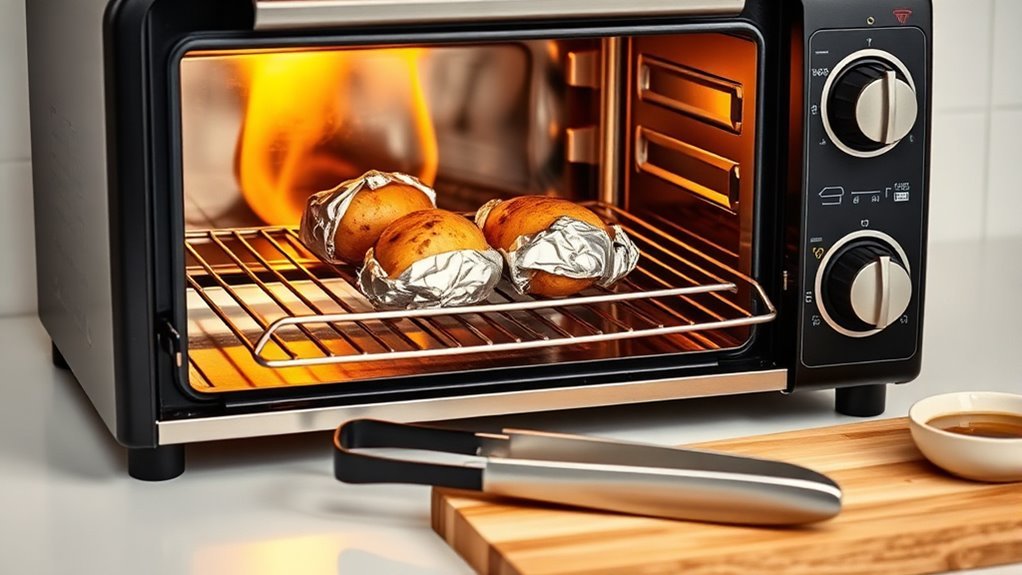
Every baked potato balances two opposing forces: escaping moisture dries and crisps the skin, while trapped heat gelatinizes internal starch into a light, fluffy crumb. Choosing the right surface prep decides whether your spud comes out crackly or soft-skinned.
| Method | Skin Texture | Interior Texture | Best For |
|---|---|---|---|
| Two-Stage Oil & Salt Crust (bare rack, then oil/salt last 15 min) | Maximum crackly steakhouse crunch | Very dry, ultra-fluffy | Eating the entire skin; loaded steakhouse spuds |
| Upfront Oil & Salt (¼ tsp oil + kosher salt before baking) | Crisp, golden, evenly seasoned | Fluffy and tender | Hands-off weeknight baking with one step |
| Foil-Wrapped (check oven manual; unwrap immediately after) | Soft, steamed, pliable | Moister, denser crumb | Diners who prefer soft skins (requires strict cooling safety) |
If you want a quick single-potato baseline first, check our How to Bake a Potato in a Toaster Oven: Time, Temp & Tips guide. Need dinner in under 25 minutes? Use our microwave-plus-crisp shortcut in How to Make Spud Potato in Oven Toaster.
Oil & Salt Crust Timing: Step-by-Step for Steakhouse Skin
Applying oil too heavily at the start can trap surface steam against the peel. Using the two-stage crust method lets the skin dehydrate first, then fries the outer millimeter into a crisp shell during the final stretch:
- Select uniform Russets: Pick firm, 8- to 10-ounce Russet (Idaho) potatoes of similar thickness so every potato finishes together.
- Scrub and dry completely: Wash under cool running water with a vegetable brush, then pat bone-dry with a clean kitchen towel.
- Prick for steam vents: Pierce each potato 6 to 8 times around the surface with a fork to prevent pressure buildup.
- Stage 1 — Dry bake at 400°F (204°C): Place potatoes directly on the center wire rack (1 to 2 inches apart) and bake uncovered for 40 to 45 minutes, flipping halfway if your heating elements run uneven.
- Stage 2 — Oil & kosher salt finish: Pull the rack forward, brush each hot skin lightly with ¼ to ½ teaspoon high-smoke-point oil (avocado, canola, or olive oil), and roll or sprinkle with coarse kosher salt.
- Crisp for 10 to 15 minutes: Return to the 400°F oven until a skewer slides in effortlessly and an instant-read thermometer reads 205°F–210°F.
- Split immediately: Slice an X into the top and gently squeeze the ends inward right away so trapped steam escapes instead of making the flesh gummy.
Multiple-Potato Rack Spacing & Airflow Rules
Toaster ovens have compact chambers where heating elements sit much closer to the food than in a full-size wall oven. Overcrowding causes two issues: potatoes touching each other stay pale and soggy at the contact points, and blocked airflow slows the center bake by 10 to 15 minutes.
- Keep 1–2 inches between every potato: Hot air must circulate 360 degrees around each skin.
- Use the center rack position: Keeps skins far enough from upper broil coils to avoid scorching before the core hits 205°F.
- Match batch count to chamber size: Bake 2–3 medium spuds max in a 4-slice toaster oven, or 4–6 medium spuds in a 6-slice countertop oven.
- Rotate at the halfway mark: Swap front-row and back-row potatoes at 25–30 minutes, since toaster oven doors lose slightly more heat than the rear wall.
- Skip solid baking sheets for Russets: Baking directly on the wire rack prevents a flat, steamed bottom—place a drip tray on the rack below if needed, never blocking the bottom elements.
Sweet Potato vs. Russet Adjustments in a Toaster Oven
Sweet potatoes bake beautifully in a toaster oven, but their higher sugar and water content requires small adjustments to prevent burnt drips and overly soft centers:
| Setting / Detail | Russet (8–10 oz) | Sweet Potato (8–10 oz) |
|---|---|---|
| Temperature | 400°F (204°C) | 375°F–400°F (190°C–204°C) |
| Bake Time | 45–60 minutes | 35–55 minutes (check early) |
| Internal Temp Target | 205°F–210°F (96°C–99°C) | ~205°F (96°C) |
| Rack & Drip Setup | Directly on center wire rack | Wire rack with foil-lined pan below to catch caramelized syrup drips |
| Oil & Salt | Neutral oil + kosher salt for crisp crust | Optional light oil; skip heavy salt if serving sweet |
Pros & Limitations of Baking Potatoes in a Toaster Oven
- Pros: Preheats in 3–5 minutes instead of 15 minutes; uses less electricity and heats up your kitchen far less than a full-size oven; small chamber produces strong radiative browning for crisp skins.
- Limitations: Limited batch capacity (typically 2–6 medium potatoes max); hot spots near heating elements require rotating halfway; parchment paper is often prohibited in toaster ovens (check manufacturer warnings).
USDA & CDC Food Safety: Foil-Wrapped Baked Potato Warning
Botulism Warning: Never leave foil-wrapped baked potatoes sitting at room temperature. Soil-borne Clostridium botulinum spores can survive baking; sealed foil traps moisture and blocks oxygen, allowing spores to produce botulinum toxin in the danger zone. Per USDA FSIS and CDC Botulism Prevention guidelines, keep foil-wrapped potatoes hot at 140°F or above, or unwrap/loosen the foil and refrigerate promptly.
- 2-hour refrigeration rule: Cool uncovered leftovers and refrigerate at 40°F (4°C) or below within 2 hours (1 hour if ambient temperature exceeds 90°F).
- Safe storage & reheating: Use refrigerated baked potatoes within 3 to 4 days and reheat to 165°F (74°C) before eating.
Key Takeaways
- Dry-bake Russets bare on the center wire rack at 400°F for 40–45 minutes, then oil and kosher-salt for the final 10–15 minutes for the crispiest skin.
- Leave 1 to 2 inches of spacing between potatoes and rotate halfway to overcome toaster-oven hot spots.
- Bake sweet potatoes at 375°F–400°F for 35–55 minutes with a drip pan below the rack to catch caramelized syrup.
- Unwrap foil-baked potatoes immediately before cooling and refrigerate within 2 hours to prevent Clostridium botulinum toxin risk.
Frequently Asked Questions
Should you oil and salt potatoes before baking or near the end for the crispiest skin?
For the crunchiest steakhouse-style skin, bake scrubbed, dried, pierced Russets bare on the rack at 400°F for 40 to 45 minutes so moisture evaporates freely, then brush lightly with neutral oil, sprinkle with kosher salt, and bake 10 to 15 minutes more. Oiling upfront still produces a pleasant crisp skin with less handling, just slightly softer than the late-oil crust method.
How many potatoes can you bake in a toaster oven at once?
A compact 4-slice toaster oven comfortably fits 2 to 3 medium Russets, while a 6-slice or countertop convection oven fits 4 to 6. Always leave at least 1 to 2 inches of open space between potatoes so hot air circulates evenly; crowding traps steam and softens the skins.
What internal temperature means a toaster-oven baked potato is done?
According to the Idaho Potato Commission, a Russet potato reaches its light, fluffy peak at an internal temperature of 205°F to 210°F (96°C to 99°C). Sweet potatoes also turn tender and caramelized around 205°F. A thin skewer or paring knife should slide into the center with zero resistance.
How do sweet potatoes differ from Russets when baking in a toaster oven?
Sweet potatoes contain more natural sugars and moisture than starchy Russets, so they bake slightly faster (35 to 55 minutes at 375°F to 400°F) and ooze sticky syrup as they cook. Always place a foil-lined drip pan on a lower rack—not directly wrapped around the potato—to catch sugary drips and prevent toaster-oven smoke.
Why is leaving foil-wrapped baked potatoes at room temperature dangerous?
Per USDA FSIS and CDC botulism prevention guidance, aluminum foil traps moisture and blocks oxygen, creating an anaerobic environment where heat-resistant Clostridium botulinum spores can germinate and produce deadly botulinum toxin if the potato cools at room temperature. Either keep foil-wrapped potatoes hot at 140°F or above, or unwrap/loosen the foil and refrigerate within 2 hours.
Sources
- Idaho Potato Commission: Ideal Temperature for a Baked Potato — 205°F–210°F internal temperature target for fluffy Russets.
- USDA FSIS: Clostridium botulinum & Botulism — risk of foil-wrapped baked potatoes held at room temperature.
- CDC: Botulism Prevention — keep foil-wrapped potatoes hot (≥140°F) or loosen foil and refrigerate promptly.
- USDA FSIS: Leftovers and Food Safety — 2-hour cooling rule, 3–4 day storage, and 165°F reheating target.