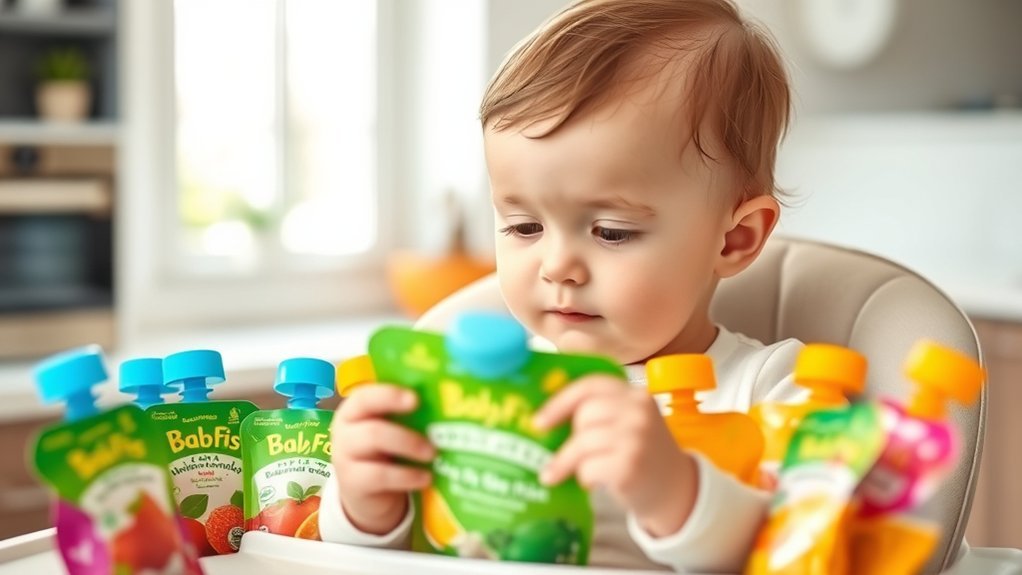
Baby food pouches can be convenient when you are traveling, short on time, or need an easy meal component for your baby. They are not automatically unhealthy, but the nutritional quality varies widely. The safest approach is to use pouches as part of a varied diet, check the label carefully, offer age-appropriate textures, and avoid relying on smooth purées for most meals.
Quick Answer
Baby food pouches can be safe and convenient when used appropriately, but they should not crowd out iron-rich foods, varied textures, or supervised family meals. Choose products without added sugars, check iron and other nutrients, serve age-appropriate portions, watch for recalls, and follow the package directions for refrigeration and leftovers.
Note: This article provides general feeding and food-safety information. A pediatrician or pediatric dietitian can give individualized advice if your baby has feeding difficulties, poor growth, allergies, iron concerns, developmental delays, or a medical condition that affects eating.
Key Takeaways
- Baby food pouches can be useful, but nutritional quality differs greatly between products.
- Most babies begin complementary foods at about 6 months when they show developmental signs of readiness; starting before 4 months is not recommended.
- Check the Nutrition Facts label for iron, added sugars, protein, fat, serving size, and ingredients instead of assuming a pouch is nutritionally complete.
- Organic baby food is not automatically lower in lead, arsenic, cadmium, or other environmental contaminants.
- Offer mashed, lumpy, chopped, and finger-food textures as your baby’s skills develop instead of relying only on smooth purées.
- Keep your baby upright and supervised while eating, follow storage directions, and check FDA recalls when you have a product-safety concern.
Understanding the Risks of Baby Food Pouches
Baby food pouches are not inherently dangerous. The main concern is what can happen when they become a large part of a baby’s diet: some products are mostly fruit purée, some contain little iron or protein, and many have the same smooth texture.
According to the CDC’s current infant-feeding guidance, most children can begin foods other than breast milk or infant formula at about 6 months. Introducing solid foods before 4 months is not recommended. Readiness also matters: your baby should have good head and neck control, be able to sit with support, bring objects toward the mouth, and swallow food instead of automatically pushing it out.
The World Health Organization recommends exclusive breastfeeding for the first 6 months when possible, followed by nutritionally adequate complementary foods while breastfeeding continues. For formula-fed babies in the United States, complementary foods are also generally introduced at about 6 months rather than according to a “4+ months” marketing label alone.
Warning: Do not start a pouch simply because the package says “4 months+.” Use your baby’s developmental readiness and your pediatrician’s advice, especially if your baby was born prematurely or has swallowing, growth, or developmental concerns.
Other concerns include frequent exposure to sweet foods, limited opportunities to practice chewing and handling food, contamination or packaging recalls, and overreliance on pouches that do not provide enough of nutrients such as iron.

Power your essentials anywhere with a 999Wh pure sine wave power station delivering up to 1000W continuous with 2000W surge. It supports fast charging via USB-C PD 60W and USB-A QC 18W, plus simultaneous output for multiple devices through AC, USB, wireless, and car/DC ports. Recharge using AC, car, or solar with a built-in MPPT controller and dual cooling fans, while the upgraded battery management system protects against surges, short circuits, and overheating.

DELICIOUS 18 COUNT VARIETY PACK: This variety pack contains (6) Protein & Fiber (apple, yogurt, raspberry, purple carrot, oat), (6) Iron & Zinc (apple, blueberry, spinach), and (6) Prebiotic Fiber (carrot, apple, sweet potato) pouches

Clearly Crafted: When it comes to caring for your baby, transparency is everything. Thats why we bring you Clearly Crafted. Our clear packaging lets you see the ingredients in each recipe, in all its vibrant color. its goodness you can see
The Benefits of Baby Food Pouches for Busy Parents
Baby food pouches do have practical advantages. The goal is not to avoid them completely, but to use their convenience without allowing them to replace dietary variety.
| Benefit | What It Means in Practice |
|---|---|
| Travel-friendly | Many unopened shelf-stable pouches travel well without refrigeration. Always check the package instructions. |
| Convenient portions | They can provide a quick component of a meal when cooking is impractical. |
| Ingredient variety | Some products combine fruits, vegetables, grains, legumes, dairy, or meat, although the nutritional balance still needs checking. |
| Portable backup | A sealed pouch can be useful during travel, appointments, or unexpected delays. |
| Low preparation | No chopping, cooking, or blending is needed, which can make complementary feeding easier on busy days. |
Convenience does not make every pouch nutritionally interchangeable with a meal. A fruit-only pouch, for example, may provide useful nutrients but little iron, fat, or protein.
Key Nutritional Shortcomings in Baby Food Pouches
Not all baby food pouches have the same nutritional weaknesses. A meat-and-vegetable pouch can look very different from a fruit-only purée, so judge the individual product rather than the packaging format alone.
Important areas to check include:
- Iron: Fruit and vegetable purées may contain little iron unless they include iron-rich or fortified ingredients.
- Protein and fat: Some fruit-heavy products provide very little of either, so they may work better as part of a meal than as the entire meal.
- Added sugars: Infants and young children should avoid added sugars. Check the “Includes Added Sugars” line on the Nutrition Facts panel rather than relying only on front-of-package wording.
- Fiber: Fiber content varies. Some purées retain useful fiber, while strained or highly processed products may provide less than the whole food.
- Texture: Even a nutritious smooth pouch cannot give your baby the same chewing, touching, grasping, and self-feeding practice as age-appropriate whole or mashed foods.
Infants ages 7–12 months have a recommended iron intake of 11 mg per day, according to the National Institutes of Health.
Because iron needs rise during later infancy, compare the iron amount on the label with your baby’s overall diet. The NIH Office of Dietary Supplements lists an iron recommendation of 11 mg per day for infants 7–12 months and 7 mg per day for children ages 1–3 years.
Pro Tip: If you use a fruit or vegetable pouch that contains little iron, pair it with an age-appropriate iron-rich food such as iron-fortified infant cereal, beans or lentils prepared to a safe texture, egg, meat, or another food recommended for your baby’s stage.
Heavy Metals in Baby Food: What You Need to Know
Lead, arsenic, cadmium, and mercury can enter foods through soil, water, air, agricultural conditions, and food processing. Their presence is not limited to pouches, and making baby food at home does not automatically eliminate them.
The FDA’s Closer to Zero program aims to reduce children’s dietary exposure to these contaminants as far as possible while maintaining access to nutritious foods.
In January 2025, the FDA finalized lead action levels for processed foods intended for babies and children younger than 2 years. The levels include:
| Food Category | FDA Lead Action Level |
|---|---|
| Fruits, most vegetables, mixtures, yogurts, custards/puddings, and single-ingredient meats | 10 parts per billion (ppb) |
| Single-ingredient root vegetables | 20 ppb |
| Dry infant cereals | 20 ppb |
These are action levels used by the FDA as part of its regulatory approach; they should not be interpreted as a target amount of lead that children need or as a guarantee that exposure below the level is risk-free.
Sources of Heavy Metals
Heavy metals and other toxic elements can reach foods in several ways:
- Lead and other contaminants can be present in soil or introduced by environmental pollution.
- Plants can absorb metals such as cadmium from soil as they grow.
- Rice tends to absorb more arsenic than many other cereal crops.
- Contamination can occasionally occur during processing, through an ingredient, or elsewhere in the supply chain.
One important misconception is that choosing organic food removes this risk. According to the American Academy of Pediatrics, organic baby foods may reduce exposure to some pesticides, but they can contain heavy-metal levels similar to non-organic foods because metals occur in the environment.
Reducing Toxic Metal Exposure
You cannot completely eliminate exposure to naturally occurring environmental contaminants through food, but you can avoid allowing one ingredient or food category to dominate your baby’s diet.
- Offer a varied diet with different fruits, vegetables, proteins, and grains.
- Rotate grains instead of relying only on rice cereal. Oat, barley, and multigrain infant cereals can provide alternatives.
- Choose iron-fortified infant cereals when appropriate for your baby’s diet.
- Check current FDA recalls if you are concerned about a particular product or lot.
- Do not assume an “organic” label means a product has lower heavy-metal levels.
The FDA maintains a 100 ppb action level for inorganic arsenic in infant rice cereal. It also recommends dietary variety rather than making rice the only grain offered to a baby.
For ordinary rice prepared at home, FDA research found that cooking rice in excess water—about 6 to 10 parts water to 1 part rice—and draining the extra water can reduce inorganic arsenic by roughly 40% to 60%, depending on the rice. However, this method can also wash away iron, folate, thiamin, and niacin from enriched rice, so grain variety remains the simpler everyday strategy.
Tips for Picking Safe Baby Food Pouches
Choosing a pouch is easier when you focus on the back label instead of front-of-package marketing.
- Check the age and ingredients. The ingredients should be foods your baby can safely eat at their developmental stage.
- Look for zero added sugars. Naturally occurring sugar from fruit can still appear under Total Sugars, so use the Added Sugars line to distinguish the two.
- Check iron. This is especially important once your baby reaches the later part of the first year.
- Look at the whole meal. A pouch with little protein or fat may be better paired with other foods rather than used alone.
- Check allergens. Read the ingredient and allergen statements every time, especially when trying a new flavor or brand.
- Inspect the package. Do not use a pouch that is leaking, swollen, punctured, damaged, or past the manufacturer’s use-by or best-by guidance.
- Keep the cap away from babies. Treat loose caps and damaged packaging as potential physical hazards.
- Check recalls. Search the FDA recall database when you hear about a baby-food safety issue or are unsure whether a product is affected.
Note: Third-party contaminant testing and transparent quality-control information can be useful when comparing brands, but no label claim or certification can guarantee that a food is completely free of naturally occurring environmental contaminants.
Why Texture and Variety in Baby Food Matters
Texture is part of learning to eat. The CDC recommends introducing different tastes and textures as your baby’s eating skills develop.
Smooth purées can be useful at the beginning of complementary feeding. Over time, however, babies also need opportunities to try mashed, lumpy, finely chopped, ground, and appropriate finger foods.
These experiences help children practice:
- chewing skills;
- moving food around the mouth;
- picking food up with their fingers;
- hand-to-mouth coordination;
- using utensils;
- accepting different tastes and food textures.
Occasional pouch use is not known to cause developmental problems. The concern is relying on smooth purées so heavily that your baby gets too few chances to practice other age-appropriate eating skills.
When practical, squeezing a pouch into a bowl or onto a spoon also lets your baby see, smell, touch, and interact with the food instead of consuming it directly through a spout.
Practical Tips for Incorporating Baby Food Pouches Safely
You can keep the convenience of pouches while making them a smaller part of a varied feeding routine.
Monitor Sugar Content
Do not assume that “no added sugar” means the pouch contains little total sugar. Fruit naturally contains sugar, and many fruit-heavy purées taste very sweet even when no table sugar or syrup has been added.
For infants and young children, the CDC advises avoiding added sugars. When comparing products:
- check the “Includes Added Sugars” line on the Nutrition Facts label;
- look at the ingredient order;
- choose vegetable, protein, grain, or mixed-meal options as well as fruit;
- avoid using very sweet pouches continuously throughout the day.
The NHS also advises against routinely allowing babies to suck directly from pouches because prolonged contact with sweet purées may increase tooth-decay risk. When practical, squeeze the food onto a spoon or into a bowl.
Encourage Variety in Diet
Use pouches alongside foods with different flavors and textures. Your baby’s menu can gradually include soft vegetables, fruit, iron-fortified cereal, beans, lentils, egg, meat, fish that is appropriate for infants, yogurt without added sugars, grains, and developmentally safe finger foods.
There is no need to make every meal perfect. The goal is variety over time rather than allowing one pouch flavor or one type of purée to become the main source of complementary food.
Feed Upright and Supervised
Keep your baby sitting upright and stay with them during every meal or snack. Do not hand a pouch to a baby in a stroller or car seat and treat it as unattended feeding.
Age-appropriate texture matters even when the food looks soft. Babies may gag as they learn new textures, but true choking can prevent effective breathing or sound and requires immediate action.
Warning: Keep pouch caps and loose packaging pieces out of reach, inspect the pouch before serving, and never leave a baby unattended while eating.
Store Opened Pouches Safely
Refrigerate an opened pouch promptly unless the manufacturer specifically instructs otherwise, and follow the package’s storage time.
The FDA’s general baby-food storage guidance gives different refrigeration times depending on the food: opened strained fruits and vegetables generally keep 2–3 days, meat or egg products about 1 day, and meat-and-vegetable combinations 1–2 days.
Do not leave baby food at room temperature for more than 2 hours. If your baby has eaten directly from the pouch spout, saliva can enter the remaining food, so the safest practice is to discard what is left rather than refrigerating it for another feeding.
Pro Tip: If you expect your baby to eat only part of a pouch, squeeze the portion you need into a clean bowl first. The untouched remainder can then be refrigerated according to the manufacturer’s directions.
When to Consult a Pediatrician About Baby Food
Most families can use baby food pouches without medical supervision, but certain situations deserve professional advice.
Contact your child’s pediatrician if you notice:
- persistent difficulty swallowing, coughing, or choking during meals;
- ongoing refusal of age-appropriate textures or difficulty advancing beyond smooth purées;
- concerns about growth or nutrient intake;
- possible iron deficiency or a diet with very few iron-rich foods;
- repeated vomiting, diarrhea, hives, or other possible food-allergy symptoms;
- concern that your child ate a recalled product associated with lead or another significant contaminant.
A pediatrician can decide whether your child needs nutrition changes, feeding therapy, allergy assessment, blood testing, or other evaluation.
Warning: A severe allergic reaction can be life-threatening. Call 911 or seek emergency care for sudden trouble breathing or swallowing, significant swelling of the tongue or throat, collapse, or other signs of anaphylaxis after eating.
Frequently Asked Questions
Can I Freeze Baby Food Pouches for Later Use?
Do not assume the commercial pouch itself is designed for freezing. Check the manufacturer’s instructions first. If you want to freeze untouched leftover food, transfer it to a clean freezer-safe container when appropriate. Do not freeze and save food that has been contaminated by saliva from direct feeding.
How Long Can Opened Baby Food Pouches Be Stored?
Follow the storage instructions on the pouch because products differ. FDA’s general guidance allows about 2–3 refrigerated days for opened strained fruits and vegetables, about 1 day for meat or egg products, and 1–2 days for meat-and-vegetable combinations. Discard leftovers if your baby ate directly from the spout.
Are Organic Baby Food Pouches Safer Than Non-Organic?
Not necessarily. Organic production can reduce exposure to some pesticides, but it does not guarantee lower lead, arsenic, cadmium, or mercury. These elements can occur naturally in soil and water and may be present in both organic and conventional foods.
Do Baby Food Pouches Require Refrigeration After Opening?
Most shelf-stable commercial pouches need refrigeration after opening. Follow the package directions, refrigerate promptly, and do not leave baby food at room temperature for more than 2 hours. If your baby has sucked directly from the spout, discard the remaining food instead of saving it.
Can Babies Choke on Baby Food Pouches?
Smooth purée from a pouch is not known to be uniquely likely to cause choking, but every baby should be supervised while eating. Keep the baby upright, use foods appropriate for their developmental skills, keep the cap out of reach, and discard any pouch with damaged packaging or possible foreign material.
What Should I Look for on a Baby Food Pouch Label?
Check the ingredient list, serving size, iron, protein, fat, Total Sugars, and Added Sugars. Look for ingredients appropriate for your baby’s age and allergy history. A fruit-heavy pouch can be convenient, but it may need to be paired with iron-, protein-, or fat-rich foods to create a more balanced meal.
How Often Should Babies Eat Food From Pouches?
There is no universal U.S. rule specifying a maximum number of pouches per week. The more important question is whether pouches are crowding out varied textures, iron-rich foods, family foods, and opportunities to practice self-feeding. Use them for convenience while continuing to offer a broad range of age-appropriate foods.
Are Homemade Baby Food Pouches Safer?
Homemade food gives you more control over ingredients, texture, and added sugar, but it is not automatically free of environmental contaminants. Safe preparation, refrigeration or freezing, clean equipment, appropriate textures, and dietary variety still matter.
Conclusion
Baby food pouches can be a useful part of complementary feeding, especially when convenience matters. The key is to treat them as one option rather than the foundation of your baby’s diet. Check the nutrition label, prioritize iron and dietary variety, avoid added sugars, offer increasingly varied textures, supervise every feeding, and follow storage instructions carefully.
Heavy metals are a real food-safety issue, but they are not unique to pouches and cannot be avoided simply by choosing organic products. A varied diet, sensible grain choices, current FDA guidance, and recall awareness are more useful ways to reduce avoidable exposure while still providing the nutrients your baby needs.
Sources
- CDC — When, What, and How to Introduce Solid Foods — timing, readiness, food variety, infant cereals, and choking prevention.
- FDA — Action Levels for Lead in Processed Food Intended for Babies and Young Children — current lead action levels for baby and toddler foods.
- FDA — What You Can Do to Limit Exposure to Arsenic — grain variety, infant rice cereal, and rice-cooking guidance.
- NIH Office of Dietary Supplements — Iron — recommended iron intake by age.
- FDA — Safe Storage of Baby Food — refrigeration, freezing, room-temperature limits, and leftover handling.
- NHS — How to Start Weaning — pouch use, texture progression, sugar, spoon feeding, and dental-health guidance.