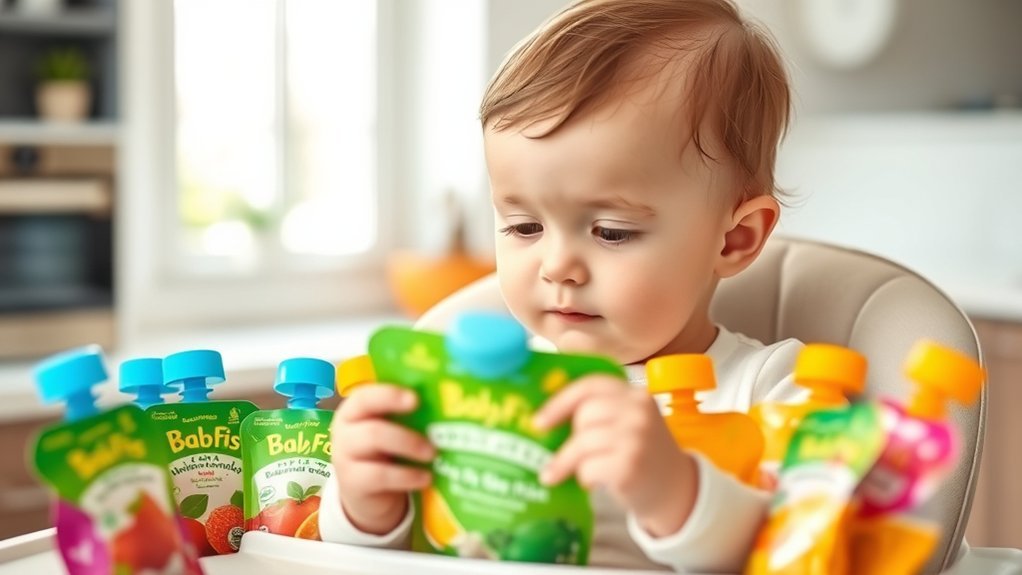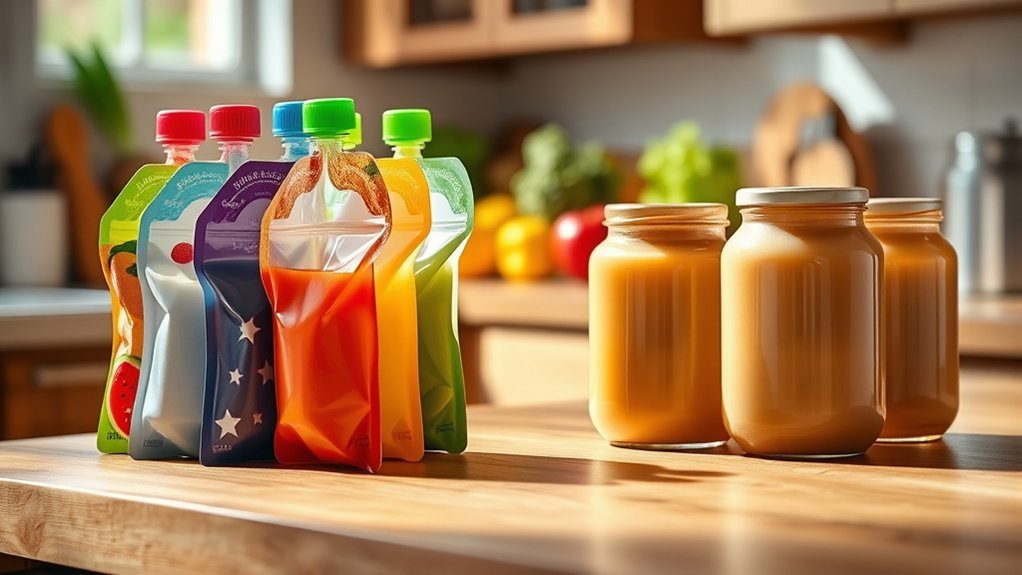
Baby food pouches and jars can both fit into a healthy feeding routine, but neither package is automatically more nutritious. Pouches are lighter and easier to carry, while jars make it easier to see, smell, spoon, and portion the food. The best choice depends on the ingredients, texture, serving method, storage needs, and your baby’s stage of feeding development.
Quick Answer
Baby food pouches are convenient for travel, but jars are often easier to portion and serve with a spoon. Nutrition depends more on the ingredient list than the package. Use both as needed, avoid added sugars, offer varied textures, and do not rely on direct-from-pouch feeding for every meal.
Key Takeaways
- The package does not determine nutritional quality. Compare the ingredient list, added sugars, total sugar, protein, iron, fat, sodium, serving size, and texture.
- Pouches are portable and less breakable, while jars are easier to portion, stir, inspect, and serve with a spoon.
- Directly sucking puree from a pouch provides less practice with spoons, chewing, food appearance, aroma, and varied textures.
- Food touched by a used spoon or your child’s mouth should not be saved for another feeding.
- Never microwave baby food in a jar or pouch. Transfer it to a microwave-safe dish, heat briefly, stir well, and test the temperature.
- Jars are commonly accepted by recycling programs, while flexible pouches often require special handling or disposal. Always check locally.
Baby Food Pouches vs. Jars at a Glance
| Feature | Pouches | Jars |
| Nutrition | Varies by product. Many blends are fruit-forward and may be high in total sugar even without added sugar. | Also varies by product. Single-ingredient foods may be easier to find in some product lines, but this is not guaranteed. |
| Convenience | Lightweight, portable, and difficult to break. Some have resealable caps. | Heavier and breakable, but easy to open, stir, portion, and serve at home. |
| Feeding Skills | Direct sucking is convenient but offers limited utensil, chewing, and sensory practice. The food can be squeezed onto a spoon instead. | Naturally supports spoon-feeding and portioning, although many jarred foods are still smooth purees. |
| Food Visibility | The child may not see or smell the food when eating directly from the spout. | The contents are visible through the container and while being served. |
| Storage | Follow the package instructions. Discard leftovers if the child ate directly from the pouch. | Easy to refrigerate if an untouched portion remains in the jar. Do not save food contaminated by a used spoon. |
| Recycling | Many flexible food pouches are not accepted curbside. Check the package label and local program. | Glass is commonly accepted, but jar and lid instructions vary by community. |
| Cost | Often priced for portability and convenience. Compare the unit price. | May cost less per ounce in some stores, but brand, ingredients, and serving size affect value. |
Power your essentials anywhere with a 999Wh pure sine wave power station delivering up to 1000W continuous with 2000W surge. It supports fast charging via USB-C PD 60W and USB-A QC 18W, plus simultaneous output for multiple devices through AC, USB, wireless, and car/DC ports. Recharge using AC, car, or solar with a built-in MPPT controller and dual cooling fans, while the upgraded battery management system protects against surges, short circuits, and overheating.

Premium Baby Food Storage Containers: The set has 20 food storage containers, 4 oz each. 5 colors, 4 of each color. There are many colors for easy differentiation of use and a large number to meet the daily needs of baby use. A pen can be used to write the name, date or other information on the lid to remind you what is inside the jar. Perfect for storing homemade baby food, solid baby food, fruit and vegetable purees, jams, etc

Premium Baby Food Storage Containers: The set has 8 food storage containers, 4 oz each. 8 colors, 1 of each color. There are many colors for easy differentiation of use and a large number to meet the daily needs of baby use. A pen can be used to write the name, date or other information on the lid to remind you what is inside the jar. Perfect for storing homemade baby food, solid baby food, fruit and vegetable purees, jams, etc
Understanding Baby Food Packaging
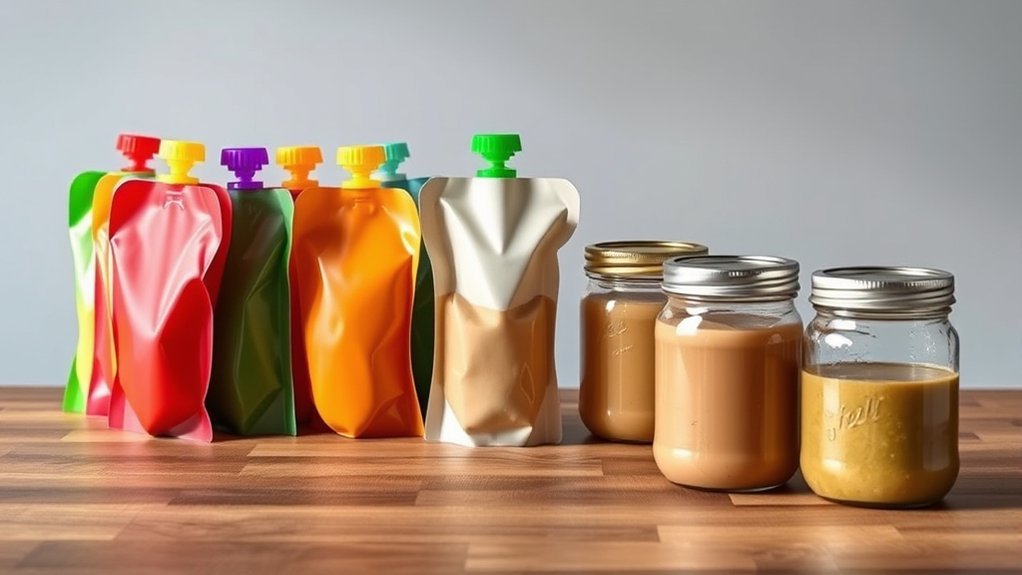
Jars and pouches are containers, not nutrition categories. A vegetable pouch can be more nutritious than a dessert-like jar, and a simple jar of peas can be a better everyday choice than a fruit-dominant pouch marketed with several vegetables on the front.
Glass jars are rigid, transparent, and easy to portion. You can see the food, stir it, smell it, and place a small serving in a separate bowl. Their main drawbacks are weight and breakage.
Pouches are light, portable, and useful when refrigeration, dishes, or a high chair may not be readily available. However, an opaque pouch makes it harder for a child to see the food, and direct sucking bypasses some of the sensory experience that occurs when food is served in a bowl or on a spoon.
The healthiest choice is not automatically the jar or the pouch. It is the product with suitable ingredients and texture, served in a way that supports safe and varied eating.
How to Compare Nutrition Labels
Research comparing commercial infant foods has found that pouch categories can contain more sugars and more fruit-based ingredients than comparable foods in other packages. That finding describes product categories, not every individual pouch or jar. The most reliable approach is to compare the actual labels in your hand.
A peer-reviewed comparison of commercial infant and toddler foods found that pouch products tended to contain more sugars and potentially less vegetable content than similar foods in jars or other packages. Another study found that some fruit- and vegetable-based pouch categories were more likely to include added sugars.
Check the First Three Ingredients
Ingredients appear in descending order by weight. A pouch named after spinach, kale, or carrots may still list apple, pear, banana, or sweet potato first. That does not make the product unsafe, but it may mean the flavor is sweeter and less vegetable-forward than the package suggests.
Choose a mixture of products rather than repeatedly buying blends built around the same sweet base. The American Academy of Pediatrics also advises parents to read ingredient labels because different blends may use the same first or second ingredient despite having different names.
Separate Total Sugar From Added Sugar
Total sugar includes naturally occurring sugar from fruit, vegetables, and dairy. Added sugar includes sweeteners added during processing. A fruit puree can contain considerable total sugar while still showing zero grams of added sugar.
The CDC recommends avoiding added sugars for infants and young children. Look for zero grams of added sugar and review the ingredient list for sugar, syrup, juice concentrate used as a sweetener, or other added sweeteners.
Note: “No added sugar” does not mean “low in total sugar.” A pouch made mostly from concentrated fruit puree may taste very sweet even without table sugar or syrup.
Look Beyond Fruit and Vegetables
Babies also need foods that supply iron, protein, fat, and other nutrients. When appropriate for your child’s age and feeding plan, rotate among vegetables, fruits, meats, beans, lentils, eggs, yogurt, grains, nut or seed ingredients prepared safely, and other nutrient-dense foods.
Check the serving size and compare:
- Iron: Especially important during infancy. Fortified cereals, meats, beans, lentils, and other iron-containing foods can help diversify intake.
- Protein and fat: Fruit-only purees may provide little of either nutrient.
- Sodium: Choose lower-sodium products when comparing similar foods.
- Allergens: Read every ingredient list, especially when introducing milk, egg, peanut, tree nuts, wheat, soy, sesame, fish, or shellfish.
- Texture and age stage: Make sure the texture matches your child’s current abilities rather than relying only on the age printed on the front.
The Convenience Factor: Why Parents Choose Pouches
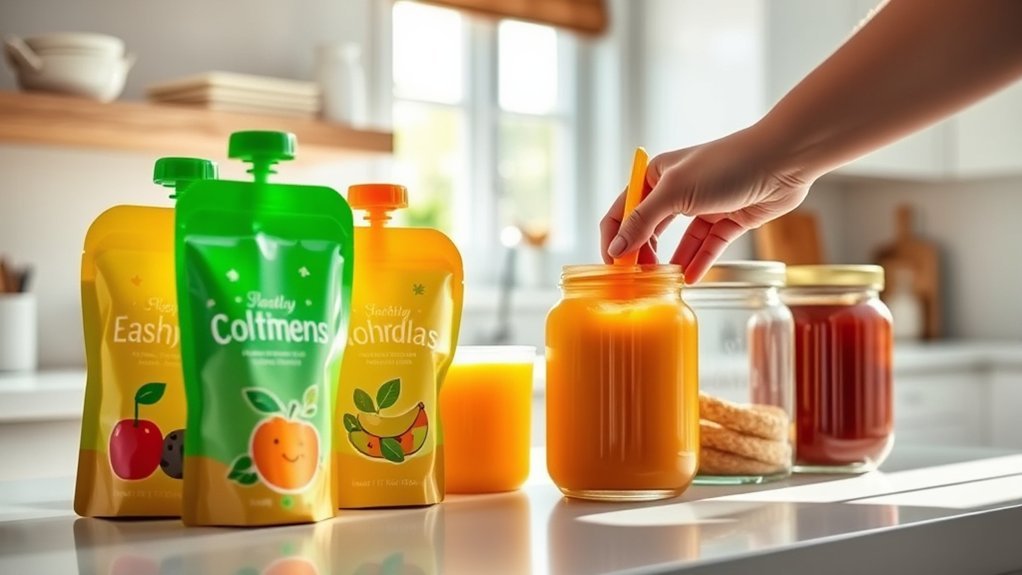
Pouches can be useful during travel, errands, daycare pickup, appointments, and other situations in which carrying a glass container and spoon is inconvenient. They fit easily into a diaper bag, are less likely to break, and can reduce cleanup.
Some pouches can be recapped before they have touched the child’s mouth. However, a cap does not make contaminated leftovers safe. Once a child sucks from the spout, saliva can enter the package, so the remaining food should not be saved for a later feeding.
Pouches may also help toddlers practice holding a container independently. That convenience should be balanced with regular opportunities to sit at a table, see the food, touch safe foods, use utensils, drink from a cup, and eat increasingly varied textures.
Pro Tip: Squeeze pouch food into a bowl or onto a spoon when practical. You keep the portability of the pouch while giving your child a better view of the food and more utensil practice.
Feeding Skills and Texture Development
Starting solid foods is not only about calories and nutrients. Babies also learn how food looks, smells, feels, and moves in the mouth. They gradually develop spoon skills, chewing movements, hand-to-mouth coordination, cup skills, and the ability to manage thicker and lumpier foods.
Directly sucking smooth puree from a pouch requires less chewing and provides less exposure to the food’s appearance and aroma. The American Academy of Pediatrics notes that overreliance on pouches may limit oral-motor and sensory experiences because the child consumes the food through sucking rather than seeing, touching, and chewing it.
This does not mean pouches must be avoided. Instead:
- Offer pouches as one option rather than the only feeding method.
- Squeeze puree onto a spoon so your baby can practice taking food from it.
- Move toward thicker, mashed, lumpy, finger, and table-food textures as your child becomes developmentally ready.
- Give your child chances to hold safe finger foods and age-appropriate utensils.
- Let your child decide how much to eat instead of pressuring them to empty the jar, pouch, or bowl.
The CDC encourages children to practice with fingers, spoons, forks, and cups as their skills develop. There is no evidence-based rule requiring a fixed percentage of spoon-fed meals.
Warning: Always have your child sit upright and remain within reach while eating. Do not allow eating while lying down, crawling, walking, riding in a moving stroller, or playing. Seek medical advice if your child repeatedly coughs, chokes, gags excessively, pockets food, struggles to swallow, or has poor growth.
Essential Safety Tips for Serving and Storing Baby Food
Saliva can transfer bacteria from a used spoon or pouch spout into the remaining food. The FDA advises placing a serving in a separate dish rather than feeding from a jar that will be returned to the refrigerator.
How to Handle Leftovers
- Wash your hands before preparing or serving food.
- Use a clean spoon to place the amount you expect your child to eat into a separate bowl.
- Immediately recap and refrigerate the untouched portion according to the package instructions.
- Discard food left in the serving bowl after the meal.
- Discard the remaining contents of a jar or pouch if a used spoon or your child’s mouth contacted the container.
- Keep the refrigerator at 40°F or below.
How Long Opened Baby Food Lasts
Storage time depends on the ingredients. According to FoodSafety.gov guidance for pureed and solid baby food:
- Opened or freshly made strained fruits and vegetables generally keep for two to three days in the refrigerator.
- Strained meats and eggs generally keep for one day.
- Meat-and-vegetable combinations generally keep for one to two days.
- Homemade baby foods generally keep for one to two days.
Always follow a shorter storage period printed by the manufacturer. When the label does not clearly cover your situation, use the more cautious limit.
How to Reheat Baby Food
Do not microwave baby food in a glass jar or flexible pouch. Transfer the portion to a microwave-safe dish. Heat it briefly, stir thoroughly, let it stand for at least 30 seconds, and test the temperature before serving. The food should feel lukewarm, not hot.
Microwaves can create hot spots even when the container feels cool. Stirring and testing are therefore necessary every time.
Inspect the Package Before Serving
Do not use a product if:
- The jar is cracked, chipped, leaking, or missing its vacuum seal.
- The lid is bulging, loose, badly dented, or does not make the expected opening sound.
- The pouch is swollen, leaking, punctured, unusually sticky, or damaged around the seal.
- The food smells unusual, appears moldy, spurts unexpectedly, or has changed in a way not explained by normal ingredient separation.
- The product has expired or is included in an active recall.
Contaminants, Heavy Metals, and Recalls
A jar is not automatically safer than a pouch when it comes to lead, arsenic, cadmium, or mercury. These contaminants may enter foods through soil, water, ingredients, and processing. FDA guidance for processed foods intended for babies and young children applies to foods in jars, pouches, tubs, and boxes.
In January 2025, the FDA finalized action levels for lead in several categories of processed baby food. Packaging choice alone does not eliminate exposure.
Parents can reduce repeated exposure to any one contaminant by serving a varied diet across food groups and rotating ingredients and grains. Check current FDA recall notices when a product has been recalled or appears abnormal.
Note: Homemade food is not guaranteed to contain fewer environmental contaminants. Variety, safe preparation, reliable ingredients, and appropriate storage remain important for both homemade and commercial foods.
Recycling Baby Food Packaging
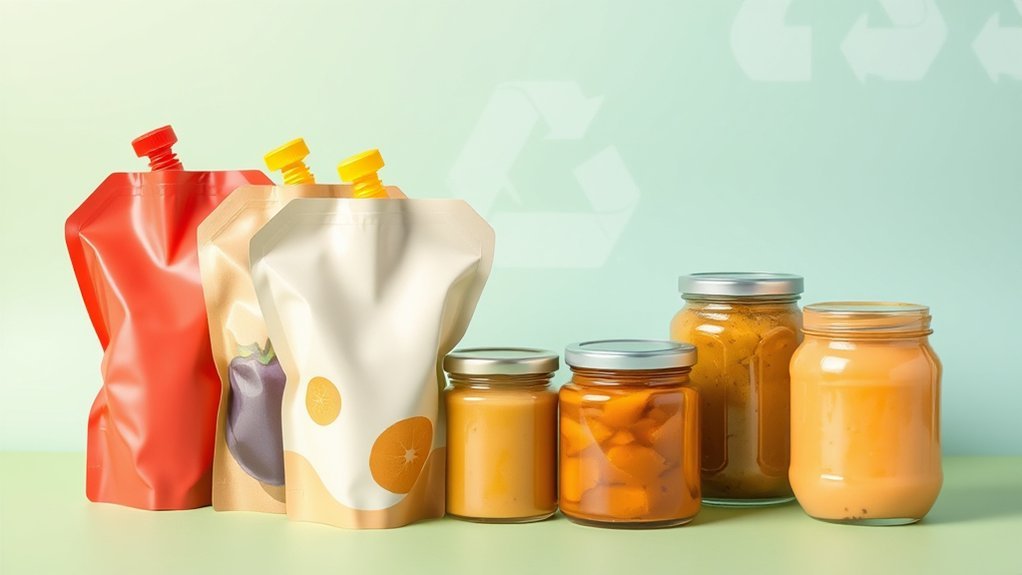
Glass baby food jars are accepted by many community recycling programs, but acceptance is not universal. Some programs want lids removed, while others prefer them replaced on the empty container. Rinse the jar and follow your local instructions rather than relying on a single national rule.
Flexible baby food pouches are commonly made from several bonded materials. Many cannot go into a standard curbside bin, and wet baby-food packaging may not qualify for store-drop-off film recycling. Look for a recycling label on the pouch and confirm the instructions with your local recycling provider.
The U.S. Environmental Protection Agency recommends checking locally because programs accept different types of glass and plastic packaging.
Reusable food pouches may reduce single-use packaging when they are designed to be fully opened, washed, rinsed, and dried. Replace them if seams, spouts, caps, or interior surfaces become damaged or cannot be cleaned completely.
Cost: Are Pouches Worth It?
Pouches may cost more per ounce in some stores because buyers are paying for portable, lightweight packaging. However, there is no reliable universal percentage that applies to every brand and retailer.
Compare value by looking at:
- The unit price per ounce rather than the package price alone.
- The number and quality of ingredients.
- Whether the product contains meaningful protein, iron, fat, or fiber.
- How much food your child normally eats at one sitting.
- Whether unused food can be refrigerated without contamination.
- The amount of breakage, leakage, or food waste likely in your routine.
A lower-cost jar may be the better everyday option at home, while a more expensive pouch may be worth buying for occasional travel. Families can also use homemade food in clean food-grade containers when that approach fits their budget and schedule.
How to Choose Between Pouches and Jars
Use the following checklist rather than judging a product by its package alone:
- Match the texture to your child’s abilities. Smooth puree may be appropriate early on, but older babies also need opportunities to progress toward thicker and more textured foods.
- Read the full ingredient list. Confirm that the foods pictured on the package are present in meaningful amounts.
- Avoid added sugars. Also watch for fruit-heavy blends that are very high in total sugar.
- Look for nutrient variety. Rotate fruits and vegetables with iron-rich, protein-rich, and fat-containing foods.
- Consider how the food will be served. A pouch can still be placed on a spoon, and food from a jar can be offered alongside safe finger foods.
- Check the seal and expiration date. Do not buy or serve damaged, leaking, swollen, or unsealed packages.
- Compare unit prices. Include likely leftovers and waste in the calculation.
- Use both when useful. Jars, pouches, homemade foods, mashed family foods, and safe finger foods can all have a place in a varied feeding routine.
Speak with your pediatrician or a pediatric dietitian if your child was born prematurely, has food allergies, has a medical condition affecting nutrition, struggles with textures, coughs during meals, or is not growing as expected.
Frequently Asked Questions
Can baby food pouches be reused after opening?
Do not wash and refill a single-use commercial pouch unless the manufacturer specifically designed it for reuse. An untouched portion may sometimes be refrigerated according to the package directions, but any food remaining after your child has sucked from the spout should be discarded. Washable reusable pouches are separate products and must be fully cleaned and dried after every use.
Are jars safer for homemade baby food storage?
Glass jars can be suitable, but they are not automatically safer than food-grade plastic containers. Use a clean container with a tight lid, refrigerate the food promptly, follow safe storage times, and discard food contaminated by a used spoon. Do not reuse damaged jars or commercial jars that are not intended for home canning.
How long can I store an opened baby food jar?
It depends on the food. Refrigerated strained fruits and vegetables generally keep for two to three days, strained meats and eggs for one day, and meat-and-vegetable combinations for one to two days. Follow the manufacturer’s label when it gives a shorter limit. Discard the remainder if a used spoon entered the jar.
Do pouches contain more preservatives than jars?
Not necessarily. Either product may be shelf-stable because it was heat processed and sealed rather than because preservatives were added. Check the ingredient list on each product instead of assuming that the package type determines its additives.
Can I microwave baby food jars safely?
No. Transfer the food to a microwave-safe dish before heating. Warm it briefly, stir thoroughly, let it stand for at least 30 seconds, and test the temperature before serving. Never microwave a sealed jar, a metal lid, or a flexible food pouch.
Are baby food pouches bad for babies?
Pouches are not inherently bad. They can be a practical part of a varied diet, especially during travel. Problems are more likely when sweet, smooth pouches replace most meals and reduce exposure to spoons, cups, chewing, visible foods, and age-appropriate textures.
What should I look for when buying a pouch or jar?
Choose a texture your child can manage, zero grams of added sugar, a short and recognizable ingredient list, and a useful mix of nutrients. Check which ingredients appear first, inspect the seal, confirm the expiration date, and avoid damaged, swollen, leaking, or recalled products.
Conclusion
Baby food pouches offer portability and quick cleanup, while jars make portioning, spoon-feeding, and inspecting the food easier. Neither option is always healthier. Compare the ingredients and nutrition label, avoid added sugars, offer a variety of flavors and textures, and use safe serving and storage practices.
Pouches work best as one tool among many rather than a complete replacement for bowls, spoons, cups, finger foods, and family meals. A flexible approach lets you use the convenience of pouches without missing the sensory and feeding experiences that help children build long-term eating skills.
Sources
- Centers for Disease Control and Prevention: Foods and Drinks to Avoid or Limit — guidance on avoiding added sugars for infants and young children.
- Centers for Disease Control and Prevention: Fingers, Spoons, Forks, and Cups — feeding-skill and utensil-development guidance.
- U.S. Food and Drug Administration: Once Baby Arrives — safe serving practices and saliva-contamination guidance.
- FoodSafety.gov: Children Under Five — refrigerated storage periods and safe reheating instructions for baby food.
- U.S. Food and Drug Administration: Action Levels for Lead in Processed Foods for Babies and Young Children — current lead guidance covering foods sold in jars, pouches, tubs, and boxes.
- Nutritional Content and Ingredients of Commercial Infant and Toddler Food Pouches Compared With Other Packages — peer-reviewed comparison of sugar, ingredients, and nutritional characteristics.