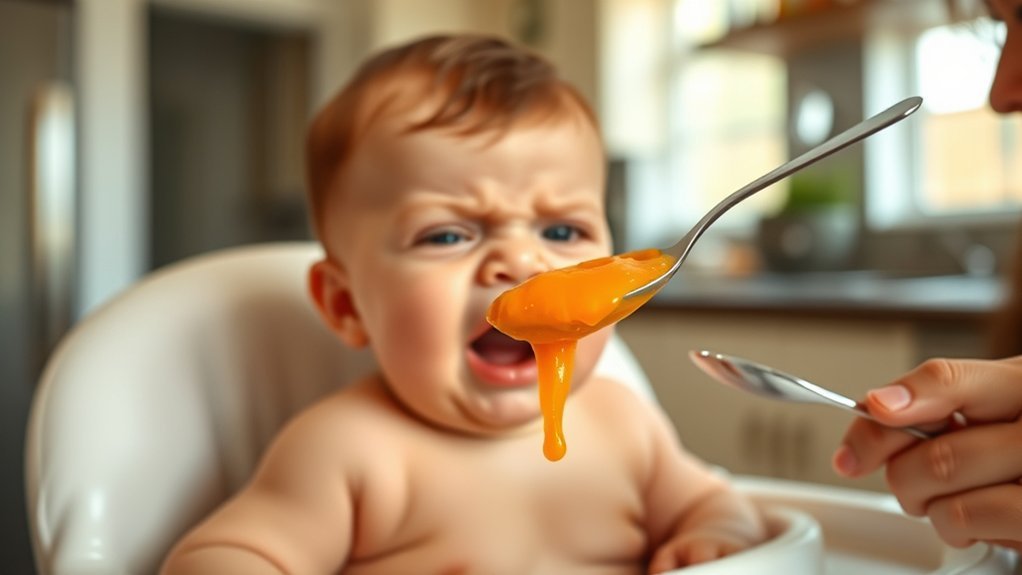
If your baby coughs while eating solids, an occasional cough, gag, or sputter can happen while they learn to manage new textures. However, coughing at most meals, coughing often with liquids, breathing changes, or a wet or gurgly sound after swallowing should not be brushed off. Knowing the difference between gagging, effective coughing, and severe choking helps you respond safely and know when to contact your baby’s healthcare provider.
Quick Answer
Occasional coughing or gagging can happen as a baby learns to eat solids, especially with unfamiliar textures. Stay close and let a baby who is breathing and coughing forcefully work the food forward. A weak or absent cough, inability to cry, blue color, breathing trouble, or unresponsiveness can signal severe choking and requires immediate action.
Key Takeaways
- Some coughing, gagging, or spitting up can occur while babies adjust to new food textures, but repeated coughing during meals can signal a feeding or swallowing problem.
- A baby who is gagging or coughing forcefully can usually still move air. Severe choking may cause a weak or absent cough, inability to cry, blue color, altered responsiveness, or apnea.
- Do not perform a blind finger sweep. If an infant has severe choking, current American Heart Association guidance calls for repeated cycles of 5 back blows followed by 5 chest thrusts while emergency help is activated.
- Seat your baby upright, supervise every meal, and prepare foods in a shape and texture that match their developmental skills.
- Seek medical advice for repeated coughing with meals, especially with liquids, wet or gurgly sounds, breathing problems, prolonged feeding, recurrent respiratory infections, or poor weight gain.
At a Glance
| Time Required | Ongoing supervision at every meal; choking emergencies require immediate response |
| Difficulty | Beginner feeding skills; infant CPR/choking training strongly recommended |
| Tools Needed | Stable high chair, developmentally appropriate foods, close adult supervision, access to a phone in an emergency |
| Cost | Usually no extra feeding cost; CPR/first-aid course fees vary |
Note: This article provides general educational information and is not a substitute for care from your child’s pediatrician, feeding specialist, or emergency medical services. Call 911 or your local emergency number for severe choking, breathing difficulty, blue or gray color, unresponsiveness, or a severe allergic reaction.
Why Babies Cough While Eating Solids: Understanding the Causes

When your baby starts eating solids, you may notice an occasional cough, gag, or sputter. The Centers for Disease Control and Prevention (CDC) notes that these reactions can occur while babies adjust to new textures.
Coughing is one of the body’s airway-protection responses. Babies are also developing the oral motor coordination needed to move food through the mouth, chew increasingly textured foods, and coordinate swallowing with breathing.
An occasional cough can occur while a baby learns new textures, but repeated coughing during or after meals deserves closer attention.
Frequent coughing is different from an occasional learning-related cough. According to the American Speech-Language-Hearing Association (ASHA), coughing during or after eating or drinking can be associated with feeding or swallowing difficulties. Other warning signs can include poor chewing, wet or gurgly sounds, chronic congestion, unusually long meals, or trouble gaining weight.
If your baby coughs frequently with thin liquids, coughs at most meals, appears distressed while swallowing, or has other feeding concerns, discuss the pattern with your pediatrician. A feeding or swallowing assessment may be appropriate.
Recognizing the Difference Between Gagging and Choking
Gagging, effective coughing, and severe choking are different events. Learning their typical signs can help you avoid unnecessary intervention during a gag while still recognizing an emergency quickly.
| What You See | Typical Signs | What to Do |
|---|---|---|
| Gagging | Retching, gagging sounds, tongue moving forward, watery eyes, possible coughing; baby continues moving air | Stay close and calm. Let the baby work the food forward. Do not put your fingers into the mouth unless an object is clearly visible and easily removable. |
| Effective cough / mild airway obstruction | Strong cough or strong cry; baby is still moving air | Encourage coughing and watch closely for worsening symptoms. |
| Severe choking | Weak or absent cough, inability to cry, blue or gray color, apnea, or altered responsiveness | Activate emergency medical services and begin age-appropriate choking first aid immediately. |
The 2025 American Heart Association and American Academy of Pediatrics pediatric basic life support guidance recommends allowing an infant with a mild obstruction and an effective cough to keep coughing while being watched for signs that the obstruction is becoming severe.
Warning: If an infant has a weak or absent cough, cannot cry, turns blue or gray, stops breathing, or becomes less responsive, treat it as severe choking. Activate emergency medical services and begin infant choking first aid. Do not perform a blind finger sweep.
Top Reasons Babies Gag While Eating: What to Know

Gagging is a protective reflex that can help move food away from the back of the throat. It is especially common while a baby is gaining experience with solids and learning how much food to move around the mouth at one time.
Common triggers include unfamiliar textures, pieces that are difficult for the baby’s current skills to manage, taking too much food at once, and new sensory experiences such as different tastes or temperatures.
The CDC explains that babies can begin with smooth mashed, pureed, or strained foods and move toward thicker, lumpier, finely chopped, or ground foods as their eating skills develop. Gagging does not have to disappear completely before textures progress.
Repeated or severe gagging, especially when accompanied by frequent coughing, breathing changes, food refusal, poor growth, or difficulty advancing textures, should be discussed with your baby’s healthcare provider or a feeding and swallowing specialist.
What to Do if Your Baby Gags on Food
When your baby gags but is still breathing, making sounds, or coughing effectively, stay close and observe. Gagging is often noisy and can look dramatic, but unnecessary attempts to remove food can push it farther back.
Stay Calm and Reassure
Keep your baby upright in the high chair and stay within arm’s reach. A calm response helps you watch what is actually happening instead of reacting to the noise alone.
Do not place your fingers into your baby’s mouth to sweep for food you cannot see. Blind finger sweeps can push an object deeper into the airway. If an object is clearly visible and easy to remove, remove only what you can see and reach safely.
Allow Baby to Self-Regulate
If your baby is gagging, breathing, and moving air effectively, give them a moment to work the food forward. Babies gradually learn to control bite size, move food around their mouths, and coordinate chewing and swallowing.
| Mealtime Practice | Why It Helps |
|---|---|
| Allowing an effective gag or cough to resolve while closely supervising | Avoids unnecessary interference while the baby is still moving air |
| Offering developmentally appropriate self-feeding opportunities | Lets the baby practice grasping, chewing, and managing food |
| Keeping meals calm and supervised | Reduces rushing and helps the caregiver notice changes quickly |
Monitor for Allergic Reactions
Gagging by itself is not the same as a food allergy. However, new foods can occasionally trigger allergic reactions, so watch for symptoms such as hives, swelling, vomiting, wheezing, sudden coughing, trouble swallowing, or breathing difficulty.
According to the American Academy of Pediatrics’ HealthyChildren guidance, immediate IgE-mediated food-allergy symptoms usually occur within minutes to a few hours after exposure. Some non-IgE food reactions can occur later.
Warning: Call 911 or your local emergency number for trouble breathing, severe wheezing, throat or tongue swelling, blue or gray color, collapse, marked limpness, or another suspected life-threatening allergic reaction. If your child has prescribed epinephrine, use it according to the child’s emergency allergy plan.
When first introducing foods, the CDC recommends offering one single-ingredient food at a time and waiting 3 to 5 days before another new food so it is easier to identify a problem if one occurs.
How to Create a Positive Eating Environment
A calm, closely supervised eating environment lets your baby focus on learning to chew and swallow while making it easier for you to notice signs of difficulty.
| Action | Purpose | Sensory Exploration |
|---|---|---|
| Create a calm atmosphere | Reduces rushing and distractions | Let your baby touch safe food textures |
| Minimize distractions | Helps your baby focus on eating | Introduce a variety of tastes over time |
| Sit nearby at the same level | Keeps supervision close and supports interaction | Model eating and chewing |
| Offer a variety of safe foods | Builds experience with tastes and textures | Offer soft foods in age-appropriate shapes |
| Maintain predictable mealtime routines | Creates a consistent eating setting | Let your baby practice safe self-feeding as skills develop |
When to Seek Medical Help

One brief cough while learning a new texture is different from coughing that repeatedly occurs with eating or drinking. Pay attention to the pattern rather than waiting for a specific number of days.
Seek emergency help immediately if your baby:
- Cannot breathe or has severe difficulty breathing.
- Has a weak or absent cough and cannot cry during a suspected choking episode.
- Turns blue or gray around the lips or face.
- Stops breathing or becomes unresponsive.
- Develops signs of a severe allergic reaction, such as breathing difficulty or significant tongue or throat swelling.
Contact your baby’s pediatrician or feeding professional if you notice:
- Repeated coughing during or immediately after meals.
- Frequent coughing when drinking thin liquids.
- Wet, gurgly, or congested-sounding breathing or voice during or after feeds.
- Repeated choking or unusually frequent gagging.
- Difficulty chewing or moving food through the mouth.
- Meals that regularly take an unusually long time.
- Food refusal or inability to advance to developmentally appropriate textures.
- Recurrent respiratory infections or pneumonia.
- Poor weight gain or concerns about hydration or nutrition.
These findings do not automatically mean your baby has a swallowing disorder, but they are reasons to ask for professional assessment. Pediatricians may involve a speech-language pathologist or another clinician with pediatric feeding and swallowing expertise when appropriate.
Tips for Safer Feeding and Reducing Gagging
You cannot prevent every gag because gagging is a protective reflex. You can, however, make meals safer by choosing appropriate textures, positioning your baby correctly, and avoiding common choking hazards.
Choose Appropriate Food Textures
There is no single required first-food order. Around the time solids begin, many babies find smooth, mashed, pureed, or strained foods easier to manage. As eating skills improve, gradually introduce thicker, lumpier, finely chopped, ground, and soft finger foods.
| Texture | Examples |
|---|---|
| Smooth or mashed | Mashed avocado, banana, smooth cooked vegetables |
| Thicker or lumpy | Mashed sweet potato, soft-cooked vegetables, thicker cereal |
| Finely chopped or ground | Finely chopped soft foods, ground meat, soft cooked grains |
| Soft finger foods | Soft ripe fruit, soft-cooked vegetables, or other foods prepared in an age-appropriate shape and size |
Food should be soft enough and prepared in a way your baby can manage with their current chewing and swallowing skills. Avoid assuming that a particular shape is safe for every baby or every developmental stage.
Monitor Baby’s Positioning
Seat your baby upright in a stable high chair or another safe feeding seat. Use the restraint system as intended so your baby does not slide or climb out.
The CDC’s choking-prevention guidance recommends having young children sit up while eating rather than lying down, crawling, walking, or eating while moving in a stroller or car.
Keep mealtimes calm, avoid rushing, and supervise continuously. Staying close matters more than simply being in the same room.
Pro Tip: Before serving a food, ask whether its texture, shape, and size match what your baby can currently chew and swallow. Softening, mashing, shredding, or cutting a food differently can reduce choking risk without limiting variety.
Common Food Choking Hazards to Watch For
Food preparation matters as much as the food itself. The CDC advises avoiding or modifying foods that are hard, round, sticky, or difficult for a young child to chew and swallow.
Common hazards include:
- Whole or uncut grapes, cherries, berries, and cherry tomatoes.
- Whole nuts and seeds.
- Thick spoonfuls or chunks of nut or seed butter.
- Hot dogs, sausages, and other cylindrical foods served in round pieces.
- Hard pieces of raw carrot or apple.
- Popcorn, pretzels, chips, and similar hard snacks.
- Large or tough chunks of meat.
- Large chunks of cheese.
- Hard candy, gummy candy, chewing gum, and marshmallows.
Cook firm fruits and vegetables until soft when needed, remove bones and hard pits, and alter round or cylindrical foods so they are less likely to seal the airway. Always continue supervising even after your baby becomes comfortable with finger foods.
The Importance of First Aid Training for Parents
Infant CPR and choking training gives parents and caregivers a chance to practice emergency skills before they are needed. Current techniques can change over time, which is another reason to take an up-to-date course rather than relying only on memory or an old handout.
What to Do for Severe Infant Choking
For an infant under 1 year old with signs of severe foreign-body airway obstruction, the 2025 American Heart Association/American Academy of Pediatrics guidance recommends the following general response:
- Activate the emergency response system. Call 911 or your local emergency number, or have someone else call.
- If the infant is responsive, give 5 back blows.
- Follow with 5 chest thrusts.
- Repeat cycles of 5 back blows and 5 chest thrusts until the object is expelled or the infant becomes unresponsive.
- If the infant becomes unresponsive, begin CPR according to current pediatric BLS guidance and follow the emergency dispatcher’s instructions. Check for a visible object before giving breaths, but do not perform a blind finger sweep.
Abdominal thrusts are not recommended for infants. For a baby who is coughing forcefully or crying strongly, do not begin severe-choking maneuvers; allow the baby to cough while you watch closely for deterioration.
Note: Reading instructions is not a substitute for hands-on infant CPR and choking training. A certified course lets you practice correct positioning, force, and technique with an instructor.
When to Introduce Solid Foods and What to Start With
The CDC and American Academy of Pediatrics recommend introducing foods other than breast milk or infant formula at about 6 months of age. Introducing solids before 4 months is not recommended.
Breast milk or infant formula remains the main source of nutrition during much of the first year while complementary foods gradually become a larger part of your baby’s diet.
Ideal Age for Solids
Age is only part of the decision. Signs that your baby may be developmentally ready include:
- Sitting upright alone or with support.
- Controlling the head and neck.
- Opening the mouth when food is offered.
- Swallowing food instead of consistently pushing it back out.
- Bringing objects toward the mouth.
- Reaching for or grasping objects or food.
- Moving food from the front toward the back of the tongue to swallow.
If your baby was born prematurely or has developmental, neurological, airway, or swallowing concerns, ask the baby’s healthcare team about the safest timing and feeding approach.
First Food Recommendations
You do not have to start foods in a particular order. Appropriate first foods can include mashed avocado or banana, unsweetened applesauce, soft-cooked vegetables, iron-rich meats or proteins, and iron-fortified cereals.
Choose textures your baby can manage safely and gradually offer variety across vegetables, fruits, proteins, dairy foods without added sugars when appropriate, and grains.
Avoid adding salt or sugar unnecessarily. Do not give honey before 12 months because of the risk of infant botulism, and do not use cow’s milk as the main drink before 12 months.
Introducing Allergenic Foods
The CDC recommends introducing potentially allergenic foods when other complementary foods are introduced rather than delaying them without a medical reason. These foods can include egg, peanut in an infant-safe form, wheat, dairy foods, and other common allergens.
Peanut guidance depends partly on allergy risk. The National Institute of Allergy and Infectious Diseases peanut-allergy prevention guidelines recommend that infants with severe eczema, egg allergy, or both be considered for evaluation before peanut introduction and, when appropriate, receive age-appropriate peanut-containing foods as early as 4 to 6 months after other solids show developmental readiness. Infants with mild to moderate eczema can generally have age-appropriate peanut-containing foods introduced around 6 months.
Never give an infant whole peanuts, whole nuts, or a thick spoonful of peanut butter because these are choking hazards.
Resources for Supporting Your Baby’s Feeding Journey
Reliable guidance can make the transition to solids safer and less stressful. Useful resources include:
- Your pediatrician: for questions about readiness, growth, allergies, reflux, or repeated coughing and gagging.
- A pediatric feeding or swallowing specialist: when your baby has repeated coughing, choking, difficulty advancing textures, prolonged meals, or other feeding-skill concerns.
- CDC infant and toddler nutrition guidance: for current information about solid-food readiness, textures, choking prevention, and food preparation.
- Infant CPR and first-aid training: for hands-on practice responding to choking and cardiac or breathing emergencies.
A simple food diary can also be helpful when you are introducing new foods or trying to identify a pattern involving coughing, gagging, vomiting, rash, or other symptoms. Record the food, texture, amount, timing, and what you observed so you can give your baby’s clinician a clearer history.
Frequently Asked Questions
How Can I Tell if My Baby Is Allergic to Certain Foods?
Watch for symptoms such as hives, swelling, vomiting, sudden coughing, wheezing, trouble swallowing, or breathing difficulty after a new food. Immediate IgE-mediated reactions usually begin within minutes to a few hours. Seek emergency care for breathing trouble, significant throat or tongue swelling, blue or gray color, collapse, or another suspected severe reaction.
What Age Is Appropriate for Introducing Allergenic Foods?
Potentially allergenic foods can generally be introduced when complementary foods begin at about 6 months rather than being deliberately delayed. Infants with severe eczema, egg allergy, or both need individualized guidance about peanut introduction and may be candidates for peanut-containing foods as early as 4 to 6 months after clinical evaluation and confirmation that they are developmentally ready for solids.
How Can I Encourage My Baby to Try New Textures?
Offer developmentally appropriate textures gradually, starting with foods your baby can manage and moving toward thicker, lumpier, finely chopped, ground, and soft finger foods as skills improve. Let your baby touch and explore foods, model eating, keep meals relaxed, and continue offering foods without pressure.
Is It Normal for Babies to Refuse Certain Solid Foods?
Yes. Babies do not always accept a new taste or texture the first time. Continue offering a variety of safe foods without forcing your baby to eat. Some children need repeated exposures before becoming comfortable with an unfamiliar food.
What Signs Indicate My Baby Is Ready for More Complex Foods?
Look at your baby’s overall eating skills rather than waiting for gagging to disappear completely. Signs of progress include better head and trunk control, moving food around the mouth, chewing soft foods, swallowing safely, picking up food, and managing the current texture without repeated distress or coughing.
What Should I Do if My Baby Coughs but Is Still Breathing?
If the cough is strong and your baby is still breathing or crying effectively, let the baby cough while you watch closely. Do not perform a blind finger sweep. Be ready to act if the cough becomes weak or absent, your baby cannot cry, breathing stops, color changes, or responsiveness decreases.
When Should Repeated Coughing During Meals Be Evaluated?
Contact your baby’s healthcare provider if coughing repeatedly happens during or after eating, especially with liquids, or if it occurs with wet or gurgly sounds, breathing difficulty, frequent choking, very long meals, recurrent respiratory infections, food refusal, or poor weight gain. These patterns can warrant a feeding and swallowing evaluation.
Conclusion
Learning to eat solids takes practice, and an occasional gag, cough, or sputter can happen as your baby develops new feeding skills. The key is knowing what is reassuring and what is not. A baby who is breathing and coughing forcefully can usually be watched closely, while a weak or absent cough, inability to cry, breathing trouble, blue or gray color, or unresponsiveness is an emergency.
Safe positioning, developmentally appropriate food preparation, continuous supervision, and current infant CPR and choking training can make mealtimes safer. If coughing happens repeatedly during meals or comes with other swallowing, breathing, or growth concerns, ask your baby’s healthcare provider for an evaluation rather than assuming it is simply part of learning to eat.
Sources
- Centers for Disease Control and Prevention — When, What, and How to Introduce Solid Foods — developmental readiness, food introduction, textures, and allergy-monitoring guidance.
- Centers for Disease Control and Prevention — Choking Hazards — food preparation, seating, supervision, and common choking hazards.
- American Heart Association — 2025 Pediatric Basic Life Support Guidelines — current infant foreign-body airway obstruction recognition and response.
- American Speech-Language-Hearing Association — Pediatric Feeding and Swallowing — signs associated with pediatric feeding and swallowing disorders.
- National Institute of Allergy and Infectious Diseases — Peanut Allergy Prevention Guidelines — peanut introduction recommendations for infants at different allergy-risk levels.
- American Academy of Pediatrics / HealthyChildren — Food Allergies in Children — food-allergy symptoms, reaction timing, and warning signs.