Baby food labels can help you compare products, but the front of the package rarely tells the whole story. The most useful information is in the product name, ingredient list, allergen statement, serving size, and Nutrition Facts panel. Read those areas together, then confirm that the texture and suggested age suit your baby’s feeding skills.
Quick Answer
To read a baby food label, check the product name and serving size first. Next, read the ingredients from first to last, review the allergen statement, choose products with 0 g added sugars and little or no added salt, and compare iron, protein, and other nutrients between similar foods.
Key Takeaways
- Ingredients appear in descending order by weight, so the first few ingredients tell you most about what is in the package.
- Current federal guidance advises avoiding added sugars during infancy and early childhood. Check both “Added Sugars” and the ingredient list.
- A serving size is a label reference, not an instruction that your baby must finish that amount.
- Check the “Contains” statement and ingredient list for milk, egg, peanut, wheat, soy, sesame, and other major allergens.
- The USDA Organic seal describes how ingredients were produced. It does not guarantee better nutrition or freedom from all residues or environmental contaminants.
- Package age and stage wording is only a starting point. Your baby also needs the head control, sitting ability, swallowing skills, and safe texture needed for the food.
At a Glance
| Time Required | About 2–3 minutes per product |
| Difficulty | Easy once you know where to look |
| Tools Needed | The package label; a phone can help check recalls or unfamiliar ingredients |
| Cost | No additional cost |
Warning: This guide provides general label-reading information, not individualized medical advice. Ask your pediatrician about starting solids, premature birth, poor growth, kidney conditions, swallowing problems, special diets, or known or suspected food allergies. Seek urgent care for breathing trouble, facial swelling, severe vomiting, or other signs of a serious allergic reaction.
Why Reading Baby Food Labels Is Essential for Your Child’s Health
Packaged baby food can be convenient, but products with similar front labels may have very different ingredients, textures, added sugars, sodium levels, and nutrient profiles. Reading the complete label helps you choose a food that fits your baby’s current needs instead of relying on fruit pictures, organic wording, or broad claims such as “wholesome.”
A 2024 study of 651 infant and toddler foods sold by 10 major U.S. retailers found that 60% failed at least one nutrition criterion in the WHO Europe model used by the researchers. Forty-four percent exceeded that model’s total-sugar criterion, and nearly all failed at least one promotional requirement. Those findings do not mean every baby food is unhealthy, but they show why the back and side panels deserve more attention than package marketing.
The front of the package sells the product. The ingredient list and Nutrition Facts panel help you evaluate it.

Power your essentials anywhere with a 999Wh pure sine wave power station delivering up to 1000W continuous with 2000W surge. It supports fast charging via USB-C PD 60W and USB-A QC 18W, plus simultaneous output for multiple devices through AC, USB, wireless, and car/DC ports. Recharge using AC, car, or solar with a built-in MPPT controller and dual cooling fans, while the upgraded battery management system protects against surges, short circuits, and overheating.

7G OF PROTEIN FOR BABY: Beech-Nut Meat Baby Food is a savory blend of real pureed chicken & chicken broth. Each jar contains 7 grams of protein to help keep baby full.

MADE WITH USDA CERTIFIED ORGANIC & NON-GMO SIMPLE INGREDIENTS: Beech-Nut Organics baby food is made with real organic apple cooked over indirect heat to preserve color, flavor and nutrients.
How to Read a Baby Food Label Step by Step
- Identify the actual product. Read the formal product name, not only the large flavor words or pictures on the front.
- Check the intended age and texture. Confirm that your baby is developmentally ready and can safely manage the consistency.
- Read the serving size. Note the amount used to calculate calories and nutrients and the number of servings in the container.
- Scan the ingredient list. Focus on the first three ingredients and look for added sweeteners, salt, and unnecessary fillers.
- Check allergens. Read both the complete ingredient list and any “Contains” statement.
- Review added sugars, sodium, and key nutrients. Compare foods in the same category and intended age group.
- Inspect the package and directions. Check the seal, date, storage instructions, preparation directions, and recall status when needed.
Pro Tip: Compare like with like. A fruit puree will naturally contain more total sugar than a vegetable-and-meat meal, so comparing those two products by sugar grams alone will not tell you which is more appropriate.
Decoding the Ingredient List: What to Look For
Ingredients are listed in descending order by weight. The first ingredient is present in the greatest amount, followed by the next-largest ingredient. For a product labeled “spinach, peas, and pear,” check whether spinach and peas actually appear near the beginning or whether pear puree, juice concentrate, water, or starch makes up most of the product.
Choose foods built mainly from recognizable, nutrient-dense ingredients. A longer list is not automatically bad: iron, vitamin C, cultures, herbs, or the scientific names of vitamins can serve a useful purpose. The goal is to understand what each ingredient contributes rather than reject every unfamiliar word.
| Label Area | What to Look For | Why It Matters |
|---|---|---|
| First ingredients | The foods promised by the product name | Shows what makes up most of the product |
| Sweeteners | No sugar, syrup, honey, or juice concentrate added mainly for sweetness | Current guidance advises avoiding added sugars during infancy and early childhood |
| Salt and sodium ingredients | No added salt when a comparable unsalted choice is available | Helps avoid unnecessary sodium and a strongly salty flavor |
| Allergens | Milk, egg, fish, crustacean shellfish, tree nuts, peanuts, wheat, soy, and sesame | Important for safe introduction and known allergies |
| Fortification | Iron and other added vitamins or minerals when appropriate | Can help a product provide nutrients needed during complementary feeding |
Match the Flavor Name to the First Ingredients
Front-label pictures may highlight several fruits or vegetables even when a sweeter fruit puree is the dominant ingredient. This is not automatically unsafe, but it may make the product less useful when your goal is to expose your baby to a less-sweet vegetable, grain, or protein food.
Check the Allergen Statement
Under U.S. labeling rules, major allergens must be declared by their common food source. A package may identify them within the ingredient list, in a separate “Contains” statement, or both. Read the full list every time because recipes can change. The FDA explains the difference between ingredient declarations and precautionary wording in its food-allergen label guidance.
Current federal guidance recommends introducing potentially allergenic foods with other complementary foods at about 6 months in safe forms. Babies with severe eczema, egg allergy, or both may need clinician-guided peanut introduction as early as 4–6 months.
Understanding the Nutrition Facts Panel and Its Importance
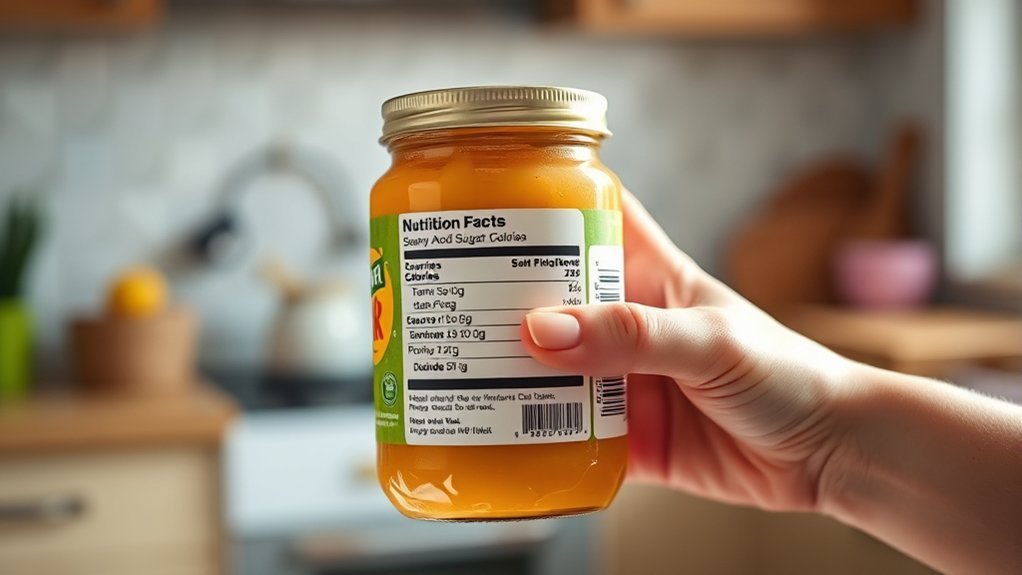
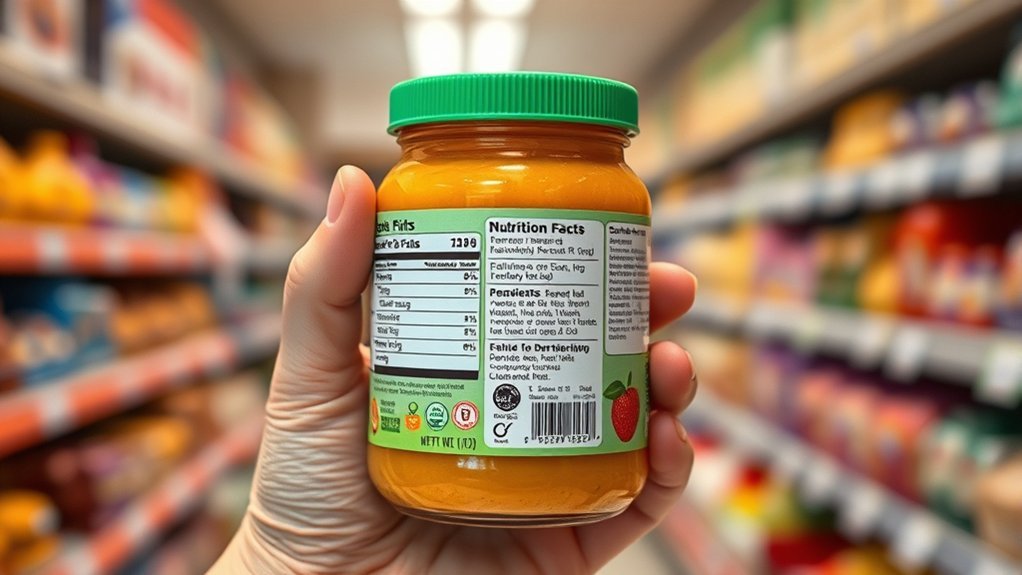
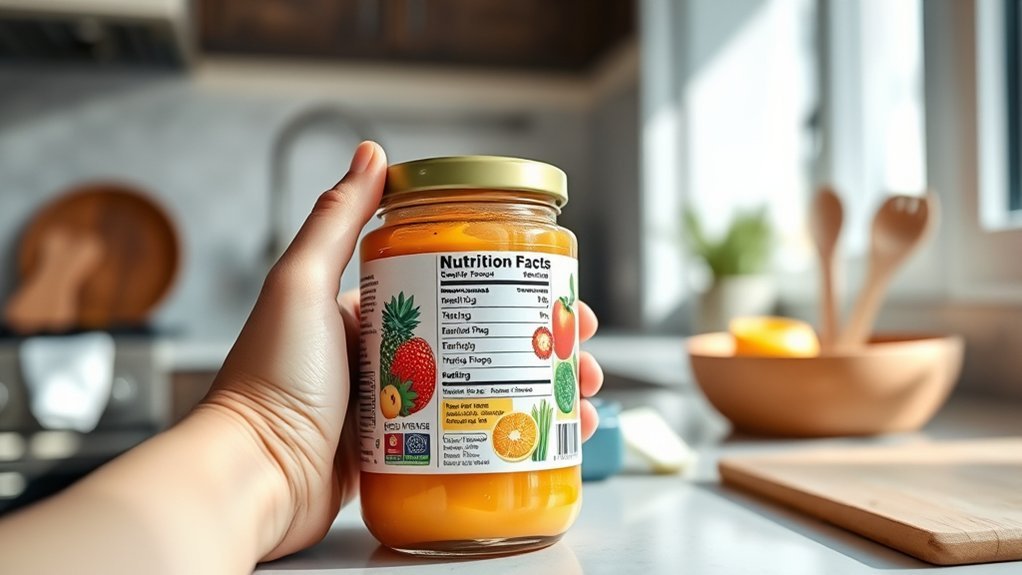
The Nutrition Facts panel shows the serving size, servings per container, calories, macronutrients, sodium, added sugars, and listed vitamins and minerals. Start at the top because every number below it applies to the stated serving.
Foods intended for infants through 12 months and children ages 1–3 may use Daily Values designed for those age groups. Do not assume that every % Daily Value is based on an adult 2,000-calorie diet. Confirm the product’s intended age and compare products designed for the same group.
The FDA’s general rule is that 5% DV or less is low and 20% DV or more is high. That guide is useful when an appropriate %DV is shown, but it does not replace your pediatrician’s advice or turn a single serving into a complete picture of your baby’s diet.
Nutrients Worth Comparing
- Iron: Around 6 months, babies begin needing nutrient-dense complementary foods, including iron-rich options such as meat, poultry, seafood, legumes, and iron-fortified cereal.
- Protein: Useful in meals and snacks, but the amount needed depends on the food category. Fruit puree is not expected to provide as much protein as a meat, bean, yogurt, or mixed meal.
- Fat: Fat supports energy needs and development. A product should not be judged as poor merely because it contains naturally occurring fat from foods such as yogurt, avocado, meat, or seeds.
- Vitamin D, calcium, and potassium: These may appear on the panel and can help with comparison, though one baby-food container does not need to supply every nutrient.
- Fiber: Fiber can be helpful, but the number varies greatly by product type and processing method.
Note: No single jar, pouch, or meal has to be perfect. Look at the pattern across the day and week, including breast milk or infant formula, family foods, and a variety of complementary foods.
How to Identify the Right Serving Size for Your Baby
The serving size appears near the top of the Nutrition Facts panel. It may be listed in ounces, grams, tablespoons, a fraction of a pouch, or one container. Some small containers hold one serving, while larger tubs and pouches may contain more than one.
The labeled serving is the amount used for calculating the nutrition information. It is not a command to feed that exact amount or to encourage your baby to finish the container. Babies may eat only a spoonful when first learning and gradually eat more as their skills and appetite develop.
Offer an appropriate portion, watch for hunger and fullness cues, and stop when your baby closes their mouth, turns away, pushes food aside, or loses interest. Speak with your pediatrician if feeding is consistently difficult, your baby coughs or chokes during meals, or you are concerned about growth.
How to Spot Added Sugars in Baby Food Labels
Start with the “Includes X g Added Sugars” line on the Nutrition Facts panel. For infant and early-childhood foods, the best first screen is generally 0 g added sugars. The 2025–2030 Dietary Guidelines for Americans advise avoiding added sugars during infancy and early childhood.
Then read the ingredient list. Added sweeteners may appear as sugar, cane sugar, corn syrup, rice syrup, agave syrup, honey, molasses, dextrose, glucose, fructose, sucrose, maltose, or fruit juice concentrate used to sweeten the food.
Warning: Never give honey to a child younger than 12 months. Honey can contain spores that cause infant botulism, even when it is organic, raw, or used in a homemade recipe.
Total Sugar Is Not the Same as Added Sugar
Total Sugars includes naturally occurring sugar from ingredients such as fruit, vegetables, and dairy as well as any added sugar. A fruit puree can therefore show several grams of total sugar while still listing 0 g added sugars.
There is no universal federal rule requiring all baby food to contain less than 7 g of total sugar per 4 ounces. Instead, first avoid added sugars, then compare total sugar among similar products. For example, compare one apple puree with another apple puree, or one yogurt product with another yogurt product.
Don’t Be Fooled: Spotting Misleading Marketing Terms
Front-label wording can be useful, but no single phrase proves that a product is nutritious or suitable for your baby. Read the regulated information on the back or side before making a decision.
- “Natural”: Does not tell you the amount of added sugar, sodium, iron, protein, or other nutrients.
- “No added sugar”: Does not mean 0 g total sugar. Fruit- or dairy-based products can still contain naturally occurring sugar.
- “Organic”: Refers to compliance with USDA production and handling standards. It does not automatically mean lower sugar, lower sodium, or better overall nutrition.
- “Non-GMO”: Addresses genetic-engineering practices, not the complete nutrient profile.
- “Made with vegetables”: Check where those vegetables appear in the ingredient list and whether sweeter fruit is the main ingredient.
- Age or stage wording: Use it as a starting clue, then check texture, ingredient complexity, and your baby’s developmental readiness.
Why Organic Certification Matters for Baby Food
Organic certification can matter to families who prefer food produced under USDA organic farming and handling standards. It is a meaningful regulated label, but it should be understood accurately and used alongside the ingredient list and Nutrition Facts panel.
Importance of Organic Ingredients
USDA organic standards restrict the use of most synthetic pesticides and fertilizers, prohibit excluded methods such as genetic engineering, and include requirements for certified farms and processors. Organic certification does not mean that a food contains no pesticide residue, no naturally occurring contaminants, or more nutrients than every conventional alternative.
Choose organic when those production standards match your priorities and budget. Do not feel that a conventional product with a simple ingredient list is automatically an unsafe or inferior choice.
Regulations by USDA
According to the USDA organic-labeling rules:
- “100 percent organic” products must contain only certified organic ingredients and processing aids, apart from allowed exclusions such as water and salt.
- “Organic” products must contain at least 95% certified organic ingredients, excluding water and salt.
- “Made with organic…” products must contain at least 70% certified organic ingredients and cannot display the USDA Organic seal as though the whole product were certified organic.
Impact on Baby Health
The seal does not provide enough information to judge the food by itself. An organic fruit pouch can still be sweet, low in protein, or less useful than a mixed meal for a particular feeding occasion. A conventional meat-and-vegetable puree may supply more iron and protein. Compare the complete product rather than treating “organic” as a health score.
Organic certification also does not certify that a product is free from lead, arsenic, cadmium, or mercury. Those contaminants can enter food through soil, water, and other environmental sources.
Understanding Sodium’s Impact on Baby Health
Sodium is an essential nutrient involved in fluid balance, nerve signaling, and muscle function. Babies need some sodium, but they do not need foods made noticeably salty, and many basic fruits, vegetables, grains, dairy foods, and protein foods contain sodium naturally.
Sodium’s Role in Development
The goal is not to eliminate sodium. It is to avoid unnecessary added salt and to keep one processed food from contributing a disproportionate amount. Check both the sodium line and the ingredient list for salt, sodium chloride, or salty flavoring ingredients.
When comparing two similar purees, cereals, meals, or snacks, the lower-sodium option is generally the more practical choice when the ingredients and nutrient value are otherwise comparable.
Recommended Sodium Limits
The National Academies’ sodium Dietary Reference Intakes list Adequate Intakes of 110 mg per day for infants through 6 months and 370 mg per day for infants ages 7–12 months. An Adequate Intake is an estimate of intake considered sufficient; it is not a maximum or a reason to add salt to food.
The 2025–2030 Dietary Guidelines recommend less than 1,200 mg of sodium per day for children ages 1–3. There is no universal rule requiring every baby-food serving to contain less than 200 mg. Product type, serving size, age, and the rest of the diet all matter.
Consequences of Excess Sodium
Frequently serving strongly salted foods can make it harder to maintain a balanced eating pattern and may encourage a preference for salty flavors. A practical label strategy is to choose foods without added salt when available, limit highly processed salty snacks, and compare the sodium content of equivalent products.
Do not use adult sodium targets or the adult 2,300 mg Daily Value as an infant feeding goal. Ask your pediatrician or a pediatric dietitian for individual guidance if your child has kidney, heart, fluid-balance, or growth concerns.
What Baby Food Labels Cannot Tell You About Heavy Metals
Lead, arsenic, cadmium, and mercury can occur in foods because these elements are present in the environment. A typical retail ingredient list or Nutrition Facts panel does not show the actual contaminant level in a particular batch.
The FDA’s Closer to Zero initiative works to reduce exposure from foods eaten by babies and young children. In January 2025, the agency issued final lead action-level guidance for several categories of processed foods intended for children younger than 2.
Because the label cannot provide a complete contaminant assessment, use several practical safeguards:
- Offer a varied diet rather than relying heavily on one grain, fruit, vegetable, or brand.
- Rotate grains such as oats, barley, quinoa, and multigrain cereal instead of using rice products exclusively.
- Check FDA and USDA recall notices when a product is named in a safety alert.
- Do not assume that organic certification means heavy-metal-free.
- Discuss specific exposure concerns with your pediatrician rather than removing broad food groups without guidance.
How to Check Package Freshness and Storage Instructions
Before buying or opening baby food, inspect the package as carefully as the nutrition label.
- Glass jars: The center safety button should be down before opening, and the lid should pop when first opened. Do not use jars with chipped glass, rusty lids, bulging lids, leaks, or broken seals.
- Pouches and tubs: Avoid packages that are swollen, leaking, punctured, badly crushed, or already open.
- Date and lot code: Follow the printed date and manufacturer’s instructions. Keep the lot code or photograph it if a recall or complaint occurs.
- Storage: Follow the label’s refrigeration and use-after-opening directions rather than applying one storage period to every product.
- Serving: Spoon a portion into a clean bowl. Do not feed directly from a jar and then refrigerate the saliva-contaminated remainder.
The FDA provides additional handling instructions in its baby-food safety guidance.
Tips for Choosing the Best Baby Food Products
Use this order when two products appear similar:
- Choose the texture that your baby can manage safely.
- Check that the first ingredients match the product name.
- Choose 0 g added sugars.
- Favor no-added-salt or lower-sodium options when comparing equivalent foods.
- Look for useful nutrient density, including iron-rich protein foods or iron-fortified cereal as part of a varied diet.
- Check allergens and preparation directions.
- Compare price per ounce or serving only after the food meets the nutrition and safety criteria.
Foods marketed as “first foods” or for a particular month range are not automatically suitable for every baby. The current Dietary Guidelines say complementary foods may begin at about 6 months, while breast milk or iron-fortified infant formula remains the main source of nutrition through 12 months. Readiness signs include sitting alone or with support, controlling the head and neck, bringing objects to the mouth, opening the mouth for food, and swallowing rather than pushing food back out.
Pro Tip: Keep a photo of a product’s ingredient list and Nutrition Facts panel when your baby first tries it. The photo can help you identify the food and lot information if a reaction occurs or the recipe changes later.
Frequently Asked Questions
How can I tell if baby food is fresh?
Check the printed date, seal, lid, pouch, and storage directions. A jar’s safety button should be down before opening, and the lid should pop when opened. Do not use a leaking, swollen, punctured, cracked, chipped, rusty, or previously opened package.
Are homemade baby foods better than store-bought foods?
Neither option is automatically better. Homemade food allows control over ingredients and texture, while commercial food offers convenience, consistent packaging, and clear nutrition information. Both can fit a healthy diet when prepared safely, offered in an age-appropriate texture, and used as part of a varied eating pattern.
What are the signs of spoiled baby food?
Discard food with an unusual odor, color, texture, mold, leakage, swelling, broken seal, or damaged container. Do not taste food to test its safety. Also discard food left on a serving dish after contact with your baby’s mouth.
How often should I introduce a new baby food?
When your baby is first starting solids, offering one new single-ingredient food and waiting about three to five days can make a reaction easier to identify. The wait does not prevent food allergy. Common allergenic foods should not be delayed solely for allergy prevention, and babies with severe eczema or egg allergy need pediatric guidance about peanut introduction.
Can I mix different baby foods together?
Yes. Once each ingredient has been tolerated, mixing age-appropriate foods can add variety and nutrients. Keep the texture safe, avoid honey before 12 months, and do not mix in added sugar or unnecessary salt.
Does organic baby food mean it is safer?
Not automatically. USDA Organic is a regulated production standard, but it does not guarantee superior nutrition, zero pesticide residue, or freedom from environmental contaminants. Check the ingredients, allergens, added sugars, sodium, package condition, and recall information regardless of certification.
Should I avoid baby food that contains any sugar?
Focus on avoiding added sugars. Naturally occurring sugars in fruit, vegetables, and plain dairy count toward Total Sugars but are not the same as sweeteners added during processing. Compare total sugar only between similar types of food.
Can the label tell me whether baby food contains lead or arsenic?
Usually not. Ingredient lists and Nutrition Facts panels do not normally display batch-level contaminant results. Offer a varied diet, avoid depending heavily on one ingredient, follow FDA safety updates, and discuss specific exposure concerns with your pediatrician.
Conclusion
Reading a baby food label becomes easier when you follow the same order every time: confirm the product and texture, check the serving size, read the first ingredients, review allergens, look for 0 g added sugars, compare sodium and useful nutrients, and inspect the package and storage directions.
No front-label term—including “natural,” “organic,” “non-GMO,” or a stage number—can replace that complete review. Choose a variety of age-appropriate, nutrient-dense foods, follow your baby’s hunger and fullness cues, and ask your pediatrician for guidance when feeding, allergy, growth, or medical concerns make the decision less straightforward.
Sources
- U.S. Food and Drug Administration: How to Understand and Use the Nutrition Facts Label — serving size, nutrients, and % Daily Value guidance
- Dietary Guidelines for Americans, 2025–2030 — complementary feeding, readiness, allergens, nutrient-dense foods, added sugars, and sodium
- USDA Agricultural Marketing Service: Labeling Organic Products — organic composition and seal requirements
- U.S. Food and Drug Administration: Have Food Allergies? Read the Label — major-allergen declarations and “Contains” statements
- U.S. Food and Drug Administration: Action Levels for Lead in Processed Food Intended for Babies and Young Children — current lead guidance
- National Academies: Sodium and Potassium Dietary Reference Intake Values — age-specific sodium Adequate Intakes