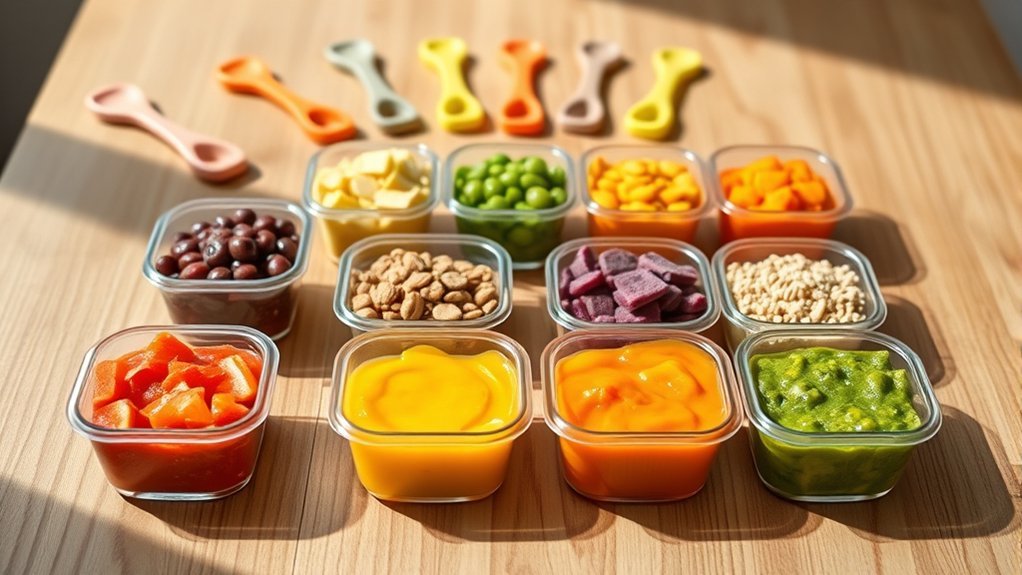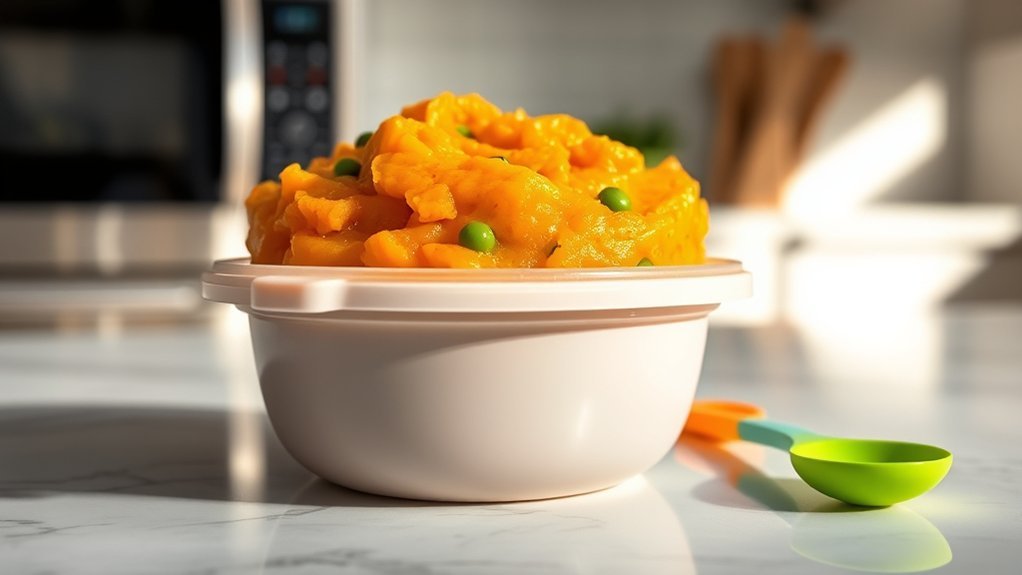

Baby food serving sizes are best treated as flexible starting points, not strict targets. Most babies begin solid foods at about 6 months when they show the necessary feeding skills. Start with small portions, offer a range of nutritious foods, and let your baby’s hunger and fullness cues guide how much they eat.
Quick Answer
Most babies start solids at about 6 months with 1 to 2 tablespoons of food per offering. Gradually add more meals, textures, and variety as feeding skills improve. Breast milk or infant formula remains the main source of nutrition through 12 months, and your baby should decide when they have had enough.
Key Takeaways
- Begin solids at about 6 months when your baby can sit with support, control their head, swallow food, and bring objects to their mouth.
- Start with 1 to 2 tablespoons at a time, then offer more when your baby remains interested and hungry.
- Breast milk or iron-fortified infant formula remains the main source of nutrition from 6 through 12 months.
- Offer iron-rich foods regularly and progress from smooth foods to thicker, lumpier, and soft finger foods as skills develop.
- Stop feeding when your baby closes their mouth, turns away, or pushes food away.
- Avoid honey, juice, unpasteurized foods, and cow’s milk as a beverage before 12 months, and prepare all foods to reduce choking risk.
Note: This guide provides general education, not individualized medical advice. Premature babies and children with growth concerns, swallowing problems, severe eczema, known food allergies, or other health conditions may need a feeding plan from their pediatrician or feeding specialist.
Baby Food Portions by Age

There is no single portion that every baby must finish. The Centers for Disease Control and Prevention recommends starting with 1 to 2 tablespoons of food and watching for signs that your child wants more or has had enough.
The ranges below are practical starting points. Appetite can change from one meal or day to the next, especially during teething, illness, growth spurts, or changes in milk intake.
| Age and stage | Practical starting portion | Typical meal progression | Suitable textures |
|---|---|---|---|
| Before solids | Breast milk or infant formula according to hunger cues | No routine solid-food meals | Liquids only unless a clinician provides different instructions |
| Around 6 months | 1 to 2 tablespoons per food offering; a few tastes may be enough at first | Begin with one meal or practice session and increase as interest and skill grow | Smooth, mashed, or very soft foods |
| About 7 to 8 months | Start with 1 to 2 tablespoons of each offered food and provide more when requested | Often 2 to 3 solid-food opportunities alongside breast milk or formula | Mashed, thicker, finely minced, or very soft graspable foods |
| About 9 to 12 months | Several tablespoons from different food groups, with more offered according to appetite | Work toward 3 meals and, when useful, 1 or 2 small snacks | Lumpy, chopped, shredded, and soft bite-sized foods |
| 12 to 24 months | Begin with roughly one-quarter of an adult portion, often 1 to 2 tablespoons of several foods | Usually 3 meals and 2 to 3 planned snacks | Soft family foods cut into safe, manageable pieces |
Pro Tip: Put a small portion on the tray or plate first. You can always add another spoonful. A less crowded plate can also make new foods feel more manageable.

Power your essentials anywhere with a 999Wh pure sine wave power station delivering up to 1000W continuous with 2000W surge. It supports fast charging via USB-C PD 60W and USB-A QC 18W, plus simultaneous output for multiple devices through AC, USB, wireless, and car/DC ports. Recharge using AC, car, or solar with a built-in MPPT controller and dual cooling fans, while the upgraded battery management system protects against surges, short circuits, and overheating.

Package Include: you will get 6 pieces different colors of portion control serving spoons, yellow, red, beige, green, black, dark blue, including 2 slotted spoons(1oz, 3oz) and 4 unslotted spoons(2oz, 4oz, 6oz, 8oz-1/4 Cup, 1/2 Cup, 3/4 Cup, 1 Cup), which is sufficient to meet your daily replacement needs

【100% SAFE】Our spoons are made of high-quality, food-grade silicone and are dishwasher safe. They are completely free from BPA, PVC, lead, phthalates, and any toxic materials. Have peace of mind when using our silicone spoons.
Key Nutritional Needs for Newborns and Infants
Before complementary foods begin, breast milk or properly prepared infant formula supplies a baby’s nutrition. After solids start, milk feeds continue while food gradually contributes more energy, nutrients, textures, and feeding practice.
Breast Milk and Formula Remain Important
From 6 through 12 months, breast milk or infant formula remains the main source of nutrition. Formula-fed babies generally take less formula as they eat more solid food, while breastfed babies can continue nursing according to their cues.
Avoid comparing a breastfed baby’s intake with a fixed bottle total. Feeding patterns differ, and growth, wet diapers, development, and medical history provide more useful context than a single ounce target.
Essential Nutrients for Infants
Once solids begin, prioritize nutrient-dense foods rather than focusing only on fruit and vegetable purees.
- Iron: Offer an iron-rich food regularly, such as meat, poultry, egg, beans, lentils, tofu, or iron-fortified infant cereal. The CDC recommends iron-containing complementary foods from about 6 months.
- Zinc: Meat, poultry, seafood, beans, yogurt, and fortified cereal can contribute zinc.
- Healthy fats: Foods such as avocado, full-fat plain yogurt, egg, oily fish, and thinly spread smooth nut butter provide energy and support growth.
- Vitamin D: Children younger than 12 months need 400 IU daily. Breastfed and combination-fed babies usually need a supplement beginning shortly after birth. Formula-fed babies may not need a separate supplement once they drink about 32 ounces of fortified formula daily. Follow your pediatrician’s advice and the current CDC vitamin D guidance.
- Variety: Rotate vegetables, fruits, grains, proteins, and safe dairy foods instead of relying on one cereal or puree.
Feeding Frequency Guidelines
Newborn milk-feeding frequency varies by feeding method and age. Breastfed newborns may feed 8 to 12 times in 24 hours, while formula-fed newborns commonly begin with small, frequent bottles. These newborn patterns should not be used as a solid-food schedule.
From 6 to 12 months, many babies receive breast milk, formula, or solid food about five or six times across 24 hours. Follow your baby’s cues instead of insisting on a fixed clock schedule or bottle size.
Introducing Solid Foods: Serving Sizes for 6 to 12 Months

The CDC and American Academy of Pediatrics recommend introducing complementary foods at about 6 months. Do not begin before 4 months, and look for several readiness signs rather than relying on the calendar alone.
Signs Your Baby Is Ready for Solids
- Can sit alone or with support and remain upright during feeding.
- Has steady head and neck control.
- Opens their mouth when food is offered.
- Swallows food instead of consistently pushing it out with the tongue.
- Brings objects to the mouth and reaches for food or other small objects.
Interest in watching someone eat is helpful, but it is not enough by itself. A baby also needs the physical skills to manage food safely.
How to Build Portions
- Begin with a taste: A baby may eat only the tip of a spoon or a few bites during the first meals.
- Offer 1 to 2 tablespoons: This is a useful starting amount, not a required minimum.
- Pause and observe: Offer another spoonful when your baby leans toward the food, opens their mouth, or reaches for more.
- Stop without pressure: End the meal when your baby repeatedly closes their mouth, turns away, or pushes food aside.
- Add variety: Over time, include an iron-rich food, produce, grains or starchy foods, and healthy fats.
Introducing Allergenic Foods
Introduce common allergens in developmentally appropriate forms when your baby starts other complementary foods. Examples include well-cooked egg, smooth peanut butter thinned with water or puree, dairy foods such as plain yogurt, wheat, soy, fish, and sesame.
Offer one new single-ingredient food at a time initially and wait three to five days before another new food if you need to identify reactions more easily. Once a food is tolerated, continue including it in the normal rotation.
Warning: Babies with severe eczema, an existing egg allergy, or a previous food reaction need individualized advice before peanut introduction. Call emergency services immediately for trouble breathing, swelling of the tongue or throat, collapse, bluish skin, or a rapidly worsening reaction. Do not give whole nuts or thick spoonfuls of nut butter because they are choking hazards.
Measuring and Serving Baby Food: Best Practices
Measuring can help you prepare a sensible starting amount, but the goal is not to make your baby clean the plate. The caregiver chooses what, when, and where food is served; the baby decides whether to eat and how much.
- Use a teaspoon or tablespoon when learning what small portions look like.
- Serve meals in a supported upright position in a high chair or other safe seat.
- Put only a little food on the tray at once to limit waste and reduce stuffing.
- Offer milk feeds and meals in a routine that works for your baby rather than allowing continuous grazing.
- Do not use food as a reward or force another bite after clear fullness cues.
- Expect appetite to vary from day to day.
Sample Meals by Stage
Early complementary feeding: One or two tablespoons of iron-fortified oatmeal mixed to a smooth texture, followed by a small amount of mashed pear.
Developing eater: Mashed lentils or finely minced chicken, soft mashed sweet potato, and plain full-fat yogurt.
Later infancy: Soft scrambled egg pieces, ripe avocado, shredded or finely chopped soft fruit, and toast prepared in a safe shape and texture.
Toddler meal: One to two tablespoons each of cooked vegetables and fruit, a small portion of rice or pasta, and one ounce or less of tender protein to start. Offer more when the child remains hungry.
Signs of Fullness: How to Know When Your Baby Is Done

Responsive feeding means noticing and respecting your baby’s communication. According to the CDC’s hunger and fullness guidance, babies communicate through movements, facial expressions, and sounds before they can speak.
Signs Your Baby May Still Be Hungry
- Opens their mouth or leans toward the spoon.
- Reaches for or points toward food.
- Becomes excited when food appears.
- Makes sounds or gestures asking for more.
Signs Your Baby May Be Full
- Closes their mouth when food is offered.
- Turns their head or body away.
- Pushes the spoon, plate, or food away.
- Uses gestures or sounds to show they are finished.
- Loses interest after eating and repeatedly declines another bite.
Touching, dropping, or playing with food can be part of learning and is not automatically a sign of fullness. Look at the full pattern of behavior instead of relying on one action.
A portion is an amount you offer—not an amount your baby is required to finish.
Choosing Safe Food Shapes and Sizes for Each Age
Food must match your child’s current chewing, swallowing, and hand skills. No shape is safe when the food is hard, sticky, round, poorly prepared, or eaten without close supervision.
Safe Shapes for Babies
- For early grasping: Offer very soft foods in pieces that are easy to hold, such as a soft cooked broccoli floret, ripe avocado wedge, or tender strip of omelet. The food should squash easily between your fingers.
- After the pincer grasp develops: Offer small, soft pieces that the baby can pick up between the thumb and forefinger.
- For spoon feeding: Begin with smooth or mashed foods, then move to thicker and lumpier textures as oral skills improve.
- For cylindrical foods: Cut foods lengthwise into thin strips rather than round coin shapes.
- For grapes and small tomatoes: Cut them lengthwise into smaller pieces appropriate for the child’s skill.
Warning: Always seat your child upright and watch continuously while they eat. Avoid whole grapes, nuts, popcorn, hard raw apple or carrot pieces, hot-dog rounds, hard candy, large cheese chunks, spoonfuls of nut butter, and other small, hard, round, or sticky foods. Review the CDC choking-hazard list and learn infant choking first aid from a qualified instructor.
Food Size and Texture by Developmental Stage
| Developmental stage | Food preparation | Examples |
|---|---|---|
| Beginning solids | Smooth, mashed, strained, or very soft | Mashed beans, smooth oatmeal, mashed avocado, pureed meat |
| Developing chewing and grasping | Thicker, lumpy, finely minced, shredded, or soft graspable pieces | Soft broccoli, shredded chicken, mashed lentils, ripe fruit |
| Pincer grasp and later infancy | Small, soft bite-sized pieces | Soft pasta, diced ripe pear, peas gently flattened with a fork, tender fish flakes |
Textures to Offer Your Baby: From Purees to Finger Foods
Purees are one option, but babies should not remain on completely smooth food longer than their skills require. Gradually offer thicker mashed foods, soft lumps, minced family foods, and safe finger foods.
- Smooth foods: Thin only enough for the baby to swallow comfortably.
- Mashed and lumpy foods: Add texture as your baby becomes more coordinated.
- Soft finger foods: Offer foods that break apart easily and are prepared for the baby’s grasp.
- Chopped family foods: Remove bones, pits, tough skins, and hard pieces, and limit added salt and sugar.
Gagging can happen while babies learn to manage textures and is often noisy. Choking occurs when the airway is blocked and the child may be unable to cough, cry, or breathe. Never leave a baby alone with food, and obtain hands-on infant first-aid training.
Transitioning to Table Foods After 12 Months
At about 12 months, most children can eat appropriately prepared versions of family foods. Begin with small toddler portions and add more when requested. The American Academy of Pediatrics notes that a toddler serving is often about one-quarter of an adult serving.
For an average starting meal, offer several small portions rather than one large serving—for example, 1 to 2 tablespoons each of vegetables and fruit, a small amount of grain, and a modest portion of protein.
Whole cow’s milk can be introduced as a beverage at 12 months, but it is not a replacement for meals. The CDC describes about two daily dairy servings for children aged 12 to 23 months, which may include milk, yogurt, cheese, or a suitable fortified dairy alternative. Too much milk can reduce appetite for iron-rich food.
Keep regular meal and snack times, allow the toddler to decide how much to eat, and expect intake to vary. Avoid following a child around with food or allowing constant grazing throughout the day.
Addressing Common Baby Feeding Challenges
My Baby Eats Only a Few Bites
This is common at the beginning. Continue milk feeds, offer a small amount without pressure, and give your baby regular chances to practice. Contact the pediatrician if poor intake is paired with poor growth, fewer wet diapers, weakness, or ongoing illness.
My Baby Refuses a New Food
Remove the food without forcing it and offer it again on another day. Children often need repeated, low-pressure exposure before accepting a new taste or texture.
My Baby Gags on Texture
Occasional gagging can occur during learning, but repeated coughing, choking, wet or gurgly breathing during meals, food remaining in the mouth, or difficulty progressing beyond smooth foods should be discussed with a pediatrician or feeding specialist.
My Baby Wants More Than the Suggested Portion
Offer more when the food is prepared safely and your baby continues to show hunger. The serving chart provides a starting amount, not a maximum.
Foods and Drinks to Avoid or Limit
- Honey before 12 months: Honey can cause infant botulism, even when mixed into food, water, or formula.
- Cow’s milk as a beverage before 12 months: Yogurt and cheese may be introduced earlier, but cow’s milk should not replace breast milk or infant formula before the first birthday.
- Juice before 12 months: Whole fruit is preferred. Juice is unnecessary after 12 months and should remain limited.
- Unpasteurized products: Avoid raw milk, unpasteurized juice, and foods made with unpasteurized milk.
- Added sugars: Infants and young toddlers do not need foods or drinks with added sugar.
- High-sodium foods: Limit processed meats, salty snacks, and heavily salted packaged foods.
- High-mercury fish: Choose lower-mercury fish and follow current FDA fish advice.
- Choking hazards: Avoid small, hard, round, sticky, chewy, or tough foods unless they are modified to a safe form.
See the CDC’s current list of foods and drinks to avoid or limit for additional examples.
When to Contact Your Baby’s Doctor
Contact a pediatric healthcare professional when your baby:
- Is not showing readiness for solids near the expected developmental stage.
- Frequently coughs, chokes, arches, vomits, or seems distressed during meals.
- Cannot move beyond smooth textures as feeding skills should progress.
- Has poor weight gain or a sudden decline in appetite lasting more than a brief illness.
- Has fewer wet diapers, a dry mouth, unusual sleepiness, or other signs of dehydration.
- Develops hives, swelling, vomiting, wheezing, or another suspected allergic reaction.
- Was born prematurely or has a medical condition that affects nutrition or swallowing.
Emergency: Call emergency services immediately if your baby cannot breathe or make sounds, becomes blue or unresponsive, or develops severe allergy symptoms such as breathing difficulty or swelling of the tongue or throat.
Frequently Asked Questions
How do I know if my baby is ready for solids?
Most babies are ready at about 6 months when they can sit upright with support, control their head and neck, open their mouth for food, swallow rather than push food out, and bring objects to their mouth. Do not start before 4 months.
Can I mix breast milk or formula with baby food?
Yes. Prepared infant formula, expressed breast milk, or water can be used to soften infant cereal or thin mashed food. Mix only the amount needed for the meal and follow safe milk and formula handling practices. Do not put cereal or other solid food in a bottle unless a clinician specifically directs you to do so.
What are signs of a food allergy in babies?
Possible signs include hives, facial swelling, vomiting, coughing, wheezing, or sudden behavior changes after eating. Stop serving the suspected food and contact your child’s healthcare professional. Call emergency services for breathing difficulty, tongue or throat swelling, collapse, bluish skin, or a rapidly worsening reaction.
How often should I feed my baby during the day?
At first, offer one solid-food practice meal while continuing normal milk feeds. Gradually work toward two or three meals as your baby’s appetite and skills grow. Many babies aged 6 to 12 months receive breast milk, formula, or food about five or six times across 24 hours.
What foods should I avoid giving a baby under one year?
Avoid honey, juice, unpasteurized food or drinks, and cow’s milk as a beverage. Also avoid added sugars, high-sodium foods, high-mercury fish, whole nuts, popcorn, whole grapes, hard raw produce, hot-dog rounds, thick spoonfuls of nut butter, and other choking hazards.
Should I limit my baby to the amount shown in a serving chart?
No. Serving charts show practical starting amounts. Offer more when your baby remains hungry, and stop when they close their mouth, turn away, push food away, or otherwise show that they are finished.
Can babies drink water with meals?
From about 6 months, a small amount of water can be offered in an open or training cup with meals. Water should complement—not replace—breast milk or infant formula during the first year.
Sources
- CDC: When, What, and How to Introduce Solid Foods — readiness, timing, allergens, textures, and food preparation.
- CDC: How Much and How Often to Feed — starting portions, feeding routines, and the role of milk feeds.
- CDC: Choking Hazards — safe positioning, supervision, preparation, and high-risk foods.
- CDC: Iron for Infants and Toddlers — iron needs and iron-rich complementary foods.
- CDC: Vitamin D for Infants and Toddlers — daily vitamin D needs and supplementation guidance.
- FDA: Introduction of Allergenic Foods to Infants — age-appropriate peanut introduction and guidance for high-risk infants.
Conclusion
Baby food serving sizes should help you decide how much to offer, not how much your baby must eat. Begin solids at about 6 months when your baby is developmentally ready, start with 1 to 2 tablespoons, and gradually add meals, textures, and variety. Keep breast milk or infant formula central through the first year, serve iron-rich foods regularly, prepare food safely, and respect clear hunger and fullness cues. When feeding skills, growth, swallowing, or allergic reactions cause concern, seek individualized guidance from your child’s healthcare professional.