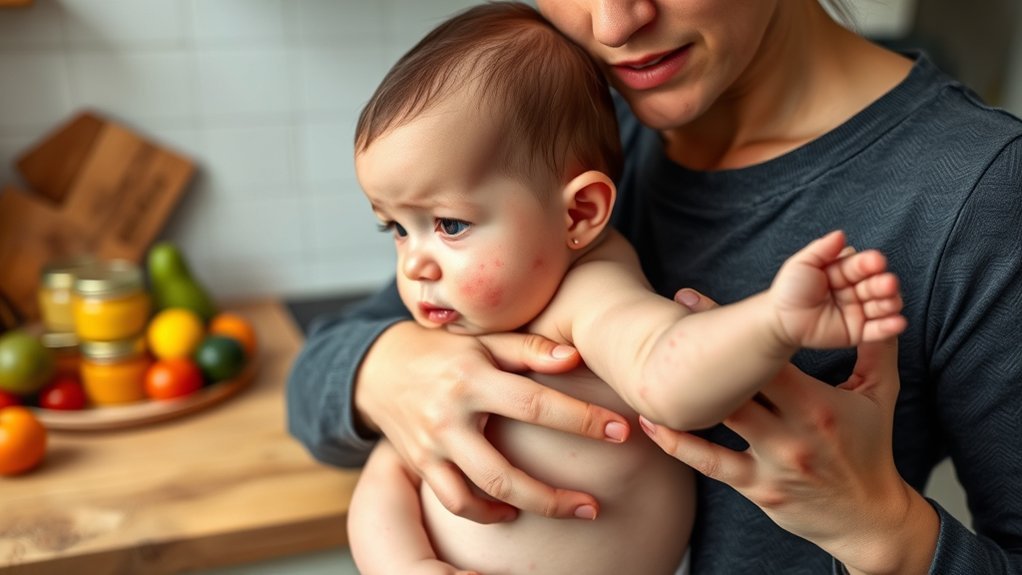
Hives after a new food can be frightening, and the safest response depends on whether your baby has only a skin reaction or signs involving breathing, circulation, alertness, or the stomach. Stop the food, stay with your baby, check for other symptoms, and be ready to get emergency help. Do not offer the suspected food again until your pediatrician has reviewed the reaction.
Quick Answer
If your baby develops hives after a new food, stop the food and check for breathing trouble, swelling, repeated vomiting, unusual sleepiness, or limpness. For severe or multi-system symptoms, give prescribed epinephrine and call 911. For hives alone, contact the pediatrician promptly and do not retry the food.
Key Takeaways
- Stop feeding the suspected food immediately and keep the package or ingredient list.
- Call 911 for trouble breathing, tongue or throat swelling, pale or blue skin, faintness, limpness, or symptoms affecting more than one body system.
- Use prescribed epinephrine immediately for possible anaphylaxis; antihistamines do not replace epinephrine.
- For isolated hives with no other symptoms, call your pediatrician for same-day advice and ask before giving any medicine.
- Take photos, record the food, amount, timing, and symptoms, and do not test the food again at home unless a clinician tells you to.
At a Glance
| Time Required | Act immediately; continue close observation and follow the pediatrician’s instructions. |
| Difficulty | Moderate because symptoms can change quickly in infants. |
| Tools Needed | Phone, clock or timer, camera, ingredient label, and prescribed epinephrine if your baby has it. |
| Cost | No cost for the first response; medical and emergency-care costs vary. |
Warning: Call 911 now if your baby has trouble breathing or swallowing, swelling of the tongue or throat, wheezing, a weak cry, pale or blue skin, sudden limpness, faintness, severe drowsiness, or hives with repeated vomiting or another body-system symptom. If epinephrine has been prescribed, give it immediately according to the emergency plan.
What Are Hives and What Causes Them?
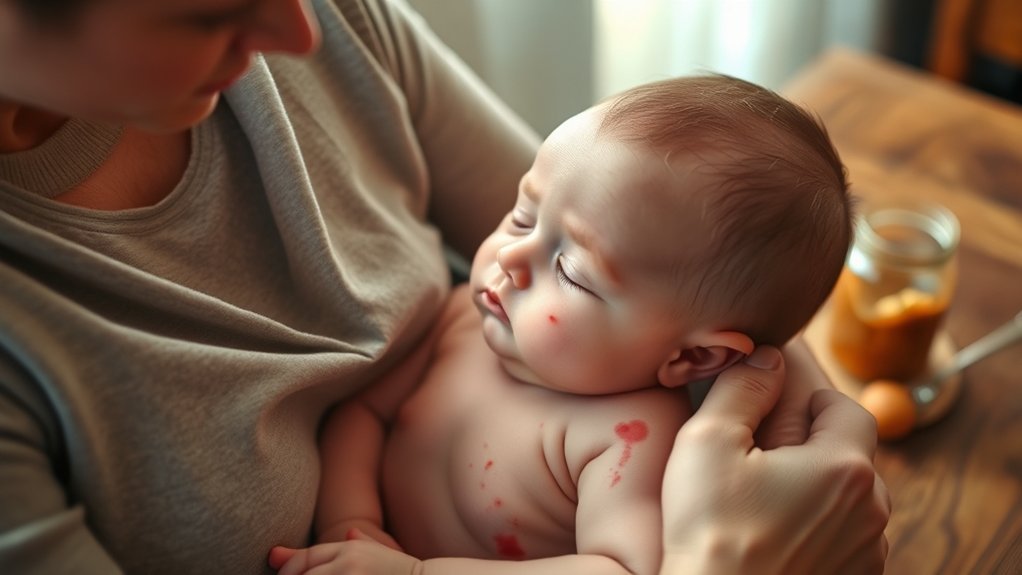
Hives, also called urticaria, are raised, itchy welts that may be pink, red, or close to the baby’s natural skin tone. They can appear anywhere, change shape, fade in one place, and show up somewhere else. Individual welts usually disappear within 24 hours without leaving a bruise or mark, according to the American Academy of Allergy, Asthma & Immunology.
A food allergy can cause hives when the immune system reacts to a food protein and releases chemicals such as histamine. Food reactions often begin within minutes to a few hours, but timing alone cannot confirm the cause.
Hives are not always caused by food. Viral illnesses, medicines, insect stings, heat, cold, pressure, and other triggers can also cause them. A rash limited to the skin where food touched the face may be irritation rather than a true food allergy, especially with acidic foods, but raised welts or symptoms away from the contact area deserve medical review.

Power your essentials anywhere with a 999Wh pure sine wave power station delivering up to 1000W continuous with 2000W surge. It supports fast charging via USB-C PD 60W and USB-A QC 18W, plus simultaneous output for multiple devices through AC, USB, wireless, and car/DC ports. Recharge using AC, car, or solar with a built-in MPPT controller and dual cooling fans, while the upgraded battery management system protects against surges, short circuits, and overheating.

Experience 100% Raw and Pure Comb Honey Straight from the Hive: Unprocessed, unheated, and unpasteurized to meticulously preserve natural enzymes, beneficial pollen, and maximum wellness benefits. Taste the difference of truly raw honey!
How Hives Differ From Other Rashes
- Hives: Raised, often itchy welts that change shape or location and fade without scaling.
- Eczema: Dry, rough, inflamed patches that tend to stay in the same area and last longer.
- Contact irritation: Redness mainly where food touched the skin, often without raised migrating welts.
Photos are useful because hives may fade before your baby is examined. A clinician should evaluate any rash you cannot confidently identify.
Recognizing Other Symptoms of Food Allergies
A food-allergic reaction can affect the skin, breathing, stomach, heart and circulation, or behavior. Infants cannot describe throat tightness or dizziness, so watch for visible changes.
- Skin and mouth: Hives, flushing, swelling of the lips or tongue, or sudden itching.
- Breathing and throat: Coughing, wheezing, hoarse or weak cry, noisy breathing, trouble swallowing, or sudden drooling.
- Stomach: Repeated vomiting, significant diarrhea, or severe belly pain.
- Circulation and alertness: Pale or blue color, weakness, limpness, fainting, unusual sleepiness, confusion, or poor responsiveness.
The American Academy of Pediatrics lists sudden breathing trouble, swallowing difficulty, hives, swelling, severe vomiting or diarrhea, weak pulse, fainting, and unusual infant behaviors among possible signs of anaphylaxis.
Anaphylaxis is more likely when symptoms are severe or when more than one body system is involved, such as hives plus repeated vomiting or hives plus coughing. Do not wait for every possible symptom to appear.
Immediate Steps to Take If Your Baby Develops Hives
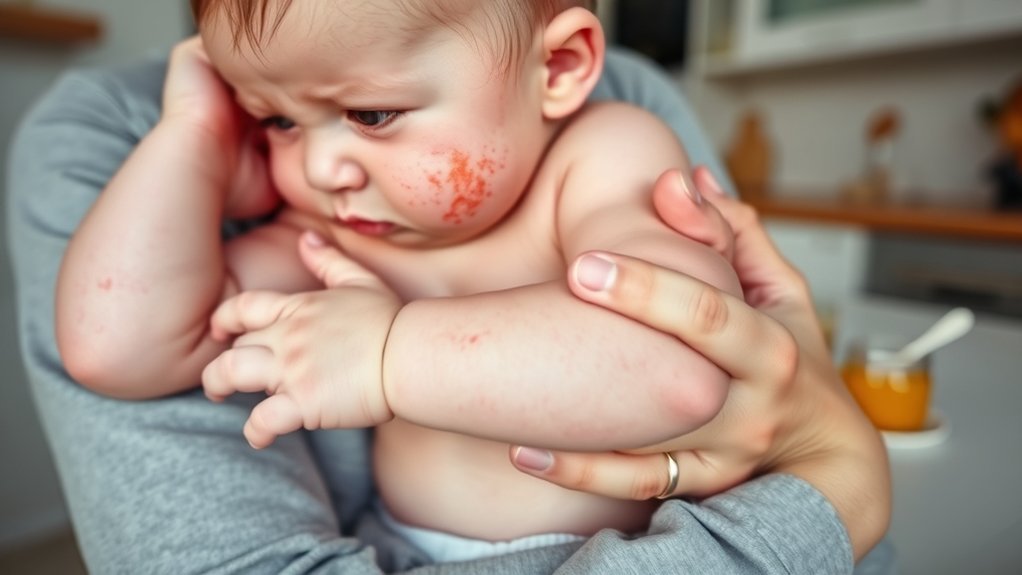
Recognize Allergy Symptoms
- Stop the food. Remove the bowl, spoon, and remaining food. Do not force more bites to “confirm” the reaction.
- Stay with your baby. Check breathing, color, swelling, vomiting, and alertness. Symptoms can progress quickly.
- Look beyond the skin. Hives with coughing, wheezing, tongue swelling, repeated vomiting, limpness, or unusual sleepiness can signal anaphylaxis.
Seek Medical Attention
If your baby has possible anaphylaxis and has prescribed epinephrine, give it immediately according to the child’s emergency plan and call 911. Epinephrine is the first-line treatment for severe allergic reactions. Antihistamines may help some skin symptoms, but they do not treat breathing problems, low blood pressure, throat swelling, or other dangerous features of anaphylaxis.
If your baby has hives only and is breathing normally, alert, and otherwise acting well, call the pediatrician for prompt, same-day advice. Ask whether your baby needs an examination and whether any age- and weight-appropriate medicine is recommended. Do not guess an infant antihistamine dose.
Note: Do not delay epinephrine or a 911 call while waiting for an antihistamine to work. The AAAAI states that antihistamines never replace epinephrine for anaphylaxis.
Document Food History
Write down the details while they are fresh:
- The food, brand, recipe, and full ingredient list.
- The amount eaten and how it was prepared.
- The time feeding started and the time symptoms began.
- Every symptom, when it appeared, and when it improved.
- Any medicine given and the time it was given.
- Photos or short videos of the rash, swelling, breathing sounds, or behavior when safe to record.
Keep the food package or photograph the label. Mixed dishes can contain several possible triggers, so this information can help the pediatrician decide whether an allergy evaluation is needed.
Avoid Another Exposure
Do not serve the suspected food again at home until your pediatrician or allergist provides a plan. A later reaction can be more severe, less severe, or similar; the first reaction does not reliably predict the next one. Also avoid removing many unrelated foods from your baby’s diet without medical guidance, because unnecessary restriction can reduce nutrition and make diagnosis harder.
Top Food Allergens to Look Out For

Any food can cause an allergy, but U.S. labeling law identifies nine major food allergens:
- Milk
- Eggs
- Peanuts
- Tree nuts
- Fish
- Crustacean shellfish
- Wheat
- Soy
- Sesame
Sesame became the ninth major allergen under U.S. law on January 1, 2023. Read the full ingredient list as well as any “Contains” statement, especially when a reaction follows a packaged or mixed food.
Introduce foods in developmentally safe forms. Whole nuts and thick spoonfuls of nut butter are choking hazards for babies. Thin smooth nut butter with warm water, breast milk, formula, puree, or yogurt, or use another age-appropriate form recommended by your pediatrician. Cow’s-milk products such as yogurt may be offered during complementary feeding, but cow’s milk should not replace breast milk or infant formula as the main drink before 12 months.
Why You Should Monitor Your Baby After New Foods
Many immediate food-allergic reactions appear within minutes to a few hours. Offer a new food when your baby is healthy, awake, and with a caregiver who can observe them—not just before sleep, daycare drop-off, or a long drive.
Start with a small, age-appropriate amount, then continue the feeding if there is no reaction. Keep watching during and after the meal. If symptoms appear, stop the food and follow the emergency steps above.
Pro Tip: Introduce a new allergen earlier in the day when possible. Keep the label, use a single-ingredient form at first, and avoid introducing several new allergens in the same mixed meal.
When to Seek Medical Attention for Allergic Reactions
Call 911 Now
Get emergency help for trouble breathing or swallowing, wheezing, throat or tongue swelling, a weak or hoarse cry, pale or blue skin, sudden limpness, faintness, poor responsiveness, or a rapidly worsening reaction. Hives plus repeated vomiting, breathing symptoms, or another body-system symptom can also indicate anaphylaxis.
Call the Pediatrician Promptly
Call for same-day advice when hives are the only symptom and your baby otherwise appears well. Also call promptly for facial swelling without breathing trouble, a rash you cannot identify, symptoms that return, or any reaction in a baby with severe eczema or a known food allergy.
Arrange Follow-Up
After any suspected food reaction, ask what to avoid, whether an allergist referral is needed, and whether your family needs an allergy and anaphylaxis emergency plan. If epinephrine is prescribed, every caregiver should learn when and how to use the specific device.
The 3-to-5-Day Approach for Introducing New Foods Safely
The “3-Day Rule” is a tracking method, not an emergency-treatment rule. The CDC recommends starting with one single-ingredient food at a time and waiting 3 to 5 days between new foods. This can make it easier to connect a reaction with a specific food.
Importance of Monitoring Reactions
Observe your baby during and after each new food. Record any hives, swelling, vomiting, diarrhea, coughing, breathing changes, or unusual behavior. A 3-to-5-day gap does not guarantee that a food is safe, and it should never replace emergency action when symptoms occur.
Timing for New Foods
Most babies begin complementary foods around 6 months when they show developmental readiness. Current guidance does not support delaying common allergens simply to prevent allergy. The American Academy of Pediatrics advises that allergenic foods can be introduced when a baby is ready for solids, with special planning for infants at higher risk.
If your baby has severe or persistent eczema, an egg allergy, or a previous immediate food reaction, talk with the pediatrician before introducing peanut or other highly allergenic foods. The clinician may recommend testing or supervised feeding.
Consistency With Previous Foods
Continue offering tolerated foods as part of a varied diet. Once an allergenic food is introduced and tolerated, regular age-appropriate intake may be advised rather than a single exposure followed by a long gap. Ask your pediatrician how often to serve it based on your baby’s health and feeding skills.
Creating a Food Diary to Track Your Baby’s Reactions
A food diary can help your healthcare team see patterns without relying on memory. Use one entry for each new food or suspected reaction.
- Date and time: When the food was served and when symptoms began.
- Food details: Brand, ingredients, recipe, texture, and cooking method.
- Amount: A taste, spoonful, or larger serving.
- Symptoms: Skin, breathing, stomach, swelling, color, and behavior.
- Duration: When symptoms peaked and resolved.
- Treatment: Medicine, epinephrine, 911 call, urgent care, or other advice.
- Photos: Clear images of the rash and the food label.
A diary can support diagnosis, but it cannot prove a food allergy on its own.
Discussing Allergy Risks and Management With Your Pediatrician
Tell the pediatrician exactly what happened, how soon it began, how much food was eaten, and whether the food contained several ingredients. Mention severe eczema, asthma, known allergies, and prior reactions.
Food allergy diagnosis begins with the reaction history. A clinician may use skin-prick testing or a blood test, but test results alone do not always prove a clinical allergy. A medically supervised oral food challenge may be needed in selected cases. The AAP notes that allergist evaluation can confirm a diagnosis and help prevent an unnecessarily restricted diet.
Ask these questions:
- Should my baby avoid only the suspected food or related foods too?
- Does my baby need a referral to a board-certified allergist?
- Should epinephrine be prescribed?
- What symptoms should trigger epinephrine and a 911 call?
- When, where, and how could the food ever be tried again?
- How should other allergens be introduced safely?
Comfort Measures and What Not to Do
For isolated hives while you are waiting for medical advice, keep your baby cool, use loose clothing, and avoid hot baths because heat can worsen itching. A cool compress may be soothing. Ask the pediatrician before using an antihistamine, cream, or other medicine in an infant.
- Do not make your baby vomit.
- Do not give another bite to test the food.
- Do not rely on an antihistamine for breathing, throat, circulation, or severe stomach symptoms.
- Do not use home allergy tests to decide which foods to remove.
- Do not place whole nuts or thick spoonfuls of nut butter in a baby’s mouth.
Frequently Asked Questions
Can hives indicate a serious food allergy in infants?
Yes. Hives can be the only sign of a mild reaction, but they can also occur during anaphylaxis. Check immediately for breathing trouble, swelling, repeated vomiting, pale or blue skin, limpness, unusual sleepiness, or symptoms involving another body system.
How can I differentiate hives from other skin rashes?
Hives are raised welts that often itch, change shape or location, and fade without scaling. Eczema usually forms dry patches that stay in one place. Contact irritation is often limited to where food touched the skin. A clinician should review any uncertain rash.
What are the long-term effects of food allergies in babies?
The effects depend on the food and the child. Some allergies are outgrown, while others may persist. Poorly planned avoidance can cause nutrition problems, and fear of reactions can affect family routines. Accurate diagnosis, diet guidance, and an emergency plan reduce these risks.
Are there home remedies for hives in infants?
A cool compress, loose clothing, and avoiding heat may reduce discomfort when hives are the only symptom. Home remedies do not treat anaphylaxis. Ask the pediatrician before giving an infant any antihistamine or applying medicated products.
How can I prevent future allergic reactions in my baby?
Avoid the suspected trigger until it is evaluated, read ingredient labels, prevent cross-contact, and follow the pediatrician’s introduction plan for other foods. If an allergy is diagnosed, keep an emergency plan and prescribed epinephrine available.
Should I give my baby an antihistamine for hives?
Call your pediatrician for an age- and weight-appropriate recommendation. Do not guess the dose. Antihistamines may help isolated skin symptoms, but they must never delay epinephrine or emergency care for possible anaphylaxis.
Can I try the suspected food again at home?
Not until your pediatrician or allergist has reviewed the reaction and gives a specific plan. Re-exposure at home can be dangerous. When confirmation is needed, a supervised oral food challenge may be the safest approach.
How long should I watch my baby after a new food?
Watch closely during and after the meal because many immediate reactions begin within minutes to a few hours. Continue normal observation afterward and follow your pediatrician’s advice. Waiting 3 to 5 days before another new food helps identify triggers but is not a substitute for emergency monitoring.
Conclusion
If your baby develops hives after a new food, stop the food and quickly check for symptoms beyond the skin. Use prescribed epinephrine and call 911 for possible anaphylaxis. For isolated hives, contact the pediatrician promptly, document the reaction, and avoid another exposure until you have a medical plan. Clear notes, photos, and ingredient information can make the follow-up evaluation safer and more accurate.
Medical disclaimer: This article provides general education and does not replace diagnosis, treatment, or an individualized emergency plan from your baby’s healthcare professional.
Sources
- American Academy of Pediatrics: Anaphylaxis in Infants & Children — emergency symptoms and epinephrine response.
- U.S. Food and Drug Administration: Food Allergies — nine major food allergens and U.S. labeling requirements.
- Centers for Disease Control and Prevention: Introducing Solid Foods — single-ingredient foods, 3-to-5-day spacing, and safe food forms.
- American Academy of Pediatrics: Introducing Common Food Allergens — timing, developmental readiness, choking prevention, and high-risk infants.
- American Academy of Allergy, Asthma & Immunology: Hives and Angioedema — hive appearance, duration, and swelling risks.
- American Academy of Pediatrics: Food Allergy Diagnosis and Planning — testing, oral food challenges, allergist care, and emergency plans.