
If your baby is vomiting after solids, a single small vomit right after a strong gag can happen while they learn new textures. Repeated, projectile, green, bloody, or symptom-related vomiting is different and should not be dismissed as part of learning to eat. The timing, food involved, related symptoms, and your baby’s hydration help show how urgent the problem may be.
Quick Answer
Stop the solid-food meal, keep your baby upright, and check breathing and alertness. If vomiting continues, focus on breast milk or formula in smaller amounts and use oral rehydration solution when advised. Seek urgent care for green or bloody vomit, repeated projectile vomiting, breathing trouble, marked sleepiness, severe pain, or dehydration.
Key Takeaways
- Gagging is usually noisy and protective; choking can be quiet because the baby cannot move enough air to cry or cough.
- Vomiting that repeats after the same food may point to an allergy, including delayed FPIES, rather than a texture problem alone.
- For babies 6 to 12 months, breast milk or formula remains the main fluid; if these are not tolerated, a commercial oral rehydration solution may be needed.
- Green or bloody vomit, repeated projectile vomiting, breathing problems, a swollen or very painful belly, unusual sleepiness, or dehydration needs prompt medical attention.
- Safe textures, small portions, upright seating, close supervision, and responsive feeding can reduce avoidable feeding problems.
Baby Vomiting After Solids: What the Timing May Suggest
The timing of vomiting after a meal can help separate gag-related episodes from patterns that need medical review. Timing alone cannot diagnose the cause, so also note the food, number of episodes, amount vomited, breathing, skin symptoms, stool changes, fever, pain, and alertness.
| Pattern | Possible explanation | What to do |
|---|---|---|
| Small vomit immediately after a strong gag | Gag reflex, unfamiliar texture, a large bite, or a very full stomach | Pause the meal, keep your baby upright, and watch breathing and alertness. Discuss frequent episodes with your pediatrician. |
| Vomiting soon after eating with hives, swelling, coughing, wheezing, or breathing trouble | Possible immediate food allergy | Seek emergency help for breathing trouble, tongue or throat swelling, collapse, or a rapidly worsening reaction. |
| Repeated vomiting about 1 to 4 hours after the same food, especially with pallor or lethargy | Possible FPIES | Seek urgent medical assessment, particularly for repeated vomiting, limpness, marked sleepiness, or dehydration. |
| Vomiting with fever, diarrhea, reduced activity, or after several different foods | Illness may be more likely than a reaction to one texture | Focus on hydration and contact your pediatrician if vomiting persists, fluids will not stay down, or your baby seems unwell. |
| Green or bloody vomit, repeated projectile vomiting, severe belly pain, or a swollen abdomen | A problem unrelated to normal learning-to-eat gagging may be present | Seek urgent medical care. |
What to Expect When Starting Solids With Your Baby

Most babies are ready to start solid foods at about 6 months, but readiness matters more than a single birthday. Your baby should have good head and neck control, sit alone or with support, bring objects to the mouth, and swallow food instead of pushing it back out.
The Centers for Disease Control and Prevention recommends starting solids at about 6 months and not before 4 months. For a deeper readiness guide, see when to start solid foods with your baby.
Learning to eat takes practice. Your baby may cough, gag, spit food out, make faces, or refuse a texture. A gag is a protective reflex that can occasionally trigger a small vomit, especially when a bite is too large, the texture is unfamiliar, or the spoon goes too far back.
True vomiting is more forceful than spit-up and usually brings up more stomach contents. One gag-related episode may settle quickly, but repeated vomiting, vomiting without gagging, or vomiting with other symptoms deserves closer attention.
Spit-Up, Gagging, Vomiting, and Choking: How They Differ
These events can look similar at first, but the baby’s breathing, sound, effort, and amount brought up are useful clues. The most urgent distinction is between gagging, which usually moves air, and choking, which may block the airway.
- Spit-up: A small, easy flow of milk or food from the mouth, often with a burp. The baby usually remains comfortable.
- Gagging: Often noisy. Your baby may cough, retch, turn red, push the tongue forward, or bring food back to the front of the mouth.
- Vomiting: A forceful emptying of stomach contents. Repeated vomiting may be caused by illness, allergy, reflux, or another medical problem.
- Choking: The airway is partly or fully blocked. A baby may be unable to cry, cough effectively, or breathe and may become blue, gray, limp, or unresponsive.
Gagging is usually noisy and protective. Choking may be quiet because the baby cannot move enough air to cry or cough.
Warning: If your baby cannot breathe, cry, or cough effectively, call 911 and begin age-appropriate choking first aid. Do not perform a blind finger sweep, because it can push the object deeper. Anyone who feeds a baby should take an infant CPR and first-aid course.
To lower choking risk, seat your baby upright, supervise every bite, and prepare food for their developmental skills. The CDC choking-prevention guidance recommends avoiding small, hard, sticky, or difficult-to-chew foods and modifying foods such as grapes, raw vegetables, nuts, popcorn, sausage pieces, and thick spoonfuls of nut butter.
Why Does My Baby Vomit After Starting Solids?
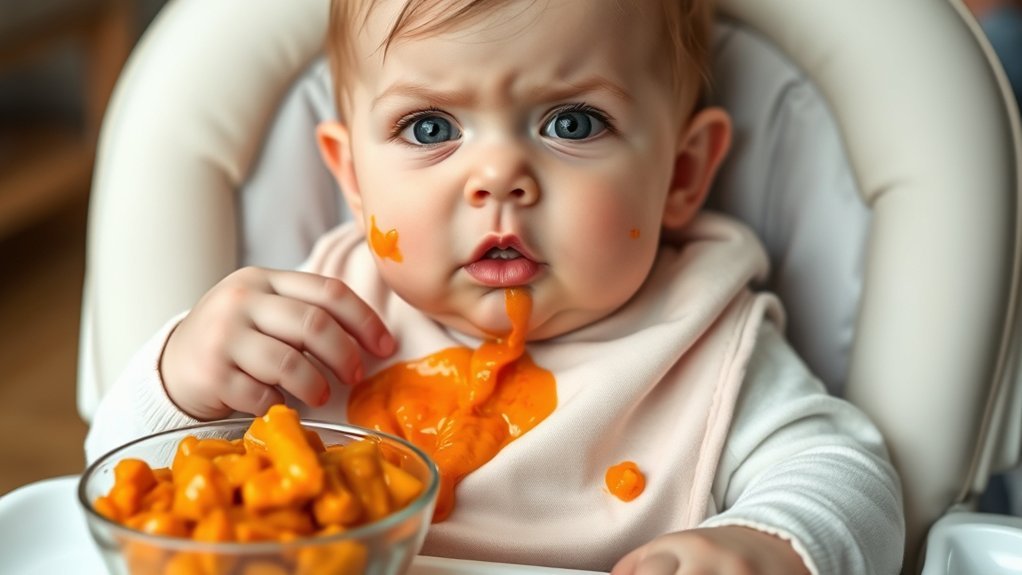
Vomiting after solids can come from a feeding issue, illness, reflux, or a food reaction. The pattern matters: vomiting tied to a gag is different from repeated vomiting after the same food or forceful vomiting with pain, lethargy, or dehydration.
Gagging on a New Texture or Large Bite
A sensitive gag reflex can cause retching and sometimes vomiting. This is more likely when food is too firm, too large, placed too far back in the mouth, or offered before your baby has the skills to manage it.
Gagging often becomes less frequent as feeding skills improve, but it does not make every vomiting episode harmless. If texture-related gagging is the main problem, see why babies gag on purees for more focused feeding guidance.
Eating Too Much or Too Fast
A very full stomach, rapid spoon-feeding, pressure to take another bite, or a large solid meal immediately after milk may lead to spit-up or vomiting. Begin with small portions, pause between bites, and stop when your baby turns away, closes the mouth, pushes food away, or loses interest.
Reflux or a Feeding Problem
Reflux can cause frequent spit-up and sometimes vomiting. Vomiting with pain, coughing during feeds, poor weight gain, feeding refusal, or breathing symptoms needs pediatric evaluation.
Repeated coughing, choking, or a wet-sounding voice during meals can also suggest a swallowing problem. Ask your pediatrician whether a feeding or swallowing assessment is needed.
Viral Illness or Foodborne Illness
Vomiting may begin around the same time as solids by coincidence. Gastroenteritis, hard coughing during another illness, or contaminated food can cause vomiting.
Fever, diarrhea, reduced activity, sick contacts, or vomiting after several different foods makes illness more likely than a reaction to one texture alone.
Immediate Food Allergy
A food allergy can cause vomiting along with hives, facial or lip swelling, coughing, wheezing, hoarseness, trouble breathing, or sudden lethargy. The American Academy of Pediatrics explains that food-allergy symptoms in children may affect the skin, digestive system, or breathing.
Warning: Call 911 for trouble breathing, wheezing, swelling of the tongue or throat, widespread hives with vomiting, collapse, or any rapidly worsening reaction. Do not wait to see whether severe symptoms pass.
FPIES, a Delayed Food Allergy
Food protein-induced enterocolitis syndrome, or FPIES, is a delayed food allergy that usually does not cause the hives or breathing symptoms seen with immediate allergic reactions. It can cause repeated, forceful vomiting about 1 to 4 hours after a trigger food, often with pallor, lethargy, limpness, or later diarrhea.
A peer-reviewed FPIES review indexed by the National Library of Medicine describes this delayed pattern. Repetitive vomiting with marked pallor, unusual sleepiness, limpness, or dehydration requires urgent medical assessment.
Other Causes That Need Medical Review
Repeated projectile vomiting, green vomit, blood in vomit, a swollen or painful abdomen, poor growth, or vomiting at most meals can signal a problem unrelated to starting solids. In young infants, repeated forceful vomiting may require urgent evaluation for conditions such as pyloric stenosis or an intestinal blockage.
What to Do If Your Baby Vomits After Eating
First stop the meal and make sure your baby is breathing and responding normally. Then protect hydration, note what happened, and avoid pushing more solid food until the vomiting has settled.
- Stop the feeding. Remove food from reach, keep your baby upright, and let them settle. Do not immediately offer another spoonful.
- Check breathing and alertness. Make sure your baby can breathe, cry, and respond normally. If the baby is choking, struggling to breathe, blue or gray, limp, or difficult to wake, call 911.
- Note the timing and symptoms. Record the food, amount eaten, time from eating to vomiting, number of episodes, and any rash, swelling, diarrhea, fever, pain, pallor, or unusual sleepiness.
- Protect hydration. Continue breastfeeding in shorter, more frequent sessions. For a formula-fed baby who vomits once, smaller regular-formula feeds may be tolerated. If vomiting repeats or usual feeds are not staying down, contact your pediatrician about a commercial oral rehydration solution.
- Use small amounts when ongoing vomiting requires rehydration. The AAP’s infant vomiting guidance advises 5 to 10 mL every 5 minutes in situations where oral rehydration solution is appropriate, then increasing amounts as vomiting settles.
- Resume solids gradually. AAP guidance advises avoiding solids during active vomiting and adding them back after about 8 hours without vomiting. Start with a small amount of familiar, age-appropriate food and do not force feeding.
Pro Tip: Keep a simple food-and-symptom log on your phone. Include the food, preparation, amount, time eaten, time vomiting began, and any skin, breathing, stool, or behavior changes. This can help your pediatrician identify a repeatable pattern.
For babies 6 to 12 months who are vomiting, breast milk or formula remains the preferred fluid. If those are not tolerated, the AAP’s vomiting and dehydration guidance recommends a commercial oral rehydration solution rather than plain water. Do not rely on soda or other sugary drinks for infant rehydration.
When to Call the Doctor About Your Baby’s Vomiting
Get medical help based on the severity of the symptoms, not just the number of times your baby vomits. Breathing problems, severe allergic symptoms, green or bloody vomit, repeated projectile vomiting, marked lethargy, severe abdominal symptoms, or dehydration need faster assessment.
Note: This article provides general education and cannot diagnose the cause of vomiting. Babies can become dehydrated quickly. Contact your pediatrician whenever you are unsure, and seek emergency help for breathing problems, choking, severe allergic symptoms, or a baby who is difficult to wake.
Call 911 Now
- Your baby cannot breathe, cry, or cough effectively.
- Your baby has blue or gray lips or skin, collapses, becomes limp, or is unresponsive.
- Vomiting occurs with trouble breathing, tongue or throat swelling, or a rapidly worsening allergic reaction.
Seek Urgent Medical Care
- The vomit is green, contains blood, or looks like coffee grounds.
- Your baby has repeated projectile vomiting, especially between about 2 weeks and 2 months of age.
- Your baby is hard to wake, unusually floppy, very pale, confused, or much less responsive than normal.
- The abdomen is swollen, hard, or very painful, or your baby has severe pain between vomiting episodes.
- Repeated vomiting begins 1 to 4 hours after a food and is followed by pallor, lethargy, limpness, or diarrhea.
- A baby younger than 3 months has a rectal temperature of 100.4°F (38°C) or higher.
- You suspect poisoning, a swallowed object, or a head injury.
Contact Your Pediatrician Promptly
- Your baby vomits after the same food more than once.
- Vomiting keeps returning, happens at most meals, or is affecting feeding or weight gain.
- Your baby vomits everything for more than 8 hours or vomiting lasts more than 12 hours.
- Vomiting occurs with fever, diarrhea, persistent cough, pain, or a new rash.
- Your baby cannot keep breast milk, formula, or oral rehydration solution down.
- You are worried, even if the symptoms do not fit a checklist.
Signs of Dehydration
Watch for fewer wet diapers, no urine for about 8 hours, dark urine, a very dry mouth or tongue, fewer or no tears, sunken eyes or soft spot, cool or discolored hands and feet, unusual sleepiness, or poor responsiveness. The AAP recommends small, frequent fluids to help prevent dehydration. Seek medical advice promptly if your baby shows dehydration signs.
Effective Strategies for Introducing Solid Foods to Your Baby

Safe feeding starts with developmental readiness, upright positioning, suitable textures, and close supervision. You do not need to rush portions or textures; let your baby’s skills and hunger cues guide the pace.
- Start when your baby is ready. Look for head and neck control, supported sitting, interest in food, and the ability to move food backward and swallow.
- Seat your baby upright. Use a supportive high chair or another stable, upright feeding position. Do not feed solids while your baby is lying down, crawling, walking, or riding in a car.
- Begin with small portions. One or two teaspoons may be enough at first. Let your baby set the pace and stop when they show fullness cues.
- Match texture to skill. Smooth, mashed, lumpy, finely chopped, or soft finger foods can all be appropriate depending on development. Food should be soft enough to manage safely and prepared to reduce choking risk.
- Introduce new foods in a trackable way. The CDC suggests offering one new single-ingredient food at a time and waiting 3 to 5 days between new foods so a reaction is easier to identify. Do not unnecessarily delay common allergens, and ask your pediatrician for a personalized plan if your baby has severe eczema, an existing food allergy, or another high-risk condition.
- Use responsive feeding. Offer food without pressure. Never force a spoon into a closed mouth or distract a baby into eating beyond fullness.
- Keep meals calm and supervised. Sit close enough to respond immediately. Avoid hard, round, sticky, or coin-shaped foods unless they are safely modified.
Self-Feeding and the Gag Reflex: What the Evidence Supports
Self-feeding can help a developmentally ready baby practice reaching, grasping, bringing food to the mouth, and controlling the pace of a meal. It may support motor practice and make texture exploration more independent.
However, self-feeding has not been shown to eliminate gagging or guarantee fewer gagging episodes than responsive spoon-feeding. Babies can gag with either method, so readiness, upright posture, supervision, and safe food preparation matter more than the feeding label.
Self-feeding can support motor practice and independence, but it is not a treatment for repeated vomiting or a substitute for safe food preparation.
Use whichever feeding approach works for your family and baby. A mixed approach—responsive spoon-feeding plus safe finger foods—is also reasonable. Ask your pediatrician or a feeding specialist for help if your baby repeatedly coughs, chokes, vomits, refuses textures, or has trouble gaining weight.
Creating Positive Eating Experiences for Your Baby
A calm, responsive approach helps your baby practice eating without turning meals into a struggle. Gagging can look dramatic, but shouting, repeatedly scooping food from the mouth, or forcing another bite may increase stress.
- Stay close and observant: Watch breathing, color, and sound so you can tell gagging from choking.
- Follow your baby’s cues: Pause when they turn away, close their mouth, arch, cry, or lose interest.
- Let exploration be messy: Touching, smelling, licking, and dropping food are normal parts of learning.
- Offer variety without pressure: A refused food can be offered again on another day.
- End the meal after vomiting: Clean and comfort your baby, then focus on hydration instead of trying to replace the food immediately.
Frequently Asked Questions
Is it normal for a baby to vomit after starting solids?
A small, one-time vomit immediately after a strong gag can happen while a baby is learning new textures. Repeated, forceful, green, bloody, illness-related, or food-specific vomiting should not be assumed to be normal. Note the timing and other symptoms and contact your pediatrician when the pattern repeats or concerns you.
Why does my baby gag and vomit on solids?
A strong gag reflex can trigger retching and a small vomit when a texture is unfamiliar, a bite is too large, food reaches too far back in the mouth, or the stomach is very full. Frequent vomiting at meals, coughing, choking, breathing changes, pain, feeding refusal, or poor growth should be discussed with your pediatrician.
Can specific foods trigger vomiting in babies starting solids?
Yes. A food may trigger an immediate allergy, delayed FPIES reaction, intolerance, or gag response caused by its texture. Record the food and timing, stop serving a suspected trigger, and contact your pediatrician before trying it again if vomiting was repeated or accompanied by other symptoms.
How can I tell if my baby is allergic to a food?
Possible signs include hives, facial or lip swelling, vomiting, diarrhea, coughing, wheezing, hoarseness, or trouble breathing. Call 911 for breathing trouble, tongue or throat swelling, collapse, or rapidly worsening symptoms. Discuss milder suspected reactions with your pediatrician before reintroducing the food.
What is FPIES, and how is it different from a typical food allergy?
FPIES is a delayed gastrointestinal food allergy. It commonly causes repetitive vomiting 1 to 4 hours after a trigger food and may cause pallor, lethargy, limpness, or diarrhea without hives or wheezing. Because severe reactions can cause significant dehydration or circulatory problems, seek urgent care for this pattern.
What are signs of dehydration after vomiting?
Warning signs include fewer wet diapers, no urine for about 8 hours, dark urine, a very dry mouth, fewer or no tears, sunken eyes or soft spot, cool or discolored hands and feet, and unusual sleepiness. Contact a clinician promptly if these appear.
When can I offer solids again after my baby vomits?
Wait until active vomiting has stopped and your baby is keeping fluids down. AAP guidance advises adding solids back gradually after about 8 hours without vomiting; start with a small amount of familiar, age-appropriate food. Do not force feeding or reintroduce a suspected allergen without medical guidance after a significant reaction.
Can teething cause vomiting after solids?
Teething may increase drooling and gagging, but it should not be assumed to cause repeated vomiting. Look for illness, feeding difficulty, or a food reaction, and contact your pediatrician if vomiting persists or your baby seems unwell.
Conclusion
A single gag-related vomit can happen while your baby learns to manage solids, but repeated or forceful vomiting needs closer attention. Stop the meal, check breathing and alertness, protect hydration, and note the timing and symptoms. If vomiting repeatedly follows the same food, prevents fluids from staying down, or comes with a warning sign, contact your pediatrician promptly.
Sources
- CDC: When, What, and How to Introduce Solid Foods — readiness signs, timing, textures, and safe introduction of solid foods.
- CDC: Choking Hazards — safe preparation, upright seating, supervision, and foods that need modification.
- American Academy of Pediatrics: Vomiting in Babies 0–12 Months — infant hydration guidance, feeding adjustments, dehydration signs, and warning symptoms.
- American Academy of Pediatrics: Drinks to Prevent Dehydration — oral rehydration and small, frequent fluids.
- American Academy of Pediatrics: Allergies in Children — food-allergy symptoms and anaphylaxis risk.
- PubMed: Food Protein-Induced Enterocolitis Syndrome — delayed vomiting pattern and clinical features of FPIES.
- AAAAI: International Consensus Guidelines for FPIES — clinical presentation, delayed 1-to-4-hour vomiting pattern, pallor, lethargy, and severe-reaction risks.