
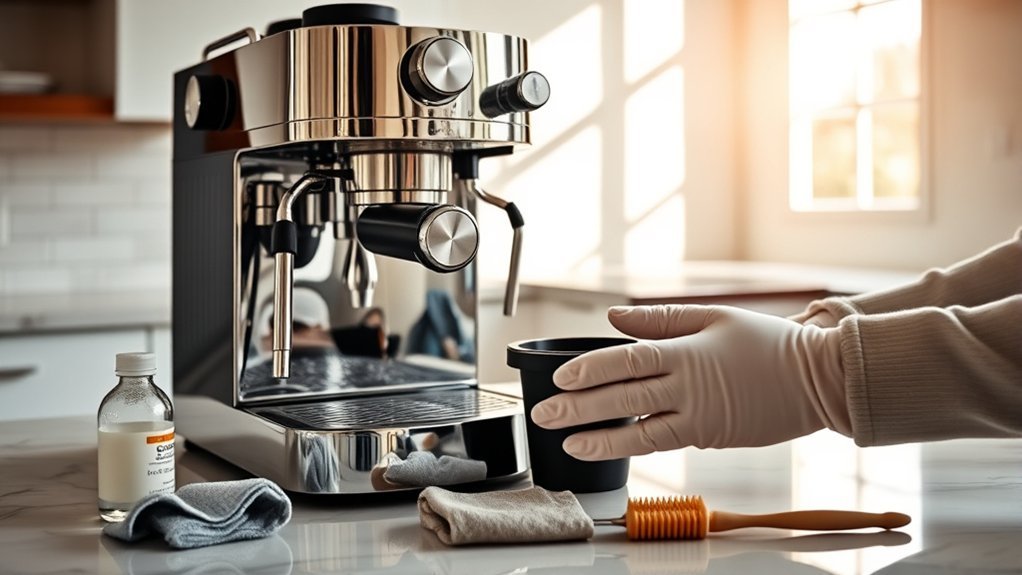
Preparing a coffee maker for long-term storage takes more than emptying the carafe and putting the machine in a box. You need to remove coffee and milk residue, clear standing water, drain internal water only as the manufacturer allows, dry every washable part, and protect the appliance from humidity, dust, pests, freezing temperatures, and impact. The exact procedure depends on the brand, model, and machine type.
Quick Answer
To store a coffee maker long term, unplug and cool it, remove coffee and water, clean the removable parts, complete any model-approved draining procedure, and let everything become completely dry. Pack the machine upright with protected accessories and keep it in a clean, dry, temperature-stable location away from freezing conditions.
Key Takeaways
- Check the exact model manual before descaling, draining internal water, removing a filter, or opening any service access point.
- Remove grounds, pods, capsules, beans, standing water, used filters, and all milk residue before storage.
- Never run the machine dry, force compressed air through its tubing, or open the powered housing unless the manufacturer specifically instructs you to do so.
- Let reservoirs, carafes, baskets, drip trays, tubes, and other washable parts become completely dry before packing.
- Store the machine upright in a dry, pest-free place protected from freezing, condensation, direct sun, major temperature swings, and crushing weight.
- Before using it again, inspect the appliance, reinstall the correct parts and filter, and complete the manufacturer’s post-storage or first-use rinse procedure.
At a Glance
| Time Required | About 30–90 minutes of hands-on work for many home machines, plus enough air-drying time for every part to become fully dry; overnight or longer is often practical |
| Difficulty | Easy for many drip brewers; moderate for pod and espresso machines with model-specific internal emptying procedures |
| Tools Needed | Owner’s manual, mild dish soap, soft cloth, nonabrasive sponge, clean towels, small accessory bag, padding, and a sturdy box or bin |
| Cost | Often $0 if you already have cleaning and packing supplies; otherwise commonly about $5–$20 for an approved descaler or basic packing material |
Warning: Unplug the coffee maker and let it cool before cleaning, moving, or packing it. Use only one manufacturer-approved cleaner at a time. Never mix household bleach or disinfectants with vinegar, citric acid, ammonia, descaling solution, or other cleaners because hazardous vapors or chemical reactions can result.
Check the Manual Before Preparing Your Coffee Maker
Start by finding the brand and exact model number, which is often printed on the bottom, back, underside of the reservoir area, or rating label. Use the manufacturer’s support site to find the matching manual instead of following instructions written for a similar-looking machine.
This matters because coffee makers retain water in different places. A simple drip machine may need only an empty reservoir and thoroughly dried removable parts. A capsule brewer may have a built-in system-emptying mode. A boiler-based espresso machine may require a specific drain sequence, while some direct-plumbed or commercial machines require the water supply to be isolated and serviced before storage.
For example, Nespresso’s Vertuo support guidance includes a dedicated procedure for emptying the system before non-use, frost exposure, or repair. The official Breville Oracle BES980 instruction manual recommends draining both boilers completely before transporting the machine or storing it for an extended period and identifies the procedure as an anti-freeze measure.
Note: This guide uses “long-term storage” as a practical term for roughly a month or more of non-use. Manufacturers do not use one universal time threshold, so the same preparation is also sensible before a move, seasonal shutdown, extended trip, or any situation where a machine could encounter freezing conditions.
Step-By-Step Guide to Cleaning Your Coffee Maker Before Storage
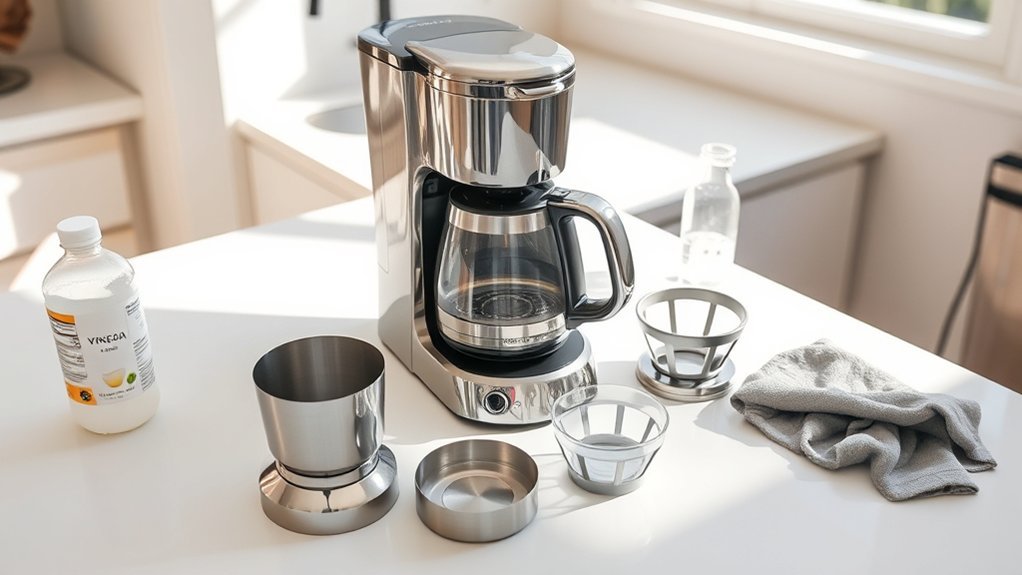
Cleaning before storage removes coffee oils, grounds, milk residue, and standing water that can create stale odors, attract pests, or leave damp areas inside the appliance. Work through the following steps in order, but let the exact model manual override any general instruction below.
1. Unplug and Cool the Machine
Turn the machine off, unplug it from the wall, and let the warming plate, brew head, boiler, steam wand, hot-water outlet, and internal water cool. Do not remove parts or begin cleaning while the appliance is hot or connected to power.
2. Remove Coffee, Water, and Consumables
- Discard used grounds, paper filters, capsules, and pods.
- Empty the visible water reservoir and carafe.
- Empty the drip tray, used-capsule bin, knock box, and grounds container.
- Remove beans from the hopper and clear loose grounds from accessible grinder areas.
- Remove milk from any milk reservoir, tube, jug, or frothing attachment.
- Handle a replaceable water-filter cartridge according to the exact manual. Some manufacturers instruct owners to remove or replace a cartridge after prolonged non-use.
Do not leave beans or coffee grounds inside the machine. Oils become stale, loose grounds can absorb moisture, and food residue can attract insects or other pests.
3. Wash the User-Removable Parts
Remove only the components identified as user-removable in the manual, such as the carafe, filter basket, reusable filter, reservoir, reservoir lid, drip tray, pod bin, milk container, or cup support. Put a part in the dishwasher only when the manufacturer identifies it as dishwasher-safe. Otherwise, use warm water, mild dish soap, and a nonabrasive sponge.
Rinse away all detergent. Check corners, removable valves, seals, lids, and narrow channels for residue. Wipe the appliance housing with a soft damp cloth, then dry it. Never immerse the powered base, cord, plug, display, or electrical controls in water.
4. Clean Milk and Grinder Components
Milk systems need careful cleaning because residue can remain in tubes, connectors, frother heads, and steam-wand tips. Complete the manufacturer’s milk-rinse or purge process while the machine is still operating normally, then switch it off, unplug it, and wash the user-removable milk-contact parts as directed.
For a machine with a built-in grinder, empty the bean hopper and accessible grounds path. Use the supplied brush or another dry, soft brush around user-accessible burr areas. Do not pour water into the grinder, burr chamber, or hopper unless the manual specifically states that a particular removable component can be washed.
5. Decide Whether Descaling Is Due
Cleaning removes coffee, milk, and food residue. Descaling removes mineral deposits from the water path. They are different maintenance jobs.
If the descale indicator is active, water flow has noticeably slowed, scale is visible, or the manufacturer’s maintenance schedule says descaling is due, complete the approved procedure before storage. Use the cleaner, concentration, cycle, and rinse sequence specified for your exact machine.
Cuisinart’s current coffee-maker cleaning guidance includes vinegar-based procedures for many of its brewers while also telling users to check the instructions for their machine. Keurig provides brewer-specific descaling guidance. Because brands and models differ, do not treat equal-parts vinegar, a particular citric-acid strength, or any other homemade formula as universal.
If descaling is not due, normal cleaning, rinsing, draining, and drying may be enough. Never leave vinegar, citric acid, cleaning solution, or descaler sitting in the reservoir, boiler, thermoblock, or tubing throughout storage.
6. Complete Every Required Rinse
After a cleaning or descaling procedure, use fresh potable water for the full rinse sequence specified in the manual or cleaner directions. One machine may need a single full rinse while another may require additional water. Continue until the approved cycle is complete and no cleaning product remains.
7. Drain Internal Water Without Improvising
Empty the visible reservoir first. Then use only the draining or storage procedure provided for your machine. An empty removable tank does not necessarily mean the pump, tubing, boiler, or internal reservoir is empty.
- Drip coffee maker: Let any normal cleaning or fresh-water rinse cycle finish, then empty the reservoir, basket, and carafe. Do not deliberately operate the heater or pump dry in an attempt to remove hidden water unless the manual specifically instructs you to do so.
- Pod or capsule machine: Eject the capsule, empty the used-capsule bin and drip tray, and use the model’s official system-emptying or storage mode when one is provided.
- Espresso machine: Empty the reservoir and drip tray, then follow the approved flushing or draining procedure for its thermoblock, boiler, or other water system.
- Dual-boiler machine: Follow the manual’s boiler-draining instructions exactly. Do not open the housing or loosen boiler fittings simply to prepare the machine for storage.
- Direct-plumbed or commercial machine: Follow the manufacturer’s shutdown procedure for the water connection. If the manual assigns draining, line disconnection, or boiler work to a service technician, use qualified service rather than improvising.
Warning: Water trapped in a pump, tube, thermoblock, or boiler can freeze and expand. Do not store a water-retaining machine where it may freeze unless you have completed its manufacturer-approved frost-protection or draining procedure. Do not use compressed air, an external pump, forced suction, or unauthorized disassembly to purge internal tubing.
8. Air-Dry Every Part Completely
Place washed components on a clean towel or drying rack with enough space for air to circulate. Let them dry until no droplets, damp film, or condensation remain. Overnight drying is often convenient, but a fixed number of hours is less important than the final condition of the part. Covered reservoirs, valves, seals, tubes, and milk-system pieces may need more time.
Leave the reservoir lid, filter-basket door, capsule head, and other appropriate hinged areas open while drying when the design allows it. Once everything is completely dry, use the storage position recommended by the manufacturer and protect the machine from dust.
A padded box cannot compensate for water left inside the coffee maker. Complete cleaning, model-approved draining, and thorough drying provide the foundation for safe long-term storage.
How to Disassemble Your Coffee Maker Properly
For routine cleaning and storage, “disassembly” should mean removing user-serviceable parts, not opening the powered appliance housing. Remove only the pieces that the owner’s manual identifies as detachable.
Gather Necessary Tools
Most home coffee makers need only a small set of supplies:
- The exact model’s owner’s manual
- A soft cloth or nonabrasive sponge
- Mild dish soap
- A small dry cleaning brush if the machine has a grinder
- Clean towels or a drying rack
- Labeled resealable bags for small accessories
- A phone or camera for recording the position of removable components
Do not reach for a screwdriver merely because a panel or fitting appears removable. Screws and housing clips can protect wiring, heaters, pumps, batteries, capacitors, and pressurized components. Use a tool only when the manufacturer’s user procedure specifically calls for it.
Follow Manufacturer’s Instructions
After the machine is unplugged and cool, remove the carafe, basket, reservoir, drip tray, pod container, milk accessories, and other approved detachable pieces. Pay attention to tabs, valves, seals, and clips. Stop if a component does not release in the way shown in the manual.
Place small parts in a labeled bag only after they are fully dry. Record where each gasket, scoop, filter holder, cleaning pin, brush, or removable seal belongs. Photos can save time during reassembly months later.
If the manufacturer provides a transport lock, shipping screw, brew-head restraint, grinder restraint, or other storage hardware, install or engage it only as directed. Do not invent restraints or wedge packing material inside moving mechanisms.
Pro Tip: Save a digital copy of the exact manual and place a note with the model number inside the storage box. Also note whether you removed a water filter or installed a transport restraint so reactivation is easier later.
How to Safely Wrap and Protect Your Coffee Maker Parts

Once every component is clean and fully dry, protect the machine from scratches, impacts, dust, and lost accessories.
Disassemble Detachable Parts Carefully
Remove the carafe, filter basket, reusable filter, reservoir, drip tray, milk container, and other pieces the manual identifies as detachable. Never force a tightly fitted component simply to make the appliance smaller for storage.
Wrap a glass carafe in clean bubble wrap, foam, or a soft towel. Protect projecting or fragile edges so they cannot strike the machine or another accessory. Keep clean food-contact parts in a clean bag or covered container before placing them beside packing materials.
Put measuring scoops, cleaning tools, filter holders, removable seals, and other small accessories in a labeled resealable bag. Keep that bag inside the main storage container so the appliance and its parts stay together.
Use Protective Wrapping Materials
Wrap the appliance in a clean cloth, foam sleeve, or bubble wrap without pressing hard against buttons, hinges, displays, steam controls, or plastic lids. Coil the power cord loosely and secure it with a reusable strap. Avoid sharp bends, knots, or tight wrapping around the machine body.
Position the plug so its metal prongs cannot scratch the housing or hit a glass carafe. Never lift or carry the appliance by its power cord.
Choose the Right Storage Container for Your Coffee Maker
The original manufacturer carton and fitted inserts are often convenient because they match the appliance’s shape. If the original packaging is unavailable, use a sturdy corrugated box or rigid plastic bin that lets the coffee maker remain in its normal upright orientation with cushioning on every side.
- Add a layer of clean cushioning to the bottom.
- Place the wrapped coffee maker upright in the center.
- Position the protected carafe and accessories so they cannot shift into the appliance.
- Fill open spaces with clean packing paper, foam, or towels.
- Keep heavy pieces away from the reservoir lid, warming plate, display, brew head, grinder controls, and other fragile areas.
- Confirm that every component is completely dry before closing the container.
- Label the box “Coffee Maker — Fragile — Keep Upright” and include the model number and packing date.
An intact silica-gel packet can provide secondary moisture protection inside a dry container, but it cannot dry a wet coffee maker or fix a humid storage area. Keep packets away from food-contact surfaces and discard any packet that is damaged or leaking.
Ideal Storage Conditions for Long-Term Protection
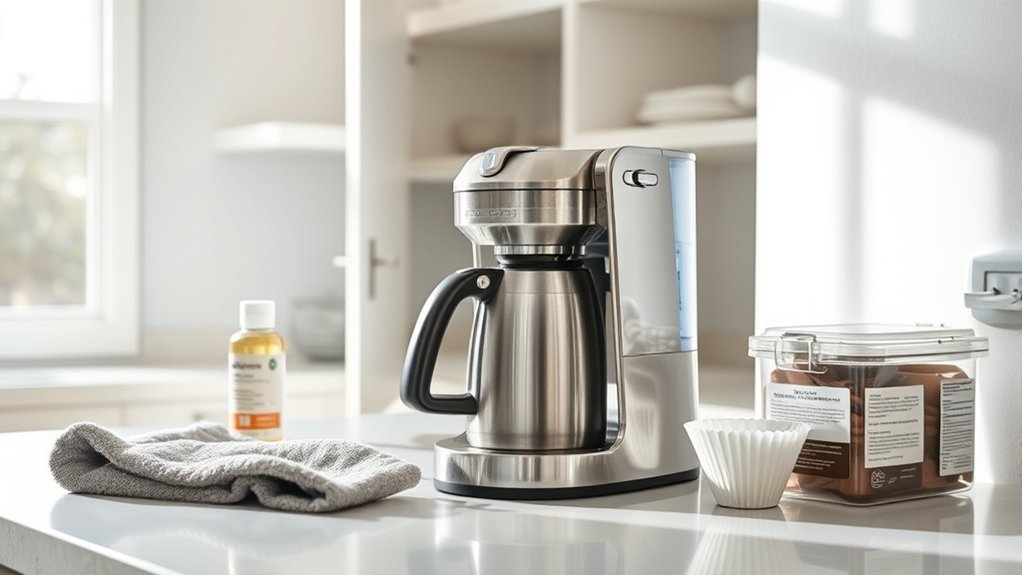
Choose a clean indoor location that stays dry and reasonably stable throughout the year. There is no single storage-temperature specification that applies to every coffee maker, so follow any range in the appliance manual. As general room-level moisture guidance, the U.S. Environmental Protection Agency recommends keeping indoor relative humidity below 60%, with 30%–50% preferred when practical.
- Keep it dry: Avoid damp basements, areas beneath plumbing, flood-prone floors, and places where condensation forms.
- Avoid freezing: Do not place a machine that may retain water in an unheated shed, vehicle, attic, or garage during freezing weather.
- Limit extreme heat: Keep the container away from furnaces, heaters, hot pipes, and very hot attic spaces.
- Reduce direct sunlight: A closed box or shaded storage area helps protect exposed plastic, labels, displays, and rubber parts.
- Control dust: Close or cover the storage container after the machine and accessories are completely dry.
- Prevent pests: Leave no coffee, grounds, pods, sugar, milk, syrup, or flavored-drink residue inside the appliance.
- Keep it upright: Use the machine’s normal operating orientation unless the manufacturer gives different transport or storage instructions.
- Avoid crushing: Do not stack heavy boxes, appliances, or furniture on top of the coffee maker container.
A garage can work only when it stays dry, clean, pest-free, and safely above freezing for a machine that may retain water. A climate-controlled closet, pantry, or utility room is usually more predictable than an unconditioned garage, shed, vehicle, or attic.
Storage Guidance by Coffee Maker Type
| Machine Type | Before Storage | Special Concern |
|---|---|---|
| Drip coffee maker | Empty the reservoir and carafe; wash the basket, reusable filter, lid, and removable reservoir. | Water may remain below a nonremovable reservoir or inside valves. Do not intentionally run the machine dry unless the manual directs it. |
| Pod or capsule brewer | Eject the pod, empty the bin and drip tray, clean the puncture area as directed, and use the approved emptying mode when provided. | Internal tanks and tubing may hold water after the removable reservoir is empty. |
| Espresso machine | Clean the portafilter, baskets, group area, steam wand, milk parts, drip tray, and reservoir. | Thermoblocks and boilers may require a model-specific draining procedure. |
| Machine with grinder | Remove beans and loose grounds; clean the hopper and user-accessible burr area only as the manual permits. | Moisture can make residual grounds cake inside grinder components. |
| Machine with milk system | Complete the approved milk rinse or purge, then wash and dry every removable milk-contact component. | Milk residue can remain in tubes, connectors, valves, steam tips, and frother heads. |
| Direct-plumbed or commercial machine | Use the manufacturer’s shutdown procedure for the water supply, filters, boiler, and drain system. | Water-line disconnection, pressure-system work, or complete boiler draining may require trained service personnel. |
Essential Items for Your Coffee Machine Storage Checklist
Use this checklist before sealing the storage container:
- The appliance is unplugged and completely cool.
- No pod, capsule, paper filter, coffee grounds, or beans remain.
- The visible water reservoir, carafe, drip tray, pod bin, and milk system are empty.
- All required manufacturer-approved cleaning and rinse cycles are complete.
- The internal water system has been emptied only as the model manual directs.
- You did not run the machine dry or force air through its internal tubing unless an official procedure specifically required it.
- Every removable component is clean and completely dry.
- The water-filter cartridge has been removed, retained, or discarded according to the manual.
- Any manufacturer-provided transport lock or restraint has been installed or engaged as directed.
- The glass carafe and other fragile accessories are separately cushioned.
- The power cord is loosely coiled and secured.
- Small accessories are stored in a labeled bag.
- The machine is packed in its normal upright orientation with padding around it.
- The box is labeled with the contents, model number, orientation, and packing date.
- The storage location is dry, stable, pest-free, and protected from freezing and condensation.
Tips for Maintaining Coffee Equipment During Storage
A properly prepared coffee maker normally does not need to be plugged in or operated while it is stored. Running occasional brew cycles can reintroduce water without providing a meaningful storage benefit.
There is no universal manufacturer rule requiring inspection every two or three months. However, if the machine is in a garage, basement, rented storage unit, or another environment where humidity, pests, leaks, or temperatures can change, a periodic check is sensible. Every two or three months is a conservative household interval for such an area, and you should also inspect after a leak, flood, pest problem, or major humidity event.
Look for:
- Water leaks or damp cardboard
- Condensation inside a plastic bin
- Musty odors
- Pest activity
- Crushed or shifting boxes
- Rust, corrosion, or damaged packing material
When the machine is stored in a clean, climate-controlled indoor location, frequent handling is usually unnecessary. A thorough inspection before reactivation may be enough.
Reactivating Your Coffee Maker After Long-Term Storage
Do not immediately plug the machine in as soon as it leaves the box. Unpack it in a well-lit, dry location and inspect it first.
If the appliance has come from a cold garage, vehicle, shed, or storage unit, check for condensation on the housing, plug, reservoir area, and accessible internal surfaces. Keep it unplugged until it has reached normal indoor temperature and every visible trace of moisture has evaporated.
Inspect All Components Thoroughly
- Check the cord and plug for cuts, crushed areas, exposed wire, bent prongs, discoloration, or heat damage.
- Inspect the housing, reservoir, carafe, drip tray, filter basket, brew head, and controls for cracks or deformation.
- Look at user-visible gaskets and seals for splitting, stiffness, deformation, or missing pieces.
- Check safely accessible areas for dust, insects, webs, corrosion, residue, or visible mold.
- Smell the reservoir, basket, pod area, and milk components for stale or musty odors.
- Confirm that every removed component is present and installed in the correct orientation.
- Release or remove any manufacturer-provided transport restraint according to the manual before operation.
Do not use the machine if the cord is damaged, liquid has entered the powered base, the housing is cracked around electrical parts, or water leaks into electrical areas during testing. Contact the manufacturer or a qualified appliance technician.
Clean and Prime the System
Wash removable parts again if they collected dust during storage. Install or replace the water-filter cartridge when the manufacturer requires it after prolonged non-use. For example, Breville’s Oracle instructions tell users to empty the water tank and replace the filter cartridge after a prolonged absence.
Fill the reservoir with fresh potable water and complete the exact first-use, post-storage, priming, or water-only rinse procedure specified for the model. Use a manufacturer-approved descaler only when descaling is due or mineral buildup is present; do not automatically put vinegar or citric acid through every machine after storage.
| Reactivation Step | Purpose |
|---|---|
| Wash removable parts | Removes storage dust and provides another chance to inspect food-contact surfaces. |
| Install the correct filter when required | Replaces a cartridge that the manufacturer says should be changed after prolonged non-use. |
| Run the approved water-only rinse or priming procedure | Primes the water path and flushes storage dust or residual stale water without wasting coffee. |
| Check flow, heat, sound, and leaks | Helps identify an air lock, blockage, damaged seal, pump issue, or storage-related leak before normal use. |
| Prepare the first beverage only after the rinse passes | Confirms normal operation. Discard the first coffee only if the manual instructs you to or if an unusual odor or taste remains. |
Common Mistakes to Avoid When Storing Coffee Machines
- Packing the machine while damp: Trapped moisture can contribute to musty odors, corrosion, and mold growth.
- Assuming an empty reservoir means the machine is fully drained: Pod and espresso machines may retain water inside tubing, tanks, thermoblocks, or boilers.
- Running the machine dry to force water out: Do this only when an official emptying procedure explicitly instructs you to.
- Using compressed air or improvised pumps: Pressure can affect valves, tubes, fittings, and sensors. Follow only an approved draining method.
- Using a universal vinegar formula: Cleaner type, strength, cycle length, and rinsing requirements differ by machine.
- Mixing cleaning products: Never combine bleach or disinfectants with acids, ammonia, descaling chemicals, or other cleaners.
- Opening the powered housing: Routine storage does not justify exposing electrical, heating, or pressurized components.
- Leaving beans, grounds, pods, milk, or a used filter inside: Food residue can create odor and attract pests.
- Storing in freezing conditions: Hidden water may freeze and damage internal components.
- Wrapping the cord tightly: Avoid sharp bends and stress near the plug and appliance body.
- Sealing a wet machine in an airtight bin: A sealed container traps moisture when the appliance is not fully dry.
- Stacking heavy weight on the box: Pressure can crack the reservoir, carafe, hinges, controls, display, or housing.
- Leaving the machine plugged in: A stored coffee maker should remain powered off and disconnected.
- Skipping inspection before reuse: Storage damage, pests, condensation, mold, or leaks may not be obvious until the appliance is unpacked.
- Powering up a cold, condensed machine: Let the appliance become dry and temperature-stable before reconnecting it to electricity.
Useful Maintenance and Storage Supplies
You do not need a large collection of specialty products. Choose supplies that match the owner’s manual and avoid abrasive or strongly scented cleaners on food-contact areas.
- Manufacturer-approved descaler: Use it only at the approved dilution and maintenance interval.
- Mild dish soap: Suitable for many removable food-contact components when the manual allows hand washing.
- Soft cloths and nonabrasive sponges: Useful for cleaning without scratching plastic, glass, metal, or displays.
- Small dry brush: Helpful for loose grounds in approved grinder, chute, and brew-head areas.
- Replacement water filter: Install the correct new cartridge during reactivation when the manufacturer requires one.
- Clean packing material: Foam, bubble wrap, packing paper, or clean towels can protect the machine and carafe.
- Resealable accessory bags: Keep scoops, filters, cleaning tools, seals, and small removable parts together.
- Humidity meter: Useful when you are unsure whether a basement, garage, or storage room stays sufficiently dry.
Avoid steel wool, abrasive scouring powder, unknown solvents, heavily fragranced chemicals, and any cleaner specifically prohibited by the appliance manufacturer.
Troubleshooting After Long-Term Storage
The Machine Has a Musty Odor
Unplug the coffee maker and inspect every removable component. The EPA advises cleaning mold from hard surfaces with detergent and water and drying them completely. For coffee-maker parts, also follow the manufacturer’s material and cleaning restrictions.
If visible mold or a persistent musty odor appears to come from inaccessible tubing, a sealed boiler, insulation, wiring, or the powered base, stop using the appliance and contact the manufacturer or an appliance service professional. Repeatedly circulating acidic cleaner through inaccessible contamination is not a reliable substitute for removing the contamination.
Water Flow Is Slow
Check that the reservoir and water filter are seated correctly and that no packing material, transport restraint, or accessory blocks the machine. Prime it according to the manual. If scale is suspected and descaling is due, use the approved procedure. Persistent low flow can indicate trapped air, a blocked valve, a pump problem, or internal damage.
The Machine Leaks
Turn the machine off and unplug it. Reseat the reservoir, drip tray, carafe, portafilter, and any user-removable seals. Do not keep operating a machine that sends water into the powered base, around electrical controls, through a cracked housing, or from a location that is not identified as a normal drain or outlet.
Coffee Tastes Stale or Like Cleaner
Discard the beverage. Rewash the carafe, basket, reservoir, pod holder, and milk parts, then run additional fresh-water rinses only as permitted by the manual. Do not resume normal brewing until cleaning-product odor and taste are gone.
The Machine Will Not Turn On
Confirm that the appliance is dry, correctly reassembled, and no transport lock remains engaged. Check the cord and plug, then verify the outlet with another suitable appliance. If the controls remain dead, do not open the housing; contact the manufacturer or a qualified appliance technician.
Frequently Asked Questions
Can I store my coffee maker in a garage?
Yes, but only if the garage remains clean, dry, pest-free, and suitable for your machine’s storage requirements. Avoid a garage where the appliance could freeze, experience condensation, or sit through major temperature and humidity swings. A climate-controlled indoor location is usually safer.
How often should I check my coffee maker during storage?
There is no universal manufacturer inspection interval. If the machine is in a garage, basement, or another variable environment, checking every two or three months is a reasonable conservative practice. In a clean, climate-controlled indoor space, one thorough inspection before reactivation may be sufficient.
Should a coffee maker remain plugged in while it is stored?
No. Turn it off, unplug it, and keep it disconnected throughout storage. Reconnect power only after the machine has been unpacked, inspected, correctly reassembled, and confirmed dry.
What should I do if I find mold inside my coffee maker?
Unplug the machine. Clean removable washable hard parts according to the manufacturer’s instructions, rinse them, and dry them completely. If mold or a musty odor remains inside inaccessible tubing, a boiler, insulation, or the powered base, stop using the appliance and contact the manufacturer or replace it rather than relying on repeated cleaner cycles.
Can I store coffee grounds or beans in the machine?
No. Remove grounds, pods, capsules, and beans before storage. Coffee oils become stale, grounds can absorb moisture, and food residue may attract insects or rodents. Store unused coffee separately in an appropriate sealed container.
Should I descale the coffee maker before storing it?
Descale it when the maintenance indicator is active, flow has slowed, scale is visible, or the manufacturer’s maintenance schedule says the process is due. Otherwise, normal washing, rinsing, approved draining, and drying may be sufficient. Never leave descaling solution in the machine during storage.
Can I use vinegar to prepare every coffee maker for storage?
No. Some manufacturers and models permit vinegar-based cleaning, while others specify a proprietary descaler or another process. Follow the exact model manual for the cleaner, concentration, cycle, and rinse procedure instead of using a universal vinegar recipe.
How long should coffee maker parts dry before packing?
Dry them until every surface and accessible cavity is completely free of visible moisture. Overnight drying is often practical, but there is no universal number of hours for every machine. Reservoirs, valves, tubes, seals, and covered components may need longer than exposed parts.
How long can a coffee maker stay in storage?
There is no universal maximum storage period for all coffee makers. A properly cleaned, drained, dry, protected machine can remain unused for an extended period, but seals, filters, batteries, plastics, and other components can age over time. Inspect the appliance carefully and follow its reactivation instructions before use.
Should I leave the reservoir lid or brew head open during storage?
Leave appropriate lids and compartments open while the machine is drying so moisture can escape. After everything is fully dry, follow the manufacturer’s storage position. Closing the machine or storage box can then help keep out dust and pests; do not rely on leaving a damp machine permanently ajar as a substitute for thorough drying.
Conclusion
Long-term coffee maker storage is safest when you remove coffee and milk residue, drain internal water only through an approved procedure, and give every washable component enough time to become completely dry. Protect the appliance and its accessories from impact, moisture, pests, freezing, and major temperature changes. Before brewing again, inspect the cord, seals, water path, removable parts, and storage condition, complete the manufacturer’s rinse or priming procedure, and stop if you discover an electrical fault, persistent mold, or an unexplained leak.
Sources
- Nespresso: Vertuo Up Machine Assistance — system emptying before non-use, frost exposure, or repair and post-storage guidance
- Breville: The Oracle BES980 Instruction Manual — extended-storage boiler draining, frost protection, cleaning, and prolonged-absence water-filter guidance
- Keurig Support: Descaling Guidance — model-specific descaling and scale-removal procedures
- Cuisinart: How to Clean Your Coffee Maker — cleaning, descaling, removable-part care, and manual-specific guidance
- U.S. Environmental Protection Agency: A Brief Guide to Mold, Moisture and Your Home — indoor humidity, moisture control, complete drying, and mold cleanup on hard surfaces
- Centers for Disease Control and Prevention: Cleaning and Disinfecting With Bleach — warning against mixing bleach or disinfectants with other cleaners