A coffee maker “cup” is not always the same as the 8-fluid-ounce cup used in U.S. kitchen measurements. Many full-size drip machines use smaller, manufacturer-defined units for their carafe markings. That is why a “12-cup” brewer may hold about 60 fluid ounces instead of 96. Checking your exact brewer and measuring water by ounces, milliliters, or weight prevents serving-size surprises and makes coffee strength easier to repeat.
Quick Answer
A U.S. measuring cup equals 8 fluid ounces, but a coffee maker’s numbered “cup” can be smaller and varies by model. One current Mr. Coffee 12-cup brewer uses approximately 5 fluid ounces per machine cup, so its 60-ounce capacity equals 7.5 standard 8-ounce cups or five 12-ounce mugs.
Key Takeaways
- A U.S. measuring cup is 8 fluid ounces, or about 237 milliliters.
- Coffee maker cup sizes are manufacturer-defined and can vary from one brewer to another.
- A 12-cup machine with a 60-fluid-ounce capacity holds 7.5 standard 8-ounce cups, not 12 standard cups.
- Your mug size does not change coffee concentration; strength changes when the coffee-to-water ratio or extraction changes.
- For repeatable drip coffee, measure water and grounds consistently and use roughly a 1:16 to 1:18 coffee-to-water ratio as a practical starting range.
At a Glance
| Time Required | About 2–5 minutes to check or measure your brewer |
| Difficulty | Easy |
| Tools Needed | Brewer manual or product specifications, plus a liquid measuring cup or digital kitchen scale if needed |
| Cost | No added cost if you already have a measuring cup or kitchen scale |
What Does “Cup” Mean on a Coffee Maker?
On a drip coffee maker, the numbered cup marks are capacity increments chosen by the manufacturer. They are not guaranteed to match a U.S. measuring cup or the mug you drink from.
NIST Handbook 133 defines one U.S. measuring cup as exactly 8 fluid ounces, commonly expressed as about 237 milliliters. By contrast, a current Mr. Coffee 12-cup model lists a 60-fluid-ounce water capacity and defines one numbered cup as approximately 5 fluid ounces or 148 milliliters.
Other brands use different conventions. For example, the Moccamaster KBGV is marketed with the combined specification “1.25 L / 40 oz / 10 cups.” Those figures are manufacturer capacity labels rather than exact unit conversions: 1.25 liters is about 42.3 U.S. fluid ounces. This is another reason not to assume that every numbered coffee-maker cup represents exactly 5, 6, or 8 fluid ounces.
| Measurement | Volume | What It Means |
|---|---|---|
| U.S. measuring cup | 8 fl oz / about 237 mL | A standardized kitchen volume |
| Coffee maker “cup” | Varies by brewer and is often smaller than 8 fl oz | A manufacturer-defined reservoir or carafe increment |
| Coffee mug | No fixed volume | A serving vessel; measure yours if exact capacity matters |
Note: The number printed on a coffee maker describes that machine’s own capacity scale. It does not promise that the brewer will fill the same number of household mugs.
How to Find Your Coffee Maker’s Actual Cup Size
If you do not know whether your brewer uses 5-ounce, 6-ounce, metric-based, or another cup increment, you can determine it without guessing.
- Check the specifications first. Look in the manual or manufacturer product page for total capacity in fluid ounces or milliliters.
- Divide capacity by the labeled cup count. A 60-fluid-ounce brewer labeled “12 cups” uses 60 ÷ 12 = 5 fluid ounces per numbered cup.
- Measure a carafe mark if the specification is unclear. Fill the carafe with water to a convenient mark, such as 4 cups, then pour that water into a liquid measuring cup. Divide the measured volume by four.
- Use a scale as another option. Tare an empty container, weigh the water, and divide the water weight by the number of machine cups. For normal kitchen measurements, 1 milliliter of water weighs approximately 1 gram.
- Write down the result. Once you know your machine’s cup size, use that number for future water, serving, and coffee-dose calculations.
For example, if water filled to the “4” line measures about 20 fluid ounces, each machine cup is about 5 fluid ounces. If the same line measures 24 fluid ounces, each machine cup is about 6 fluid ounces.
How Many 8-Ounce Cups Are in a 12-Cup Coffee Maker?
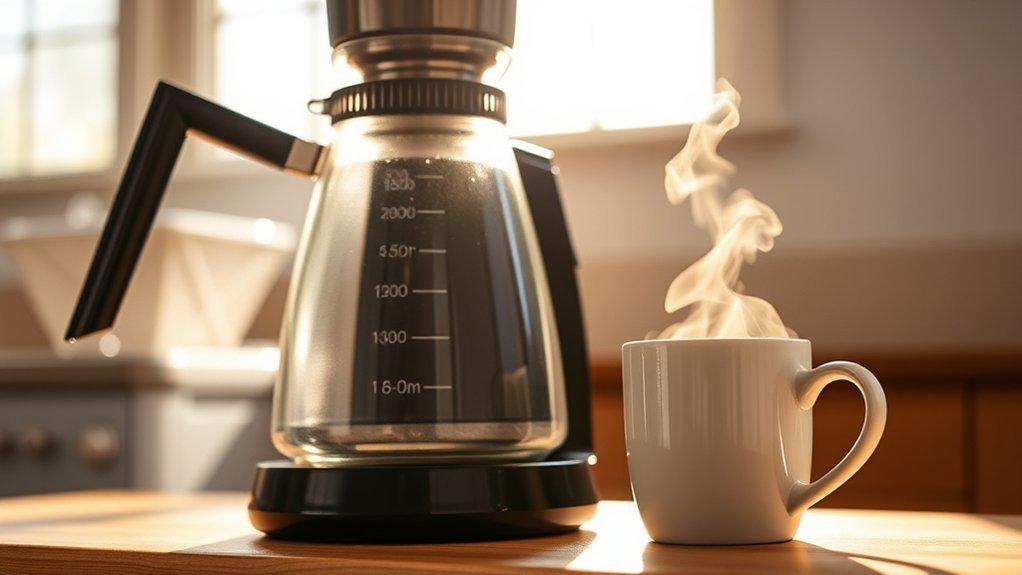
If a 12-cup brewer uses 5 fluid ounces per numbered cup, the calculation is:
12 machine cups × 5 fluid ounces = 60 fluid ounces
Then divide the total capacity by the size of your actual serving:
- 8-ounce cups: 60 ÷ 8 = 7.5 servings
- 10-ounce mugs: 60 ÷ 10 = 6 servings
- 12-ounce mugs: 60 ÷ 12 = 5 servings
- 16-ounce travel mugs: 60 ÷ 16 = 3.75 servings
| Machine Label | Water at 5 fl oz per Machine Cup | Equivalent 8-Ounce Cups |
|---|---|---|
| 4 cups | 20 fl oz | 2.5 cups |
| 6 cups | 30 fl oz | 3.75 cups |
| 8 cups | 40 fl oz | 5 cups |
| 10 cups | 50 fl oz | 6.25 cups |
| 12 cups | 60 fl oz | 7.5 cups |
A 60-ounce “12-cup” coffee maker holds 12 of its own 5-ounce units, but only 7.5 standard 8-ounce measuring cups.
Why Coffee Maker Cup Marks Do Not Match Your Mug
Coffee maker markings help you fill the reservoir and match water to the brewer’s intended capacity. Your mug is simply the vessel you use to drink the finished coffee. Because mugs do not have one fixed volume, one machine cup cannot reliably equal one mug.
The manufacturer convention is also not universal. One brewer may use about 5 fluid ounces per labeled cup, while another may use a different or metric-based increment. A coffee maker’s numbered cup is therefore a product-capacity convention, not a second standardized U.S. definition of the word “cup.”
Reservoir Water Versus Brewed Yield
The water poured into the reservoir is not always identical to the amount that reaches the carafe. Coffee grounds retain some brewing water, so the beverage yield can be lower than the starting water volume. For that reason, a brewer filled with 60 fluid ounces of water may produce somewhat less than 60 fluid ounces of finished coffee.
Use the Maximum Fill Line, Not Mug Count
You may use an 8-ounce measuring cup to fill the reservoir, but stop at the machine’s maximum line. For a brewer with a true 60-fluid-ounce maximum capacity, seven full 8-ounce measures plus another 4 ounces reaches 60 ounces. Twelve 8-ounce measures would equal 96 ounces, far above that brewer’s capacity.
Warning: Never exceed your coffee maker’s marked maximum water level in an attempt to produce more servings. Overfilling can cause water or coffee to spill or overflow. Follow the capacity and filling instructions for your specific model.
How Cup Size Affects Coffee Strength
The size of the mug does not make coffee stronger or weaker by itself. Coffee concentration changes when you change the amount of ground coffee relative to the brewing water or alter other extraction variables.
If you brew one properly proportioned pot and divide it among different mug sizes, the coffee itself keeps the same concentration. A larger mug simply contains more of the same brew. Dilution occurs when extra water, milk, ice melt, or another liquid changes the finished drink’s proportions.
Use a Coffee-to-Water Ratio
For repeatable drip coffee, weighing the ingredients is more consistent than relying only on numbered machine cups. A practical starting range is about 1 gram of coffee for every 16 to 18 grams of water. The Moccamaster brewing guide recommends 55 grams of coffee per liter of water, while the National Coffee Association drip guide gives a volume-based starting point of 1 to 2 tablespoons of ground coffee per 6 ounces of water.
The ratio is based on the amount of brewing water and coffee, not the label placed on the serving. For ordinary kitchen dosing, one milliliter of water weighs approximately one gram, making a digital scale convenient for calculating recipes.
| Water Added | Coffee at 1:18 | Coffee at 1:16 |
|---|---|---|
| 20 fl oz / about 591 g | 33 g | 37 g |
| 30 fl oz / about 887 g | 49 g | 55 g |
| 40 fl oz / about 1,183 g | 66 g | 74 g |
| 50 fl oz / about 1,479 g | 82 g | 92 g |
| 60 fl oz / about 1,774 g | 99 g | 111 g |
Why Coffee Scoops Are Less Precise
A household measuring tablespoon is approximately 15 milliliters, but a tablespoon of ground coffee does not have one fixed weight. Bean density, roast level, grind size, and how the grounds settle in the spoon can change the number of grams you actually measure.
A scoop supplied with a brewer may hold one tablespoon, two tablespoons, or another amount. Check the manual before treating “one scoop” as a universal coffee measurement. When repeatability matters, grams are more reliable than scoops.
Pro Tip: Put an empty carafe or container on a digital scale and tare it to zero. Weigh the brewing water, then divide the water weight by 16 to 18 to estimate a useful starting dose of coffee.
How to Measure Coffee Accurately
- Find the real capacity. Check the manual, manufacturer product page, reservoir markings, or carafe markings for fluid ounces or milliliters.
- Choose the amount you want to brew. Base the batch on your actual mug size and number of drinkers rather than relying only on the brewer’s cup number.
- Measure the water. Use a digital scale, marked carafe, or liquid measuring cup. Never exceed the brewer’s maximum fill line.
- Calculate the coffee dose. Divide the water weight by 16 for a stronger starting recipe or by 18 for a milder one.
- Brew and taste. Keep the water amount fixed, then make small changes to the coffee dose or appropriate drip grind on the next batch if necessary.
Measuring Without a Scale
When a scale is unavailable, follow the scoop guidance in your machine’s manual or start with the National Coffee Association’s range of 1 to 2 tablespoons per 6 fluid ounces of water. Use level tablespoons and the same coffee each time. Because spoon measurements are less precise than weighing, make small adjustments and record the recipe that tastes best to you.
Useful Conversion Formulas
- Machine cups to fluid ounces: machine cups × the manufacturer’s ounces per machine cup
- Fluid ounces to 8-ounce cups: total fluid ounces ÷ 8
- Fluid ounces to milliliters: fluid ounces × 29.573
- Coffee dose at 1:18: water weight in grams ÷ 18
- Coffee dose at 1:16: water weight in grams ÷ 16
Troubleshooting Coffee Strength and Volume
| Problem | Likely Cause | What to Change |
|---|---|---|
| Coffee tastes weak or watery | Too little coffee for the water used, or a grind that is too coarse for the brewer | Confirm the coffee-to-water ratio first; then make small grind adjustments if needed |
| Coffee tastes harsh or overly strong | Too much coffee for the water used, or a grind that is too fine for the brewer | Reduce the dose slightly; if necessary, use a slightly coarser appropriate drip grind |
| The pot fills fewer mugs than expected | The brewer’s numbered cup is smaller than your mug | Calculate servings from total fluid ounces and your actual mug capacity |
| Brewed volume is lower than water added | Coffee grounds retain some brewing water | Allow for some yield loss and never overfill past the machine’s maximum line to compensate |
| Results change from pot to pot | Heaped scoops, changing beans, inconsistent water amounts, or changing grind settings | Use level measures or a scale and record the water, dose, and grind you used |
Measuring Coffee for Other Brewing Methods
The numbered “cup” issue mainly affects machines that label reservoirs or carafes with their own serving increments. Pour-over brewers, French presses, espresso machines, and cold-brew systems use different recipes and extraction methods, so a drip-machine recipe should not automatically be copied to them.
For those methods, measure coffee and water according to a method-specific recipe. The National Coffee Association’s brewing guides provide separate instructions for drip coffee, pour-over, French press, espresso, and cold brew.
Frequently Asked Questions
Why do coffee makers use different cup measurements?
The cup marks are manufacturer-defined capacity increments rather than a universal serving standard. Designs and labeling conventions vary by brand and model, so check the listed fluid-ounce or milliliter capacity for your exact brewer.
Is a coffee maker cup 5, 6, or 8 ounces?
There is no universal coffee-maker cup size. Some brewers use approximately 5-ounce increments, while other machines use different amounts. An 8-fluid-ounce cup is the U.S. measuring-cup unit, not a guaranteed coffee-maker increment. Check your specific brewer instead of assuming a number.
Can I use an 8-ounce measuring cup to fill a coffee maker?
Yes. An 8-ounce measuring cup is fine as long as you stop at the brewer’s maximum capacity. A true 60-ounce reservoir takes seven full 8-ounce measures plus 4 additional ounces.
How can I measure my coffee maker’s cup size myself?
Fill the carafe with water to a known machine-cup mark, such as the 4-cup line, and measure that water in a liquid measuring cup. Divide the total fluid ounces by the number on the carafe. For example, 20 ounces at the 4-cup mark equals 5 ounces per machine cup.
How much coffee should I use for one 5-ounce machine cup?
At a 1:16 to 1:18 coffee-to-water ratio, 5 fluid ounces of water calls for roughly 8 to 9 grams of coffee. Treat that as a starting range and adjust the recipe for your brewer and taste.
How much coffee should I use for a 12-cup, 60-ounce pot?
A useful starting range is about 99 grams of coffee at a 1:18 ratio to about 111 grams at 1:16. If you prefer a milder pot, begin near the lower dose and change one variable at a time.
Are there coffee makers that brew an actual 8-ounce serving?
Yes. Some single-serve machines provide an 8-ounce brew setting. That does not mean a multi-cup carafe brewer uses 8 ounces for every numbered cup, so check the specifications for the exact model you use.
How do I convert coffee maker cups to ounces?
Multiply the number of machine cups by the fluid ounces assigned to each machine cup. On a brewer using 5-ounce increments, 12 cups equal 60 fluid ounces. To convert that total to standard 8-ounce measuring cups, divide 60 by 8.
Why does the carafe contain less coffee than the water I added?
Coffee grounds retain some of the brewing water, so the finished beverage can be lower in volume than the water you poured into the machine. This is normal. Do not exceed the brewer’s maximum fill line to compensate.
Conclusion
A coffee maker cup and an 8-ounce U.S. measuring cup are not automatically the same unit. On a 12-cup brewer that uses 5-ounce increments, the full 60-ounce capacity equals 12 machine cups, 7.5 standard 8-ounce cups, six 10-ounce mugs, or five 12-ounce mugs before normal brewing-water retention. Check your exact model’s capacity, measure your mug if necessary, and use a consistent coffee-to-water ratio for dependable results.
Sources
- NIST Handbook 133—2026, Appendix E — U.S. measuring-cup, fluid-ounce, milliliter, and volume conversions.
- Mr. Coffee 12-Cup Programmable Coffee Maker specifications — approximately 5-fluid-ounce machine-cup definition and 60-fluid-ounce capacity example.
- Moccamaster KBGV specifications — example of a brewer using a different manufacturer capacity convention.
- Moccamaster coffee-to-water formula — 55 grams of coffee per liter of water.
- National Coffee Association: Drip Coffee — volume-based coffee-to-water guidance and general drip-brewing instructions.
- National Coffee Association: Brewing Guides — method-specific guidance for drip, pour-over, French press, espresso, and cold brew.