Descaling removes mineral deposits from a coffee maker’s water system, but the wrong product or process can cause new problems. The safest approach is to check the instructions for your exact model, use only an approved solution, complete every required stage, and rinse the machine thoroughly before brewing coffee again.
Quick Answer
The biggest coffee maker descaling mistake is assuming one method works for every machine. Some drip brewers allow diluted vinegar, while many pod and automatic espresso machines prohibit it. Follow your model’s manual, use the specified amount of solution, finish the full cycle, and run every required fresh-water rinse.
Key Takeaways
- Check the manual for your exact model before choosing vinegar, tablets, powder, citric acid, or liquid descaler.
- Do not mix descaling solution with vinegar, bleach, dish soap, or another cleaner.
- Use the machine’s warning light, water-hardness setting, beverage count, or stated interval to decide when to descale.
- Complete the entire programmed cycle and every required rinse stage without interruption.
- Treat descaling and routine cleaning as separate jobs: scale forms in the water circuit, while coffee oils and milk residue collect elsewhere.
At a Glance
| Time Required | About 15–45 minutes, depending on the machine and its rinse cycle |
| Difficulty | Easy, provided you have the correct model instructions |
| Tools Needed | Approved descaling product, fresh water, measuring container, and a large catch container |
| Cost | Usually a few dollars per treatment; model-specific kits may cost more |
Why Coffee Maker Descaling Matters
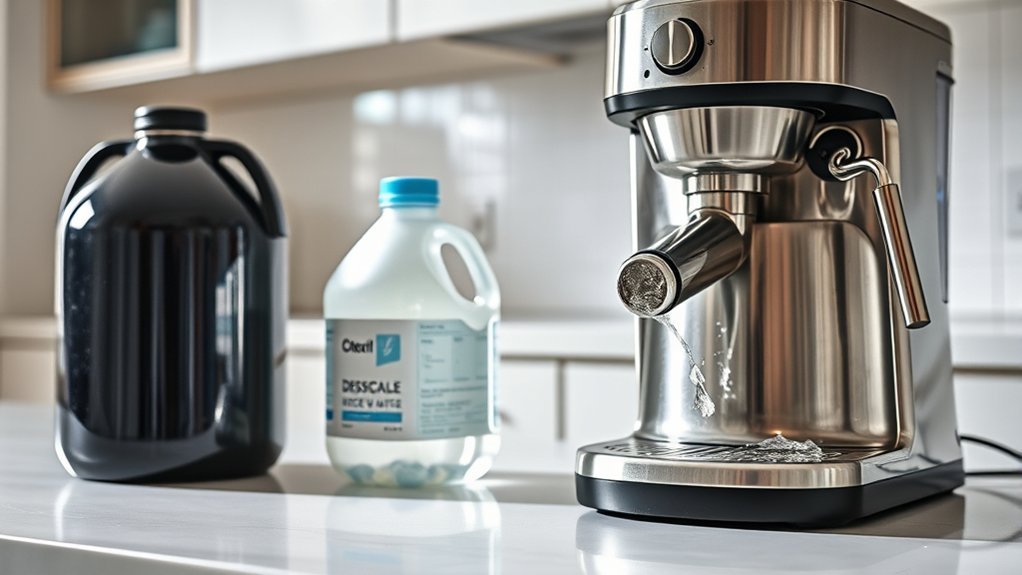
Water containing calcium and magnesium can leave mineral scale on hot internal surfaces. The U.S. Geological Survey classifies water by its concentration of hardness minerals and notes that these minerals can form deposits in plumbing and equipment.
Inside a coffee maker, scale can restrict water flow and reduce heat-transfer efficiency. You may notice slower brewing, lower output, extra noise, or a change in extraction. Removing the deposits helps the machine move and heat water as designed.
Descaling removes mineral deposits from the water circuit. It does not replace washing the carafe, brew basket, drip tray, milk system, capsule bin, or other parts that collect coffee and food residue.
Check Your Manual Before Descaling
Manufacturers use different tubing, seals, boilers, heating systems, filters, and programmed cycles. A product that is approved for a basic drip brewer may be prohibited in a capsule machine or fully automatic espresso machine.
Find the model number on the rating label, then open the official manual or support page. Confirm all of the following before you begin:
- Which descaling product or acid is allowed
- Whether the water filter must be removed
- The required solution-to-water ratio
- The container capacity needed under the outlets
- Which buttons start the descaling mode
- Whether the cycle can be paused
- How many fresh-water rinses are required
- How to clear or reset the descale alert
Warning: Never mix descaler with vinegar, bleach, ammonia, dish detergent, or another cleaning product. Follow the descaler label, keep it away from children, avoid eye contact, and wash your hands after handling it.
Signs Your Coffee Maker Needs Descaling
The most reliable sign is the machine’s descale or clean alert. Machines without an alert may show changes in flow, sound, temperature, or brewing time. These symptoms can also have other causes, so inspect removable parts and consult the troubleshooting guide before repeating a descaling cycle.
| Sign | Possible Cause | What to Do |
|---|---|---|
| Descale or clean alert | Programmed maintenance interval | Start the official cycle for your model |
| Brewing takes longer | Scale, a blocked outlet, or a clogged filter | Inspect removable parts, then descale if indicated |
| Weak or uneven water flow | Scale or coffee debris | Clean accessible outlets and follow the manual |
| Hissing, popping, or louder pumping | Restricted flow, trapped air, or another fault | Stop if the sound is severe; check the troubleshooting guide |
| Chalky residue near water outlets | Hard-water deposits | Clean the accessible area and descale as directed |
| Coffee tastes different | Scale, stale coffee oils, old water, beans, or brewing variables | Clean removable parts and evaluate all likely causes |
Common Coffee Maker Descaling Mistakes
Mistake #1: Assuming Vinegar Is Always Safe—or Always Unsafe
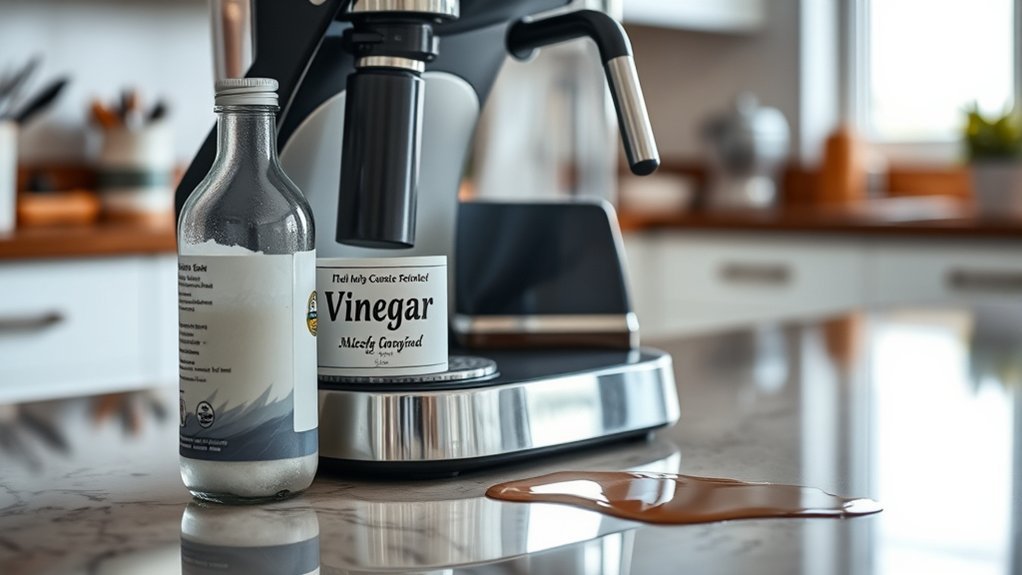
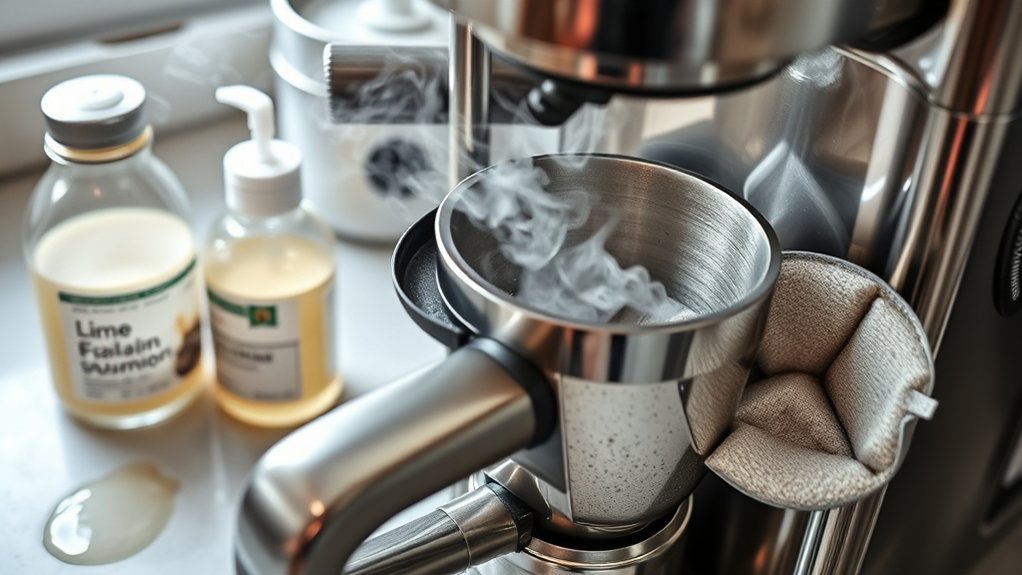
Vinegar rules differ by manufacturer and machine type. Nespresso warns that vinegar can damage its machines, and Philips directs owners of its espresso machines to use the specified descaler instead of vinegar.
Other manufacturers permit vinegar for particular drip brewers. For example, KitchenAid’s drip-coffee guidance describes both commercial descaler and diluted white vinegar as options. That permission does not automatically apply to the brand’s fully automatic espresso machines or to another model.
The correct rule is simple: use vinegar only when the official instructions for your exact machine explicitly allow it. Otherwise, use the approved descaling product.
Mistake #2: Ignoring Manufacturer Instructions
Using an incorrect solution, concentration, button sequence, or rinse procedure can leave residue or interfere with the maintenance program. It may also affect warranty coverage when the damage results from prohibited products or improper care.
Do not rely only on a generic online tutorial. Match the instructions to the exact model number, especially for capsule and automatic espresso machines.
Mistake #3: Following a Fixed Calendar Instead of Your Machine
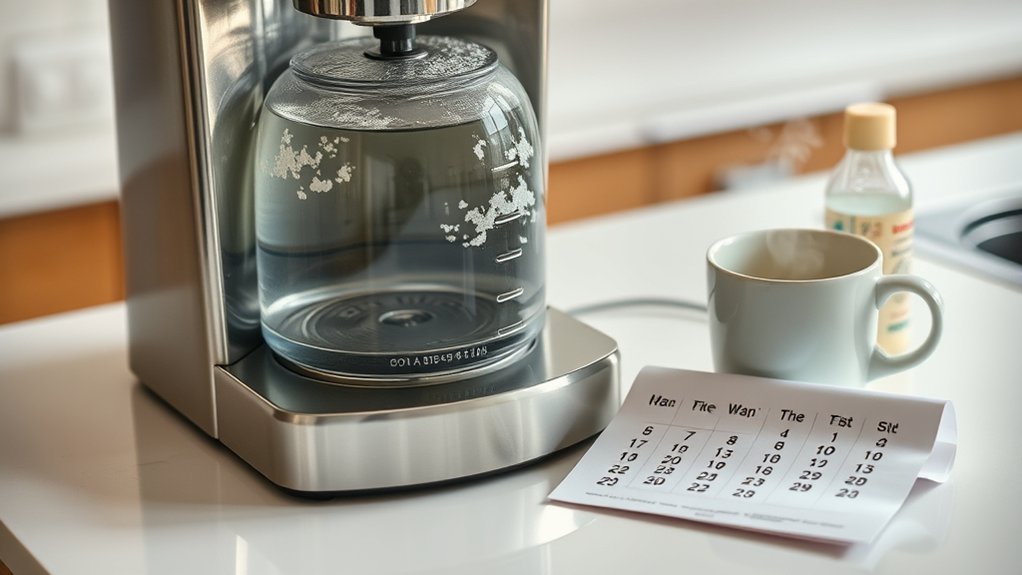
A three-to-six-month interval is a common general estimate, but it is not a universal requirement. Keurig, for example, gives a general interval of every three to six months. Other machines calculate maintenance from water hardness, beverage count, or an internal alert.
Hard water and heavy use normally shorten the interval. An approved water filter may extend it, but a filter does not always eliminate the need to descale.
Pro Tip: Record the date after each completed cycle. If your machine has a water-hardness setting, test the water and enter the correct level so its maintenance alert is more useful.
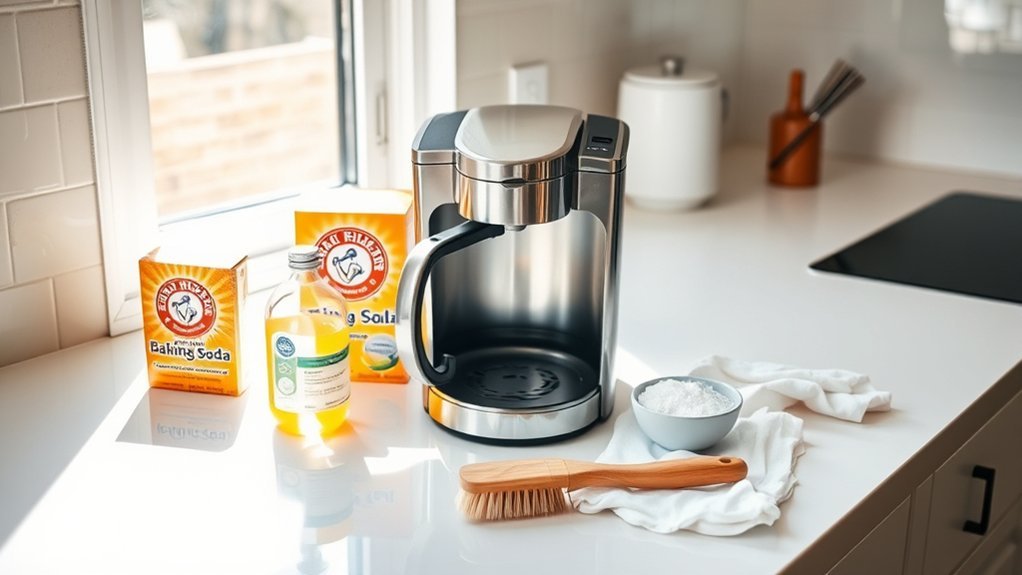
Mistake #4: Using Baking Soda or an Unknown DIY Mixture
Baking soda can help with some surface-cleaning or odor tasks, but it is not a reliable universal treatment for mineral scale inside a coffee maker. It may also leave particles or residue when used incorrectly.
Avoid lemon juice, concentrated acids, powdered mixtures, or homemade recipes unless the machine manufacturer specifically approves the formula and concentration. “Natural” does not automatically mean compatible with seals, tubing, coatings, or boilers.
Mistake #5: Using Abrasive Cleaners
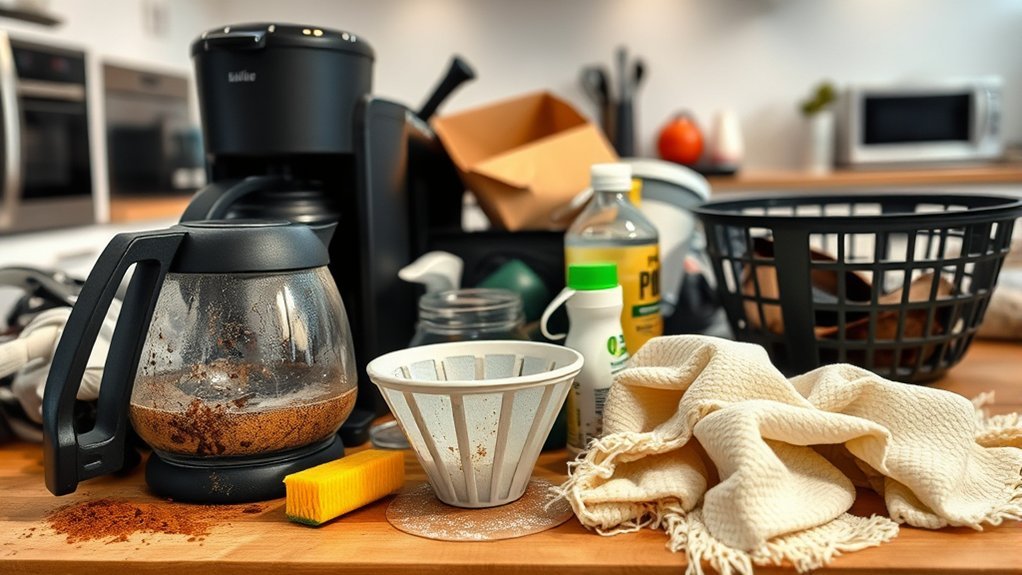
Scouring powders, steel wool, rough pads, and abrasive pastes can scratch reservoirs, carafes, drip trays, touch surfaces, and protective finishes. These products are not substitutes for an internal descaling solution.
Wash removable parts only as directed. Use a soft cloth or nonabrasive sponge on surfaces that permit hand washing, and check whether each part is dishwasher-safe.
Mistake #6: Mixing Cleaning Products
Never combine two descalers or add bleach, ammonia, detergent, vinegar, or another cleaner to a prepared descaling solution. Mixing products can create hazardous fumes, excessive foaming, damaging concentrations, or residue that is difficult to rinse from the water circuit.
If you accidentally mix products, do not run the machine. Move away from fumes, ventilate the area when it is safe to do so, and follow the product labels. Contact the manufacturer or poison-control service appropriate to your location if exposure may have occurred.
Mistake #7: Interrupting an Automatic Cycle
Some espresso and capsule machines must complete a programmed sequence before they can return to normal operation. Unplugging the machine, turning it off, refilling at the wrong time, or pressing unrelated controls can leave it stuck in descaling mode.
Prepare enough time, water, and container capacity before starting. Once the cycle begins, follow every screen prompt or indicator-light sequence until the manual says it is complete.
Mistake #8: Skipping the Rinse Cycles
Residual descaler can produce a sour or chemical taste. It may also trigger continued foaming or irritation if the solution was not fully flushed.
Complete the stated number of rinses with fresh water. Do not add coffee, a capsule, or grounds during rinsing. If the water still smells or tastes acidic after the required cycle, repeat a fresh-water rinse when the manual permits it.
Mistake #9: Confusing Descaling With Cleaning
Descaler targets mineral deposits in the water path. It does not remove all coffee oils, grounds, milk residue, or standing liquid from other parts of the machine.
Continue the regular cleaning routine for the carafe, brew basket, portafilter, group head, steam wand, milk container, drip tray, capsule bin, grounds container, and removable brew group as applicable. Use only the cleaning method specified for each part.
How to Choose a Descaling Solution
Start with the product named in the official manual. A manufacturer-approved liquid, powder, or tablet is usually the lowest-risk option because its concentration and cycle instructions are matched to the machine.
| Machine Type | Best Starting Point | Main Risk to Avoid |
|---|---|---|
| Basic drip coffee maker | Use the manual-approved descaler or vinegar ratio | Assuming advice for another drip model applies |
| Capsule or pod machine | Use the brand’s approved kit and programmed cycle | Using vinegar or interrupting the light sequence |
| Semi-automatic espresso machine | Follow the model’s water-path and steam-wand instructions | Confusing a cleaning tablet with descaler |
| Fully automatic espresso machine | Use the specified product and on-screen program | Using household acids or stopping mid-cycle |
| Unknown or secondhand machine | Find the model number and official manual first | Guessing the product, ratio, or button sequence |
Note: A coffee-machine cleaning tablet and a descaling product are not necessarily interchangeable. Cleaning tablets commonly target coffee oils, while descalers target mineral deposits. Use each only where the manual directs.
A Safe, Model-Neutral Descaling Workflow
The exact buttons, quantities, and cycle stages differ by model. Use this workflow as a preparation checklist rather than a substitute for the official instructions.
- Identify the exact model. Locate the model number and open the official manual or support page.
- Confirm the approved solution. Check the product type, amount, dilution ratio, and whether vinegar is allowed.
- Prepare the machine. Remove coffee grounds, capsules, and waste. Empty the drip tray and grounds container. Remove the water filter only when instructed.
- Prepare a catch container. Use one large enough for the discharged solution and rinse water. Machines with a hot-water outlet or steam wand may require more than one container.
- Mix the solution exactly as directed. Do not estimate the concentration or add another cleaner.
- Start the correct cycle. Use the dedicated descaling program when the machine has one. Follow every light, button, or display prompt.
- Complete every rinse. Empty and rinse the reservoir when instructed, refill it with fresh water, and finish all rinse stages.
- Restore the machine. Reinstall or replace the water filter when required, empty the trays, and clear the maintenance alert according to the manual.
- Check the first brew. Run an extra water-only cycle if permitted and needed. Do not drink a beverage that smells or tastes like descaler.
Maintaining Your Coffee Maker After Descaling
Use Water With Known Hardness
Water hardness is mainly related to dissolved calcium and magnesium. Soft or moderately hard water generally forms scale more slowly than hard or very hard water, but the machine may still require periodic descaling.
Filtered water can reduce certain minerals only when the filter is designed to do so and is replaced on schedule. Bottled water is not automatically low in minerals; check its mineral analysis rather than relying on the word “bottled.” Avoid distilled or heavily softened water unless the machine manufacturer says it is suitable.
Keep a Maintenance Record
Record the descaling date, solution used, and any change in brewing time or water flow. A simple record helps you identify whether scale returns quickly and whether your water-hardness setting or maintenance interval needs adjustment.
Clean Removable Parts Regularly
Empty wet grounds, pods, drip trays, and milk residue promptly. Wash removable parts according to the manual and allow them to dry where recommended. Regular cleaning helps control residue that descaling does not remove.
How to Monitor Performance After Descaling
A successful cycle should normally improve or maintain water flow without leaving a chemical smell or taste. Watch the next few brewing cycles for leaks, warning lights, unusual sounds, or continued low output.
| Problem After Descaling | Likely Explanation | Next Step |
|---|---|---|
| Sour or chemical taste | Descaler remains in the water circuit | Run another permitted fresh-water rinse |
| Descale alert stays on | Cycle was incomplete or the alert needs a reset sequence | Follow the model-specific completion or reset steps |
| Water flow is still weak | Heavy scale, blocked outlet, clogged filter, airlock, or pump issue | Check accessible parts; do not repeat strong treatments without guidance |
| Machine leaks | Reservoir or tray is misseated, a seal is damaged, or an internal fault is present | Stop using the machine, unplug it when safe, and contact support |
| Loud or abnormal noise continues | Air, restricted flow, or mechanical trouble | Follow the priming or troubleshooting instructions; seek service if severe |
What to Do If You Used the Wrong Solution
Stop the cycle if the machine instructions or product label say the solution is incompatible. Do not add another chemical in an attempt to neutralize it.
Empty and rinse removable containers only when it is safe to do so. Record the product name, concentration, and amount used, then contact the machine manufacturer for model-specific flushing or service advice. Stop using the machine if it leaks, overheats, produces a strong chemical odor, or behaves abnormally.
Frequently Asked Questions
Can I use bottled water to prevent limescale buildup?
Not all bottled water is low in minerals. Check the calcium, magnesium, or total dissolved mineral information on the label and compare it with your machine’s water requirements. A compatible filter or water with known moderate or low hardness may slow scale formation.
How often should I descale if I use filtered water?
Follow the machine’s alert or manual. Filtered water may extend the interval when the filter reduces hardness minerals, but it does not always eliminate scale. Replace the filter on schedule and keep the machine’s water-hardness setting accurate.
What are signs that descaling may have damaged my coffee maker?
Stop using the machine if you notice a new leak, electrical smell, overheating, severe noise, cracked parts, or a persistent error after completing the correct reset steps. A mild acidic taste usually points to incomplete rinsing rather than permanent damage.
Do I need to clean the coffee maker before descaling?
Remove grounds, capsules, and waste, and empty the drip tray before starting. Wash removable parts when the manual directs, but do not add detergent to the descaling reservoir. Cleaning coffee residue and removing mineral scale are separate maintenance tasks.
Can descaling improve the taste of my coffee?
It can help when scale has affected water flow or heating. However, stale beans, an incorrect grind, dirty removable parts, old water, and brewing temperature can also change flavor. Descaling should be one part of a complete maintenance routine.
Why is the descale light still on after I finished?
The machine may not have detected a complete cycle, a rinse stage may have been skipped, or the alert may require a specific reset sequence. Do not repeatedly descale it. Review the model’s completion instructions and contact support if the light remains on.
Can I use a cleaning tablet instead of descaling solution?
Only when the manual says the product performs both jobs. Many cleaning tablets remove coffee oils from a brew group or coffee path, while descaling solutions remove mineral deposits from the water circuit. They should not be treated as interchangeable.
Conclusion
The safest way to avoid coffee maker descaling mistakes is to make every decision from the instructions for your exact model. Do not assume vinegar is always safe or always prohibited, do not mix products, and do not interrupt a programmed cycle. Use the correct solution, complete every rinse, and continue cleaning coffee and milk residue separately. These steps protect the machine while helping it maintain steady water flow, heating, and brewing performance.
Sources
- U.S. Geological Survey: Hardness of Water — explains calcium, magnesium, and water-hardness classifications.
- Nespresso Descaling Kit Guidance — supports the warning against vinegar in Nespresso machines.
- Philips Coffee Machine Descaling Guidance — covers approved products and acids that may damage Philips espresso machines.
- KitchenAid Coffee Maker Cleaning and Descaling Guide — shows that some drip coffee makers permit either commercial descaler or diluted vinegar.
- Keurig Descaling Guidance — supports the general three-to-six-month maintenance range for compatible Keurig brewers.
- De’Longhi Fully Automatic Espresso Maker Descaling FAQ — supports following model instructions and adjusting maintenance to water hardness.