Stage 1 and Stage 2 baby foods mainly differ in texture and ingredient complexity, but the numbers on the package are not strict developmental milestones. Most babies begin complementary foods at about 6 months, when they show the right feeding skills. From there, you can gradually move from smooth purees to thicker, mashed, and mixed foods as your baby learns to swallow and manage texture safely.
Quick Answer
Stage 1 baby food is usually very smooth and often contains one ingredient. Stage 2 food is generally thicker and may combine several ingredients. However, stage labels vary by brand. Move to thicker foods when your baby can sit with good head control, swallow smooth foods well, and comfortably handle increasing texture.
Key Takeaways
- Most babies start complementary foods at about 6 months; introducing solids before 4 months is not recommended.
- Stage 1 and Stage 2 are commercial food labels, so exact textures and age recommendations can vary by brand.
- Stage 1 foods are generally smooth purees, while Stage 2 foods are often thicker, mashed, or made from multiple ingredients.
- Developmental readiness matters more than finishing a certain number of Stage 1 jars or reaching an exact age.
- Breast milk or infant formula remains the main source of nutrition from 6 to 12 months while complementary foods gradually become more important.
- Choose textures that your baby can handle safely, supervise every meal, and do not delay age-appropriate allergenic foods simply because of a stage label.
What Are Stage 1 and Stage 2 Baby Foods?
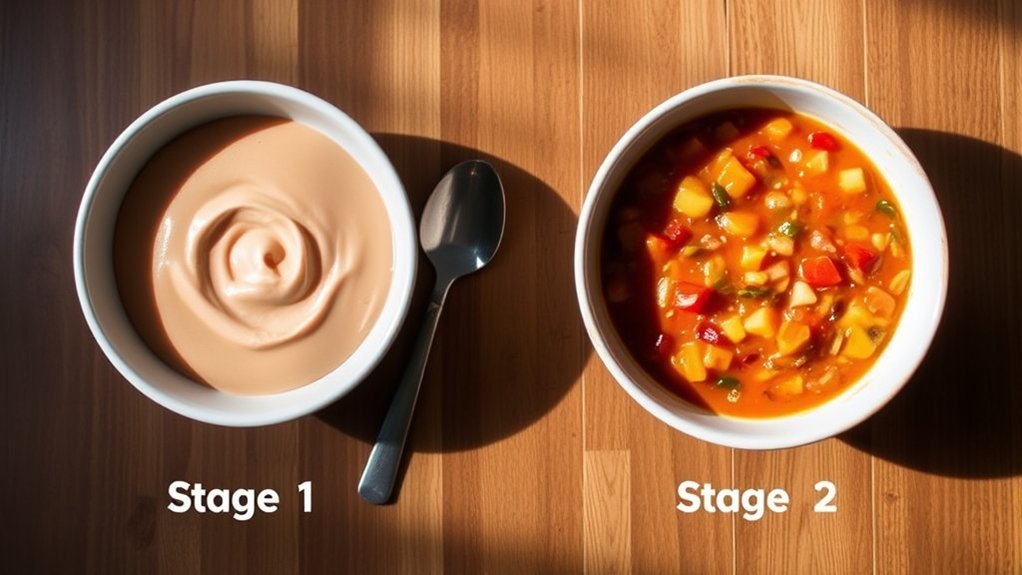
When you’re introducing solid foods, Stage 1 and Stage 2 labels can help describe a product’s texture. They should not be treated as a rigid medical feeding schedule.
According to the Centers for Disease Control and Prevention, most children can begin foods other than breast milk or infant formula at about 6 months. Starting before 4 months is not recommended. Readiness signs matter alongside age.
Stage 1 baby foods are generally very smooth, strained, or pureed. Many are single-ingredient foods such as banana, pear, carrot, sweet potato, meat, or infant cereal. Their smooth consistency can make learning to move food from the front of the mouth to the back easier.
Stage 2 baby foods are usually thicker. They may be mashed or strained rather than completely smooth, and many combine ingredients such as sweet potato and chicken, pear and spinach, or banana and oatmeal.
Note: Baby-food staging is not identical across manufacturers. Read the package description and ingredient list instead of assuming every product marked “Stage 2” has the same texture.
How to Recognize Signs of Readiness for Stage 2 Baby Food
There is no requirement that a baby finish a certain number of Stage 1 foods before trying a thicker consistency. Instead, look at how your baby manages the foods they already eat.
Useful readiness signs include:
- Sitting upright with support and maintaining good head and neck control.
- Opening the mouth when food is offered.
- Moving food toward the back of the mouth and swallowing instead of consistently pushing it out.
- Handling smooth purees without persistent difficulty.
- Showing interest in food and participating comfortably at mealtimes.
- Beginning to manage slightly thicker textures without repeated distress.
Finishing Stage 1 Purees
Your baby does not need to clean the bowl or finish a jar before moving forward. Portion size and texture readiness are different things.
The CDC recommends beginning with small quantities, such as 1 or 2 tablespoons, and following hunger and fullness cues. Some days your baby may eat more; on other days they may eat very little.
A better sign of progress is that your baby can comfortably eat smooth foods and appears ready to experiment with a slightly thicker consistency.
Swallowing Without Tongue Thrusting
Early in complementary feeding, babies may push food forward with their tongue because eating from a spoon is new. With practice, they learn to move food backward and swallow it.
When your baby consistently keeps food in the mouth and swallows it, you can gradually make familiar purees thicker. The CDC’s guidance on tastes and textures recommends progressing from smooth foods toward mashed, lumpy, finely chopped, or ground textures as eating skills develop.
Do not rush the process if your baby repeatedly struggles to swallow, coughs during meals, or appears distressed.
Curiosity About New Foods
Interest in food is another useful readiness clue. Your baby may watch you eat, open their mouth when food approaches, reach toward safe foods, or become interested in participating in family meals.
Curiosity alone does not prove that a particular texture is safe, so combine it with physical feeding skills such as good head control and the ability to swallow food.
Pro Tip: Instead of changing both the flavor and texture at once, thicken a food your baby already enjoys. That makes it easier to see how they respond specifically to the new texture.
Stage 1 vs. Stage 2 Baby Food: Ingredient Differences
Stage 1 products are often single-ingredient foods, while Stage 2 products commonly combine fruits, vegetables, grains, legumes, dairy foods, meat, or other proteins. However, this distinction is not universal. Some Stage 2 products still contain only one main food.
Here’s a practical comparison:
| Feature | Stage 1 | Stage 2 |
|---|---|---|
| Typical texture | Very smooth, strained, or thin puree | Thicker puree, mash, or slightly more textured blend |
| Ingredients | Often one ingredient | Often two or more ingredients, but varies |
| Examples | Pureed banana, carrots, apples, meat, or infant cereal | Sweet potato and chicken, pear and spinach, apple and blueberry |
| Main purpose | Learning to accept food and smooth textures | Building experience with thicker textures and food combinations |
| When to use | When beginning solids and developmentally ready | When baby comfortably manages smoother foods and is ready for more texture |
Understanding Texture: Smooth Purees vs. Thicker Blends
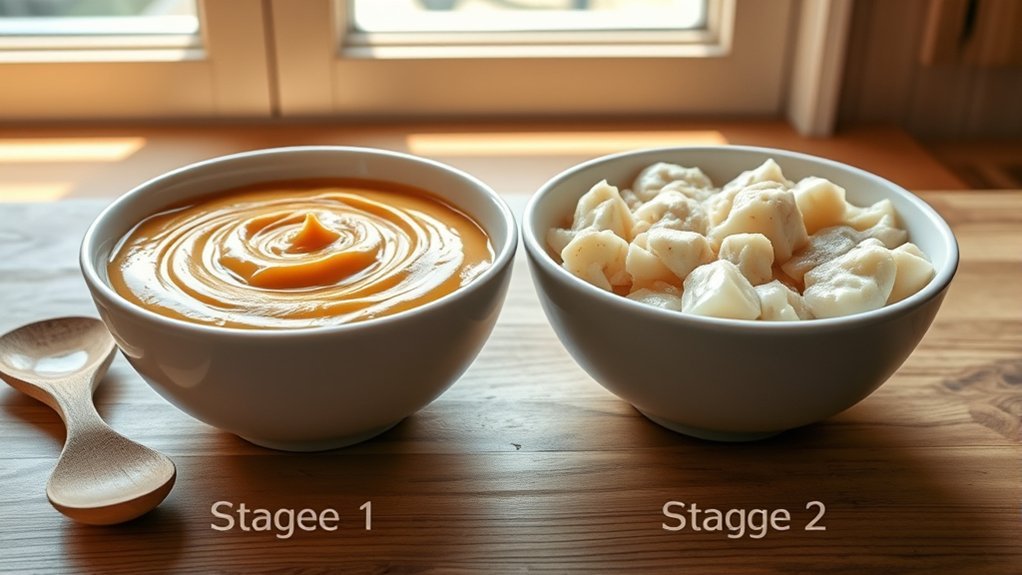
Texture is one of the most useful differences between Stage 1 and Stage 2 baby food.
- Smooth purees require very little oral manipulation and can help beginners practice moving food backward and swallowing.
- Thicker purees and mashes require more tongue and jaw movement.
- Lumpy, finely chopped, and soft finger foods can be added as your baby develops the skills to manage them safely.
The CDC notes that babies can be exposed to a range of smooth, mashed, lumpy, finely chopped, and ground textures as their abilities develop. Exposure to different textures also supports chewing and fine-motor skills.
Do not assume that a product labeled Stage 2 is automatically safe for your baby. Check its actual consistency and make sure it matches your baby’s current feeding abilities.
Top Stage 2 Baby Food Combinations
Once individual foods are tolerated, combining familiar ingredients can add variety without making meals unnecessarily complicated.
Examples include:
- Sweet potato and pear
- Banana and oatmeal
- Apple and blueberry
- Carrot and lentils
- Zucchini and spinach
- Plain full-fat yogurt and mashed fruit
- Sweet potato and finely pureed chicken
- Avocado and banana
You can also use small amounts of mild herbs and spices, such as cinnamon or basil, provided the finished food remains developmentally appropriate and does not contain unnecessary added sugar or excess salt.
When combining foods, include foods from different groups over the course of the week rather than relying only on fruit-and-vegetable blends.
Nutritional Benefits of Stage 1 and Stage 2 Baby Foods
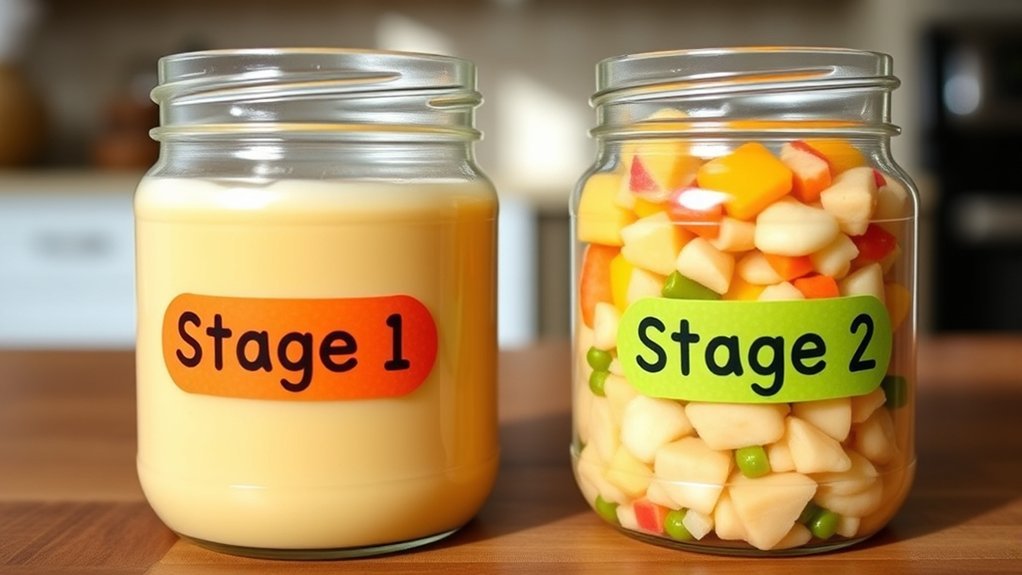
Stage 1 is not automatically less nutritious than Stage 2, and Stage 2 does not automatically contain more protein or healthy fat. The ingredients determine the nutritional value.
From about 6 to 12 months, breast milk or infant formula remains the main source of nutrition, while complementary foods gradually contribute more energy and nutrients.
As your baby’s diet expands, include a variety of foods such as:
- Iron- and zinc-rich foods: meat, beans, lentils, eggs, tofu, and iron-fortified infant cereals.
- Healthy fats: avocado, appropriate nut or seed butters thinned into a safe consistency, and full-fat unsweetened yogurt.
- Fruits and vegetables: offer different colors, tastes, and textures.
- Whole grains: oatmeal, barley, multigrain infant cereals, and other developmentally appropriate grains.
If you use infant cereal regularly, the CDC recommends offering a variety such as oat, barley, and multigrain instead of relying only on rice cereal.
How to Safely Transition to Stage 2 Baby Food
The safest transition is gradual and based on feeding skills rather than a deadline.
- Start with a familiar food. Make a puree your baby already tolerates slightly thicker.
- Offer a small amount. Let your baby explore the consistency without pressure to finish it.
- Watch swallowing. Look for comfortable movement of food through the mouth without repeated coughing or distress.
- Increase texture gradually. Move from smooth to thicker puree, then toward mashed or appropriately lumpy food as skills improve.
- Add food combinations. Once individual ingredients are tolerated, combine familiar foods.
- Continue breast milk or infant formula. Complementary foods add to, rather than immediately replace, milk feeds during the first year.
Warning: Choking can happen with any feeding approach. Prepare foods in a shape, size, and texture your baby can safely manage. Keep your baby seated upright in a high chair or other safe eating seat and supervise the entire meal. Avoid hard, round, sticky, or large pieces of food that can block the airway.
See the CDC choking-hazard guidance for current food-preparation recommendations.
Tips for Introducing New Flavors at Stage 2
Stage 2 is a convenient time to expand flavor variety, but there is no need to hide unfamiliar foods inside sweet purees every time.
- Pair one familiar ingredient with one newer ingredient.
- Offer vegetables, proteins, grains, fruits, and healthy fats rather than relying mainly on sweet fruit blends.
- Try mild herbs and spices without added sugar.
- Repeat foods that were initially refused; acceptance can take multiple exposures.
- Let your baby stop when they show fullness cues instead of encouraging them to finish a serving.
- Change texture gradually so your baby gets experience moving thicker food around the mouth.
The goal is not to make every bite exciting. Regular exposure to a variety of tastes and textures helps your baby learn what different foods feel and taste like.
How to Monitor Your Baby’s Reaction to Stage 2 Foods
When introducing thicker foods or new ingredients, watch both feeding skills and physical reactions.
Observe Eating Behavior
Signs your baby is handling the progression well can include:
- Opening the mouth willingly for food.
- Moving thicker food around the mouth.
- Swallowing comfortably.
- Reaching for food or a spoon.
- Remaining relaxed and engaged during meals.
- Stopping or turning away when full.
Do not force another bite when your baby closes their mouth, turns away, becomes distracted, or otherwise signals that they are finished.
Monitor Digestive Reactions
Stool appearance and frequency can change after solid foods begin. Mild changes do not automatically mean a food allergy.
When introducing foods for the first time, the CDC currently recommends offering one single-ingredient new food at a time initially and waiting 3 to 5 days before another new food. This can make a reaction easier to identify.
Possible food-allergy symptoms can include hives, swelling, vomiting, diarrhea, coughing, wheezing, or breathing difficulty.
Warning: Trouble breathing or swallowing, rapidly increasing swelling, faintness, blue or unusually pale coloring, or other signs of a severe allergic reaction require immediate emergency medical care.
Introducing Common Food Allergens
Stage 2 does not need to be completed before allergenic foods are introduced. Once your baby is developmentally ready for complementary foods, common allergens can be introduced in safe, age-appropriate forms rather than being deliberately delayed.
Common food allergens include:
- Peanut
- Egg
- Cow’s-milk products
- Wheat
- Soy
- Sesame
- Fish
- Shellfish
- Tree nuts
The American Academy of Pediatrics’ HealthyChildren guidance explains that delaying allergenic foods once a baby is ready for solids does not prevent food allergy.
For peanut specifically, NIAID guidance recommends that babies with severe eczema, egg allergy, or both be evaluated with their healthcare professional because age-appropriate peanut introduction may be recommended as early as 4 to 6 months.
Never give whole nuts or a thick spoonful of nut butter to a baby. Nut butters should be thinned or mixed into another suitable food so the texture does not create a choking hazard.
Gagging vs. Choking When Textures Get Thicker
Babies may cough, gag, or spit food out while learning new textures. Gagging is a protective reflex and can occur as babies learn to move food around their mouths.
Choking is different: food blocks the airway and prevents normal breathing. Because choking can be life-threatening, prevention is essential.
To reduce risk:
- Keep your baby upright while eating.
- Supervise continuously.
- Keep meals calm and unhurried.
- Prepare food to an appropriate softness, shape, and size.
- Avoid whole nuts, hard raw vegetables, popcorn, whole grapes, large meat or cheese chunks, thick spoonfuls of nut butter, and other foods that can obstruct the airway.
Parents and caregivers should also learn what to do if an infant chokes.
Foods and Drinks to Avoid or Prepare Carefully
Moving to Stage 2 does not mean your baby can eat every family food without modification.
- Honey: Do not give honey before 12 months because of the risk of infant botulism.
- Cow’s milk as a drink: Do not replace breast milk or infant formula with cow’s milk before 12 months. Pasteurized yogurt and cheese can be offered earlier in developmentally appropriate forms.
- Juice: Babies younger than 12 months do not need fruit or vegetable juice.
- Added sugar: Choose foods without added sugars for infants and young children.
- Choking hazards: Modify or avoid hard, sticky, round, or tough foods.
- Unpasteurized foods or drinks: Avoid unpasteurized milk and juices because they may contain harmful bacteria.
Current recommendations are summarized in the CDC’s foods and drinks to avoid or limit guidance.
Stage 2 Baby Food and Finger Foods
Finger foods do not have to wait until your baby has “completed” Stage 2. Purees, mashed foods, preloaded spoons, and safe finger foods can overlap as feeding skills develop.
The American Academy of Pediatrics notes that finger foods can be considered when a baby can sit up and bring their hands or other objects to the mouth. Foods still need to be soft, easy to swallow, and appropriately prepared.
Examples may include:
- Very soft pieces of ripe banana.
- Soft-cooked vegetables prepared to an appropriate size and shape.
- Small pieces of well-cooked pasta.
- Soft scrambled egg.
- Other soft foods prepared so they do not present a choking hazard.
You do not need to choose between “purees” and “finger foods” as two completely separate feeding systems. Many families safely use a combination.
When to Ask Your Pediatrician About Feeding
Most babies progress through textures at their own pace, but individualized advice is especially important if your baby:
- Was born prematurely and you are unsure how corrected age affects feeding readiness.
- Has poor head or trunk control.
- Frequently coughs, chokes, or has difficulty swallowing during meals.
- Consistently cannot advance beyond very smooth textures.
- Has severe eczema, an egg allergy, or a previous food reaction.
- Is not gaining weight as expected.
- Has a medical or developmental condition that affects feeding.
This article provides general feeding information and does not replace individualized advice from your child’s pediatrician or feeding specialist.
Frequently Asked Questions
Can I Mix Stage 1 and Stage 2 Baby Foods Together?
Yes. Mixing a familiar smooth puree with a thicker food can be a useful way to increase texture gradually. Make sure every ingredient is appropriate for your baby and that the final consistency matches their current swallowing and feeding skills.
Are Homemade Baby Foods Suitable for Stage 2?
Yes. Homemade foods can be mashed or blended to the texture your baby can safely handle. Use safe food-handling practices, avoid unnecessary added sugar and excess salt, and make sure meats, eggs, fish, and other foods are properly cooked.
How Long Can I Store Opened Stage 2 Baby Food?
Storage time depends on the ingredients. FDA guidance lists refrigerated strained fruits and vegetables for about 2 to 3 days, strained meats and eggs for 1 day, meat-and-vegetable combinations for 1 to 2 days, and homemade baby food for about 1 to 2 days. Follow a product’s label if it gives a shorter limit. Serve food from a separate dish rather than feeding directly from a jar you plan to refrigerate, because saliva from the spoon can contaminate the remaining food.
What Are Common Allergens in Stage 2 Baby Foods?
Common allergens can include milk, egg, peanut, tree nuts, wheat, soy, sesame, fish, and shellfish. Check ingredient labels carefully. Once your baby is developmentally ready for solids, current guidance does not recommend delaying allergenic foods solely because of a stage label. Ask your pediatrician before peanut introduction if your baby has severe eczema or an egg allergy.
When Should I Introduce Finger Foods After Stage 2?
You do not have to wait until Stage 2 is finished. Babies can begin exploring appropriately prepared finger foods when they have the necessary sitting, head-control, reaching, and oral-motor skills. Purees and finger foods can be offered during the same developmental period.
Does My Baby Have to Eat Stage 1 Before Stage 2?
Not necessarily. Stage numbers are product labels rather than required developmental steps. A baby who is developmentally ready for complementary feeding may be able to handle foods with more body than a very thin Stage 1 puree. Start with a safe texture and progress according to your baby’s skills.
Is Gagging on Thicker Baby Food Normal?
Some coughing, gagging, or spitting food out can occur while babies learn new textures. However, repeated coughing, choking, breathing difficulty, or persistent trouble swallowing should not simply be treated as normal. Stop feeding and seek medical guidance if you are concerned about your baby’s ability to swallow safely.
Conclusion
The biggest difference between Stage 1 and Stage 2 baby food is usually texture and ingredient complexity—not a strict age cutoff. Most babies begin complementary foods at about 6 months and then progress toward thicker, mashed, mixed, and finger foods as their feeding skills develop.
Follow your baby’s developmental cues instead of trying to complete each commercial stage on a schedule. Keep breast milk or infant formula as the main source of nutrition through the first year, offer a varied selection of nutrient-rich foods, introduce textures gradually, and make choking prevention part of every meal.
Sources
- Centers for Disease Control and Prevention — When, What, and How to Introduce Solid Foods — starting age, developmental readiness, new-food introduction, and complementary feeding.
- Centers for Disease Control and Prevention — Tastes and Textures — progression from smooth foods to thicker and more textured foods.
- Centers for Disease Control and Prevention — Choking Hazards — food preparation, supervision, seating, and choking prevention.
- American Academy of Pediatrics / HealthyChildren.org — Starting Solid Foods — readiness, feeding progression, allergens, and finger foods.
- U.S. Food and Drug Administration — Once Baby Arrives — safe handling and refrigerated storage of baby food.
- National Institute of Allergy and Infectious Diseases — Peanut Allergy Prevention Guidelines — peanut introduction guidance for infants at different allergy-risk levels.