A plastic or chemical taste from a new coffee maker is unpleasant, but it does not automatically mean the machine is unsafe. The taste may come from packaging residue, a new water filter, stale reservoir water, the carafe, or the source water itself. Start with the cleaning and priming steps in your model’s manual, then isolate the cause before using any descaler.
Quick Answer
Wash the removable parts, remove all packaging, and run two or three full water-only cycles before brewing coffee. Use vinegar only if your model’s manual permits it; some manufacturers prohibit vinegar. If a strong chemical taste or odor remains after the approved cleaning process, stop using the machine and contact the manufacturer.
Key Takeaways
- Read the owner’s manual before circulating vinegar, descaler, or any other cleaner through the machine.
- Wash removable food-contact parts with warm water and mild dish soap, but do not put soap in the internal water path.
- Run water-only priming cycles and compare the brewed water with your unheated tap or filtered water.
- Do not assume a plastic-like taste proves BPA, phthalate, or other harmful chemical exposure.
- Stop using the appliance and contact the manufacturer if the strong odor persists, the machine leaks, or you see damaged plastic.
At a Glance
| Time Required | 20–45 minutes, plus drying time |
| Difficulty | Easy |
| Tools Needed | Fresh water, mild dish soap, a soft sponge or cloth, and a manufacturer-approved descaler only if needed |
| Cost | Usually $0–$15 |
What Makes Coffee Taste Like Plastic?
A new coffee maker can produce an unfamiliar taste for several reasons. Possible sources include manufacturing dust or residue on removable parts, odors trapped during shipping, a new charcoal water filter, water left in the reservoir, or plastic parts that have absorbed packaging smells.
A plastic-like taste is a symptom, not proof that your coffee contains BPA, phthalates, or another specific chemical.
Food-contact materials can release very small amounts of their components into food or water, but the taste of a drink cannot identify which material is present or whether an exposure is unsafe. The U.S. Food and Drug Administration evaluates authorized food-contact uses and currently states that BPA is safe at the levels occurring in food.
The water may also be responsible. Chlorine, dissolved minerals, metals, and other aesthetic water-quality factors can affect taste and odor. The U.S. Environmental Protection Agency notes that drinking water can have noticeable taste or odor characteristics even when those characteristics are not a health threat.
Note: Pour a glass of the same water used in the coffee maker and taste it at room temperature. If the same chemical, metallic, or chlorine note is present, the water may be contributing to the problem.
Power your essentials anywhere with a 999Wh pure sine wave power station delivering up to 1000W continuous with 2000W surge. It supports fast charging via USB-C PD 60W and USB-A QC 18W, plus simultaneous output for multiple devices through AC, USB, wireless, and car/DC ports. Recharge using AC, car, or solar with a built-in MPPT controller and dual cooling fans, while the upgraded battery management system protects against surges, short circuits, and overheating.

No Plastic Touching Food: Made with 304 stainless steel and food-grade silicone, our French press keeps all brewing surfaces plastic-free— no odor and no plastic particle into your coffee. Safe and worry-free

Effortless Café-Quality Brews: The Takeya Deluxe Cold Brew Coffee Maker delivers smooth, less acidic coffee at home. Its fine-mesh filter keeps grounds out, ensuring rich, clean coffee from any bean, making your kitchen feel like a personal café.
Why Cleaning Your New Coffee Maker Is Essential
Cleaning before the first pot removes loose residue from the reservoir, carafe, brew basket, permanent filter, pod holder, and other accessible food-contact parts. It also gives you a chance to find protective film, cardboard, foam, stickers, or packing material that should not remain in or near the brewing path.
Use this first-use process:
- Read the manual: Check the “before first use,” priming, cleaning, and descaling sections for your exact model.
- Remove packaging: Inspect the reservoir, brew basket, carafe, drip tray, pod holder, and water-filter compartment.
- Wash removable parts: Use warm water, mild dish soap, and a nonabrasive sponge unless the manual gives different directions.
- Rinse and dry: Remove all soap before reinstalling the parts.
- Run a water-only cycle: Fill the reservoir with fresh water and brew without coffee, a pod, or a paper filter unless the manual requires one.
- Repeat as directed: Run additional water-only cycles until the water has no noticeable manufacturing or packaging taste.
Warning: Unplug the coffee maker and let it cool before hand-cleaning. Never immerse the appliance base. Do not put bleach, rubbing alcohol, dish soap, lemon juice, essential oils, or another unapproved cleaner into the internal water path. Never mix bleach with vinegar, acids, ammonia, or other household cleaners; dangerous gas can be released.
Use Vinegar Only If Your Coffee Maker Allows It
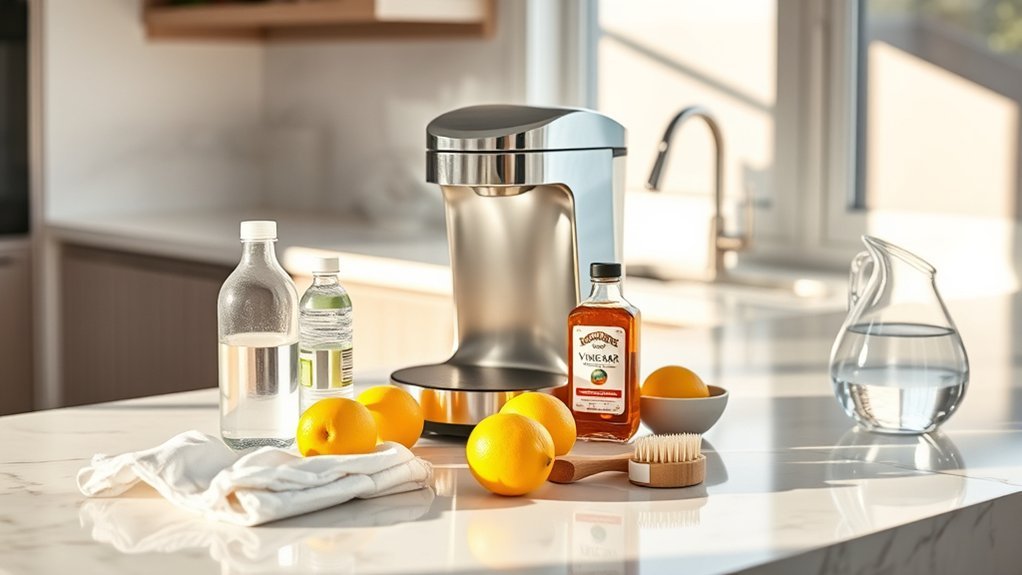
Vinegar can remove mineral scale in some drip coffee makers, but it is not a universal first-use cleaner. For example, Cuisinart cleaning guidance permits diluted vinegar for many of its models. In contrast, Nespresso advises against using vinegar because it may damage the machine.
Do not choose a vinegar ratio from a general article when your manufacturer supplies different instructions. The manual may call for a branded descaling solution, a citric-acid product, a cleaning tablet, a special cleaning mode, or water-only priming.
When Vinegar Is Appropriate
If your manual specifically permits diluted white vinegar, it may help dissolve calcium and other mineral deposits that collect in the reservoir, tubing, or heating system. This process is called descaling. It is different from washing coffee oils and residue from removable parts.
Follow the model-specific directions for:
- The approved type and concentration of vinegar.
- The amount of water placed in the reservoir.
- Whether the brew cycle should be paused.
- Whether a water filter must be removed first.
- The number of required rinse cycles.
Do not repeat acidic cleaning cycles indefinitely to treat a strong new-plastic odor. Acid may remove mineral scale, but it cannot repair defective plastic, damaged seals, or contaminated components.
Effective Rinsing Techniques
After an approved cleaning or descaling cycle, empty and rinse the reservoir, carafe, brew basket, drip tray, and any other removable parts. Refill the reservoir with fresh water at the temperature recommended in the manual, then run the required number of water-only cycles.
Smell and taste a small amount of the cooled rinse water before brewing coffee. If it tastes clean but the coffee does not, inspect the permanent filter, reusable pod, paper filters, grinder, coffee container, and travel mug.
Pro Tip: Test one variable at a time. Brew plain water first, then add a fresh paper filter, and finally add coffee. This makes it easier to identify whether the off-taste comes from the machine, filter, water, or coffee.
Frequency of Cleaning
There is no single cleaning schedule for every machine. Wash the carafe, brew basket, permanent filter, drip tray, and other regularly used removable parts after use or as directed by the manufacturer.
Descale according to your manual, the machine’s descale indicator, your water hardness, and how often you brew. Some manufacturers suggest an interval of one to three months, while others use a brew count or an indicator light. Descaling too rarely can allow mineral buildup, but unnecessary acid cycles can also be hard on seals and internal parts.
Tips for Airing Out and Reducing Odors in Your Machine
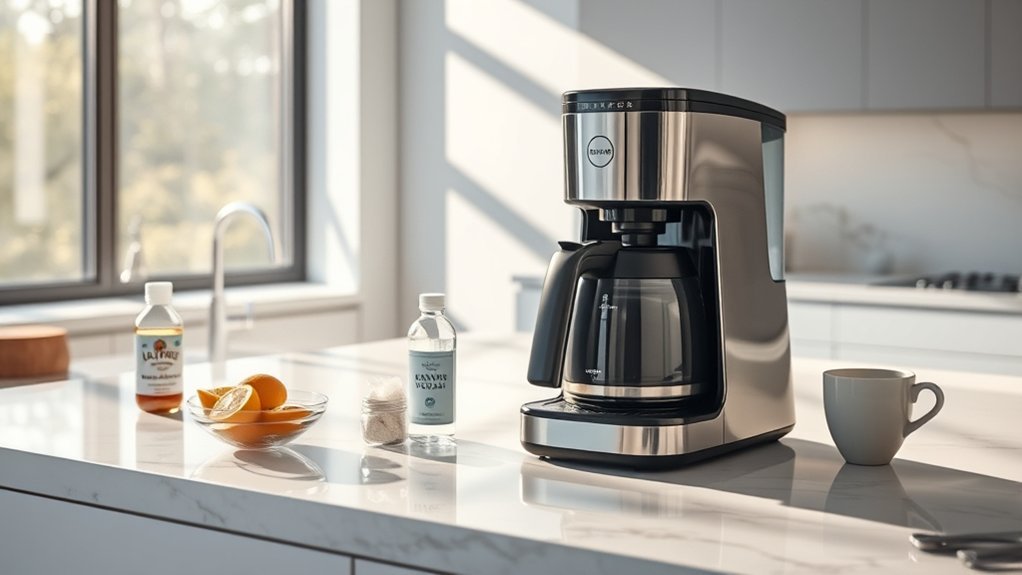
After washing and rinsing the coffee maker, let the accessible parts dry fully. Trapped moisture can become stale and may carry odors into the next pot.
Keep the empty reservoir and brew basket open while the machine is unplugged and cooling, provided this is safe for your model and location. Do not add perfume, essential oils, coffee beans, baking soda, or another odor-masking substance to the machine.
Open and Ventilate the Machine
Place the clean, unplugged coffee maker in a dry, ventilated area away from direct heat and sunlight. Remove the carafe lid, open the reservoir lid, and leave removable parts on a clean drying rack.
Before the next brew:
- Confirm that no cleaning solution remains in the reservoir or carafe.
- Reinstall only fully rinsed and dry parts.
- Run one fresh-water cycle if the machine has been left unused.
- Discard water that has remained in the reservoir for an extended period.
Use Fresh Water and Fresh Coffee Beans
Whole coffee beans should not be used as an odor absorber inside the machine. Coffee beans contain aromatic oils that may cover an odor temporarily without removing its source.
Instead, store beans in a sealed container in a cool, dark, dry place and grind only what you need. Use fresh water for every brew. If your tap water has a strong chlorine, sulfur, metallic, or mineral taste, try potable filtered water that is suitable for your machine. Do not use distilled water unless the manufacturer allows it, because some machines rely on minerals for level sensors or brewing performance.
Regular Cleaning Schedule
A simple routine helps prevent old coffee oils, standing water, and mineral buildup from causing new off-flavors:
- After brewing: Discard wet grounds or pods and rinse the brew basket or pod holder.
- Daily or after use: Wash the carafe and other removable parts as directed.
- Regularly: Empty, rinse, and dry a removable reservoir instead of leaving water in it for long periods.
- When indicated: Replace the charcoal water filter and run the approved cleaning or descaling cycle.
- Before storage: Empty, clean, rinse, and dry the machine thoroughly.
What BPA-Free Coffee Makers Do—and Do Not—Tell You
A BPA-free label may be useful when you prefer to avoid BPA in food-contact products, but the label does not mean the machine is plastic-free, chemical-free, odor-free, or guaranteed to produce better-tasting coffee.
| What the label may indicate | The labeled components are not made with BPA under the manufacturer’s stated standard. |
| What it does not indicate | That the machine contains no plastic, additives, adhesives, coatings, seals, or other food-contact materials. |
| Flavor guarantee | None. Water quality, coffee freshness, cleanliness, temperature, and filter materials also affect taste. |
| Better buying checks | Review the manual, food-contact materials, warranty, replacement-part availability, cleaning instructions, and return policy. |
The FDA continues to evaluate food-contact substances. Its 2026 phthalate update explains that authorized uses are under continuing review and that phthalates are mainly associated with specific flexible-plastic applications, not every plastic product.
Alternative Brewing Methods to Reduce Plastic Contact
If you prefer a brewer with less plastic in the hot-water path, compare the materials used in the reservoir, lid, filter holder, seals, tubing, and serving vessel. A product described as glass or stainless steel may still contain plastic handles, gaskets, valves, or filter components.
- Glass pour-over brewer: Choose a glass or ceramic dripper and verify the filter holder and server materials.
- French press: Look for a glass or stainless steel body with a stainless plunger and food-contact components.
- Chemex-style brewer: The glass vessel reduces plastic contact, although the collar, handle, or accessories may use other materials.
- Stainless steel Moka pot or percolator: Check the handle, knob, gasket, valve, and internal filter materials.
Manual brewers still require cleaning, fresh water, and correct storage. Changing brew methods will not solve an off-taste caused by poor water or stale coffee.
How to Maintain Your Coffee Maker for Great Flavor
Good maintenance focuses on three separate tasks: washing removable parts, removing coffee oils, and descaling mineral deposits. Treating all three as the same cleaning job can lead to unnecessary chemical use.
For consistent flavor:
- Use fresh potable water for each brew.
- Do not leave wet grounds, pods, or standing water in the machine.
- Wash removable parts with the cleaning method approved in the manual.
- Replace charcoal or paper filters at the specified interval.
- Use only the approved cleaner or descaler in the internal water path.
- Keep the heating base, cord, plug, and electrical housing dry.
- Inspect seals, pods, permanent filters, and reusable accessories for trapped residue or damage.
Stop using the coffee maker and contact the manufacturer or retailer if a strong chemical odor remains after the documented first-use procedure, if the taste becomes stronger, or if you notice smoke, melting, discoloration, leaking, electrical problems, or irritated eyes or throat.
Frequently Asked Questions
How long does it take to flush out a plastic taste?
Many new machines improve after two or three water-only cycles, but there is no universal number. Complete the priming and rinsing process in your manual. If a strong chemical taste remains after the approved procedure, stop repeating cleaning cycles and contact the manufacturer.
Can I use lemon juice instead of vinegar?
Do not run lemon juice through the machine unless the manufacturer specifically approves it. Its acid concentration and natural sugars can vary, and residue may remain in tubing or seals. Use the cleaning product and dilution listed in the manual.
Does the type of water affect a plastic-like taste?
Yes. Chlorine, minerals, metals, sulfur compounds, and stale water can create chemical or unusual tastes. Compare the source water with cooled water from a water-only brew. A suitable filter may improve water-related taste, but it will not correct a damaged or defective machine component.
Is it safe to use bleach for cleaning?
Do not put bleach in a coffee maker unless the manufacturer explicitly instructs you to do so. Never mix bleach with vinegar, acidic descaler, ammonia, or another cleaner. The CDC warns that bleach can release chlorine gas when mixed with certain cleaning products.
How often should I clean my coffee maker?
Rinse or wash frequently used removable parts after use or as directed. Descale according to the owner’s manual, water hardness, brew frequency, or the machine’s indicator. A fixed monthly schedule is not appropriate for every model.
Can I run dish soap through the brewing system?
No. Use mild dish soap only on removable parts that the manual says may be washed. Soap circulated through internal tubing can foam, leave residue, and be difficult to rinse completely.
What should I check if the water tastes fine but the coffee does not?
Check the coffee beans or grounds, grinder, paper filter, permanent filter, reusable pod, carafe, travel mug, and any flavored-coffee residue. Clean one component at a time and brew a small test batch to identify the source.
Should I return a new coffee maker that still smells strongly?
Contact the manufacturer or retailer if the strong taste or odor remains after the documented first-use cleaning and rinse process. Do not keep applying stronger cleaners. Return or service the machine promptly if you see melting, damaged plastic, leaks, smoke, discoloration, or electrical problems.
Conclusion
A new coffee maker should not require endless acid cycles or odor-masking tricks. Start with the owner’s manual, wash the removable parts, run water-only priming cycles, and test the water separately from the coffee. Use vinegar only when your manufacturer allows it. If the strong plastic or chemical taste remains after the approved process, stop using the appliance and contact the manufacturer while the return or warranty period is still open.
Sources
- Cuisinart — How to Clean a Coffee Maker — supports model-specific cleaning, vinegar dilution, rinsing, and descaling guidance.
- Nespresso — How to Clean and Descale Your Coffee Machine — supports the warning that some manufacturers prohibit vinegar.
- U.S. Food and Drug Administration — BPA in Food-Contact Applications — supports the explanation of BPA migration and FDA’s current safety position.
- U.S. Food and Drug Administration — Phthalates in Food-Contact Applications — supports current 2026 regulatory and material-use context.
- Centers for Disease Control and Prevention — Chlorine Safety — supports the warning against mixing bleach with other cleaners.
- U.S. Environmental Protection Agency — Secondary Drinking Water Standards — supports information about water-related taste and odor.