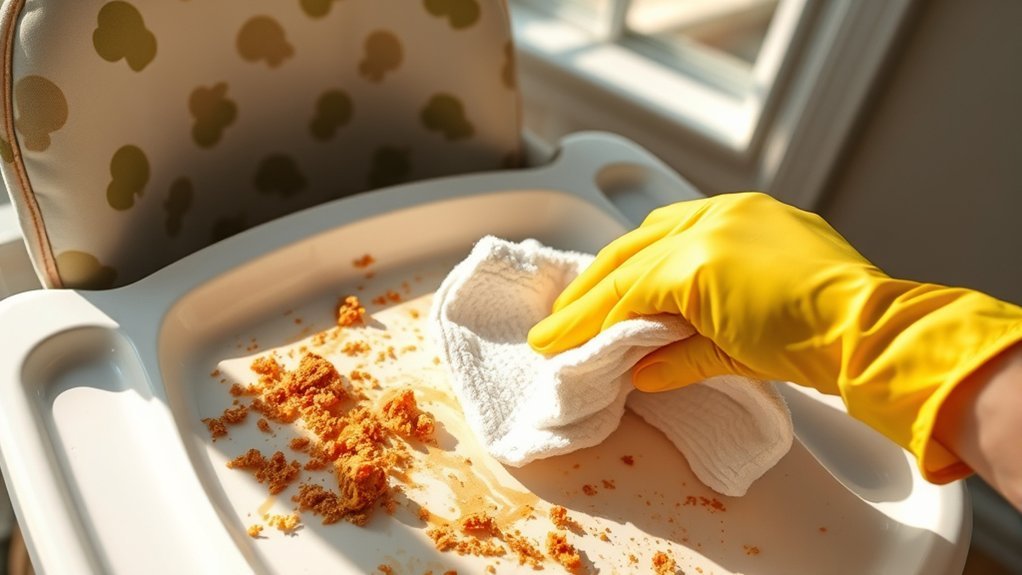
Cleaning dried baby food off a high chair is easiest when you soften the residue before you scrub. Start with the care instructions for your exact model because trays, straps, pads, buckles, and finishes vary. For most routine messes, warm water, mild dish soap, and soft cleaning tools are enough.
Quick Answer
To clean dried baby food off a high chair, first check the care manual. Remove crumbs, soften stuck food with a warm damp cloth for 5–10 minutes, then lift it with a plastic or silicone scraper. Wash compatible surfaces with mild dish soap, rinse away residue, and dry every part completely before reassembly.
At a Glance
| Time Required | 15–30 minutes, plus drying time |
| Difficulty | Easy |
| Tools Needed | Microfiber cloths, soft sponge, plastic or silicone scraper, soft brush, mild dish soap, and a small bowl |
| Cost | Usually under $5 when using supplies already at home |
Check the Manual and Gather Your Cleaning Supplies
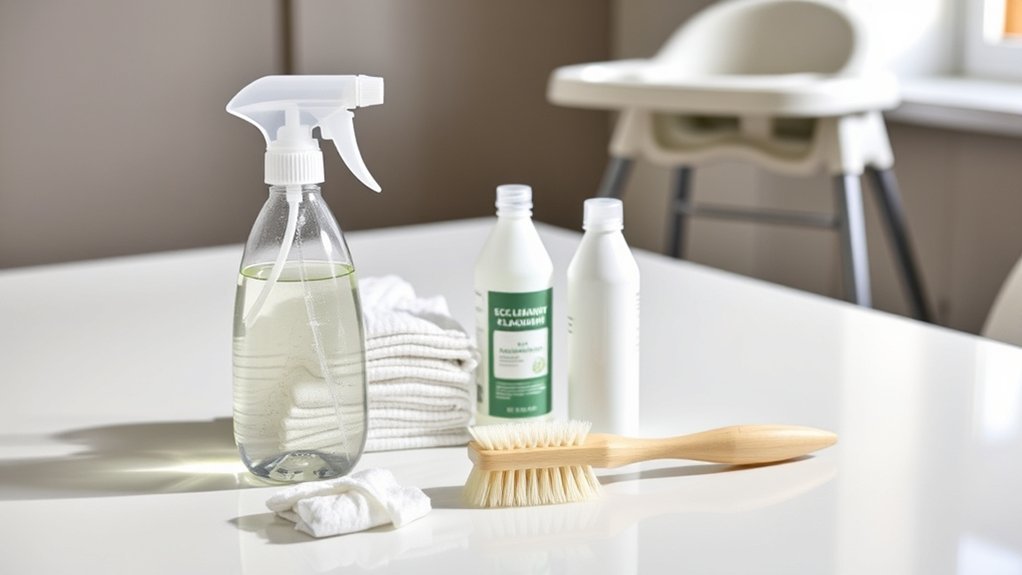
Before cleaning, find the instruction manual or care information for your exact high-chair model. Manufacturers use different plastics, coatings, fabrics, buckles, and tray designs. A method that is safe for one chair may discolor, weaken, or damage another.
Your high chair’s care manual takes priority over generic cleaning advice, especially for bleach, dishwashers, washing machines, and removable harness parts.
Gather the following supplies:
- Microfiber or soft terry cloths
- A nonabrasive sponge
- Mild dish soap
- A plastic spatula or silicone scraper
- A soft nylon or silicone-bristle brush
- An unused soft toothbrush for narrow crevices
- A small bowl of warm water
- Clean towels or a drying rack
- A vacuum or handheld brush for dry crumbs
Avoid steel wool, razor blades, metal scrapers, rough scouring pads, and stiff wire brushes. These tools can scratch the tray or create grooves that become harder to clean.
Prepare the Chair
Remove the child and move the chair to a well-lit area. Brush or vacuum crumbs from the seat, footrest, tray tracks, and floor. Place a towel under the chair if water could damage the flooring.
Remove only the parts that the manual identifies as removable. These may include a tray insert, main tray, seat pad, shoulder straps, waist straps, and buckle. Do not force clips or pull a harness through the seat unless the manual explains how to remove and reinstall it.
Note: A removable tray insert may be dishwasher-safe even when the main tray is not. Check the manual for each individual part rather than treating the whole tray assembly the same way.
How to Clean Dried Baby Food Off a High Chair
Use a simple sequence: remove dry crumbs, soften stuck food, scrape gently, wash with mild soap, rinse, and inspect. This reduces the need for hard scrubbing and helps keep food out of seams, tray rails, and adjustment points.
1. Remove Loose Food and Scrape Gently
Brush away loose crumbs first. Hold a plastic spatula or silicone scraper at a shallow angle and slide it under the edge of the dried food. Use light pressure and work in small sections instead of digging into the surface.
| Step | Action | Why It Helps |
|---|---|---|
| 1 | Brush away loose crumbs | Prevents wet crumbs from spreading into seams |
| 2 | Hold the scraper at a shallow angle | Reduces the chance of scratching the surface |
| 3 | Work one small area at a time | Keeps loosened food from being pushed deeper into joints |
| 4 | Collect and discard the scraps | Makes the wet-cleaning stage faster |
2. Soften Stubborn Food With Warm Water
Wet a clean cloth with warm water, wring it out, and lay it over the dried food for 5–10 minutes. The moisture softens cereal, fruit puree, pasta sauce, and other residue so it can be lifted without aggressive scraping.
For a removable part that the manual says may be submerged, soak it in warm, soapy water for 10–15 minutes. Do not submerge the chair frame, electronic parts, padded components, buckle mechanisms, or a tray that the manufacturer identifies as wipe-clean only.
Pro Tip: Rewet the cloth if it starts to dry. Two short softening rounds are safer for the finish than one round of hard scraping.
3. Wash With Mild Soapy Water
Mix a few drops of mild dish soap with warm water in a bowl. Dip a soft cloth or nonabrasive sponge into the solution and wring it out so it is damp rather than dripping.
Wipe the tray, seat shell, footrest, armrests, frame, and underside of the tray. Use a soft brush around tray rails, seams, screw heads, release buttons, and other narrow areas. Do not spray liquid directly into adjustment mechanisms or hollow frame openings.
Rinse the cloth often. Using a clean section of cloth prevents loosened food from being spread across the chair.
4. Rinse Away Soap and Remaining Food
Use a separate cloth dampened with clean water to remove soap and loosened residue. Repeat until the surface no longer feels slippery or produces suds.
| Cleaning Technique | Main Benefit | Best Practice |
|---|---|---|
| Warm damp cloth | Softens dried food | Let it rest on the spot before wiping |
| Plastic or silicone scraper | Lifts thick residue | Use a shallow angle and light pressure |
| Soft detail brush | Reaches seams and tray tracks | Test first to confirm the bristles do not scratch |
| Clean-water cloth | Removes soap residue | Rinse and wring the cloth repeatedly |
5. Inspect the Chair Before Drying
Look under the tray, behind the seat pad, around the crotch restraint, inside cup-holder edges, and along frame joints. Food commonly hides in these areas even when the visible tray looks clean.
Operate each tray release and adjustment button after cleaning. It should move normally without sticky residue. Do not lubricate a buckle or safety-harness mechanism unless the manufacturer specifically instructs you to do so.
Clean the Main Tray and Removable Insert Correctly
The tray is a food-contact surface, so it needs careful washing. Remove the tray insert if your model has one and clean both sides. Wash the main tray separately so food trapped between the two pieces is not missed.
Use a dishwasher only when the manual or molded care mark says the specific part is dishwasher-safe. Some high chairs permit the removable insert in the dishwasher but require the main tray to be wiped by hand. Other models do not permit either part to be submerged.
When a tray insert is dishwasher-safe, place it on the rack specified by the manufacturer. Let the cycle finish and allow the part to dry fully before returning it to the chair.
Clean Straps, Buckles, and Fabric Parts
Clean each soft or safety-related part according to its own care instructions. Straps usually need gentle hand cleaning, buckles should stay free of trapped food, and seat pads may require either spot cleaning or machine washing depending on the care label.
Harness Straps
Brush dry crumbs from the straps before adding water. If the straps are not removable, wipe them from top to bottom with a cloth dipped in mild soapy water. Use a soft toothbrush to loosen food from the webbing, then wipe again with a clean damp cloth.
If the straps are removable and washable, follow the manual’s removal and rethreading instructions exactly. Do not use bleach, fabric softener, harsh stain remover, or a clothes dryer unless the care label permits it. These treatments can damage some types of webbing.
Buckle and Harness Openings
Use a soft brush to remove dry crumbs from buckle slots and harness openings. Wipe the exterior with a damp cloth. Do not flood the buckle, place it in a dishwasher, or soak it unless the manufacturer says that method is safe.
After cleaning and drying, fasten and release the buckle several times. Stop using the chair if the buckle sticks, fails to latch, has a crack, or does not hold securely.
Seat Pad and Fabric Cover
Check the sewn-in care label. Some pads are machine-washable, while others require spot cleaning. Close any hook-and-loop fasteners before washing so they do not catch on the fabric.
Use the recommended water temperature and drying method. Reinstall the pad only when it is completely dry, including seams, foam-backed areas, and strap openings.
Try Vinegar Only on Compatible Surfaces
Vinegar is optional, not a required high-chair cleaner. Use it only when the manufacturer allows it, and treat it as a cleaner for compatible residue or odors rather than as a sanitizer or disinfectant.

Diluted white vinegar may help loosen some cloudy residue or reduce food odors, but it is not a substitute for an EPA-registered sanitizer or disinfectant. It may also damage certain finishes, coatings, natural stone surfaces, metals, or printed seat materials.
A vinegar solution can be an optional cleaner for compatible surfaces, but it should not be described as a universal disinfectant.
If the high-chair manual allows vinegar:
- Mix equal parts white vinegar and water in a clean container.
- Test the mixture on a hidden area.
- Apply it to the stain with a cloth instead of flooding the chair.
- Let it sit for up to 5 minutes.
- Wipe gently with a soft cloth.
- Rinse the area with a separate clean, damp cloth.
- Dry the surface completely.
Do not use vinegar on a part when the manual limits cleaning to soap and water. Do not apply bleach or another disinfectant over vinegar residue.
Warning: Never mix bleach with vinegar, ammonia, dish soap, or any other cleaner. Mixing products can release dangerous vapors. Rinse the surface thoroughly, ventilate the room, and put one product away before using another.
Know When to Clean, Sanitize, or Disinfect
Clean first whenever food, dirt, or sticky residue is present. Sanitizing and disinfecting are separate steps used for specific germ-control needs, and they work best on a surface that has already been cleaned.
The terms describe different jobs:
- Cleaning uses soap, water, and scrubbing to remove food, dirt, and many germs.
- Sanitizing reduces bacteria on a cleaned surface to a level specified by the sanitizer’s label or a public-health standard.
- Disinfecting uses a registered chemical product to kill the germs listed on its label.
According to the Centers for Disease Control and Prevention, cleaning with soap and water is sufficient in many home situations. Disinfection is more likely to be appropriate when someone is ill, has recently been ill, or a surface has been contaminated with vomit, stool, blood, or another body fluid.
In early-care and education settings, the CDC recommends washing, rinsing, and sanitizing high-chair trays around mealtimes. Home requirements may differ, but a feeding tray can still be sanitized when the chair manual permits it and the sanitizer is labeled for food-contact surfaces.
How to Sanitize a Compatible Tray Safely
- Wash away all visible food with mild soap and water.
- Rinse away the soap.
- Confirm that the chair manufacturer allows the chemical or dishwasher method.
- Choose an EPA-registered product labeled for the exact surface and intended food-contact use.
- Apply it at the label dilution and keep the surface visibly wet for the full contact time.
- Rinse with potable water if the label requires a food-contact post-rinse.
- Allow the tray to air dry completely.
Do not assume that all wipes, sprays, mists, or bleach products are approved for a feeding tray. The label must identify the intended surface and explain the required contact time, ventilation, protective equipment, and rinse procedure.
Note: Bleach concentration and approved uses vary by product. Some high-chair manufacturers prohibit bleach completely. When bleach is permitted, follow the current bottle label rather than a recipe copied from another product or website.
Chemical Safety Around Children
- Keep the child away while cleaners are being mixed or applied.
- Open a window or use another form of ventilation when the label calls for it.
- Wear gloves or eye protection when directed by the label.
- Never transfer a cleaner into a drink bottle or unlabeled container.
- Store cleaners, concentrates, and prepared solutions locked away from children.
- Wash your hands after cleaning or sanitizing the chair.
Let Every Part Dry Completely
Drying is the final part of the cleaning process, not a substitute for it. Give straps, pads, tray rails, folds, and joints enough time to dry fully so moisture is not trapped when you reassemble the chair.

Place removable parts on a clean drying rack or unused towel. Leave space between the pieces so air can reach both sides. Hang straps so folds and stitched areas can drain and dry.
Air drying does not replace cleaning or the product’s required contact time. It does, however, prevent moisture from being trapped under the seat pad, inside folds, or between the tray and its insert.
Do not reassemble the chair while the straps, seat pad, tray rails, or frame joints are still damp. Trapped moisture can contribute to odors, staining, and mold growth.
Tips for Preventing Future Stains
The easiest dried food to remove is food that never has time to harden. A quick cleanup after meals keeps puree, cereal, sauce, and crumbs from building up in the tray, straps, and seams.
Use these habits to make cleanup faster:
- Brush crumbs away and wipe the tray immediately after each meal.
- Remove the tray insert and check underneath it before food dries.
- Use a bib with a food-catching pocket when it is appropriate for the child.
- Place a washable mat under the chair to catch dropped food.
- If using a disposable stick-on placemat, secure it flat and supervise the child so a loose edge does not become a plaything.
- Keep a clean damp cloth nearby during meals for quick spill cleanup.
- Wash heavily soiled straps before puree dries inside the webbing.
A one-minute wipe after a meal can prevent a much longer deep-cleaning job later.
There is no need to choose a child’s food based on how easily it wipes off the chair. Serve foods that fit the child’s nutritional and developmental needs, then rely on prompt cleaning to control stains.
A Practical High-Chair Cleaning Schedule
A useful home routine is to clean visible food after meals, clean hidden areas regularly, and inspect the full chair from time to time. The schedule below is a practical maintenance guide; your model’s care instructions take priority if they call for a different frequency or method.
| Frequency | What to Clean |
|---|---|
| After each meal | Remove food, wash or wipe the tray, check the seat and straps, and clean visible spills. |
| Every few days | Clean under the tray insert, tray tracks, footrest, armrests, buckle exterior, and frame joints. |
| Weekly or as needed | Clean the harness thoroughly and wash or spot-clean the seat pad according to its care label. |
| Monthly | Perform a full inspection, clean the underside and wheels, and check fasteners, straps, vinyl, and buckles for damage. |
| After illness or body-fluid contamination | Clean first, then sanitize or disinfect compatible surfaces with a product labeled for the intended use. |
Troubleshooting Common Cleaning Problems
If the chair still feels sticky, smells sour, or has food trapped in moving parts, stop adding stronger cleaners and identify the cause first. Most problems come from leftover food, soap residue, hidden moisture, or debris in seams and rails.
The Tray Still Feels Sticky
Sticky film often comes from food residue, too much dish soap, or cleaner that was not fully removed. Wash the area again with a small amount of mild soap, then wipe it several times with a clean water-dampened cloth.
Food Is Trapped in a Joint or Tray Rail
Allow the area to dry, then loosen crumbs with a soft dry brush or vacuum crevice attachment. Follow with a lightly damp cloth. Do not pour water into a hollow frame or adjustment mechanism.
The Chair Has a Sour Odor
Remove the tray insert and seat pad and check underneath them. Wash hidden surfaces, clean the straps, and dry all parts completely. Persistent odor may indicate food inside a nonremovable seam, deteriorated foam, or mold.
Mold Is Visible
Stop using the chair until it has been inspected and cleaned according to the manufacturer’s instructions. Porous padding or cracked material may not be recoverable. Contact the manufacturer about a replacement pad, strap, tray, or other affected part rather than applying an unapproved chemical.
A Part Is Cracked, Loose, or Damaged
Do not use the chair if the frame, tray attachment, restraint, buckle, or locking mechanism is damaged. Cleaning cannot restore the strength of a cracked or worn safety component. Obtain an approved replacement part or replace the chair.
Key Takeaways
- Check the high chair’s manual before soaking parts, using a dishwasher, applying vinegar, or using a sanitizer.
- Soften dried food before scraping so you do not scratch plastic, vinyl, wood, or painted surfaces.
- Mild dish soap and warm water are sufficient for most routine cleaning at home.
- Clean food-contact surfaces before sanitizing or disinfecting them, and follow the product label’s contact-time and rinse instructions.
- Never mix bleach with vinegar, ammonia, dish soap, or another cleaning product.
Frequently Asked Questions
These answers cover the most common questions about trays, straps, bleach, vinegar, fabric parts, and mold. For any method that involves soaking, machine washing, a dishwasher, or chemicals, follow the care instructions for your exact high-chair model.
Can I use bleach to clean a high chair?
Use bleach only when the high-chair manufacturer permits it and the bleach label approves the intended surface and use. Some manufacturers specifically prohibit bleach. Never mix bleach with vinegar, ammonia, dish soap, or another cleaner.
Is it safe to use disinfectant wipes?
Only use a wipe that is compatible with the chair and labeled for the intended surface. For a feeding tray, check whether the label permits food-contact use and requires a potable-water rinse after the stated contact time.
How often should I clean the high chair?
Remove visible food and clean the tray after every meal. Clean the straps, pad, tray tracks, and frame whenever they are soiled, and perform a more detailed inspection and cleaning about once a month.
What if my high chair has fabric parts?
Follow the care label. Some pads can be machine-washed on a gentle cycle, while others must be spot-cleaned. Use the recommended detergent and drying method, and do not reinstall the pad until it is completely dry.
Can I put the tray in a dishwasher?
Only when the manual or care mark says the specific tray part is dishwasher-safe. Many chairs allow the removable insert in the dishwasher but require the main tray to be hand-washed or wiped clean.
Does vinegar disinfect a high-chair tray?
Ordinary vinegar should not be treated as an EPA-registered disinfectant. It may help with some residue or odors on compatible surfaces, but sanitizing or disinfecting requires a product labeled for that purpose.
How do I clean dried food from the straps?
Brush away dry crumbs, work mild soapy water into the webbing with a soft brush, and wipe it with a clean damp cloth. Remove or machine-wash the straps only when the manufacturer’s instructions allow it.
What should I do if the high chair has mold?
Stop using the chair, identify every affected part, and follow the manufacturer’s cleaning instructions. Replace porous, cracked, or permanently stained parts when they cannot be cleaned completely or safely.
Conclusion
Soften dried food before you scrub, then use mild dish soap and soft tools to clean the tray, straps, buckle openings, seat-pad seams, and adjustment tracks. This approach removes stuck residue without relying on aggressive scraping or unnecessary chemicals.
For routine home cleanup, thorough washing is often enough. If sanitizing or disinfecting is appropriate, follow both the high-chair manual and the product label, then let every part dry completely and confirm that the harness and tray locks work correctly before the next meal.
Sources
- CDC: Cleaning and Disinfecting — definitions and guidance on when routine cleaning or disinfection is appropriate.
- CDC: Cleaning and Disinfecting Early Care and Education Settings — guidance for washing, rinsing, sanitizing, and drying high-chair trays and feeding items.
- CDC: Cleaning and Disinfecting With Bleach — bleach precautions, ventilation, label use, and the warning against mixing cleaners.
- U.S. Environmental Protection Agency: Selected EPA-Registered Disinfectants — product registration, approved-use sites, safety information, and label requirements.
- Chicco: How to Clean a High Chair — manufacturer guidance on daily cleaning, removable parts, straps, seat pads, and model-specific restrictions.