
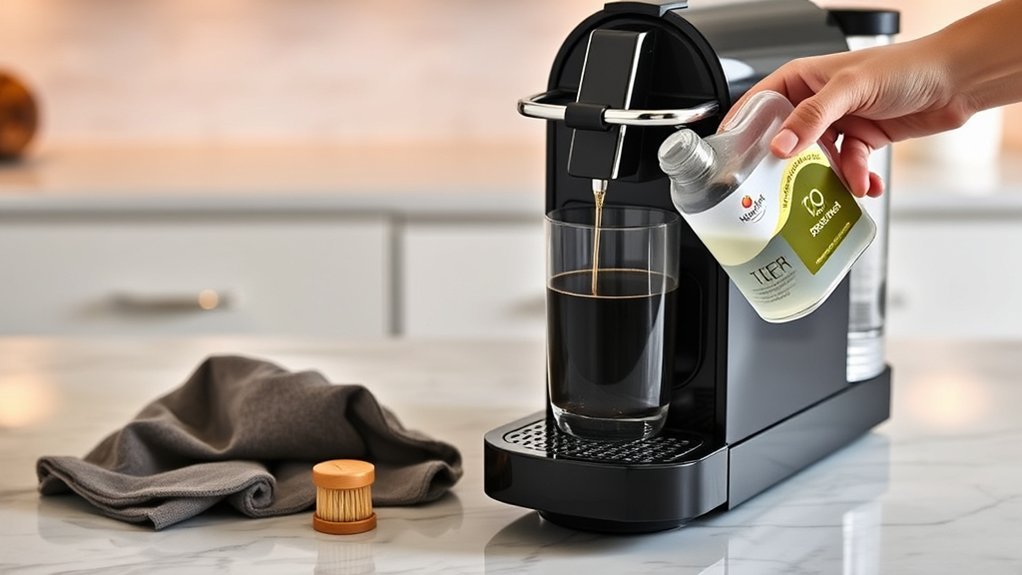
Cleaning a Nespresso machine involves two different jobs: removing coffee residue through routine washing and water-only cleaning cycles, and removing mineral scale through descaling. The correct controls, water volume, warning lights, and cleaning frequency vary by model, so confirm your exact machine before starting any automated maintenance program.
Quick Answer
Empty and rinse the drip tray, capsule container, and water tank regularly, wipe the outlet and exterior with a clean damp cloth, and run the water-only cleaning cycle specified for your model. Descale when your machine alerts you or its manual says it is due; cited US Vertuo Next and VertuoPlus guides use three months or 300 capsules as their benchmark.
Key Takeaways
- Routine cleaning removes coffee oils, residue, drips, and standing water; descaling removes mineral deposits from the internal water system.
- Nespresso controls are model-specific. VertuoPlus, Vertuo Next, Vertuo Pop, Vertuo Up, Original machines, Lattissima, and Creatista models should not be assumed to use the same sequence.
- The cited US Vertuo Next and VertuoPlus guides recommend descaling every three months or 300 capsules, whichever comes first; other models may rely more heavily on alerts, usage, or water-hardness settings.
- Use the descaling product specified by Nespresso for your model. Do not substitute vinegar when the manufacturer tells you to use Nespresso descaling solution.
- Dishwasher compatibility is model- and part-specific. Vertuo Next parts are not dishwasher-safe, while the Vertuo Lattissima manual recommends dishwashing its milk-carafe components.
At a Glance
| Time Required | About 5–10 minutes for routine cleaning; common Vertuo descaling programs covered here take roughly 20 minutes, with model-specific differences and rest time |
| Difficulty | Easy when you follow the instructions for your exact model |
| Tools Needed | Clean soft cloth, warm water, a suitable collection container, and a soft nonabrasive cleaning tool if permitted by the manual |
| Cost | Routine cleaning costs little; descaling requires the descaling product specified for your machine |
Cleaning and Descaling Are Different
Routine cleaning removes spilled coffee, oils, grounds, and standing water that collect around the coffee outlet, capsule container, drip tray, and tank. These areas should be cleaned regularly because they come into contact with coffee, capsules, or water.
Descaling circulates an acidic descaling solution through the internal water path to dissolve mineral deposits. It is performed less often, takes longer, and must use the program specified for the exact machine.
Cleaning removes coffee residue. Descaling removes mineral scale. One process does not replace the other.
Why Regular Cleaning Is Essential for Your Nespresso Machine
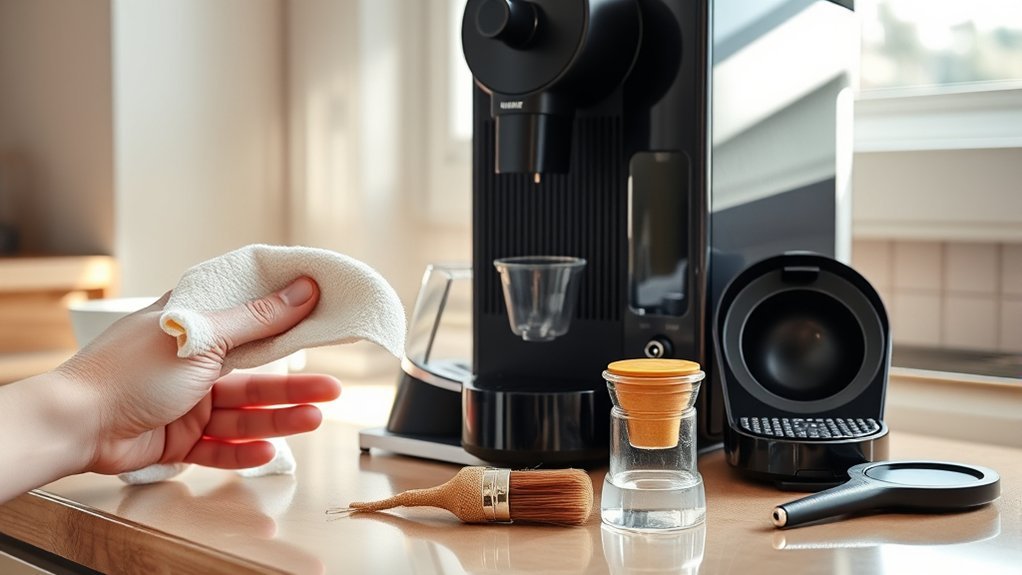
Coffee residue can collect around the outlet, capsule chamber, drip tray, and used-capsule container. Standing water can also develop odors when a tank or tray remains full for an extended period. Regular care keeps these areas cleaner and helps you notice leaks, blocked outlets, incorrectly seated parts, or other maintenance problems sooner.
Minerals from water build up inside the heating and water-delivery system over time. Descaling removes that scale. Nespresso troubleshooting guidance also lists descaling as a possible remedy when coffee flow becomes abnormal or coffee is not hot enough, although those symptoms can have other causes.
Follow the instructions supplied with your machine rather than relying on one universal button sequence. Nespresso maintains an official Machine Assistance library where you can select the exact model and open its cleaning, descaling, first-use, storage, and troubleshooting guidance.
Identify Your Nespresso Model Before You Start
Look for the model name on the machine, packaging, registration record, or rating label. Nespresso families include Vertuo Next, Vertuo Pop and Pop+, VertuoPlus, Vertuo Up, other Vertuo models, Evoluo, Essenza Mini, CitiZ, Pixie, Lattissima, and Creatista machines.
- VertuoPlus: Uses a motorized head and movable lever. Its descaling special-functions menu is opened by pressing the coffee button and lever together.
- Vertuo Next: Uses a locking handle and timed button-and-lock sequences that differ from VertuoPlus.
- Vertuo Pop and Pop+: Use a locking lever and a model-specific descaling sequence. Do not assume every Vertuo Next instruction applies unchanged.
- Vertuo Up: Uses a newer maintenance-button interface and can guide maintenance through the Nespresso app when connected. Do not use an older Vertuo sequence simply because the capsule system looks similar.
- Original machines: Models such as Pixie, CitiZ, and Essenza Mini commonly use their coffee buttons or model-specific combinations for maintenance.
- Lattissima and Creatista machines: Add milk-carafe, steam-wand, display-guided, or other milk-system cleaning requirements to the coffee-system routine.
Note: Do not choose a cleaning or descaling sequence by the machine’s color, capsule type, or appearance alone. Confirm the full model name because similar-looking Nespresso machines can use different controls.
Safety and Supplies
Gather the following items before cleaning:
- A clean, soft, lint-free cloth
- Warm or lukewarm water
- A soft brush or nonabrasive sponge if the model manual permits it
- A container large enough for the cleaning or descaling output specified by the model
- The amount of Nespresso descaling solution specified in the official instructions
- A towel or washable mat to protect the counter from splashes
Warning: Switch off and unplug the machine before cleaning the exterior or handling areas that should not be powered, unless the official procedure specifically requires the machine to remain plugged in. Never immerse the appliance, cord, or plug. Keep descaling liquid away from children, eyes, skin, and food, and wipe up spills promptly because the solution can damage or discolor surfaces.
Daily Nespresso Machine Cleaning Routine
- Eject the used capsule. Let brewing finish before opening the head or lever. Nearby parts and liquids may still be hot.
- Empty the drip tray and capsule container. Empty them whenever they are full and sooner when standing coffee or water has collected.
- Refresh the water. Replace water that has been standing for an extended period, rinse the tank as instructed, and refill it with fresh drinking water.
- Wipe the coffee outlet. Use a clean damp cloth. Do not insert sharp tools into the outlet or capsule chamber.
- Wipe exterior spills. Clean exposed surfaces with a soft damp cloth, then dry them.
- Clean milk-contact parts promptly. If your machine has a milk container, steam wand, or frothing system, follow its separate after-use cleaning instructions.
Pro Tip: Dry removable components before reinstalling them. This limits standing moisture around the tray, capsule container, tank, and milk-system parts.
Weekly Deep-Clean and Rinse Routine
For a home machine used every day, a weekly deeper clean is a practical maintenance cadence rather than a universal Nespresso requirement. Increase the frequency when several people use the machine, the tray fills quickly, coffee residue becomes visible, or your specific manual calls for more frequent cleaning. The Vertuo Next manual, for example, allows its cleaning procedure to be launched at the user’s discretion and notes daily cleaning for office use.
- Turn the machine off, unplug it when appropriate, and allow hot surfaces to cool.
- Remove the tank, tank lid, drip tray, cup support, and used-capsule container as permitted by the model.
- Hand-wash approved removable parts with warm water. Use a small amount of mild detergent only when the exact manual allows it.
- Rinse away detergent and dry the parts with a clean cloth or allow them to air-dry.
- Wipe the exterior, accessible capsule-area surfaces, and coffee outlet with a clean damp cloth.
- Reassemble the machine and run the water-only cleaning or rinse cycle specified for the model.
For example, the official Vertuo Next user manual tells users to rinse the tank and cup support, empty the capsule container and drip tray, confirm that no capsule remains, close and lock the machine, wait for a steady light, and press the coffee button three times within two seconds. The automatic cleaning procedure then runs for about seven minutes. Do not apply this sequence to another model unless its manual gives the same instructions.
Can Nespresso Parts Go in the Dishwasher?
Dishwasher compatibility depends on the exact machine and accessory. There is no safe universal yes-or-no answer for every removable Nespresso component.
The Vertuo Next manual says not to place the appliance or any part of it in a dishwasher. For that model, hand-washing and wiping are the appropriate default.
Milk accessories can be different. The official Vertuo Lattissima user manual instructs users to disassemble the milk carafe and place all six milk-carafe components in the upper part of a dishwasher after use. When a dishwasher is unavailable, it specifies soaking the parts in hot potable water at 50°C/122°F with mild detergent for at least 30 minutes, followed by thorough rinsing and drying.
Note: Dishwasher permission for one accessory does not make the machine body, another model’s drip tray, an electrical frother base, or every removable part dishwasher-safe. Check the exact component instructions.
How Often Should You Descale a Nespresso Machine?
The official US Vertuo Next and VertuoPlus descaling guides recommend descaling every three months or 300 capsules, whichever comes first. That benchmark should not automatically be applied to every Nespresso machine.
Actual maintenance timing can depend on the model, usage, water hardness, programmed hardness setting, app status, and maintenance alert. For machines that track maintenance, the machine’s alert and official instructions are the best guide. Some newer connected models also provide maintenance information through the Nespresso app.
Possible signs that cleaning, troubleshooting, or descaling may be due include:
- A descaling or maintenance light
- Slower or unusual coffee flow
- Coffee that is not as hot as expected after cup temperature and normal operation have been checked
- Repeated maintenance or flow-related warnings
- A reduced amount of coffee when the programmed volume has not been intentionally changed
These symptoms can have other causes, including an empty or poorly seated tank, an incorrectly locked head, a blocked outlet, a capsule problem, or another machine fault. Check the basic troubleshooting steps before assuming mineral scale is the only cause.
How to Descale a Nespresso Machine Safely
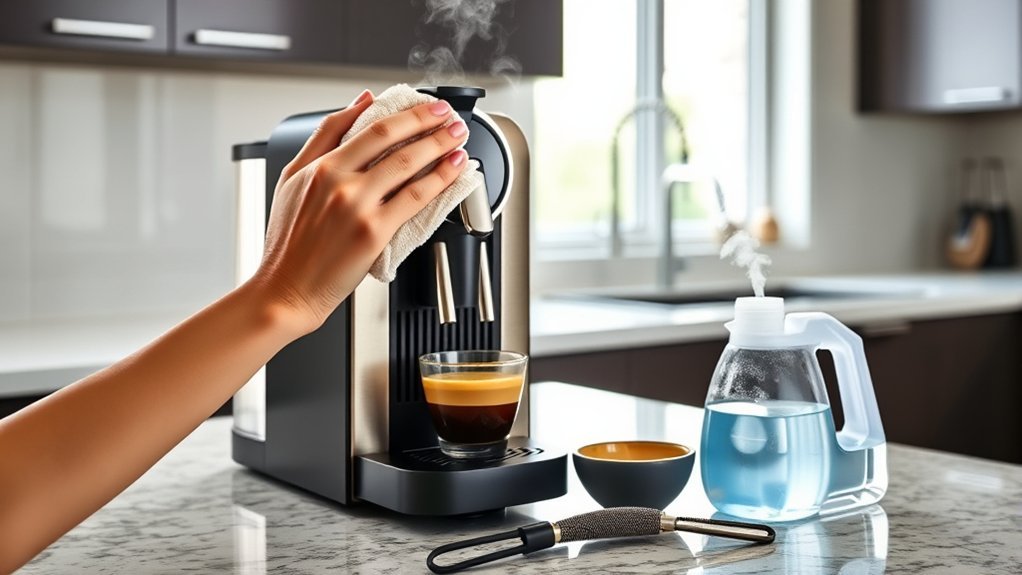
Before starting, eject any capsule and empty the drip tray and used-capsule container. Protect the counter from splashes and use a collection container at least as large as the capacity specified in the official guide. Once you begin, follow that model’s instructions about whether the cycle can be paused or interrupted.
Warning: Do not replace the specified descaling product with vinegar or another household acid. Nespresso’s cited Vertuo guides warn that vinegar and store-bought descalers may damage the machine. Never brew or drink coffee until the required fresh-water rinse has been completed.
VertuoPlus Descaling Steps
The following condensed sequence is based on Nespresso’s official VertuoPlus descaling guide. It is not the correct sequence for Vertuo Next, Vertuo Pop, or Vertuo Up.
- Turn on the machine, open the head, eject the capsule, and close the head.
- Turn the machine off by holding the lever down for three seconds.
- Empty the cup support and used-capsule container.
- Add one unit of Nespresso descaling liquid and at least 17 ounces of water to the tank.
- While the machine is off, press the coffee button and lever down together for three seconds.
- Confirm that the steady orange light shows you are in the special-functions menu.
- Press and release the lever once to select descaling mode.
- Place a container holding at least 27 ounces beneath the coffee outlet.
- Press the coffee button once to begin descaling. The orange light blinks while the machine dispenses in intervals and stops automatically.
- If necessary, the official VertuoPlus guide says the process can be stopped by pressing the button.
- When descaling finishes, empty, clean, and rinse the tank and cup support, then refill the tank with fresh drinking water.
- Press the coffee button once to start the rinse cycle.
- When rinsing finishes, hold the button and lever together for three seconds, or until the light becomes green, to exit descaling mode.
- Let the machine rest for ten minutes before using it.
Vertuo Next Descaling Steps
The official Vertuo Next descaling guide uses a different timed locking and button sequence:
- Empty the capsule container and drip tray and reinstall them. Confirm that no capsule remains in the machine.
- Add one packet of Nespresso descaling solution and 17 ounces of water to the tank.
- Close and lock the head, turn on the machine, and wait for a steady light.
- With the head closed, unlock the lever. Hold the button for about seven seconds until the steady light turns off and begins blinking orange rapidly.
- Lock the lever and then unlock it again.
- Within 45 seconds, hold the button for about seven seconds again until the light turns off and begins blinking orange rapidly.
- Lock the lever. A rapidly blinking orange light confirms descaling mode.
- Place a container holding at least 34 ounces beneath the outlet and press the button once.
- When the descaling solution has finished running, discard the collected liquid.
- Empty the drip tray and capsule container. Rinse the tank thoroughly and fill it to the top with fresh water.
- Press the button once to begin the rinsing phase.
- Allow the machine to stop automatically and return to a steady light.
- Refill the tank, rinse the capsule container and drip tray, and reinstall them.
- Wipe the machine with a damp cloth and let it rest for ten minutes.
Vertuo Pop Descaling Steps
The official Vertuo Pop descaling guide lists a roughly 20-minute procedure that should not be interrupted after it begins:
- Eject any capsule, empty the capsule container and drip tray, and reinstall them.
- Add 17 ounces of water and one packet of Nespresso descaling solution to the tank.
- Remove the cup support and place a container holding at least 34 ounces under the outlet.
- With the machine on, close the head and leave the lever unlocked.
- Hold the button for about seven seconds until the steady light turns off and begins blinking orange rapidly.
- Turn the lever left to lock it, then return it to the front to unlock it.
- Within the required 45-second window, hold the button again for about seven seconds until it begins blinking orange rapidly.
- Lock the lever. The rapidly blinking orange light confirms descaling mode.
- Press and release the button once to start descaling.
- When the solution has finished running, discard the collected liquid.
- Empty the drip tray and capsule container. Rinse the tank thoroughly, refill it to the top with fresh water, and reinstall it.
- Press and release the button to begin rinsing.
- Allow the machine to stop automatically and return to a steady button light.
- Refill the tank and rinse and reinstall the capsule container and drip tray.
- Replace the cup support, wipe the machine with a damp cloth, and allow it to rest for ten minutes before use.
Vertuo Up, Original, Lattissima, and Creatista Models
Do not substitute the VertuoPlus, Vertuo Next, or Vertuo Pop procedures above for another Nespresso machine.
- Vertuo Up: Uses its own maintenance-button system and can provide connected maintenance guidance through the Nespresso app. Use the current instructions for Vertuo Up rather than an older Vertuo lock-and-button sequence.
- Original models: Machines such as Essenza Mini, CitiZ, and Pixie can use their Espresso and Lungo buttons or other model-specific combinations. Open the exact model guide before descaling.
- Lattissima models: Coffee-system descaling is only part of maintenance. Milk-carafe components have separate after-use cleaning requirements.
- Creatista models: Steam-wand care and model-specific descaling controls must also be followed. Some Creatista procedures use display or steam-related controls rather than the Vertuo sequences above.
For any machine not covered step by step here, select the exact model in the official Nespresso Machine Assistance directory before starting.
Rinsing and Caring for Your Nespresso After Descaling
The rinse phase is part of descaling, not an optional cleanup step. It flushes the remaining descaling liquid from the internal water path.
- Discard the used solution. Do not reuse it or leave it in the collection container.
- Rinse the tank thoroughly. Remove remaining solution before filling it with fresh drinking water.
- Run the complete rinse program. Follow the model-specific sequence and allow it to finish.
- Rinse removable parts again. Empty and rinse the drip tray, cup support, and capsule container as directed.
- Wipe and dry the machine. Clean splashes promptly and observe any stated rest time.
If the first drink smells or tastes like descaling solution, stop using the machine. Empty and rinse the tank and removable parts, then repeat the model-approved fresh-water rinse. Do not try to hide a chemical taste with coffee, milk, syrup, or flavoring.
Avoid These Common Cleaning and Descaling Mistakes
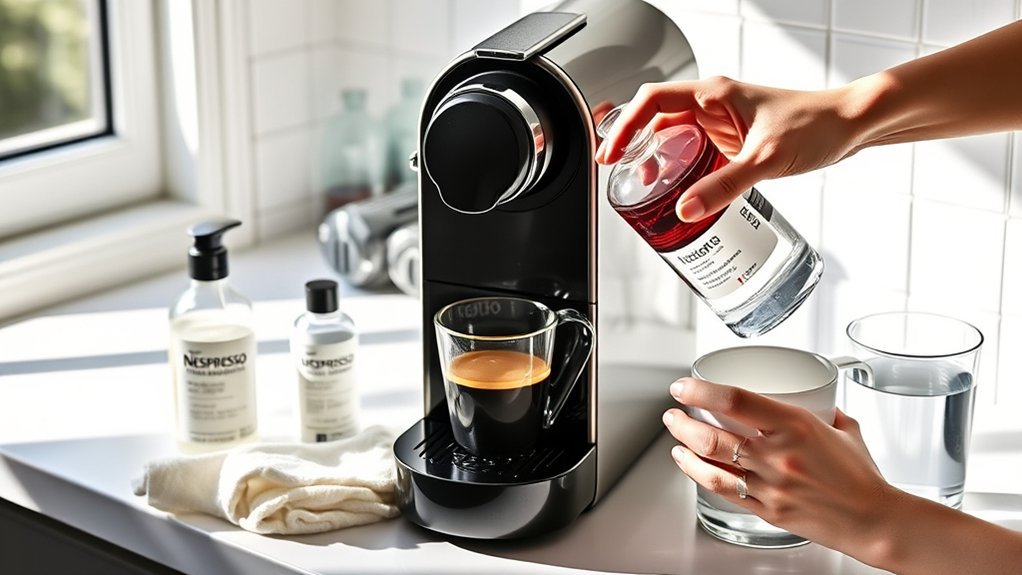
- Using the wrong model instructions: A VertuoPlus sequence may not work on Vertuo Next, Vertuo Pop, Vertuo Up, or an Original machine.
- Using vinegar: It is not the manufacturer-approved substitute in the cited Nespresso Vertuo guides.
- Pouring soap into the tank: Detergent is for specific removable parts only when their manual permits it, never for circulation through the internal water circuit.
- Skipping the rinse: Residual descaling solution can affect taste and should not be consumed.
- Using abrasive pads or strong solvents: They can scratch surfaces or damage finishes and components.
- Immersing the appliance: The machine body, power cord, and plug must not be submerged.
- Forcing the head open: Hot liquid or grounds may splash. Wait for the operating cycle to stop as instructed.
- Adding water during the active descaling phase: Do not refill during a programmed phase unless the model instructions specifically prompt you to do so.
- Assuming all removable parts are dishwasher-safe: Dishwasher permission varies by machine and accessory.
- Ignoring the milk system: Cleaning only the coffee side can leave milk residue in Lattissima, Creatista, or other milk-equipped machines.
Simple Nespresso Maintenance Schedule
- After each drink: Eject the capsule and wipe obvious spills once the machine is safe to handle.
- After milk drinks: Perform the cleaning or rinse procedure required for the milk carafe, steam wand, frother, or other milk-contact parts.
- Daily or as needed: Empty the drip tray and capsule container, replace stale water, and wipe the coffee outlet.
- Weekly for frequently used home machines: A deeper clean of approved removable parts plus the model-approved water-only cycle is a practical routine; follow a different interval if your manual specifies one.
- When the machine alerts you: Follow its maintenance or descaling prompt rather than waiting for a calendar date.
- For cited Vertuo Next and VertuoPlus models: Their US guides use about three months or 300 capsules, whichever comes first, as the descaling benchmark.
- After long non-use: Follow the model’s first-use or post-storage cleaning instructions before brewing.
Before Long-Term Storage, Moving, or Freezing Conditions
Nespresso provides model-specific procedures for emptying water from the internal system before a long period of non-use, frost exposure, or some repairs. This is different from merely emptying the removable water tank.
- Eject any capsule and empty the drip tray and used-capsule container.
- Open your exact machine’s official “emptying the system” or storage instructions.
- Run the specified empty-system program rather than trying to drain internal tubing manually.
- Clean and dry removable parts before storage.
- After storage, follow the model’s first-use or post-storage rinse instructions before making coffee.
Note: Do not invent an emptying sequence from another Nespresso model. The button combinations used for storage and frost protection are model-specific just like descaling controls.
Troubleshooting Cleaning and Descaling Problems
The Machine Will Not Enter Descaling Mode
Confirm that you are using instructions for the exact model. Remove any capsule, check the required locked or unlocked position, and repeat the button timing carefully. Vertuo Next and Vertuo Pop include timed steps that must be completed within a limited window, while VertuoPlus uses its special-functions menu. Newer models such as Vertuo Up use a different maintenance interface.
The Warning Light Stays On
Make sure the rinse cycle completed and that you performed the required exit procedure. VertuoPlus, for example, requires the coffee button and lever to be held together to leave descaling mode. For other models, consult the exact maintenance-light or error-code instructions rather than repeating a VertuoPlus sequence.
Little or No Water Flows
Check that the tank contains fresh water, is seated correctly, and is unobstructed. Confirm that no capsule remains in place when the cleaning program requires an empty head. Clean the outlet as instructed. Descale when the maintenance alert or troubleshooting guidance indicates that mineral buildup may be involved.
The Machine Leaks During Cleaning
Stop or pause the cycle only when that model allows it. Once it is safe, check the water tank, drip tray, capsule container, maintenance module, and collection container for correct installation or overfilling. Contact Nespresso support if liquid appears to be leaking from the machine body, electrical area, cord area, or another location that is not explained by an incorrectly positioned removable component.
Coffee Tastes Strange After Descaling
Do not keep brewing coffee. Empty and rinse the tank, rinse the removable parts and collection container, and run another complete model-approved fresh-water rinse. Resume drinking coffee only when there is no descaling-solution smell or taste.
Frequently Asked Questions
Can I use vinegar instead of Nespresso descaling solution?
No. The cited Nespresso Vertuo guides warn that vinegar and store-bought descalers may damage the machine. Use the descaling product specified for your exact model.
How often should I descale my Nespresso machine?
Follow your machine’s alert and manual. The cited US Vertuo Next and VertuoPlus guides recommend every three months or 300 capsules, whichever comes first, but other models can use different timing based on usage, water hardness, or programmed maintenance settings.
Does water hardness affect how often a Nespresso needs descaling?
It can. Harder water generally produces mineral scale faster, and some Nespresso machines allow a water-hardness setting or use maintenance alerts to determine when descaling is required. Follow the setting and alert system built into your model.
What water temperature should I use to wash removable parts?
Use the temperature specified for the part. Warm or lukewarm water is a safe general starting point, but some milk-system instructions are more specific. For example, the Vertuo Lattissima manual specifies 50°C/122°F potable water when its milk-carafe parts are washed by hand.
Can I clean Nespresso parts in a dishwasher?
Only when the exact machine or accessory manual allows it. The Vertuo Next manual says not to put the appliance or its parts in a dishwasher, while the Vertuo Lattissima manual recommends placing its disassembled milk-carafe components in the upper part of a dishwasher.
What should I do if my machine will not enter descaling mode?
Verify the complete model name, remove the capsule, check the required lever or maintenance-button position, and repeat the exact timing in the official guide. VertuoPlus, Vertuo Next, Vertuo Pop, and Vertuo Up do not all use the same entry procedure.
Is running a rinse cycle the same as descaling?
No. A water-only cleaning or rinse cycle removes loose residue and refreshes the water path. Descaling uses a specified acidic solution and maintenance program to remove mineral buildup.
Can I use dish soap to clean a Nespresso machine?
Use mild detergent only on removable parts when their instructions permit it. Never add dish soap to the water tank for circulation through the coffee system, and do not use strong solvents or abrasive cleaning products on the machine.
Why does my coffee taste chemical after descaling?
The machine may need more rinsing. Stop brewing coffee, rinse the tank and removable parts, wash the collection container, and run another complete fresh-water rinse using the instructions for your model.
Can I use Vertuo Next descaling instructions on Vertuo Pop or VertuoPlus?
No. Even when two machines use similar locks or lights, the entry sequence, collection-container size, interruption rules, or exit procedure can differ. Use the official guide for the complete model name.
Conclusion
Clean the drip tray, capsule container, tank, outlet, and exterior regularly, then use the water-only cleaning cycle approved for your model. Descale according to the machine’s alert and official maintenance schedule rather than assuming every Nespresso uses the same calendar interval. The most important rule is model matching: VertuoPlus, Vertuo Next, Vertuo Pop, Vertuo Up, Original, Lattissima, and Creatista machines can require different controls, containers, milk-system care, and descaling procedures. Correct instructions, a complete fresh-water rinse, and basic electrical and chemical precautions protect both the machine and the taste of your coffee.
Sources
- Nespresso Machine Assistance — current model selection, manuals, maintenance guidance, storage procedures, and troubleshooting
- Nespresso Vertuo Next Descaling Guide — solution volume, timed descaling sequence, rinse procedure, and safety precautions
- Nespresso Vertuo Next User Manual — water-only cleaning cycle, dishwasher restriction, outlet cleaning, and troubleshooting
- Nespresso VertuoPlus Descaling Guide — special-functions menu, solution and container quantities, rinsing, and exit procedure
- Nespresso Vertuo Pop Descaling Guide — model-specific Vertuo Pop descaling, rinse, and rest procedure
- Nespresso Vertuo Lattissima User Manual — milk-carafe dishwasher and hand-washing instructions, water-hardness settings, and maintenance


[…] routine care beyond this no-flow diagnosis, see our guide to cleaning a Nespresso machine. This troubleshooting page stays focused on restoring water flow and deciding when maintenance or […]